Google Law #1: Is It Legal to Spank Your Child in Virginia?

Update: This was the first post in what I thought might become an ongoing feature called “Google Law.” The idea was simple: using Google Instant, I’d find out what legal questions most people are asking. Then, I’d try to answer them. But simple ideas aren’t always good one, so I abandoned this concept.

Is it legal to spank in Virginia?In this “edition,” I consider whether it’s legal to spank your child in Virginia.

Courts in Virginia have long recognized that parents have a right to punish their children, even using corporal punishment. Still, parents can be held criminally liable for assault and battery (or other crimes, such as malicious wounding or even abduction) if the punishment they inflict exceeds “due moderation.”  Harbaugh v. Commonwealth, 209 Va. 695, 698 (1969). What amounts to “due moderation” depends on a number of factors, including the child’s age, “size and conduct,” particular misconduct, and the severity of the punishment (as indicated by marks or wounds). So, for instance, if a parent causes a very small child to bleed, or reacts to the smallest of offenses with brutality, he or she could face punishment. See, e.g., Campbell v. Commonwealth, 405 S.E.2d 1 (Va.Ct.App. 1991) (affirming malicious wounding conviction where stepfather “spanked” stepson with belt fifteen times, leaving substantial bruising).  It’s sort of common sense.

So, like many legal questions, this question can only be answered on a case-by-case basis. (I think it’s safe to say that this Yahoo! Answers scenario, for instance, would not be unlawful.) There is not any apparent law in Virginia (or elsewhere in this country) specifically “outlawing” spanking, but you can’t go too far as a parent.  It all depends. (Of course, this wishy washy answer is a somewhat unsatisfying result for my first “Google Law” question, but that’s the way it goes).

If you’d like to learn more about spanking, you could visit Wikipedia. For a less disinterested approach, you could also try this … ummm … “interesting” fellow’s website, where he argues:

There is a De Facto SPANKING BAN, and there will continue to be until the New Agers finally figure out they are FATALLY WRONG and that they have DESTROYED AMERICA with their New Age parenting THEORIES- and the laws plainly clarified to ENCOURAGE spanking as necessary.

Yeah. Well, that’s certainly a different view than mine, but I’m not an expert. So who you end up believing is really all up to you.

-Michael

*As we explain in the disclaimer, I’m not offering specific legal advice. This is more just my musings on a given legal subject. If you have a real legal issue, please go see an attorney.

Once Again, Law Professors Need to Shut the Hell Up

The Associated Press is reporting on a federal government plan to destroy several million paper copies of court files. Apparently, these paper files are expensive to store, so the government is going to shred and recycle them. (Digitizing them would have cost “tens of millions of dollars.”) These are not the important docs, but rather amount to a bunch of old (at least 15 years old, in fact) district and bankruptcy court cases that did not go to trial. Anything that is deemed historically significant will be saved, while basic case information will be preserved for all cases. Lawyers, apparently, are largely unconcerned about this massive pulping project.

Ah, but the law professors! Because they love to complain, they just had to complain about this, too. The documents could contain important things! They could evidence important trends! We might not realize what we are destroying! On and on they go, even though all parties seem to concede that trying to preserve all this stuff would be “outrageously expensive.”

You know what law professors? Shut. Up.

You know what law professors? Shut. Up. If this stuff is really so valuable to academia, then law schools should be willing to pay up to preserve it. All signs indicate they aren’t. Meanwhile, the government should not be forced to bear the bill. And if the U.S. Courts are somehow bearing a portion of this bill–that’s even more reason to chuck all this waste, pronto. It seems like our federal court system barely has enough money to buy new, clean paper; it shouldn’t be wasting cash on the old, used stuff.

And seriously, this is what law professors want to complain about? No wonder Chief Justice Roberts thinks academia is no longer especially relevant to the practice of law. For the love of god, law professors, do something useful. I do not want to hear why you have a problem with pulp. Recognize that, here in the real world, few are shedding a tear over 500,000 musty boxes of boring legal materials from yesteryear.

/end rant

-Michael

A Weird State Brings a Weird New Approach to Appellate Fact-Finding

The Real Housewives of New Jersey

Ladies love appellate fact-finding.

Ah, New Jersey. It’s the state that brought us Jersey Shore, Jerseylicious, and that undefinable “New Jersey smell.” Now, it’s brought us something else weird: a new test for using eyewitness identifications in criminal trials. In an opinion issued today, the New Jersey Supreme Court imposed several new restrictions on the use of such testimony, requiring trial judges to assess the reliability of such evidence and issue new jury instructions when its used. In reaching its decision, though, the court relied on a “scientific record” that it essentially developed on appeal. Because so many are sure to write about the substantive aspects of the opinion, I thought I’d briefly note the decidedly weird way the court got to its result.

Apparently, the court decided when it got the case that the ordinary rules applicable to eyewitness testimony might no longer apply. This is so, the court apparently supposed, because the science surrounding human memory had changed. Thus, the court “remanded” for a “plenary hearing” to determine whether the “assumptions and other factors reflected in the” old test “remain valid and appropriate in light of recent scientific and other evidence.” But instead of simply sending it back to the trial court, the Supreme Court gave it to a Special Master, who then heard evidence from the State of New Jersey, the New Jersey Public Defender, the Association of Criminal Defense Lawyers of New Jersey, and the Innocence Project. These parties presented expert testimony and scientific evidence on the reliability of eyewitness testimony, which the Supreme Court then heavily cited in reaching its opinion.

The little “remand” maneuver was necessary because appellate courts usually aren’t allowed to do their own fact-finding. By remanding, they were able to pretend like they didn’t. That’s a better approach than another one taken by some other courts, which simply conduct their own extra-record research or rely on amicus briefs to give them the empirical evidence they think they need. But this “New Jersey” approach still presents one of the most substantial problems of appellate fact-finding: it misapprehends the role of appellate courts and trial courts, alike.

Continue reading

Earthquacalypse 2011

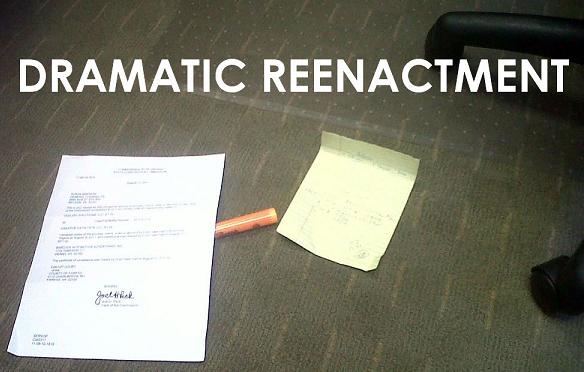
Pictured below is a reenactment of my office immediately following the Great DC Earthquake of 2011:

Note that this photo is only an approximate recreation of the devastating scene, as the original havoc and destruction caused by the earthquake had been repaired before someone reminded me that I should have taken a photo.

-Susan

Update (from Michael): The horrible earthquake depicted above actually caused several D.C. law firms and courts to close for the day. Oh the humanity.

Hands Off That Fish: What’s With the Noodling Legalization Movement?

If you watch Animal Planet, you might have seen an odd new show called Hillbilly Handfishin’. It documents the undeniably odd habit of “noodling,” that is, fishing for catfish with your bare hands. Evidently this involves sticking your hand down a hole in a river and waiting for a large fish to bite your hand hard enough that you can pull it out. It looks something like this:

Illustration by Kevin Hand for Texas Lawyer

Noodling is evidently gaining ground in popularity. Earning its own television show (and a movie, too) isn’t the only consequence: whereas it was legal in only 4 states as recently as 2001, it is now legal in 14. Most recently, Texas legalized the practice in the midst of a tense budget crisis.

But why is this happening? Most likely, this trend towards noodle legalization is a result of (a) a mistaken belief that there is no logical reason to outlaw the practice, combined with (b) a broader but strengthening–yet equally mistaken–idea that this type of “meddlesome” regulation should be eliminated. Yet there’s a good reason for laws against noodling: it can be unsafe (as the fish can severely bite or scratch the fisherman, or simply drag him under) and it could harm fish stocks (because it wrenches fish from their nests in the midst of breeding). In other words, the common rule against noodling hits the sweet spot of good law: it protects a public good (i.e., fisheries) while encouraging individual interests (i.e., safety) as well. So maybe legislators should be a little more cautious in knocking down rules against this humorous hobby.

In the meantime, I encourage you to watch Hillbilly Handfishin‘ and consider how it typifies the careful balance between state regulation and individual liberty. Or just have a good time chucklin’ at some redneck fun.

-Michael

Who Does Google Think You Are?

Ever wonder how Google figures out which ads it is going to flash at you? To see who Google thinks you are, you can check out your Google demographic profile by clicking over to http://www.google.com/ads/preferences/. The interest categories appear to be updated regularly based upon what sites have been visited over the past few days, but the inferred demographics do not seem to change as much. Here is Google’s stalking profile for me:

While my age demographic has been correctly pegged, apparently Google thinks I’m actually a dude. At least for the moment, under the user history for this particular browser.

I guess it is sort of comforting that Google isn’t using my Google account or my Google+ profile — which correctly identifies me as female — or any other Google profile I have to figure out what web ads to direct at me. According to Google’s Privacy Policy for Google Ads, it looks like the ads Google generates are not based upon anyone’s individual Google accounts, but rather the web activity on each individual browser or device. So while you’re not exactly anonymous, it at least provides the comforting illusion that Google is not stalking everything you do.

-Susan

Bethesda Softworks, IP Troll

Mojang, the Swedish-based game developer behind MineCraft, has a new game coming out. It’s called Scrolls, and as far as I can figure out, it is the computer game hybrid of Magic the Gathering and Settlers of Catan. As described by developer Jacob Porser,

“At the core it’s a collectable card game, but it’s also a board game… It’s combining the two. As you place your units or your buildings, or your siege weapons, you place it on the game board to play against your opponent. It’s not only about designing a proper collection of scrolls [cards], and the tactical aspect of that deck, but it’s also about the tactical sense of how to place your units on the game board.”

Each scroll is essentially the same as an individual Magic card. This makes “Scrolls” a pretty obvious name for the game — and Mojang has already put a fair bit of money and effort into the branding:

“It’s always been Scrolls to me,” adds Carl Manneh, Mojang’s CEO, who joined the company a few months ago. “I think it’s a great name.” It seems pretty amazing that they managed to get the URLs. I ask if they [were] free? Both laugh, and shake their heads. So how did they get them? Carl explains, “It helps when you’ve got some cash.”

So while it’s still a little bit unclear exactly what Scrolls is going to be, it is clear that it is not going to be anything like a quest-based, sandbox RPG. In other words, it will be absolutely nothing like Morrowind or Oblivion or any other game in Bethesda Softworks’ The Elder Scrolls series.

Bethesda Softworks is not one to let such minor details get in the way of a good IP fight, however, and the company is now suing Mojang in Sweden for trademark infringement, over Mojang’s use of the Scrolls mark. According to Notch, Mojang’s owner,

I got a 15 page letter from some Swedish lawyer firm, saying they demand us to stop using the name Scrolls, that they will sue us (and have already paid the fee to the Swedish court), and that they demand a pile of money up front before the legal process has even started.

Currently, there is no lawsuit in the United States. Although Mojang filed a trademark application for Scrolls [PDF] in the U.S. on May 17, 2011, as it usually takes four months for the USPTO to get around to reviewing a trademark filing, a decision on the application won’t be expected until some time next month. Then, if the USPTO has no objections to the Scrolls mark, Bethesda Softworks’ parent company will then have 30 days to file a Notice of Opposition to it, and make its case that there is a likelihood of confusion between the two game titles.

In other words, expect the Bethesda vs. Mojang battle to be opening a second front over here in the States sometime around mid-October.

But do Bethesda’s objections to the Scrolls mark have any merit? While I couldn’t quite label them frivolous, they are unquestionably silly — the risk of consumer confusion here is close to nil, as there is no self-respecting gamer on earth that is going to try to buy Elder Scrolls V: Skyrim and accidentally end up buying Scrolls: The Gathering instead. Nor are they going to see Scrolls and go, “Gee, I wonder if this is the Oblivion card game!” No one even calls The Elder Scolls games “the Elder Scrolls games”; for that matter, hardly anyone seems to know what the “elder scrolls” of the series’ title are even supposed to be.

So in honor of Bethesda Softworks’ attempt to bully Mojang into abandoning the game title by threatening Mojang with rounds of expensive litigation, I have made Bethesda its own scroll. I hope Notch adds it to the game:

-Susan

Update: Tobacco Companies File Motions and Cool Graphics in Labeling Case

Earlier, I discussed the recent tobacco lawsuit over the new FDA warning labels on cigarettes. Now, just a few days after filing the complaint, the companies have filed a motion for a preliminary injunction and a motion for summary judgment. (These guys work quickly.) They make some of the First Amendment arguments that I discuss in my earlier post, but give short shrift to my argument that compelled commercial speech is treated differently than regular commercial speech.

The best part of these filings, however, is the pretty graphic design. In an effort to show how shocking these labels would be in other contexts, the companies have designed their own labels–using the same pictures as the cigarette labels–for other “vice” items:

Yikes. Shocking. But that’s pretty talented graphic design for a law firm, especially when it comes to pictures within a filing. (Keep in mind I’m using a “law firm” metric. In the real world of graphic design, the pictures are not that great. Take for instance, the fact that the label is not lined up properly on the bag.) There are also pictures showing a “before” and “after” cigarette counter, where the labels cover much of the product in the after shot. I wish lawyers used this kind of straightforward stuff in their filings more often.

Still, it remains to be seen whether all this artistry will have any effect on the outcome. Maybe the FDA will respond with pictures of its own.

-Michael

“The Pink’s Paradox” and the Lure of Big Law Firms

Over at Concurring Opinions, David Fagundes recently discussed the “Pink’s Paradox,” a confusing pattern of behavior seen at Pink’s Famous Hot Dogs in Los Angeles:

… Pink’s doesn’t just have a 15-20 minute wait at meal times like many local eateries. Rather, at almost any time of day, the line to get a Pink’s chili (or any other) dog snakes through a few switchbacks, up La Brea, and back into their parking lot, frequently lasting a good hour.  At peak times, the line has been said to approach 1.5 or two hours.

… I can understand waiting in line for hours, say, to obtain critical medical services, or in a bread line in Soviet Russia where the only alternative is starving.  I can even imagine waiting in line for a couple hours to get tickets for a once-in-a-lifetime chance to see your favorite performer appear live.  But for chili dogs?  No way.  Something more than simple preference satisfaction has to be going on.

So what explains the Pink’s paradox?  Why is it that demand for these chili dogs continues to grow, even as the experience costs and actual costs associated with its food increase at an even greater rate (and appear to swamp the benefits of eating even the tastiest chili dog)?  And what does this tell us about the rationality (or irrationality) of line-waiting generally?

Fagundes suggests several reasons for people’s willingness to wait so long in line: (1) the long line is a product of group think; (2) the long line signals that the food is good, helping people sift through the overwhelming number of food choices in Los Angeles; (3) the long line provides some intangible benefits; or (4) the long line indicates the food is unique. I think he’s definitely onto something here. But Fagundes’ theories don’t just explain why people wait a long time for hot dogs; they also help explain why people are willing to to bear an unreasonably high “cost” for another good: BigLaw attorneys.  In fact, every one of Fagundes’ theories could be employed to understand better why people pay extraordinarily high rates to big law firms.

Continue reading