
Braddock’s Rock: The Key of All Keys, at the Bottom of a Well

If you head across the entrance ramp to the Roosevelt Memorial Bridge,
going along US 50 across to Virginia
, if you look out the driver’s side window you can see an unassuming circular rock structure. It looks like it might just be nothing more than a sewer cover, but the little plaque in front of it suggests otherwise.

For a few years now, I have wondered what the heck this thing is. I thought it might be some sort of historic site, but not one I had ever heard of, and not one I was able to find any information on. But I drive by this area a lot, and pretty much every time it I saw it, it bugged me that I didn’t know what it was.

I did try Googling variations of, “round stone historical marker on US 50 just before Roosevelt Bridge,” but to no avail. A few times, while out playing softball near Lincoln, I have considered slipping away from the game to get a closer look. The rock is in an awkward spot, though, with no foot paths and a busy road with no crosswalks in the way, and I never got around to it.
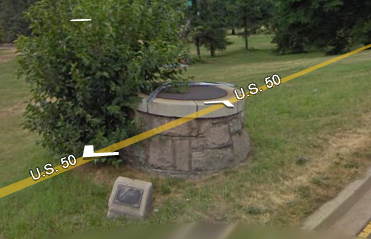
Braddock's Rock, as seen from Google Maps

I was wondering about the rock again today, for no particular reason, and thought I would try to look it up on Google Earth. I hit pay dirt. Someone had taken a photo of the monument, labeled it, and linked it up to the spot on Google Earth where its located. Turns out, this is the marker for Braddock’s Rock, a memorial that pre-dates even the existence of the United States. An excellent compilation on the history of Braddock’s Rock can be found here, in the 1899 edition of The American Monthly Magazine.

Braddock’s Rock got its name in commemoration of the landing of General Edward Braddock, at the beginning of his march to Fort Duquesne in 1755. [Spoiler Alert: It didn't go well for him.] According to legend, anyway, the fleet carrying Braddock’s army — which included a young soldier named George Washington — tied up on the rock when it set up camp alongside the shore of the Potomac, while on its way to the Battle of the Monongahela.

No, Braddock’s boat was not tied up to the round stone outcropping depicted here. Rather, Braddock’s Rock is located some 16 feet below, down at the bottom of the well and usually under a few inches of water. In 1755, however, this now submerged rock was in fact a notable outcropping, and “[t]he water, at the time of Braddock’s ill-fated expedition, was so deep that his vessels landed the troops at what was known as the ‘Big Rock,’ at the foot of ‘Observatory Hill.” As one account of Braddock’s Rock has it,

Alexandria, then a colonial village, eight miles down the Virginia side of the Potomac, was the recruiting point of Braddock’s Army… [As the fleet headed up the river,] Braddock himself, with his own personal retinue, got separated from the remainder of his party and landed on this side of the river opposite Analostan Island [note: now known as Theodore Roosevelt Island], at what is now the foot of Twenty-fourth Street, Northwest, then a stretch of woods. Braddock’s vessel was drawn close up to shore and moored to a big boulder protruding from the bank[.]

And another account:

Braddock’s Rock is upon the site occupied by the British and provincial troops in April, 1755. The British troops landed here from their transports, the ‘Sea Horse’ and the ‘Nightingale,’ and here pitched their tents on April 14, 1755. It is a matter of tradition that Washington, then an officer of Virginia colonial troops, and later aide-de-camp to Braddock, was camped also on this very hill, and was so impressed with the beauty of the site and of the surrounding country that he was subsequently led to choose it for the location of the National Capital. This is the very spot which he, in 1796, designated as the location for the University of the United States.

Braddock’s rock has been known by this name ever since the time of Braddock’s departure, and is still so known by old inhabitants of the vicinity, among whom are several who remember when it was touched by the waters of the Potomac, since diverted farther southward[.]

Although there is some debate about how much truth there is to the legends of Braddock’s mooring, the rock predates the failed Braddock Expedition, and has been mentioned in historical writings from as early as 1632. Early accounts of the area described it “as a large rock lying at and in the river Potomack,” and it was commonly labeled on maps as the “Key of All Keys.” The promontory was also used as a starting point for surveys establishing property lines for early settlers along that stretch of the Potomac.

The construction of Washington, D.C. marked the beginning of the end of Braddock’s Rock. The stone outcropping was a convenient source of rock for building the Capital, and in the early 1800′s it was blasted away:

It is said to have furnished stone for the foundations of both the White House and the Capitol. Later, stone from Braddock’s Rock was used in the construction of the Chesapeake and Ohio Canal. About 1832, when the canal was extended below Georgetown to connect with the Washington City Canal, nearly all that was left of the original outcrop of Braddock’s Rock was blasted away. The riverside swamps have long since been filled and the land raised above the level of the original surface. All that remains of Braddock’s Rock can still be seen enclosed in a circular granite-lined well south of the grounds of the old Naval Hospital, amidst the approach ramps to the Theodore Roosevelt Bridge.

What little remained of Braddock’s Rock was left standing when the Roosevelt Bridge was constructed. Although very few people will ever see it, a marker now sits next to it, giving a brief account of submerged rock’s historical significance:
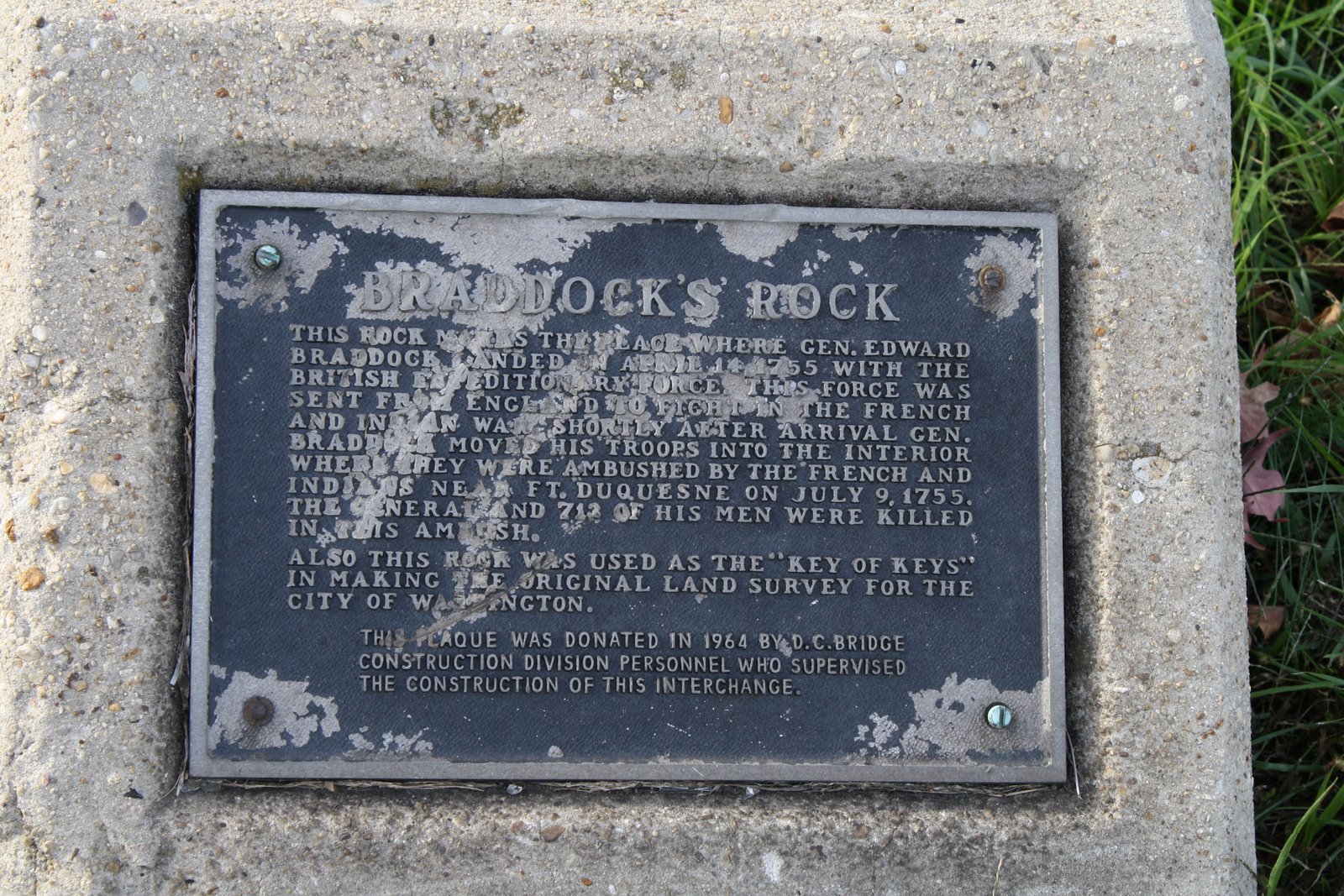
The Memorial Plaque at Braddock's Rock

The Braddock’s Rock plaque is wrong, though. Braddock’s expedition wasn’t ambushed, they just got the snot kicked out of them. Braddock died four days after the battle, and only 456 of the British troops were killed. (Also, I know I’m being nitpicky, but saying “his men” were killed is also misleading. About 50 women marched with the expedition, too, and over 90% of them did not make it back alive.)

-Susan
The Worst Idea . . . Ever.

The world has too many lawyers.  And too many law students.  But one law professor has decided that, numbers be damned, it should be easier for students to go to law school.  Professor Christine Hurt of the University of Illinois thus proposes one of the most absurd “solutions” I’ve heard in a very long time:  she wants to make the first year of law school free.  Professor Hurt reasons that too many students get locked into law school because of heavy debt loads, even after they decide the law is not for them.  Free 1L tuition would allow them to run free without committing financial suicide.

Great thinking, Professor.  Except, there’s no such thing as a free lunch.  So, who’s going to pay for the free tryout years?  Second years and third years.  And because some students are going to drop out before they get to their second and third years (after all, that’s the point of this bizarre system), tuition will have to be raised for second and third years to account for the “lost” year of tuition for dropouts.  Even the Professor admits she’s got a problem:

“I was bouncing this idea around to a colleague who suggested that the second and third years could also be increased over $45,000 to subsidize those who took the option, but I still think the number would be small enough that this might be unnecessary (or require a very small increase).”

So, wait, the tuition increase is not going to be substantial because not many people are going to drop out of law school, even when there’s no financial cost?  So why does she feel the need to create this whole ridiculous system in the first place?!

And let’s not forget that this system would effectively punish those who are serious about the law before they make the big life choice of enrolling by creating more competition as a result of increased demand from “fluff” applicants.  Why does the professor think its a good thing that some poor kid who truly wants to be a lawyer might get bumped out during the admissions process for a slightly smarter kid with no interest in law who wants to take a cost-free one-year vacation avoiding the real world?  I’m sure that’ll create a great pool of students.

If we’re worried about dissatisfied students staying in law school because of the debt, we should be giving more lectures on the meaning of sunk costs.  (I know lawyers don’t do well with numbers, economics, and the like, but c’mon.)  More financial counseling would help address this problem without the financial calisthenics that Professor Hurt proposes.

Moreover, information on what law school is really like is already out there.  There are plenty of websites, books, and other resources that given honest perspectives on the law school experience.  Kaplan even hosts “simulated” law school classes now for prospective students.  We shouldn’t be coddling those who are too lazy or dumb to take advantage of these resources before they make a significant personal and financial investment in law school.

Lastly, I question whether we should be encouraging students to attend law school at all.  If students are truly interested in the law, let them find a way to get there.  Creating ludicrous systems like Professor Hurt’s would only strengthen the current system under which many students head to law school because there’s just nothing else they care to do.

-Michael

North Korea Officially World’s Worst Place To Watch the World Cup

Things are not looking good for North Korea’s football fans.

After qualifying for the World Cup for the second time ever, and for the first time since 1966, the North Korean squad’s prospects took a nose dive when the draw for the tournament put it in the same group as Brazil, Cote d’Ivore, and Portugal — a.k.a. the Group of Death.

And now North Korea might not even be able to watch the World Cup, as South Korea is threatening not to broadcast the games to the North:

As part of a policy to improve ties with Pyongyang, [in 2006] the South Korean government picked up the bill for national broadcasters to relay live transmissions of the matches into the North.

Since then, North Korea has conducted two nuclear weapons tests and shot a South Korean tourist in the back. Many here also suspect the North may have attacked a South Korean warship, the Cheonan, killing 46 sailors.

Now that South Korea has concluded that North Korea is responsible for the attack on the Cheonan, North Korea’s access to World Cup broadcasts is likely in even greater jeopardy. The Cheonan, a South Korean warship, sank on March 26, with the loss of 46 lives. Serial numbers on the torpedoes that were recovered from the wreckage of the ship have since been identified as originating from North Korea.

Even had North Korea managed to refrain from attacking its only source of World Cup coverage, however, it was already unlikely that the average North Korean citizen would have the opportunity to watch any of the matches. Kim Jong-il has already declared that games will not be shown live, and only footage from games which North Korea wins will be shown at all.

As it turns outs, this means that whether or not South Korea is willing to broadcast the World Cup to North Korea is probably a moot issue. The North Korean team — nicknamed the Chollima, after Korea’s version of the Pegasus — is something of an underdog, facing (rather generous) odds of 350-to-1 against them winning the tournament. North Korea’s placement in the Group of Death, which means they will face Brazil (ranked #1), Portugal (#3), and Cote d’Ivore (#27) in the opening rounds, makes it extremely unlikely that they will win even a single game.

North Korean citizens hoping to catch the World Cup won’t have the option of seeing it in person, either, thanks to North Korea’s policies regarding border security. It would not look good for North Korea, however, if it no fans showed up at its games. This presents Kim Jong-il with something of a problem: how can North Korea make sure it has supporters in the bleachers when the team heads down to South Africa?

Answer: Buy them.

Few North Koreans will be able to cheer their team at the World Cup in South Africa. So the country is recruiting 1,000 Chinese fans.

The Beijing office of the North Korean Sports Committee is giving out tickets to the tournament, China’s state-run Xinhua News Agency reported.

The Chinese fans will attend North Korea’s games against Brazil and Portugal, Xinhua said.

Rather than watching the World Cup, North Koreans hoping to watch some soccer this summer may have to settle for Centre Forward instead. You can watch the the trailer for the movie on YouTube here, and see why critics have declared Centre Forward to be “the best North Korean football-themed movie of all time.”

-Susan

Arizona’s Ban on Ethnic Studies Doesn’t Actually Ban Anything

When I first heard talk about Arizona’s HB 2281 — a.k.a. the anti-ethnic studies bill — I couldn’t decide if the law banned a majority of all social science classes, or if it banned nothing at all.

After getting a chance to read the bill’s text, however, I think it’s clear that the answer is almost certainly the latter. The law is too vaguely written for it to be anything other than a disorganized attempt at populist rabble-rousing, resulting in a bill that lacks any teeth and has no actual legal effect.

But saying that the bill has no real effect is not the same as saying that the bill is harmless. Chicken Little laws are not something to be encouraged, particularly where they invoke racial bogeymans that do not exist outside of legislature’s minds.

Look, no one involved in passing HB 2281 is making a secret of what this bill is really trying to prohibit: a hypothetical high school class intended for Hispanic students which tells them to blame their problems on the people whom are euphemistically referred to today as “Real Americans.” That such a class does not actually exist is, apparently, an unimportant consideration.

Tom Horne, the bill’s champion, is quite open about the fact that he is specifically attacking Latino studies courses. Although the Tuscon school district also offers courses in African-American studies, Native American studies and Pan-Asian studies, Horne claims he is not (yet) trying to get rid of those — Horne says that he’s studying those classes now to see whether they can stay, but that he “felt he [already] knew enough about Mexican-American studies” courses to advocate for their elimination. (As an Agnes Scott grad, I suppose I’ll just be grateful he hasn’t yet decided to target women’s studies.)

Some people have argued there is an inequity in the fact that Arizona offers all these ethnic studies courses, and yet doesn’t offer “European-American studies.” The reason that class doesn’t exist, of course, isn’t because of some anti-European-American sentiment, but because in the context of American school curriculums today, a European-American course simply wouldn’t have any academic value; a majority of humanities courses are already approached from a predominantly European-American perspective, so there is nothing new to be gained from magnifying that focus even more.

On the other hand, there are plenty of universities overseas that offer American studies classes, a course offering that is completely appropriate given that “American culture” is not the predominant theme of the rest of those universities’ curriculums. I’m sure Tom Horne or other supporters of the Arizona bill don’t find it objectionable that foreign schools offer courses in American studies, so why is it objectionable to offer studies of foreign cultures here in States?

The ethnic studies courses in Arizona come in a variety of forms — there are offerings in history, sociology, and literature. As with all humanities or arts courses, these classes have selected a particular narrow segment of human civilization for special scrutiny. The usual theme in ethnic studies courses is a focus on a given subset of the population with common traits and historical backgrounds, be it a race, a nationality, or a culture. The courses then pick out relevant people, events, or books related to that category, which the students are then expected to learn about, discuss, and then do typical high school class tasks such as “analyze the unifying themes” or “identify similarities between the authors.” It’s not exactly rocket science, no, but it is a useful academic enterprise.

Selecting “Latin American literature” as the lens through which the art of writing will be examined is no more or less legitimate than selecting “modern literature” or “Middle English literature” or “Shakespeare.” Selecting “African-American history” as the lens through which some segment of American history is to be examined is no more or less legitimate than selecting “history of American cuisine” or “history of the women’s movement” or “history of the Oregon Trail.” Ethnic studies classes simply are not different from other humanities courses in any manner which could create a legitimate government interest in banning them without banning all other humanities courses to boot.

Luckily, however, the Arizona bill doesn’t actually ban anything at all. Ethnic studies courses are not in jeopardy in Arizona, or at least they aren’t threatened by HB 2281.

Let’s take a look at the text. The law states in its Declaration of Policy that:

The legislature finds and declares that public school pupils should be taught to treat and value each other as individuals and not be taught to resent or hate other races or classes of people.

Ignoring the gratuitous use of political buzzwords, this isn’t too objectionable. Valuing individuals is good. Hatred is bad. Courses that teach the opposite don’t actually exist, but sure, why not, let’s prohibit them, just for funsies.

After the O&P, we get to the actual prohibitions of the bill:

A. A school district or charter school in this state shall not include in its program of instruction any courses or classes that include any of the following:

1. Promote the overthrow of the United States government;

Again, there is nothing particularly objectionable about this law, save for the fact it is tilting at windmills. Advocating the overthrow of the government already puts you on rather shaky First Amendment grounds, not to mention that First Amendment rights in public schools already can be restricted based upon legitimate pedagogical concerns — and those who fund public school systems can legitimately object to teaching that they should be overthrown by coup — so I can’t say I really disagree with this clause. But it doesn’t actually do anything, because no course in Arizona, or in all of the U.S., actually promotes such a thing.

Just to be sure, however, I did go look for evidence of a case where a public school was advocating for the overthrow of the U.S. government. The closest I could find on all the interwebs was this video here. This video features a dude who is a teacher who is speaking on some steps somewhere, and he apparently has a crush on Che Guevara. However, he is speaking at night, so he is obviously not teaching public school course of any sort. Whether or not you believe that people who share the dude’s views on Che Guevara should be allowed to be public school teachers, this law would do nothing to address the issue either way.

2. Promote resentment toward a race or class of people;

I would love to see a court try to handle this section of the ethnic studies bill. How on earth do you ban middle and high school courses that “promote resentment?” That’s what middle schoolers and high schoolers do. They are essentially jackals that have acquired the rudimentary elements of speech; they spend their days resenting stuff and hating stuff, no matter what courses they are in. Gym makes them resent gym teachers and peers that are more athletic than they are. Calculus makes them resent Newton. English lit makes them resent the fact that Chaucer couldn’t just speak normal English like everyone else does. It can’t be helped.

On a more serious note: how do you teach WWII without teaching students to resent or hate those who carried out the Holocaust? How do you teach the Civil War without promoting “resentment or hate” for the ideology that believed one human could own another? How do you teach about the suffrage movement without promoting “resentment” for those who believed two X chromosomes made you unqualified to vote?

Unless Tom Horne has the balls to come out and actually re-phrase the law so that it specifically prohibits teaching student about anything bad that any white Europeans or Americans may have ever done to any Native American or Latin American, the Arizona statute is meaningless. This legislation cannot actually address the “problems” its framers are claiming its supposed to fix, or at least the bill cannot do so without simultaneously prohibiting the teaching of most of global history.

3. Are designed primarily for pupils of a particular ethnic group.

The Federal Constitution already prohibits any real problem that this portion of the law is aimed at, so it’s more or less redundant. Once again, I don’t agree that the problem is real, but to whatever extent this is an actual issue, I’m fine with the Arizona legislature prohibiting it. The greatest value to be had from any ethnic studies course is the same as it for any other humanities course — that is, exposing students to ideas and knowledge they had not encountered to before. An ethnic studies course designed only for students already of that ethnicity is needlessly crippling itself.

4. Advocate ethnic solidarity instead of the treatment of pupils as individuals.

This portion of the law would target subjects its framers never intended to. Any sort of pro-America message could conceivably be prohibited — because, after all, nationalism does not advocate the individualism of every special snowflake, but advocates a unity based upon shared passports.

Not to mention, teaching “Asian studies” does not advocate “Asian solidarity” any more than “Philosophy of the Enlightenment” might advocate “Rationalist solidarity.”

But all of the above aside, any potential bite that the prohibitions in the Arizona law may have had is completely eviscerated by parts E & F of the bill:

e. This section shall not be construed to restrict or prohibit:

1. Courses or classes for Native American pupils that are required to comply with federal law.
2. The grouping of pupils according to academic performance, including capability in the English language, that may result in a disparate impact by ethnicity.
3. Courses or classes that include the history of any ethnic group and that are open to all students, unless the course or class violates subsection a.
4. Courses or classes that include the discussion of controversial aspects of history.

f. Nothing in this section shall be construed to restrict or prohibit the instruction of the Holocaust, any other instance of genocide, or the historical oppression of a particular group of people based on ethnicity, race, or class.

Pay special attention to e(4) and f. Because e(4) does not contain the “unless the course or class violates subsection a” language which is specifically enumerated in e(3), it very likely that e(4) would be interpreted to offer a blanket exemption for courses which include controversial aspects of history. As if that wasn’t clear enough, section f goes on to explicitly exempt from the prohibition the study of the Holocaust or any other oppression of a particular class of people. That pretty much gives a pass to every ethnic studies course in Arizona that doesn’t happen to be calling for a revolution. Which is, well, all of them.

-Susan

Fraudulent Height Clearance Signs: Recklessness, or Merely Gross Negligence?

Up until now, I have been rather fond of my apartment building. The office manager is lovely, the neighbors are nice, the rent is reasonable (“reasonable” being a relative term in DC), and the maintenance people are impressively prompt and attentive.

However, a few days ago I discovered a rather glaring act of negligence on the apartment’s behalf.

My apartment — I’ll let it remain anonymous for now and call it “the Doesburg” — has an underground garage. Above the entrance to this garage is a sign that says:

CAUTION
Low Clearance
6FT. 5IN.

One would think that such max height signs would generally be rather accurate. If anything, they’d lean a bit towards the conservative side, and underestimate the actual clearance available. At the very least, one would assume, a sign that claims to have a max height of 6’5″ actually offers clearance for anything shorter than 6’5″.

This is in fact not true. It turns out that the actual max clearance height for my apartment’s garage is approximately 6 feet, 2.25 inches. I would know this because my car is very definitely 6 feet, 2.5 inches high.

You can probably see where this is going.

A quarter of an inch might not sound like a very large amount. When it comes to car heights and garage entrance clearance heights, however, it turns out that a mere .25″ discrepancy between the two is actually rather crucial, at least in cases where the car is the taller entity.

To sum the story up, let’s just say that my jeep now has a sunroof, whereas just a few short days ago it did not. Luckily, the jeep is a soft top, so the damage is not quite as extensive as it might have been on another car, but geez. I can only assume the Doesburg doesn’t have adequate legal counsel, or else they should know how utterly ris

Probably because law school irreparably rotted my brain, I have spent a fair bit of time griping to myself about all the ways in which my apartment might be liable for the damage done to my poor car. No, I’m not actually going to sue my building, so I’ve had to settle for darkly imagining all the hypothetical ways I could if I were so inclined. Currently, my favorite theory is fraud. Because that stupid sign is damned well a false misrepresentations that I relied upon. (I have also considered intentional infliction of emotional distress. So long as I didn’t get a jury full of pedestrians, I totally bet I could prevail on that. In fact, if I had a jury full of suburban-driving soccer moms, I bet I’d be guaranteed to win.)

-Susan

Kagan Called on the Carpet for Quotation Marks

The comical indictments of Kagan’s nomination keep on coming.  Again, the National Review (don’t ask me why I read this stuff) reprints some Kagan criticism from Doug Johnson of the National Right to Life Committee:

Regarding Ms. Kagan’s specific views on the Court’s past abortion-related rulings, there is little on the public record.  But Ms. Kagan may have betrayed a possible personal animus towards the pro-life movement in a 1980 essay lamenting Republican gains in the 1980 election, in which she referred disparagingly to “victories of these anonymous but Moral Majority-backed [candidates] . . . these avengers of ‘innocent life’ and the B-1 Bomber . . .”   Was Ms. Kagan so dismissive of the belief that unborn children are members of the human family that she felt it necessary to put the term “innocent life” in quote marks, or does she have another explanation?

I think the National Review is having a lot of “success” digging up “troubling issues” on Kagan.  She should really be “worried.”  But why didn’t someone call out John Roberts (when he was a nominee) for his excessive use of semicolons, eh?!

-Michael

Bad Drivers = Bad Justices?

I wouldn’t call myself Elena Kagan’s biggest fan, but some of the conservative attacks on her are getting ridiculous.  Here’s a particularly pitiful one from The National Review:

In addition to her kicking military recruiters off Harvard’s campus during wartime and being paid for a comfy position on a Goldman Sachs advisory board, this passage (from this article) nicely captures Elena Kagan’s remoteness from the lives of most Americans:

Kagan … is such a product of New York City that she did not learn to drive until her late 20s. According to her friend John Q. Barrett, a law professor at St. John’s University, it is a skill she has not yet mastered.

Apparently, kids, if you want to be a Supreme Court justice, you’d better do well in drivers’ ed.

-Michael

Evil Lieberman Bill Would Introduce More International Law Into U.S. Courts

Joe Lieberman introduced a controversial new bill today that would extend 8 U.S.C.  § 1481 to “terrorists”. In more obvious terms, the bill serves to strip terrorists of their U.S. citizenship. There are many reasons why this bill is dumb, some of which are mentioned here (including the fact that it might be unconstitutional). Even conservatives don’t like the thing:

John Bellinger, a legal adviser to the Secretary of State during the Bush administration, told the Huffington Post’s Sam Stein that the Lieberman bill “sounds like a draconian solution. I assume the Senate has thought through the constitutional issues but I would want to see what the standards are for stripping someone of their citizenship and what opportunities they would have for notice and to challenge the decision… It certainly seems like a far-reaching step.”

I was originally going to write a post about how this bill is actually rather meaningless, but Opinio Juris beat me to it.  Surprisingly, however, they overlooked the interesting consequence of the bill for international law scholars.  The bill would strip citizenship from anyone doing any of the following:

(A) providing material support or resources to a foreign terrorist organization;

(B) engaging in, or purposefully and materially supporting, hostilities against the United States; or

(C) engaging in, or purposefully and materially supporting, hostilities against any country or armed force that is—

(i) directly engaged along with the United States in hostilities engaged in by the United States; or

(ii) providing direct operational support to the United States in hostilities engaged in by the United States;

“Hostilities” are defined as “any conflict subject to the laws of war.”  Hmmm … what an interesting way to frame “hostilities.”  So basically, anytime a ‘terrorist’ is accused of being engaged in ‘hostilities,’ courts will have to determine if humanitarian law is applicable.  That means (I would imagine) looking to the Geneva Conventions, the Hague Conventions, and the many other treaties, etc. governing the laws of war.  Sounds like a Jessup problem in the making.

No doubt there are many U.S. District Courts that are excited about the prospect of diving into IHL.  Or maybe not.

-Michael

Update: Professor Steve Vladeck suggests that a lawyer filing an amicus brief on behalf of a terrorist organization could face automatic expatriation under this bill.

Putting the “Party” in the Description of Parties

The big news in the reality-television-show-blogosphere today relates to a lawsuit filed by a young woman filmed in The Real World: DC.  Apparently, the young woman thought it would be a good idea to hang out with Real World castmembers (strike one) and drink Jagermeister (strike two) at the Sign of the Whale (BIG strike three). Oddly, mixing these things together produced embarrassment for her.

She’s now suing for invasion of privacy, intentional infliction of emotional distress, and negligent infliction of emotional distress. The whole complaint is worth a read, but the “PARTIES” section provides one of the most unusual party descriptions I’ve ever seen:

It’s almost as if the attorneys were trying to see how many things entirely unrelated to each other they could squeeze into one sentence.

-Michael

Building a Better Supreme Court (Literally): The Architecture of Courts

A while back, I considered how we could build a better Supreme Court.  Today I’d like to return to the issue of buildings and courts, but this time I’m not going to offer another cuckoo plan for reform.

No, I want to focus on the actual buildings.  The architecture of the U.S. Supreme Court has recently been getting some attention, following a decision to close the majestic front entrance to the public for security reasons.  The Court was carefully constructed to send a message that it was a unified center of power and a place of equal access for all.  Many are now concerned that security changes will destroy that message.

Enough has been said about the U.S. Supreme Court building, so I wanted to take a moment to examine the court’s 50 little cousins:  the highest courts of the states.  (By the way, I would add that D.C. just opened a very nice new building for its highest court.)  The states’ highest courts are a decidedly mixed bag:  some are nice, some are ugly, some are just scary.  Below are some of my favorites.

Nicest Court

  • Supreme Court of Hawaii:  This building has some style — and history!  Aliʻiōlani Hale, formerly the seat of government for the Kingdom of Hawaii, is now the hangout for the five justices of Hawaii.  I like the sophistication, the style (it was once meant to be a palace!), and the awesome Kamehameha Statue.

You really thought this was a good idea, Colorado?

Ugliest Courts

  • Colorado Supreme Court:  It’s a big, ugly box on stilts (see right).  Who thought this was a good idea?
  • New Jersey Supreme Court: People who know me know that I have an admittedly irrational distaste for New Jersey.  This time, however, it’s deserved.  First, of all the stupid thing is in the Trenton, a city perhaps most famous for a series of riots in ’68.  (I know it’s the capital, but Trenton still sucks.)  Second, the building itself is a hideous glass box.

The Michigan Supreme Court

Most Intimidating

  • Michigan Supreme Court:  Michigan’s highest court looks HUGE.  And it has giant sweeping wings that seem to scream “be afraid.”  Even the name of this place is a little intimidating:  ”the Hall of Justice.”  I would be nervous if I knew my appeal was being heard by the Super Friends.
  • Supreme Court of Ohio:  It’s a large, imposing box.  And for some reason the architecture strikes me as a bit Nazi-esque.

Also available for weddings and bar mitzvahs.

Least Intimidating

-Michael