In interviews with Rachel Maddow and Anderson Cooper, Lev Parnas made a number of explosive claims. For purposes of the impeachment proceedings against President Trump, however, one of the most critical parts of Parnas’s story has to do with a meeting that took place in Kyiv on May 12, 2019. This May 12 meeting, according to Parnas, was one of two occasions in which, while acting on President Trump’s behalf, he delivered an explicit quid pro quo to Ukrainian officials. The first meeting had been in February, at a meeting with then-President Petro Poroshenko. The second meeting, the one on May 12, occurred in the wake of Rudy Giuliani canceled trip to Ukraine. According to Parnas, on the instructions of Giuliani and Trump, Parnas and his business partner Igor Fruman arranged to meet with Sergey Shefir, senior advisor to President-Elect Volodymyr Zelensky. Parnas says that, at this meeting, he delivered a “very harsh message” to Zelensky’s aid: announce the Biden investigations, or else Ukraine would face consequences.
Although the existence of the May 12 meeting has been known about for some time – it was first reported on over two months ago, in November of 2019 – it has received relatively little attention compared to some of Parnas’s other claims. However, the May 12 meeting is significant because of its potential to be corroborated by an extensive documentary record. And, unlike most the documents relevant to the impeachment proceedings against President Trump, the documents that have the power to corroborate Parnas’s claims are outside of the White House’s sole possession and control. In fact, if Parnas’s claims are true, then much of what he has described about the May 12 meeting should be corroborated by records already in the possession of the House Permanent Select Committee on Intelligence. And, in addition to what the HPSCI already possess, thousands more pages are likely to become available as criminal proceedings against Parnas and his co-defendants continue. Although production is still ongoing, in letters to the court the Government has noted that, so far, it has produced over 100,000 pages of discovery to defendants, including “thousands of pages of materials obtained pursuant to grand jury subpoenas or voluntary requests and full copies of their own email accounts, social media accounts, and device extractions (to the extent available) that were obtained by the Government pursuant to search warrants.”
Although only a fraction of the total record has been made public so far, the documents that are available already provide extensive corroboration for Parnas’s claims about the May 12 meeting. This post will provide a detailed look at the current record, and how it compares to what Parnas has described.
Events Leading up to the May 12 Meeting
The May 12 meeting was a small but important part of President Trump’s scheme to coerce Ukraine into announcing meritless criminal investigations into his political rivals. This scheme – referred to here as “the Ukraine Scheme,” for brevity’s sake – involved numerous actors with overlapping interests in Ukraine, but the primary participants of the May 12 meeting were Lev Parnas, Igor Fruman, and Rudy Giuliani. Beginning in at least November 2018, the three men had worked closely together in their efforts to secure an announcement of a Biden investigation from the Ukrainian president. These efforts are documented in the WhatsApp messages obtained by federal investigators from Parnas’s phone, and that were produced by Parnas to the HPSCI in mid-January.
These WhatsApp conversations detail the Ukraine Scheme’s failed efforts in the spring of 2019 to secure the announcement of a Biden investigation. The messages show that, although the May 12 meeting had not been part of the original plan, it became necessary after a series of failures and set-backs had blocked the Ukraine Scheme from establishing a back channel to President-Elect Zelensky.
The Failed Attempt at a Poroshenko Quid Pro Quo
One of the major roadblocks to the Ukraine Scheme’s plans for a Biden investigation was the 2019 Ukrainian presidential election. In February, when Parnas first met with then-President Poroshenko to offer a quid pro quo of support in the upcoming election in exchange for the announcement of a Biden election, the first round of the Ukrainian presidential election was only a month away. As a result, due to concerns about the potential domestic political impact, Poroshenko seems to have been unwilling to announce such a politically sensitive investigation at that time. Later on, in early March, members of the Ukraine Scheme arranged for a friendly journalist to interview President Poroshenko, in the hopes of obtaining a public comment on the Bidens from the Ukrainian president. In advance of the interview, Parnas sent over a list of planned questions for President Poroshenko to review, which included the following:

As WhatsApp messages between Parnas and then-Prosecutor General of Ukraine Yuriy Lutsenko show, however, the Poroshenko administration rebuffed this request:

If there were plans to have Poroshenko announce the Biden investigation after the Ukrainian election, those plans fell apart when it became clear that President Poroshenko’s odds of winning reelection were grim. On April 21, President Poroshenko was voted out of office, and his opponent, Volodymyr Zelensky, won in a landslide victory with over 73% of the vote.
The Ukraine Scheme had not been caught completely off guard by Zelensky’s election, however. In early April of 2019, when it became clear that Poroshenko was unlikely to win re-election and Zelensky was likely to be the next president of Ukraine, Parnas and Fruman were dispatched on a mission to Israel. This was actually the first of two trips that Parnas and Fruman would make to Israel that month. The second trip – which took place three weeks later on April 23, days after Zelensky’s election – has been widely reported on, and the purpose was for Parnas and Fruman to meet with Ihor Kolomoisky, a Ukrainian billionaire who had fled to Israel as a result of his conflicts with President Poroshenko’s administration. Kolomoisky is also a long-standing ally and patron of Zelensky, and was believed to hold substantial influence with the incoming administration.
As Kolomoisky later described in interviews, the purpose of Parnas and Fruman’s second trip to Israel was to develop a back channel of communication with Zelensky, in order to convince the incoming president to announce the Biden investigation:
“Look, there is Giuliani, and there [are] two clowns, Lev Parnas and Igor Fruman, who were milking the bull here. They are Giuliani’s clients. … They came here and told us that they would organize a meeting with Zelensky. They allegedly struck a deal with [Prosecutor-general Yuriy] Lutsenko about the fate of this criminal case – Burisma, [former vice president] Biden, meddling in the U.S. election and so on.”
Parnas and Fruman did not receive a warm welcome from Kolomoisky, however:
Fruman and Parnas were introduced to the oligarch by Alexander Levin, another pro-Trump Ukrainian-American businessman, on the pretence that they wanted to talk about their plan to sell gas to Ukraine, Kolomoisky said in an interview.
However, once inside the meeting, the two men told Kolomoisky that they wanted his help getting in touch with Zelensky, in order to help set up a meeting between Giuliani and the president-elect.
Offended, Kolomoisky said, he then stormed out of the meeting.
“I told them I am not going to be a middleman in anybody’s meetings with Zelensky,” Kolomoisky said. “Not for them, not for anybody else. They tried to say something like, ‘Hey, we are serious people here. Giuliani. Trump.’ They started throwing names at me.”
Although Kolomoisky’s comments are presumed to be in reference to Parnas and Fruman’s second Israel trip, the WhatsApp messages confirm that there had in fact been another, earlier trip to Israel, which took place on or about April 3. And, as confirmed by Parnas’s messages another of the scheme’s participants, attorney Victoria Toensing, this first April trip to Israel was also a part of the Ukraine Scheme:

Although the details surrounding Parnas’s and Fruman’s first April trip to Israel have not yet been reported on, Parnas, should he given the opportunity to testify before the Senate, would presumably be able to provide more complete explanation of the pair’s activities there. However, it is probable that the purpose of the first Israel trip, like the second trip, was to meet with Kolomoisky in an effort to develop a backchannel to the likely next president of Ukraine.[1] If that is the case, then the available record would suggest that Parnas and Fruman’s first trip to Israel met with no more success than the second trip did.[2]
Giuliani’s Failed Trip to Ukraine
In the first two weeks following Zelensky’s election, the Ukraine Scheme tried, but failed, to develop a backchannel to the President-Elect. By early May, a new plan was put together: rather than rely on Parnas and Fruman to set up a channel of communication with the incoming administration, Giuliani himself would travel to Ukraine to meet with Zelensky. The trip was scheduled to take place from May 12-15, and, as Giuliani told the New York Times, the explicit purpose of this visit was to convince the incoming Ukrainian president to open a criminal investigation into President Trump’s political rival, Joe Biden:
“I am going to tell [Zelensky] what I know about the people that are surrounding him, and how important it is to do a full, complete and fair investigation.” . . .
“There’s nothing illegal about it,” he said. “Somebody could say it’s improper. And this isn’t foreign policy — I’m asking them to do an investigation that they’re doing already and that other people are telling them to stop. And I’m going to give them reasons why they shouldn’t stop it because that information will be very, very helpful to my client, and may turn out to be helpful to my government.”
To prepare for Giuliani’s trip, Parnas began reaching out to Ukrainian officials to ask for their help in arranging a meeting between Giuliani and President-Elect Zelensky. In particular, Parnas worked closely with Arsen Avakov, the Ukrainian Minister of Internal Affairs, who had served under the Poroshenko administration, but would remain in office under President Zelensky administration.

Parnas also reached out to Ivan Bakanov, a close ally of Zelensky’s, in an attempt to arrange for a pre-trip call between Giuliani and the President-Elect’s team. Those messages reveal that the incoming Zelensky administration took Parnas seriously enough to ensure that his messages were relayed to Zelensky:

Shortly before Giuliani’s scheduled trip to Ukraine, however, Bakanov suddenly cut off Parnas. His last message – a deleted message, contents unknown – was sent on May 6:

It is possible Bakanov’s decision to cut off communications with Parnas was part of a new strategy adopted by the incoming administration, during a special meeting that President-Elect Zelensky quietly convened on May 7 to discuss how the incoming administration should respond to President Trump’s efforts to pressure Zelensky into announcing an investigation into Joe Biden:
Volodymyr Zelenskiy gathered a small group of advisers on May 7 in Kyiv for a meeting that was supposed to be about his nation’s energy needs. Instead, the group spent most of the three-hour discussion talking about how to navigate the insistence from Trump and his personal lawyer Rudy Giuliani for a probe and how to avoid becoming entangled in the American elections, according to three people familiar with the details of the meeting.
On that same day, several members of the Ukraine scheme – including Giuliani, Parnas, Derek Harvey, and John Solomon – had themselves gathered for a meeting at the Trump Hotel in DC, where they discussed their plans to obtain the announcement of a Biden investigation. As Parnas’s exchanges with former Devin Nunes aide Derek Harvey show, Parnas took off for Kyiv the following day:
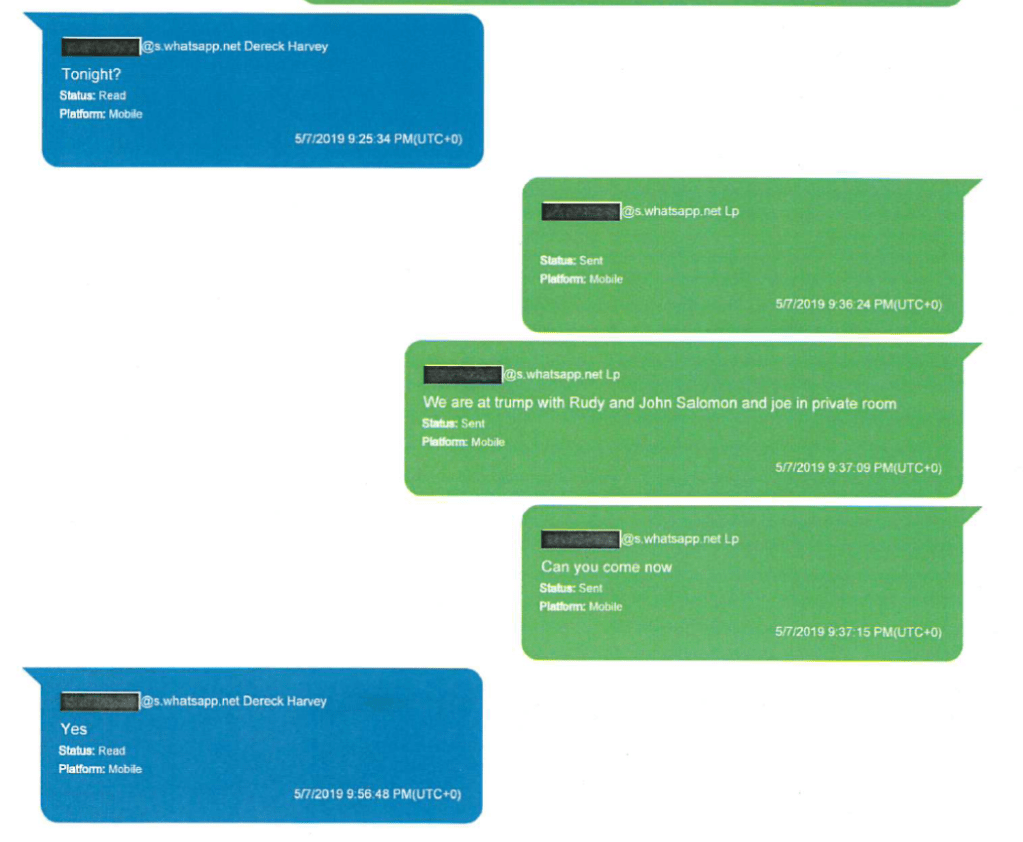
The plan was for Giuliani to join Parnas in Ukraine four days later, on May 12. In the meantime, Parnas would scout ahead in Kyiv, and work on scheduling a meeting between Giuliani and President-Elect Zelensky.
May 10: Parnas Delivers Giuliani’s letter to the President-Elect
WhatsApp messages show that on May 10, Parnas made plans with Interior Minister Arsen Avakov to meet that afternoon, at approximately 2:30pm, Kyiv time. The apparent purpose of this meeting was for Parnas to pass on a letter, which Avakov could then have delivered to the President-Elect. The letter – which was dated May 10, 2019, and copied to Avakov – was from Giuliani, who identified himself as “private counsel” to President Trump. Giuliani’s letter stressed this point repeatedly, noting that Giuliani “represent[ed] [Trump] as a private citizen, not as President of the United States,” and that, in seeking a meeting with Zelensky, he was acting in his “capacity as personal counsel to President Trump and with his knowledge and consent.” To that end, Giuliani wrote, he was requesting a brief meeting with President-Elect Zelensky on either May 13 or May 14.
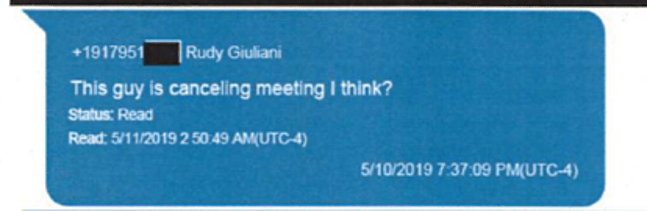
Things did not go as planned. Approximately 12 hours after Parnas had delivered Giuliani’s letter to the Ukrainian officials, Giuliani made an appearance on Fox News to announce that he had called off his planned trip to Ukraine, and complained that President-Elect Zelensky was “in the hands of people who are avowed enemies of the [U.S.] President.” The following day, May 11, Giuliani released a more detailed explanation of his reasoning. Canceling the meeting with Zelensky had been necessary, Giuliani claimed, because “the President elect is being advised by people who were very vocal opponents of President Trump,” and “under these circumstances the meeting would have accomplished little and may be in the hands of those who might misrepresent it.”
Contrary to Giuliani’s claims that he was the one who canceled the meeting with Zelensky, however, the WhatsApp exchanges between Giuliani and Parnas suggest an all together different explanation for why the meeting was called off – that it was Zelensky who had refused to meet with Giuliani, and not the other way around.
May 11: Meetings with Lutsenko
After Giuliani’s trip to Kyiv was canceled, the Ukraine Scheme seems to have been scrambling to come up with a new plan. Giuliani, still in the States, made the rounds on cable news to decry the enemies in Zelensky’s cabinet, and talk about how important it was for there to be an investigation into Joe Biden. Meanwhile, Parnas remained in Kyiv and continued with his efforts to connect with President-Elect Zelensky. WhatsApp records from Parnas’s phone show that, on May 11, Parnas was in close contact with Prosecutor General Lutsenko throughout the day. The two of them met up on at least two separate occasions that day, once early that afternoon and once again that evening.
And, in between those two meetings, at 3:24pm Kyiv time, Parnas sent Lutsenko an intriguing series of WhatsApp messages:
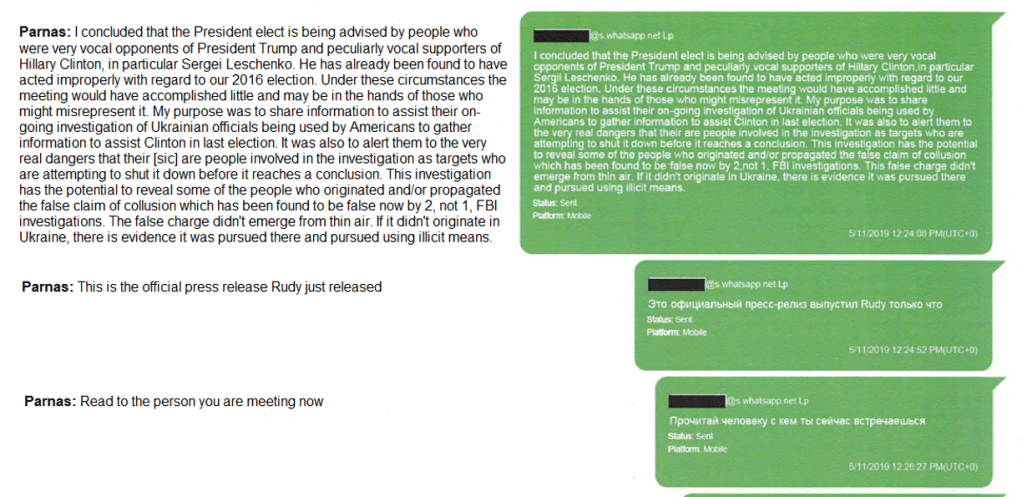
Parnas sent Lutsenko the full text of a press release from Giuliani, and instructed Lutsenko to “read [this] to the person you are meeting now.” Although Parnas’s messages don’t identify by name who Lutsenko was meeting with at that time, Lutsenko later told Ukrainian media about the nature of this meeting. These statements from Lutsenko were later included in the whistleblower’s report:

It was President-Elect Zelensky that Parnas was requesting Lutsenko communicate with on his behalf.
WhatsApp messages show that, following Lutsenko’s meeting with Zelensky, Lutsenko and Parnas met up once again – and, presumably, the two of them discussed what had transpired at the meeting with Zelensky. A few hours later, Parnas would send his first WhatsApp message to Sergey Shefir, senior advisor to the President-Elect.
It is not clear how exactly Parnas obtained Shefir’s number, but it seems that, even prior to Parnas’s message, it had already been agreed that Parnas and Shefir would meet. In his message to Shefir, Parnas introduced himself as a “friend of Mayor Giuliani,” and passed along a copy of Giuliani’s letter to Zelensky:

Later that evening, at 9:08pm, Kyiv time, Parnas and Shefir confirmed plans for the two of them to meet the following morning, at the Restaurant Prague:

This meeting would be the May 12 meeting that Parnas spoke of in his interviews with Maddow and Cooper.
May 12: The Meeting at the Restaurant Prague
In his interview with Rachel Maddow, Parnas gave his most detailed account yet of what actually took place at the May 12 meeting:
PARNAS: . . . Basically, the message that I was supposed – that I gave Sergiy Shefir was a very harsh message. I was told to give it to him in a very harsh way, not in a pleasant way.
MADDOW: Who told you to give it to him a harsh way?
PARNAS: Mayor Giuliani, Rudy, told me after, you know, meeting with the president at the White House. He called me. The message was, it wasn’t just military aid, it was all aid. Basically their relationships would be sour, that he would – that we would stop giving them any kind of aid that –
MADDOW: Unless?
PARNAS: – unless that there was announcement made – it was several things. There were several demands at that point. A, the most important was the announcement of the Biden investigation.
MADDOW: Did you also convey to him that the U.S. government would stop showing support for Mr. Zelensky, that they wouldn’t attend the inauguration? Or that –
. . .
PARNAS: At our meeting, I was very, very stern. It was a heated conversation from our part to him, basically telling him what needs to be done. I mean, basically me. And at the – at – in the conversation, I told him that if he doesn’t – the announcement was the key at that time because of the inauguration, that Pence would not show up. Nobody would show up to his inauguration.
. . .
PARNAS: Particularly Vice President Mike Pence.
MADDOW: So, the day after that meeting that you had with Mr. Shaffer –
PARNAS: This was Sunday, Sunday the 12th.
MADDOW: I believe it was the following day that, in fact, Vice President Pence’s visit to the inauguration was canceled.
PARNAS: It was after my phone call. The conversation I laid out to Mr. Shaffer was basically what I was told to do by Giuliani and the president.
In addition to his interview on The Rachel Maddow Show, Parnas also gave a second, shorter, interview with CNN’s Anderson Cooper, in which Parnas described the May 12 meeting in similar terms:
COOPER: And what’s the message you deliver [at the May 12 meeting]?
PARNAS: I basically told them very strict, and very stern, several things. A, that he needed to make an announcement, to immediately make an announcement literally that night or tomorrow, that within the next 24 hours, that they were opening up an investigation on Biden.
COOPER: At that point, was there any mention of withholding of aid?
PARNAS: Yes. Well, if they didn’t make the announcement, basically, there would be no relationship. Not just to – it was no specific military, there was no way they were going to be assisted. There was going to be no inauguration. Pence wouldn’t be at the inauguration. And there would be no visit to the White House. There would be basically – they would have no communications.
COOPER: So how, you told the top official in the Zelensky inner circle if they did not announce an investigation of the Bidens immediately and get rid of some folks around Zelensky who they believed were opposed to President Trump, that there wouldn’t be any aid and Vice President Pence would not even come to the inauguration?
PARNAS: Correct.
COOPER: And what happened? What did they say?
PARNAS: I called Rudy, told them that I don’t think it’s going to – there is going to be an announcement. And he said, OK, they’ll see.
Parnas’s claims, if corroborated, would show President Trump’s direct involvement in a scheme to use the powers of his office to coerce Ukraine into providing assistance to his 2020 campaign. The key phrase there being, of course, “if corroborated.”
Summary of Events Surrounding the May 12 Meeting
Below is summary of relevant events leading up to, and following, Parnas’s May 12 meeting in Kyiv. Events that have been established either by the existing documentary record or by undisputed witness testimony are below in regular font, while events based on Parnas’s account of events – and in need of corroboration – are in bold.
May 10:
- Sometime around midday, Kyiv time, Parnas meets with Arsen Avakov, the Ukrainian Minister of Internal Affairs. Parnas gives Avakov Giuliani’s letter, with instructions to pass the letter on to Present-Elect Zelensky. In the letter, Giuliani requests a meeting with President-Elect Zelensky on either May 13 or May 14. According to Giuliani’s contemporaneous statements to reporters, his purpose in seeking a meeting with Zelensky is to ask the President-Elect to open an investigation into Joe Biden.
- Giuliani’s efforts to arrange a meeting with Zelensky fail.
- Giuliani goes on Fox News and announces that he is calling off his trip to Ukraine, and claims that he decided against meeting with Zelensky because he is surrounded by enemies of President Trump.
May 11:
- Shortly after noon, Kyiv time, Parnas and Prosecutor General Lutsenko meet up, apparently at Parnas’s hotel.
- Lutsenko then attends a meeting with President-Elect Zelensky, during which Lutsenko asks Zelensky to let him keep his job as Prosecutor General.
- At 3:24pm, Kyiv time, Parnas sends a message to Lutsenko, copying Giuliani’s press release stating that he had canceled his trip to Kyiv after “conclud[ing] that the President elect is being advised by people who were very vocal opponents of President Trump and peculiarly vocal supports of Hillary Clinton.” Parnas instructs Lutsenko to read the message out to Zelensky.
- Following his meeting with Zelensky, Lutsenko meets with Parnas for a second time.
- That evening, Parnas sends a WhatsApp message to Sergey Shefir, a senior advisor to Zelensky, and introduces himself. From their communications with one another, it appears that an agreement had already been reached for Parnas and Shefir to meet at some point the following day. Via WhatsApp, Shefir and Parnas make plans to meet the following morning at 10:00am.
- According to Parnas, Giuliani has a “meeting with the president at the White House,” during which Giuliani and Trump discuss what should be done at Parnas’s meeting with Shefir. (Maddow at 7)
- Following Giuliani’s meeting at the White House, Giuliani calls Parnas and tells him that, in his meeting the following day, Parnas should deliver a “a very harsh message.” (Maddow at 7) Parnas is to tell Shefir that Zelensky “need[s] to make an announcement, to immediately make an announcement literally that night or tomorrow, that within the next 24 hours, that they were opening up an investigation on Biden.” (Cooper at 3) Parnas says he communicated to Shefir that, should Zelensky fail to meet these demands, the entire U.S.-Ukraine relationship would be in jeopardy; not only would the U.S. would cut off assistance to Ukraine, but “Pence wouldn’t be at the inauguration. And there would be no visit to the White House. There would be basically – they would have no communications.” (Cooper at 3)
May 12:
- At approximately 10:00am, Kyiv time, Parnas, Shefir, and Fruman meet at Restaurant Prague.
- During the meeting, following Giuliani’s instructions, Parnas delivers the message to Shefir: “The conversation I laid out to [Shefir] was basically what I was told to do by Giuliani and the president.” (Maddow at 9)
- Shefir and Parnas conclude their meeting by agreeing that Shefir would report back to Zelensky, and Shefir and Giuliani would meet up again at the end of the day in order for Shefir to give Parnas Zelensky’s answer. According to Parnas, after the meeting he updated Giuliani on what had happened: “And then, afterwards, I relayed back to them saying that he’s going to get back to me later that tonight and we’re supposed to meet.” (Maddow at 9)
- For the rest of the day on May 12, Parnas waits to hear back from the Ukrainian officials, but by that evening, he has not received word from anyone. Finally, Parnas reaches out to Shefir again: “around 8:00, or 9:00 at night, I texted them back again saying, any word? What’s the situation? And at that point, because on WhatsApp when a person like disconnects you” (Maddow at 9)
- Parnas contacts Giuliani and tells him that he does not think Zelensky has agreed to their demands: “I understood that [Shefir’s lack of response] was a no. So, I called [Giuliani] back and said no-go, and he – I remember Rudy going, OK, they’ll see” (Maddow at 9); “I called Rudy, told them that I don’t think it’s going to – there is going to be an announcement. And he said, OK, they’ll see.” (Cooper at 3)
May 13:
- Parnas tells Toensing, via WhatsApp messages sent just after 4:00am, Eastern time, that he was “waiting to hear from president elect today” and that he was “on standby waiting to hear [for the] next couple of hours.”
- Shortly after 11:00am, Eastern time, Vice President Pence’s office receives instructions that President Trump has decided to cancel Pence’s trip to the Zelensky inauguration.
- Parnas learns that Pence will not be attending Zelensky’s inauguration: “I got called and said that they got a call from them, some – basically some – they found out that Pence is not going to be there, they got – he got cancelled. They said that there was a scheduling problem or something.” (Cooper at 3)
May 15-16
- A few days after Parnas’s meeting with Shefir, Zelensky’s team learns that Vice President Pence’s trip to Ukraine has been canceled.
- According to Parnas, “And then after that, like I think on the 16th or the 15th, I don’t remember the exact dates, [Zelensky’s team] had – because they were flipping out what to do. They didn’t want to be embarrassed. They didn’t know if anybody at all was going to show up, you know, but they knew Pence wasn’t coming, Trump wasn’t coming.” (Cooper at 4); “[W]ithin the next couple of days, all of a sudden, [the Ukrainian officials] realize that now they get word, because obviously, when Pence cancels, they get word that Pence is not coming. So, now, they realize that what I – what I was telling them is true.” (Maddow at 9)
Corroborating Parnas’s Claims About the May 12 Meeting
Parnas’s story about the May 12 meeting is specific, detailed, and based on his first-hand experiences – and contains numerous details that, if true, should be relatively easy to confirm. At the moment, the public record available about the May 12 meeting comes from (1) statements to the media from other witnesses; and (2) documentary records that have been made available to the House in the course of the impeachment inquiry. Thus far, Parnas’s account is consistent with the existing record of evidence. Additional corroboration for Parnas’s claims is also likely to be found in additional materials that have previously been produced to the House, but have not been publicly released.
Statements from Other Witnesses
The existence of the May 12 meeting is not in dispute.[3] It took place at the Restaurant Prague at approximately 10:00am on May 12, and three people were there: Lev Parnas, Igor Fruman, and Sergey Shefir. Per the New York Times, the three men sipped coffee and spoke in Russian.
In the November 10, 2019 article that first reported on the existence of the May 12 meeting, the New York Times describes Parnas’s account of the meeting as “potentially significant,” but cautions that it has been “contradicted on several fronts,” suggesting that other witnesses have disputed Parnas’s assertions about what happened.
Although skepticism of Parnas’s account is very much warranted, in describing Parnas’s account as “contradicted,” the New York Times appears to have been overstating the case. All three meeting participants (or their attorneys) are quoted in the article, along with Giuliani, but none of the quoted statements in the Times article actually contradict anything that Parnas has said.
For instance, Igor Fruman’s attorney, John Dowd, gave the following statement about the May 12 meeting:
A lawyer for Mr. Fruman, John M. Dowd, said his client told him the men were seeking only a meeting with Mr. Zelensky, the new president. “There was no mention of any terms, military aid or whatever they are talking about it — it’s false,” said Mr. Dowd, who represents Mr. Fruman along with the lawyer Todd Blanche.
Fruman, through Dowd, denies that a specific term – “military aid” – ever came up during the May 12 meeting. But that isn’t actually a contradiction of anything Parnas has said; nowhere in the Times article is Parnas quoted as having used the term “military aid,” either. And, in his interview with Maddow, when Maddow used the term “military aid” in questioning Parnas about the meeting, Parnas corrects her:
It has been reported as far as we understand, from public reporting, that you conveyed to Mr. Shaffer the exact quid pro quo, that you wanted Zelensky to announce investigations into Joe Biden or military aid would not be released to Ukraine. Is that accurate?
. . .
PARNAS: … The message was, it wasn’t just military aid, it was all aid. Basically their relationships would be sour.
Parnas made a similar point in his interview with Cooper:
COOPER: At that point, was there any mention of withholding of aid?
PARNAS: Yes. Well, if they didn’t make the announcement, basically, there would be no relationship. Not just to – it was no specific military, there was no way they were going to be assisted.
Based on Parnas’s descriptions of the meeting, the threat Parnas had conveyed to Shefir was not in regards to any particular category of foreign assistance to Ukraine. Rather, Parnas says he was conveying a more generalized threat: that Zelensky must announce the Biden investigations immediately, or else the entire relationship between the U.S. and Ukraine would be at risk, along with all U.S. monetary assistance to Ukraine, military or otherwise. The only specific threat that Parnas says he conveyed to Shefir was not about any monetary aid, but about Vice President Pence’s attendance at Zelensky’s upcoming inauguration.
Giuliani is also quoted in the New York Times article, but does not deny Parnas’s account of the message he conveyed to Shefir. Instead, Giuliani only denies that he instructed Parnas to deliver that message:
Mr. Giuliani denied Mr. Parnas’s contention that he had delivered the warning at the direction of Mr. Giuliani. “Categorically, I did not tell him to say that,” Mr. Giuliani said.
In his statement, Sergey Shefir, like Fruman, denies that the term “military aid” ever came up during the May 12 meeting. But Shefir does not otherwise contradict Parnas’s account of what transpired at the meeting:
In a statement on Friday, Mr. Shefir acknowledged meeting with Mr. Parnas and Mr. Fruman. But he said they had not raised the issue of military aid. Mr. Shefir said he briefed the incoming president on the meeting. … “We did not treat Mr. Parnas and Mr. Fruman as official representatives, and therefore we did not consider that they could speak on behalf of the U.S. government,” Mr. Shefir said. He added Mr. Parnas and Mr. Fruman had requested that Mr. Zelensky meet with Mr. Giuliani.
Mr. Shefir said in his statement that he had told Mr. Parnas and Mr. Fruman “that we could consider meeting with Mr. Giuliani, but only publicly and officially and only after the inauguration of the newly elected president.”
In fact, Shefir’s statement is consistent with Parnas’s own account of the meeting dynamics.[4] In Parnas’s interview with Maddow, Parnas described how Shefir (and, through him, Zelensky) had not seemed to take Parnas’s demands seriously; Parnas implies that the Ukrainian officials may have harbored doubts as to whether Parnas truly spoke on behalf of Giuliani and President Trump, like he claims. According to Parnas, it was only after Vice President canceled his attendance to Zelensky’s inauguration that the Ukrainian officials realized Parnas had been telling them the truth:
Next, within the next couple of days, all of a sudden, they realize that now they get word, because obviously, when Pence cancels, they get word that Pence is not coming. So, now, they realize that what I – what I was telling them is true. (Maddow at 9)
Documentary Records Already in the Possession of HPSCI
If Parnas’s account of May 12 is true, the HPSCI should already be in possession of records that could provide significant corroboration for many of his claims.
- Records corroborating Parnas’s claim that, prior to the May 12 meeting, Giuliani instructed Parnas to deliver the “very harsh message” to Shefir
In his interview with Maddow, Parnas stated that he received instructions to deliver “a very harsh message” to Shefir pursuant to a phone call from Giuliani, and that Giuliani had made this call “after … meeting with the president at the White House.” (Maddow at 7)
If Parnas’s account is true, then there are likely phone records that confirm the existence of phone calls between Parnas and Giuliani on the afternoon or evening of May 11 – that is, sometime after Parnas and Shefir had made plans to meet, but before their meeting actually took place. Moreover, these communications between Parnas and Giuliani would have occurred shortly after Giuliani had an opportunity to meet with President Trump.
It turns out that there is a fairly limited window during which these communications could have taken place. On May 11, a Saturday, Trump spent the day at his Virginia golf club, and left the White House at 9:16am, Eastern time, and returned at 3:03pm. If Parnas is correct about Giuliani having met with Trump at the White House that day, then any meeting between Giuliani and President Trump presumably occurred either before 9:16am or after 3:03pm. And, based on Parnas’s account, we would expect to see phone activity between Giuliani and Parnas that follows on the heels of that.
Conveniently, HPSCI should already be in possession of the phone records that could confirm Parnas’s account, including call records for Giuliani, Parnas, and Fruman.[5] These records were obtained by the House during the impeachment inquiry, and cited extensively throughout the HPSCI report. Although that report does not mention any phone calls that took place on May 11 or May 12 – and so does not make public the specific portions of the phone records that are relevant to Parnas’s account – the report does include detailed discussion of call records for Parnas and Giuliani from other dates. Such as on May 8:
On the morning of May 8, Mr. Giuliani called the White House Switchboard and connected for six minutes and 26 seconds with someone at the White House. That same day, Mr. Giuliani also connected with Mr. Solomon for almost six minutes, with Mr. Parnas, and with Derek Harvey, a member of Representative Nunes’ staff on the Intelligence Committee. (HPSCI Report at 56)
And on May 9:
On May 9, following public revelation of his trip by the New York Times, Mr. Giuliani connected in quick succession with Mr. Solomon and then Mr. Parnas for several minutes at a time. Mr. Giuliani then made brief connections with the White House Switchboard and Situation Room several times, before connecting at 1:43 p.m. Eastern Time with someone at the White House for over four minutes. He connected, separately, thereafter with Mr. Parnas several times in the afternoon and into the evening. (HPSCI Report at 57)
And on May 10:
[Giuliani] then had another flurry of calls with Mr. Parnas. Shortly after 2:00 p.m., Eastern Time, Mr. Giuliani also spoke with Ambassador Volker on the phone. Ambassador Volker had learned that Mr. Giuliani intended to travel to Ukraine “to pursue these allegations that Lutsenko had made, and he was going to investigate these things”—specifically, the debunked story that Vice President Biden had improperly pressured Ukraine to fire a corrupt prosecutor general, as well as the Russian-backed conspiracy that the Ukrainians interfered in the 2016 U.S. election. Ambassador Volker testified that he had a simple warning for Mr. Giuliani: Prosecutor General Lutsenko “is not credible. Don’t listen to what he is saying.” Call records obtained by the Committees reveal that their call lasted more than 30 minutes.
Call records also show that around midday on May 10, Mr. Giuliani began trading aborted calls with Kashyap “Kash” Patel, an official at the National Security Council who previously served on Ranking Member Devin Nunes’ staff on the Intelligence Committee. Mr. Patel successfully connected with Mr. Giuliani less than an hour after Mr. Giuliani’s call with Ambassador Volker. Beginning at 3:23 p.m., Eastern Time, Mr. Patel and Mr. Giuliani spoke for over 25 minutes. Five minutes after Mr. Patel and Mr. Giuliani disconnected, an unidentified “-1” number connected with Mr. Giuliani for over 17 minutes. Shortly thereafter, Mr. Giuliani spoke with Mr. Parnas for approximately 12 minutes. (HPSCI Report at 58)
The call records from May 8-10 also show a recurring pattern: Giuliani would have a “flurry” of calls with Parnas early in the day, which was later followed by call(s) with the White House, which in turn was followed with additional calls to Parnas. Interspersed with Giuliani’s communications with both Parnas and the White House are additional calls between Giuliani and reporter John Solomon, as well as calls between Giuliani and individuals who were or have been members of Rep. Devin Nunes’ staff.
Although phone records for May 11 and May 12 are not referenced in the HPSCI report, the subpoenaed call records would have included call activity for that time period as well. WhatsApp messages exchanged between Parnas and Giuliani confirm that it is likely the two of them were in phone contact when Parnas’s meeting with Shefir was in the planning stages:

Additionally, Parnas’s messages with Victoria Toensing show that he was likely in phone contact with her as well. For instance, shortly after Parnas made contact with Sergey Shefir, Parnas and Toensing had the following exchange:

It should be noted that Giuliani’s phone records alone will not be sufficient to corroborate one aspect of Parnas’s story: that before Parnas received his instructions from Giuliani about what to say at the meeting, Giuliani discussed the matter with Trump. According to Parnas, Giuliani and Trump had this conversation at a face-to-face meeting, which Parnas says happened at the White House. If Parnas is correct about that, then Giuliani’s phone records alone won’t provide corroborating evidence for it. Other records may exist that could confirm this aspect of Parnas’s account, however.[6] And President Trump’s social media activity on May 11 suggests that Biden’s activities in Ukraine were very much on his mind. That morning, before departing for his golf course, he retweeted Mike Huckabee’s tweet accusing former Vice President Biden of misconduct in Ukraine:

- Records of calls made between Parnas and Giuliani during the May 12 meeting.
Parnas told Maddow that when he met with Ukrainian officials, it was common practice for Giuliani to be called and put on speakerphone at some point during the meeting, so that Giuliani could confirm to the Ukrainian officials that Parnas had the authority to speak with them on his behalf.
However, it is unclear if complete phone records for May 12 would show evidence of Parnas and Giuliani communicating during the May 12 meeting. Parnas and Fruman met with Shefir at 10:00am Kyiv time, or 3:00am Eastern time, and given the late hour it is possible Giuliani would not have been available to call in to the meeting. However, if the House does in fact have Parnas’s and Giuliani’s phone records for May 12, it would be interesting to see if any calls between Giuliani and Parnas (or Giuliani and Fruman) appear between 3:00am and 4:00am Eastern time. Such a call would provide strong proof of Giuliani’s knowledge of the meeting.
- Records of Parnas’s communications with Giuliani immediately following the May 12 meeting, in which Parnas “relayed back” to Giuliani “that [Shefir is] going to get back to me later that night and we’re supposed to meet.” (Maddow at 9)
According to Parnas, after the May 12 meeting, Parnas updated Giuliani on events, and informed him that Shefir was to get back to him later that evening with Zelensky’s answer. Whether this communication happened via a phone call, text message, or some other form was not specified in Parnas’s interview with Maddow. Unfortunately, the WhatsApp communications that have been made publicly available so far are incomplete, and no communications between Parnas and Giuliani that occurred between May 12 and May 15 were included. Pagination on the produced WhatsApp records show that there were frequent WhatsApp exchanges between them at this time, however, as the last available message from May 11 appears on page 230, and the next record, from May 16, jumps ahead to page 246.
While the nature of any WhatsApp communications between Giuliani and Parnas is thus unknown to the public at this time (and perhaps unknown to the House, as well – it is unclear how complete the record handed over by Parnas was), reporting from the Wall Street Journal has already indicated that there were in fact phone calls between Parnas and Giuliani on the relevant days:
Messrs. Giuliani and Parnas were in close contact in the days surrounding both meetings: The two men called or tried to call each other nearly 40 times the week of the February meeting, a person familiar with the matter said. On the day of the May meeting, Mr. Giuliani called Mr. Parnas twice, and Mr. Parnas called him three times the next day, the person said, and they exchanged hundreds of calls over the course of that week.
The Wall Street Journal does not provide any further details about these calls, such as what time they were made or how long the calls lasted, but its report does appear to confirm that call records for the dates in question do exist, and do show contact between Parnas and Giuliani in the approximate time period that would be expected, based on Parnas’s account. Additionally, if Parnas is called to testify before the Senate, he would be able to provide further details about how he and Giuliani communicated that day, and might be able to identify other forms of records that could corroborate his account.
- Records of Parnas’s communication with Shefir following the May 12 meeting.
According to Parnas, the May 12 meeting ended with Shefir and Parnas agreeing to connect again later that day, once Shefir had a chance to brief Zelensky on what Parnas and Fruman had told him. Parnas did not hear back from the Ukrainian officials, however, so that evening he reached out again to Shefir: “Then around 8:00, or 9:00 at night, I texted them back again saying, any word? What’s the situation? And at that point, because on WhatsApp when a person like disconnects you, and he disconnected me, our conversation.” (Maddow at 9)
The available record supports Parnas’s description of events. In the WhatsApp messages between Parnas and Shefir show that, after their meeting at 10:00am that morning, the next and final communication between them that day occurred at 9:41pm, Kyiv time, when Parnas messaged Shefir: “Serhiy[,] good evening[,] is there any news!”
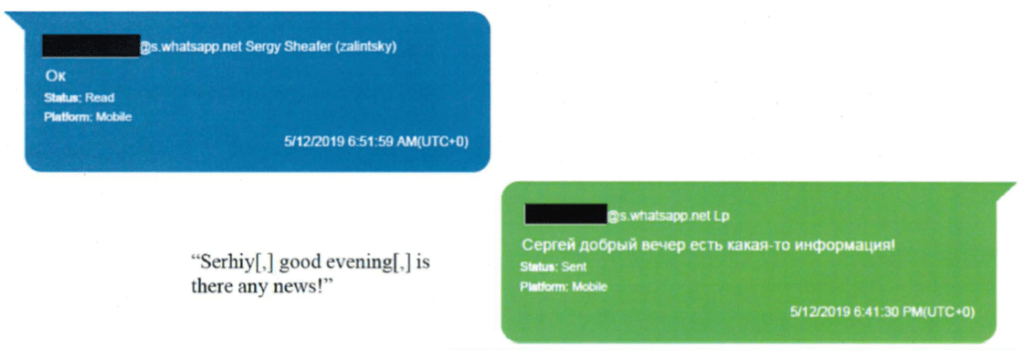
Shefir did not respond to Parnas’s message. In fact, although in the following months Parnas would try twice more to message Shefir, Shefir never responded to Parnas again.
Other WhatsApp messages sent and received by Parnas on May 12 provide additional context for Parnas’s account of events – though due to the cryptic wording used in many of the WhatsApp exchanges, the exact meaning of these messages is often ambiguous at best. For instance, half an hour after Parnas’s message to Shefir, Parnas sent a message to Lutsenko: “Yuriy dial me I have something important to tell you.” It is unclear if the two connected by phone, but at 10:51pm, Kyiv time, Parnas sent a second message, telling Lutsenko that if he can’t reach Parnas tonight, to call him tomorrow at 1pm. At nearly 1am, Lutsenko finally responded, stating “Let’s call. Better after 4. I have a lot of work to do.”

It is unclear what the “something important” was that Parnas needed to communicate to Lutsenko, but Lutsenko’s next response to Parnas, sent the following day, may provide a clue:

“So is he against the investigation?”, Lutsenko asks. Unfortunately, this exchange between Lutsenko and Parnas is maddeningly devoid of context. Who is the “he” in Lutsenko’s message? Is it Shefir? Zelensky himself? If so, this message would seem to be corroboration of Parnas’s claim about what was discussed at the May 12th meeting: the announcement of a Biden investigation.
- Records of Parnas’s call to Giuliani on May 12, in which Parnas told Giuliani, “I don’t think [ ] there is going to be an announcement [of a Biden investigation],” to which Giuliani responds, “OK, they’ll see” (Cooper at 3)
In his interviews with both Maddow and Cooper, Parnas stated that, after he did not hear back from the Zelensky administration on the evening of May 12, he “called Rudy, told them that I don’t think it’s going to – there is going to be an announcement. And he said, OK, they’ll see.” (Cooper at 3) If Parnas’s account is true, there should be phone records reflecting the call he described. Moreover, based on Parnas’s version of events, Giuliani must have passed the word on to the White House in a very short amount of time, because less than 24 hours later – by approximately 11:00am, Eastern time, on May 13 – President Trump had already issued instructions to the Vice President’s office, informing him that he would no longer be attending Zelensky’s inauguration. This means that, under Parnas’s story, communications between Parnas and Giuliani would have fallen within a narrow window of time.
Based on the reporting from the Wall Street Journal, Giuliani and Parnas exchanged phone calls on both May 12 and May 13. Further details from the call records may help corroborate Parnas’s account by showing that the timing of his communications with Giuliani corresponds with the known timeline of when it was decided that Vice President Pence would not attend the inauguration.
- Records that could explain when and why President Trump made the decision to cancel Vice President Pence’s trip to attend the Zelensky inauguration
In his interviews with Maddow and Cooper, Parnas stated that, the day following his meeting with Shefir, President Trump ordered Vice President Pence to cancel his plans to attend Zelensky’s inauguration. On this point, Parnas’s account is factually correct; the known sequence of events surrounding the cancelation of Vice President Pence’s trip to Ukraine matches his description. But the explosive part of Parnas’s account – and the part that remains to be corroborated – is his claim that Trump’s decision to cancel Pence’s trip to Ukraine had been made in response to the Zelensky administration’s failure to comply with the demands conveyed by Parnas in the May 12 meeting.
In his interview with Cooper, Parnas said that he told Shefir “that [Zelensky] needed to make an announcement, to immediately make an announcement literally that night or tomorrow, that within the next 24 hours, that they were opening up an investigation on Biden,” and that Shefir was warned that, should Zelensky fail to comply with the demands, Pence would not be at the inauguration. (Cooper at 3) The following day, when no announcement had been made, President Trump made good on his threat and pulled Pence from the inauguration.
Prior to the May 12 meeting, Pence’s attendance at Zelensky’s inauguration had already been agreed upon, and the Ukrainian officials would have been expecting him to be there. President Trump had made the decision for Pence to attend the inauguration on April 21, the day Zelensky won the election. (Williams at 37-38, 41) However, at that point, the exact date of the inauguration was unknown, as under Ukrainian law the parliament was responsible for scheduling the inauguration, based on the president-elect’s recommendations, but the parliament could not do so until May 13, when they were back in session. (Williams at 57) After Zelensky’s election, the Ukrainians informed their American counterparts that a final decision on the inauguration date would be announced sometime during the week of May 13, but that they were “looking at the end of May window” for the inauguration, or possibly early June. (Id.) The Vice President’s office had begun initial planning for the trip, but shortly after 11:00am on May 13 (the day after Parnas’s meeting with Shefir) Vice President Pence’s staff received a phone call informing them that Pence would not be attending the inauguration. (Williams at 38) There was no explanation given for why the trip was canceled, and at that point there were no scheduling conflicts or other difficulties that would have prevented Pence from attending; instead, all the Vice President’s office was told was that “the President had determined that the Vice President should not go.” (Williams at 160) Following Pence’s cancelation, the Ukrainian parliament announced, on May 16, that the inauguration would be held much sooner than they had previously anticipated, and would take place just four days later, on May 20. (Williams at 57)
Because President Trump has refused to produce any records before the House’s impeachment inquiry, there is nothing available in the public record that can explain why Pence’s attendance at the inauguration was canceled. But there must be some explanation for this. Immediately following Zelensky’s election, Pence’s attendance at the inauguration had been deemed to be in the U.S.’s best foreign policy interest – so how, and why, did the White House come to suddenly change its mind about this, on the morning of May 13? No reason has ever been offered by President Trump or the White House, and although Republicans in the House have tried to dismiss Pence’s failure to attend as some kind of scheduling mix up or logistical conflict, no evidence has been produced that supports this explanation.
In contrast, Parnas’s claims about why Pence was withdrawn from the inauguration do provide a plausible and coherent explanation for the known sequence of events. That, by itself, cannot confirm the truth of Parnas’s account. But the available evidence lends far more support to Parnas’s account than it does to any of the explanations that have been proffered by House Republicans.
Parnas’s WhatsApp messages are also consistent with Parnas’s statements to Anderson Cooper about the specific demands that Parnas conveyed to Shefir. According to Parnas, Shefir was told that Zelensky needed to make the Biden announcement right away, as in “literally that night or tomorrow, [ ] within the next 24 hours.” (Cooper at 3) Parnas says that when Shefir failed to respond to him on the evening of May 12 as had been planned, Parnas interpreted this as a no, and contacted Giuliani to tell him, “I don’t think it’s going to – there is going to be an announcement.” (Id.)
But Parnas says that the message he gave to Shefir was that Zelensky had “the next 24 hours” to make a decision. That would mean that, by the evening of May 12, Zelensky technically had not failed to comply with the demands – it would not be until May 13 that Giuliani and Parnas could have known for sure that Zelensky was not going to comply.
And in fact, Parnas’s WhatsApp messages to Toensing provide strong supporting evidence that the following morning, on May 13, Parnas was still waiting for word from President-Elect Zelensky:

Just after 4:00am, Eastern time, Parnas told Toensing that he was “waiting to hear from president elect today,” and that plans were “on standby waiting to hear [in the] next couple hours.” These messages are fully consistent with Parnas’ account about what happened at the May 12 meeting, as well as with the known timeline of events with regards to the cancelation of Pence’s trip.
If Parnas’s account is true, then within a few hours of Parnas’s messages to Toensing, Parnas must have communicate to Giuliani that Zelensky had not agreed to the demands, and, in turn, Giuliani must have quickly communicated this message to the White House – because just a few hours later, the decision was made to cancel Pence’s attendance at the inauguration.
Based on the Wall Street Journal report, the call records between Parnas and Giuliani show at least three calls from Parnas to Giuliani on May 13. A review of the complete call records obtained by HPSCI may provide further corroboration of Parnas’s story, if it is shown that Giuliani communicated with the White House that morning, after he had spoken to Parnas but before Pence’s trip was canceled at 11:00am.
A Note of Caution: Parnas Has His Own Reasons for Talking
The record made available so far has, in fact, been largely consistent with Parnas’s account of the May 12 meeting, and provides corroboration for many key details in his claims. However, while this evidence supports Parnas’s account to a degree, or at least doesn’t contradict it, there are numerous suggestions in the record that Parnas’s account is incomplete. In particular, Parnas’s claims appear to be selectively omitting events that could suggest his culpability in as-of-yet uncharged crimes under the Foreign Agent Registration Act and the Foreign Corrupt Practices Act.
For instance, in his interviews with both Cooper and Maddow, Parnas acknowledged that the demand for the Biden investigation was not the only demand conveyed in the May 12 meeting:
“I basically told them very strict, and very stem, several things. A, that he needed to make an announcement, to immediately make an announcement literally that night or tomorrow, that within the next 24 hours, that they were opening up an investigation on Biden.” (Cooper at 3)
“It was several things. There were several demands at that point. A, the most important was the announcement of the Biden investigation.” (Maddow at 8)
There were “several demands” that Parnas made of Shefir, Parnas acknowledges, but Parnas only identifies one. What were these other demands made of Shefir? Were those demands also requested by Giuliani, or by Trump, or were they independently made by Parnas?
Should Parnas testify before the Senate, it is possible that he would be able to provide a fuller account of these activities.[7]
The TL;DR
Lev Parnas’s account of the May 12 meeting, if proven, would demonstrate President Trump’s direct involvement in the Ukraine Scheme’s efforts to coerce the Ukrainian government into providing his campaign with assistance in the 2020 election. Parnas’s testimony is critical evidence that should be heard at the Senate’s impeachment trial, and his answers under oath would provide clarification for many of the details that Parnas did not address in the course of two brief cable news interviews.
But already there is already strong evidence to suggest that the central planks of Parnas’s claims are true, at least in regards to the portion of the Ukraine Scheme’s efforts that were focused on the Biden investigation. Based on the existing public record, Parnas’s account of the May 12 meeting, as described in his interviews with Rachel Maddow and Anderson Cooper, can be shown to be consistent with all available witness statements and documents, and many of the key details of his claims can be corroborated by documents already produced by the House in the course of the impeachment inquiry. Finally, in addition to the public records cited in this article, other records that are already in HPSCI’s possession, as well as additional discovery materials produced in the criminal proceeding against Parnas that may later be transmitted to HPSCI, are likely to provide additional corroboration for Parnas’s account.
-Susan
[1] Parnas’s WhatsApp messages suggest that Yuriy Lutsenko may have also been aware of the purpose of the pair’s early April trip to Israel. On April 2, Parnas messaged Lutsenko, “This is going to be a big week.” In response, Lutsenko sent Parnas an image of David fighting Goliath – a possible reference to Parnas’s upcoming plans to meet with the billionaire Kolomoisky.
[2] On April 7, at the conclusion of Parnas’s and Fruman’s first trip to Israel, the Department of Justice leaked a story to the Daily Beast that described how Kolomoisky was under FBI investigation for financial crimes. That the DOJ would choose to leak this news at all is questionable – there is no apparent legitimate basis for why the FBI would have wanted to make its ongoing investigation public at that time, particularly given the timing of the release, just weeks before the Ukrainian election – and raises question about whether this leak was ordered by the White House in order to increase pressure on Kolomoisky, with the aim of inducing his cooperation with Giuliani’s and Parnas’s efforts to open an investigation into Biden in Ukraine. Should either Parnas or Giuliani testify before the Senate, they should be questioned as to whether they have knowledge about the timing of the Daily Beast’s story.
[3] That the meeting with Shefir did in fact take place is further confirmed by Parnas’s messages to Shefir on the morning of May 12 on his way to the Restaurant Prague:
Parnas: Good morning Sergei I am already on the road but I was delayed for 15 minutes, so I will be there somewhere around 10:15 to 10:20 thank you.
Shefir: Ok
[4] Additionally, Shefir’s statement that they “did not consider that [Parnas and Fruman] could speak on behalf of the U.S. government” is in no way a contradiction of Parnas’s version of events. Parnas used Giuliani’s letter to introduce himself to Shefir, and that letter makes clear that Giuliani – and through him Parnas – are not representatives of the U.S. government, but instead represent Donald Trump in his personal capacity.
[5] As part of its investigation, HPSCI issued at least six subpoenas for cellphone records, including subpoenas for call records for both Giuliani and Fruman. Although Parnas’s phone records were not specifically identified as among those obtained by subpoena, the HPSCI’s report on the impeachment inquiry indicates that the HPSCI was in fact of possession of call records for Parnas.
[6] Although no public records are currently available to confirm that Trump and Giuliani met on May 11, there is evidence to suggest such a meeting was in fact planned. On the afternoon of May 10, Trump gave an interview to Politico in which, after being asked about Giuliani’s plans to travel to Kyiv on May 12, Trump stated, “I have not spoken to him at any great length, but I will … I will speak to him about it before he leaves.”
[7] In fact, it is possible that is exactly what Parnas is hoping for. Parnas’s testimony, given under subpoena, will have use immunity, and cannot be used by the government to charge him with additional criminal offenses. Although the government would not be barred from charging Parnas for that conduct based on evidence derived from other sources, as shown by the example of Oliver North’s testimony before Congress in the Iran-Contra affair, the act of testifying before Congress about your own criminal activities can, in the right circumstances, successfully prevent your prosecution for those acts.





























 The View From LL2