Ungrateful Cat Rejects Awesome Cat Bed

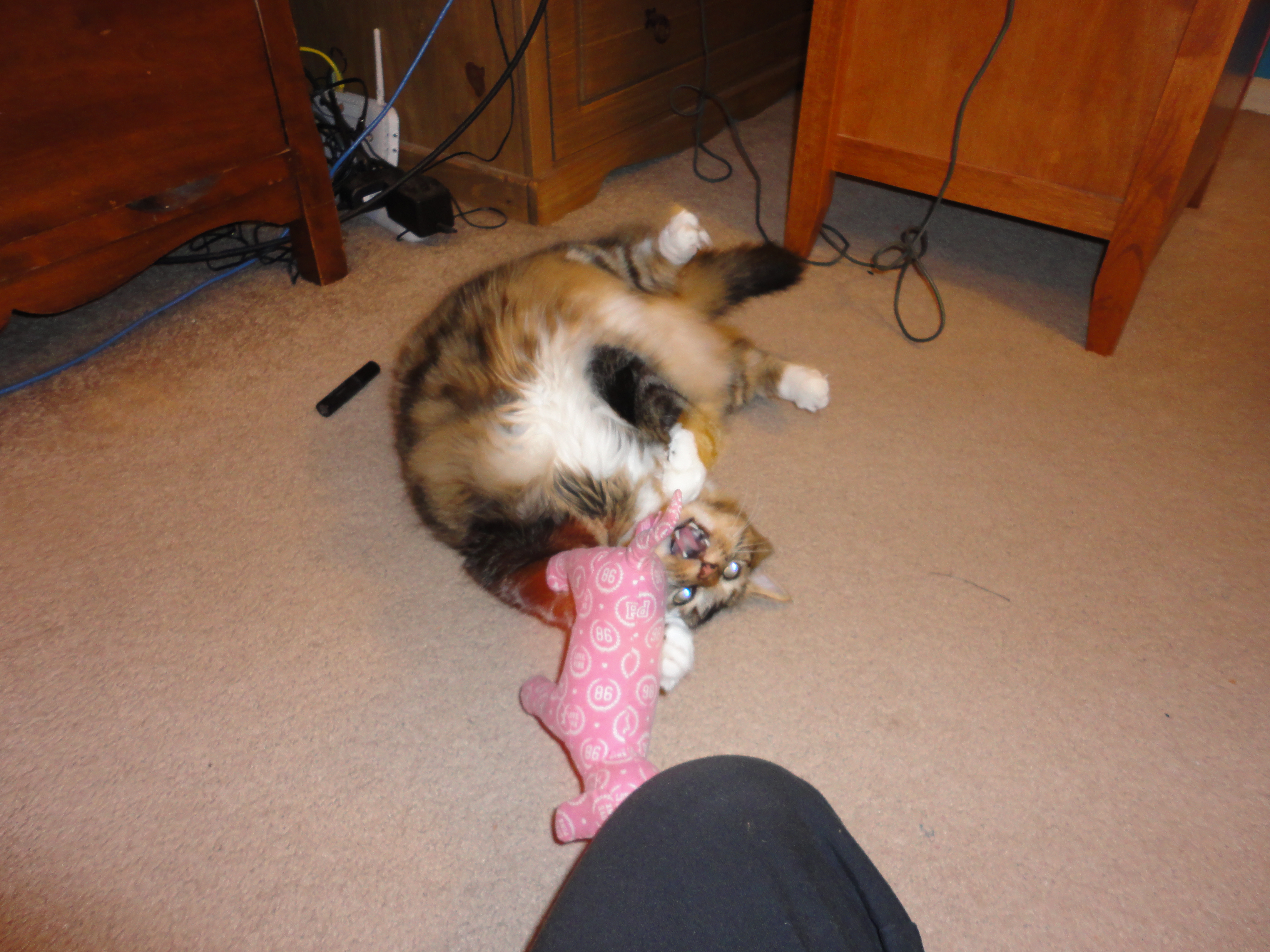
My cat is a jerk. I spent the entire morning risking electrocution and vacuum tube implosions to disassemble an old CRT monitor. All so that the noble Lord Ragnarok could have a nifty looking bed to lounge about in.

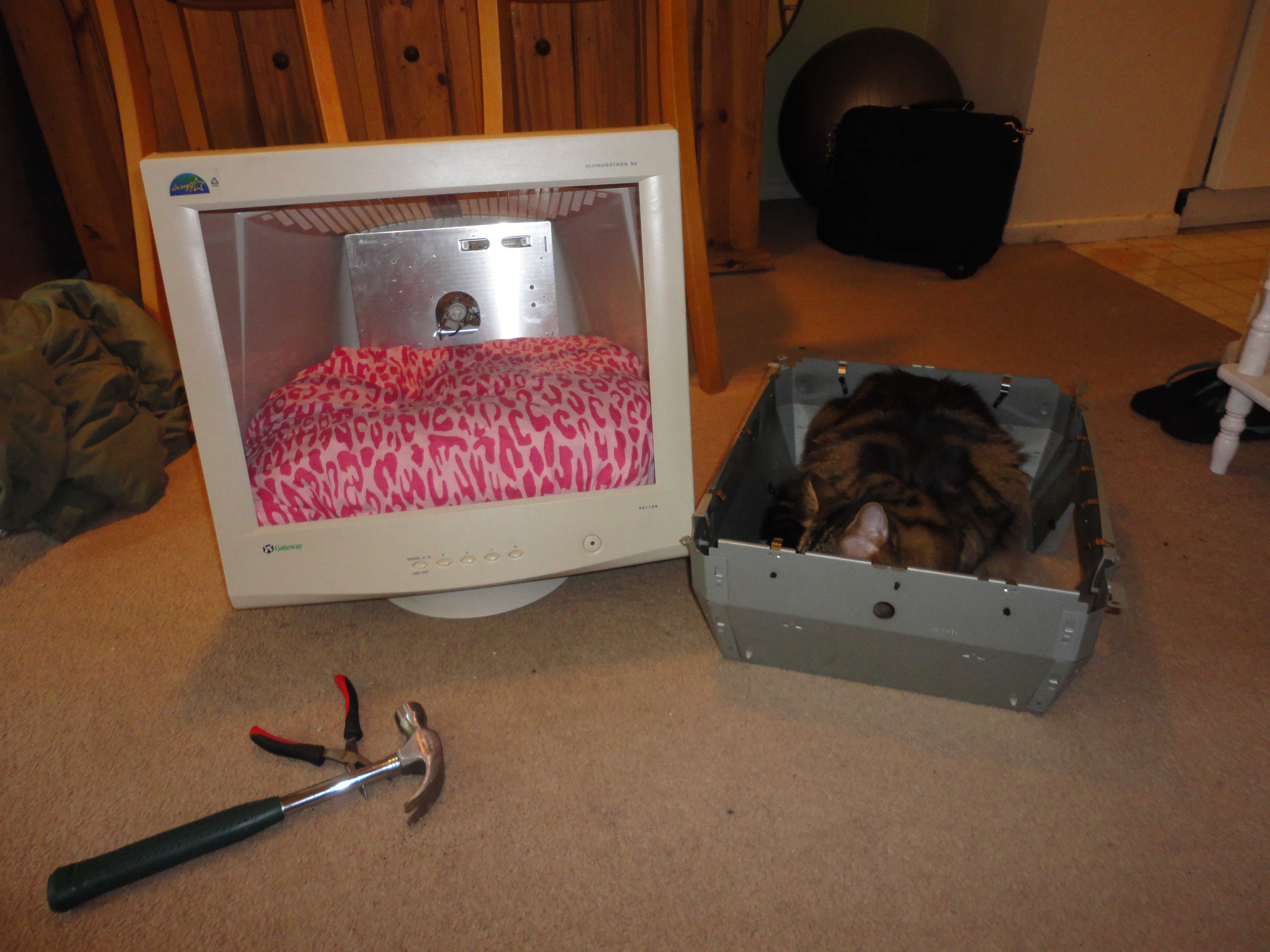
He loves boxes of all kinds, so I figured he’d enjoy this. He’s kind of, um, big boned, so I needed a big monitor — and the abandoned 21″ inch CRT monitor I found while cleaning out our closets was perfect. Taking it apart was difficult only because I am sometimes an idiot. Also it turns out there are lots of hidden screws on monitors. When in doubt, however, I found that just kind of forcing things apart, with liberal application of wire cutters, pretty much got the job done.

Once it was finished, complete with a stylish pink leopard print pillow, I put it upright and proudly waited for Ragnarok to discover his awesome new bed.

Instead, he excitedly jumped into the discarded metal box interior. And lounged there. For fifteen minutes. While purring happily. What an asshole.
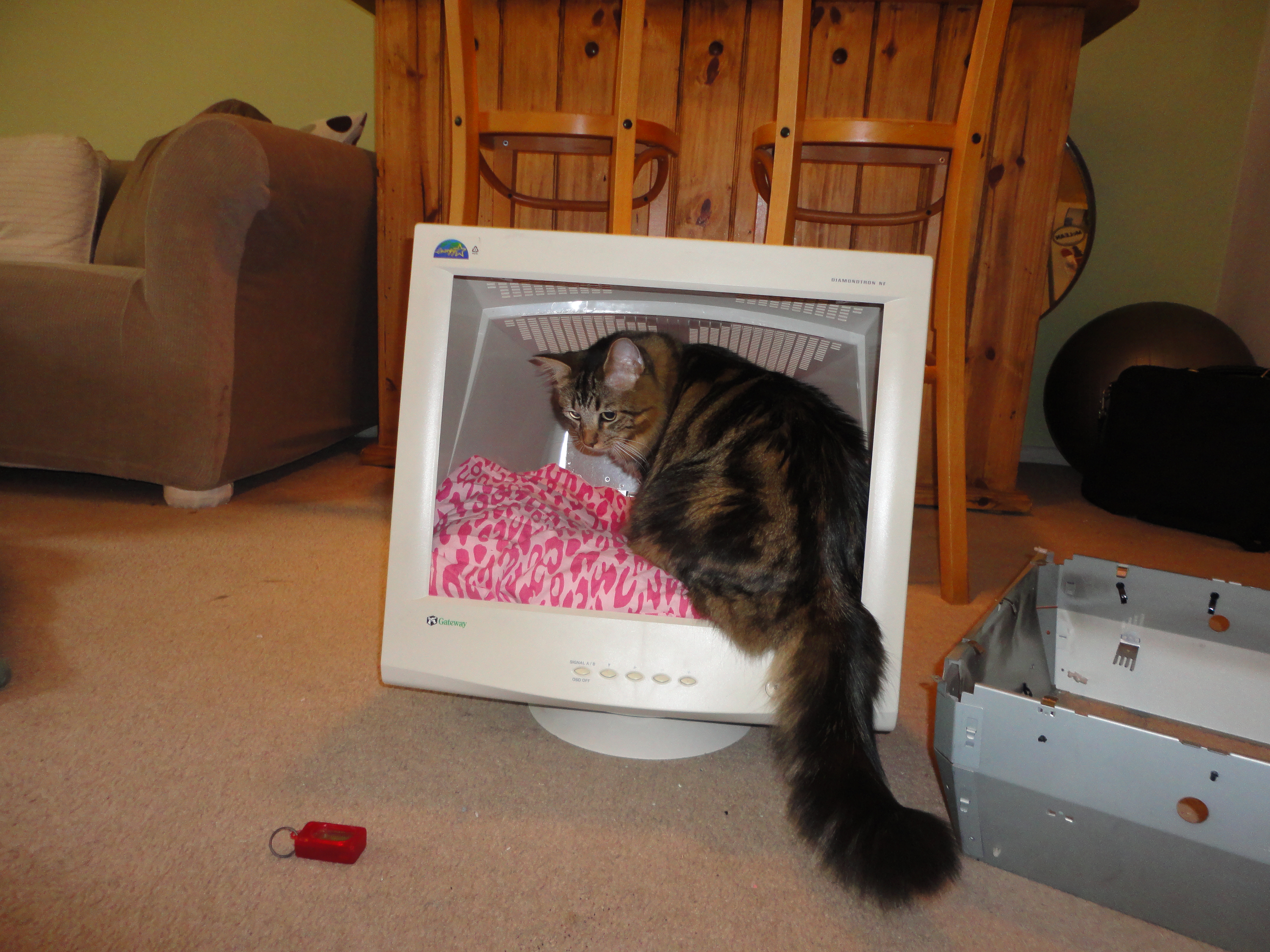
Attempts to force him into the monitor were resisted strenuously. But I deserved to have pictures of my cat pretending to enjoy his new luxury geek bed, dammit, so it was time to pull out the big guns. After heavily dosing the pillow with crushed up catnip and scattering his favorite treats in the back of the monitor, Ragnarok finally agreed to hop inside.
Hopefully, he’ll learn to appreciate the new bed. If not, I’m just going to have to turn it into a cage and get myself a pet mouse.

Update: A solution has been found. To make Ragnar use the monitor bed, simply give him his favorite kind of bed — a plastic tub — and then load the whole thing into the monitor, like it’s some kind of demented kitty oven. Apparently this is much more comfortable than curling up on a nice pillow.

-Susan
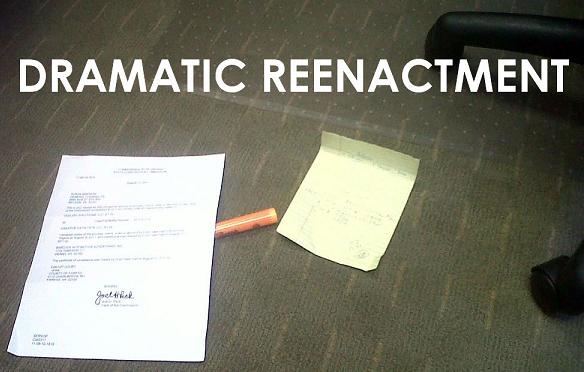
Earthquacalypse 2011

Pictured below is a reenactment of my office immediately following the Great DC Earthquake of 2011:

Note that this photo is only an approximate recreation of the devastating scene, as the original havoc and destruction caused by the earthquake had been repaired before someone reminded me that I should have taken a photo.

-Susan

Update (from Michael): The horrible earthquake depicted above actually caused several D.C. law firms and courts to close for the day. Oh the humanity.

Who Does Google Think You Are?

Ever wonder how Google figures out which ads it is going to flash at you? To see who Google thinks you are, you can check out your Google demographic profile by clicking over to http://www.google.com/ads/preferences/. The interest categories appear to be updated regularly based upon what sites have been visited over the past few days, but the inferred demographics do not seem to change as much. Here is Google’s stalking profile for me:

While my age demographic has been correctly pegged, apparently Google thinks I’m actually a dude. At least for the moment, under the user history for this particular browser.

I guess it is sort of comforting that Google isn’t using my Google account or my Google+ profile — which correctly identifies me as female — or any other Google profile I have to figure out what web ads to direct at me. According to Google’s Privacy Policy for Google Ads, it looks like the ads Google generates are not based upon anyone’s individual Google accounts, but rather the web activity on each individual browser or device. So while you’re not exactly anonymous, it at least provides the comforting illusion that Google is not stalking everything you do.

-Susan

Bethesda Softworks, IP Troll

Mojang, the Swedish-based game developer behind MineCraft, has a new game coming out. It’s called Scrolls, and as far as I can figure out, it is the computer game hybrid of Magic the Gathering and Settlers of Catan. As described by developer Jacob Porser,

“At the core it’s a collectable card game, but it’s also a board game… It’s combining the two. As you place your units or your buildings, or your siege weapons, you place it on the game board to play against your opponent. It’s not only about designing a proper collection of scrolls [cards], and the tactical aspect of that deck, but it’s also about the tactical sense of how to place your units on the game board.”

Each scroll is essentially the same as an individual Magic card. This makes “Scrolls” a pretty obvious name for the game — and Mojang has already put a fair bit of money and effort into the branding:

“It’s always been Scrolls to me,” adds Carl Manneh, Mojang’s CEO, who joined the company a few months ago. “I think it’s a great name.” It seems pretty amazing that they managed to get the URLs. I ask if they [were] free? Both laugh, and shake their heads. So how did they get them? Carl explains, “It helps when you’ve got some cash.”

So while it’s still a little bit unclear exactly what Scrolls is going to be, it is clear that it is not going to be anything like a quest-based, sandbox RPG. In other words, it will be absolutely nothing like Morrowind or Oblivion or any other game in Bethesda Softworks’ The Elder Scrolls series.

Bethesda Softworks is not one to let such minor details get in the way of a good IP fight, however, and the company is now suing Mojang in Sweden for trademark infringement, over Mojang’s use of the Scrolls mark. According to Notch, Mojang’s owner,

I got a 15 page letter from some Swedish lawyer firm, saying they demand us to stop using the name Scrolls, that they will sue us (and have already paid the fee to the Swedish court), and that they demand a pile of money up front before the legal process has even started.

Currently, there is no lawsuit in the United States. Although Mojang filed a trademark application for Scrolls [PDF] in the U.S. on May 17, 2011, as it usually takes four months for the USPTO to get around to reviewing a trademark filing, a decision on the application won’t be expected until some time next month. Then, if the USPTO has no objections to the Scrolls mark, Bethesda Softworks’ parent company will then have 30 days to file a Notice of Opposition to it, and make its case that there is a likelihood of confusion between the two game titles.

In other words, expect the Bethesda vs. Mojang battle to be opening a second front over here in the States sometime around mid-October.

But do Bethesda’s objections to the Scrolls mark have any merit? While I couldn’t quite label them frivolous, they are unquestionably silly — the risk of consumer confusion here is close to nil, as there is no self-respecting gamer on earth that is going to try to buy Elder Scrolls V: Skyrim and accidentally end up buying Scrolls: The Gathering instead. Nor are they going to see Scrolls and go, “Gee, I wonder if this is the Oblivion card game!” No one even calls The Elder Scolls games “the Elder Scrolls games”; for that matter, hardly anyone seems to know what the “elder scrolls” of the series’ title are even supposed to be.

So in honor of Bethesda Softworks’ attempt to bully Mojang into abandoning the game title by threatening Mojang with rounds of expensive litigation, I have made Bethesda its own scroll. I hope Notch adds it to the game:

-Susan

An Inquiry Into the History of First-Person Shooter Video Game Villains, Pt. 2

Continued from An Inquiry Into the History of First-Person Shooter Video Game Villains, Pt. 1.

3. Third Wave: Modern Reenactments and Al-Qaeda Clones (circa 2002-2008)

The third wave of First Person Shooter (FPS) video games involves a combination of the two previous game styles: reenactments of currently occurring conflicts and conflicts with entities that are clearly stand-ins for Al-Qaeda. Beginning in about 2002, video games started to make the jump from historical and generic battle scenes to battle scenes that parallel real wars that are occurring today. Inevitably, political entanglements accompanied this increase in realism, as unlike their predecessors, these games cannot claim to be abstract diversions that are independent of actualy events. They are, necessarily, commentary on war and international disputes, whether the developers intend them to be or not.

It is not just the plots that cause the political entanglements; these games are also political in their very origin. What is unique about the third wave of video games is that it was not private developers that first pushed the boundaries, making it acceptable for video games to be set in modern day conflicts. Rather it was the U.S. military that first developed games that attempt to recreated on-going, real life wars.

Continue reading

An Inquiry Into the History of First-Person Shooter Video Game Villains, Pt. 1

A few months back, an infograph on video game villains was making the rounds, depicting the nationality and setting of various combat video games. The infograph makes an interesting point: the identity of bad guys in video games is very much a reflection of real-world geopolitical developments. But the graph does not go quite far enough. It is obviously comprised of only a few hand selected games, and as it goes back only to 2001, it does not show the more general, historical trends in video game development regarding bad guy nationality.

For video games set on modern day earth, the question of who should play the villain is a very delicate issue for game developers. It is also a new one: prior to 2001, it was virtually unheard of for a video game to feature a real world nation as a villain, and it is only in the past four or five years that games featuring real nations and organizations fighting each other in hypothetical conflicts have become commonplace. Having real countries be video game bad guys has, however, been part of long arc in video game development, wherein video games have persistently pushed the boundaries regarding what is considered an “acceptable” story line. At the very beginning of video game development, realism of any sort was strongly frowned upon; even having bad guys that bled red blood was considered too shocking and graphic. Over time, however, games have incorporated more and more elements of realism into their game play, beginning with the least controversial elements and then working its way up to games based on hypothetical armed conflicts between existing nations.

Continue reading

EDVA’s Tasteful New ECF Color Scheme

The website for the Eastern District of Virginia’s ECF system is having some issues. It has unexpectedly acquired the following color scheme:

And so, when I logged into ECF earlier, I was suddenly and unexpectedly confronted with a screen entirely filled with the most horrifying shade of green-gold the world has ever known. The color has been variously identified by attorneys viewing it as “aggressively cat diarrhea green”, “baby poop green”, and “ebola-infested olive.”

A quick look at the source code for the page shows what it wrong — and reveals that, thankfully, EDVA is not intentionally inflicting that color scheme on its users. Apparently, whoever handles the website was trying to go for the much more predictably bland #999966 for the background shade. Unfortunately for them, they accidentally set the color with the following: <BODY BGCOLOR=#999966″>. And, as I am reliably informed by someone who knows a lot more about such things than I do, that little extra ” has somehow managed to convert the website’s background from the staid #999966 into the cringe-inducing #999600 instead.

Now let’s see just how long it takes for them to fix it.

-Susan

Update: As of July 27, the website is still not fixed. Damn, EDVA needs to look into hiring some new, more diligent tech people.

Asset Partitioning, Legal Personhood, and its Implications for Corporate Civil Liability

What entities can be liable under the alien tort statute? At a minimum, it has been established that natural persons and foreign sovereigns can be successfully sued under the ATS. Beyond that, there is, to put it mildly, quite a bit of disagreement, most of it centered around whether or not a juridical person can be a validly named defendant alongside humans and nations.

The legal historians’ amicus brief [PDF] in support of the cert petition in Kiobel addresses this question in the context of the common law’s historical approach to questions of liability, arguing that “the Second Circuit erred in concluding that ‘who is liable for what’ is a matter of customary international law,” and that, in the United States, entities are liable for their agents’ torts without regard to the source of the substantive norm of conduct, and this applies to the ATS no less than it would any other tort statute. Although I largely agree with the brief, I wanted to expand upon some of its arguments here, and, in particular, to challenge the claims that, under international law, a “corporation” is a distinct and insular category that can or ought to be afforded its own set of rules. Questions of corporate personality — and for that matter, natural personhood — were not cognizable on the international plane at the time of the ATS’s enactment, as distinctions between sub-state entities could only be made through a state’s domestic law. Accordingly, the question of whether a non-state actor has committed a violation of international law is entirely independent of how a state’s domestic law assigns legal personhood to its subjects.

Continue reading

Another Step Forward

I got back home tonight just in time to hear that it really had gone through: New York has legislatively authorized same sex marriages.

Forty years from now, everyone is going to claim that, on this date, they were “not against” gay marriage. Some might still claim they were “against the way it was done,” but that they “weren’t against it in principle” — because obviously the only philosophically valid piece of legislation is one done by popular referendum — but very few will acknowledge that they believed that marriage equality would be a contributing cause to the destruction of America, or that they thought today would be a day to be mourned.

And that’s fine. Letting people forget that they disagreed with Brown v. Board was the best way to proceed, and it is the same here.

But tonight, freedom scored another victory. By a small amount — albeit a very large amount for those whom it directly affects — there has been an increase in the ability of Americans to order their lives as they see fit, in accordance with their own beliefs and convictions.

And to, most importantly, live their own lives however they goddamned want to. That is worth celebrating.

-Susan

The Alien Tort Statute, the Blackstone Three, and the Historical Basis of Judge Williams’ Concurrence In Shafi v. Palestinian Authority

Judge Williams’ concurring opinion in Ali Shafi v. the Palestinian Authority, affirming the district court’s dismissal of the plaintiffs’ claims against the Palestinian Authority, is a long overdue attempt to create a new theoretical framework for the recognition of causes of action under Alien Tort Statute — or, more properly speaking, attempts to revive a very old one. His concurrence is an original attempt to link the ATS’ alleged origins in Blackstone’s Commentaries with the statute’s modern revival in Sosa v. Alvarez-Machain. Ultimately, it proposes a new standard all together for judges struggling to vigilantly police the ATS threshold: that the causes of action recognized under the ATS’s jurisdictional grant ought to be those which “protect[] and facilitate[] the system of international relations arising out of the Westphalian view of national sovereignty, particularly with respect to the avoidance and termination of war.”

While I disagree with Judge Williams’ conclusion — that, in considering whether a plaintiff has stated a claim under the ATS, courts should look to “whether the defendant’s alleged behavior might provoke war if the United States occupied no more than an average position in global power rankings” — his concurrence attempts to inject some much needed ideological coherency into the federal courts’ constant invocations of the “Blackstone Three,” which, thanks to Sosa, are now an ubiquitous feature of modern ATS jurisprudence. Despite its prominent role in ATS litigation, however, most courts fail to understand the true significance of the Blackstone Three, and do not understand what unifies these three disparate norms of international law or why they have been chosen to be the paradigmatic causes of action under the ATS.

Continue reading