Prudential Considerations, Canons of Construction, and Other Mechanisms of Judicial Receivership

In United States v. Windsor, there is one aside from Justica Scalia’s dissent, written in his trademark snarky fashion, which particularly stands out to me. Scalia, describing himself as being “wryly amus[ed]” (and by which he means “impotently furious”) at the majority’s approach to Article III’s case-or-controversy requirement, makes the following observation:

(Relegating a jurisdictional requirement to “prudential” status is a wondrous device, enabling courts to ignore the requirement whenever they believe it “prudent”—which is to say, a good idea.)

How very true. Alas, where was this Scalia in Kiobel? I seem to recall that, in that particular instance, he was quite content to join in with a majority opinion which happily forsook jurisdictional limitations, in favor of a mercurial, and curiously flexible, rule of statutory interpretation. And I can’t help but find this faintly hypocritical. At least when it comes to prudential standing, the Court is being perfectly honest about whose whim it is following. As opposed to the polite fiction now known as the presumption against extraterritoriality, which permits the Court to aver that it is merely following the whims of the legislature — after having ascertained those whims, of course, through the application of its own esoteric art.

But then again, I suppose Scalia always does save the mocking, legal realist jibes for his dissents. It often seems that his formalism is reserved solely for those occasions on which his opinion gets enough votes to be the majority.

-Susan

p.s. Someone should tell Scalia that citing reverently to Justice Taney in a civil rights decision is probably a bad idea.

Closing arguments haven’t been made yet, but after

Aside

Closing arguments haven’t been made yet, but after the close of Zimmerman’s defense, my prediction is a manslaughter conviction, by a slight margin, with acquittal the next most likely option, and Murder 2 trailing as the least likely result. Call it a 45/40/15 split.

As far as I am aware, Zimmerman’s defense didn’t present any testimony or evidence concerning how the fight started. Their entire story of the shooting starts about halfway through the fight — call it the “Zimmerman is a fat and slow Dudley Do-Right who was getting his butt kicked” defense. Which is kind of a double edged sword for Zimmerman, because it means his case didn’t introduce any evidence that Trayvon started the fight. It’s counting on the jury to focus on the fact that, at the moment of the shooting, Zimmerman may have genuinely been in fear for his life — while steering the jury away from closely examining his conflicting police statements. The defense’s story is that Zimmerman is bumbling and quixotic, but too inept to be culpable for any harm that resulted.

So if there’s a conviction, it’s more likely to be manslaughter. The state’s strongest case for Murder 2 was always being able to show that Zimmerman intentionally deceived investigators about how the fight started, and that he used his knowledge of self-defense law to deliberately craft a story about why he was justified in killing Trayvon. But since the defense opted to avoid all together Zimmerman’s statements about who threw the first punch, Zimmerman’s veracity didn’t really come into play. The jury could buy that Zimmerman is a reckless fool, who was oblivious of his own limitations and too in love with the idea of playing the hero, but the state wasn’t able to show Zimmerman as calculating and malicious.

In a nutshell: if the jury believes Rachel Jeantel testified truthfully about what she heard on the phone that night, Zimmerman will be convicted of manslaughter. If they’re unsure of what she heard, then the odds are much less likely.

-Susan

Zimmerman’s Statements are the Defense’s Own Worst Enemy

As I discussed in my previous post, there are two plausible scenarios that fit the undisputed evidence in the Zimmerman trial. Zimmerman’s defense is now presenting their case in support of scenario 1: that Trayvon decided to commit murder and beat Zimmerman to death with his bare hands, as revenge for Zimmerman having “disrespected” Trayvon. In making their case, however, Zimmerman has two problems they face. The first is that there is very little they can do to directly disprove the prosecution’s case, as the prosecution’s evidence is largely circumstantial and based on known parts of the record. The second is that the evidence of their version of events all comes from a single witness, George Zimmerman himself — and there are so many points of question and confusion over his testimony that it is difficult, if not outright impossible, to accept his version as being wholly accurate. The prosecution’s job will therefore be to argue that even if Zimmerman’s story cannot be completely relied upon, it reliable enough to create doubt to prove one central point: that perhaps Zimmerman doesn’t know what happened that night, but the events were so confusing that no one else can know either.

I’ve provided below a run-down of the central points for both problems that the prosecution will face.

Continue reading

The Undisputed Facts in the Zimmerman Trial, and the Competing Scenarios of the Prosecution and the Defense

The prosecution is wrapping up its case against George Zimmerman today, after presenting nearly forty witnesses in total, and having provided the jury with a fairly comprehensive overview of the available evidence. The defense has not gotten a chance to make its own case yet. From the trial so far, we have a rough idea of the facts that are agreed to by both parties. And, based only on the agreed-upon facts, there appear to be two possible scenarios for what occurred on the night Trayvon died.

The first, the defense’s scenario, is that Trayvon, while walking home from the store, decided to kill Zimmerman in order to defend his honor, after Zimmerman offended Trayvon by following him. And the second, the prosecution’s scenario, is that, when Zimmerman followed Trayvon and encountered him in the grassy area between the houses, Zimmerman tried to detain Trayvon, and Trayvon resisted, resulting in the fight that lead to Trayvon’s death.

By my reckoning, these are the facts that both the prosecution and the defense would agree to:

  1. On the night of the shooting, Trayvon stated that he was going to walk to the store to get skittles and a drink. Trayvon did in fact get those items from the store, and he was walking directly home from the store at the time that Zimmerman first saw him. There is no evidence to indicate that, prior to the moment of the fight, Trayvon was engaged in any form of unlawful behavior. Zimmerman was correct in that he did not recognize Trayvon as being a resident of the community, as Trayvon had only been there one week at the time of his death.
  2. Zimmerman pursued Trayvon for a period of approximately four minutes, while Zimmerman was in his car and Trayvon was moving on foot. Trayvon and Zimmerman did not speak or attempt to speak to each other at any point during this time period.
  3. Based on the fact that Trayvon was walking in the rain, and that Zimmerman did not recognize him, Zimmerman believed that Trayvon was either on drugs or in the middle of committing a criminal act. Concerned that Trayvon was a criminal, Zimmerman called the non-emergency number to request that police be dispatched to investigate Trayvon.
  4. Trayvon was on the phone with a friend, Rachel Jeantel, for the duration of his walk home from the store. Call records show that the phone call began before Zimmerman first observed Trayvon. The records also show that, at approximately 7:12pm, the call’s connection was dropped unexpectedly, but that the call was resumed 20 seconds later.
  5. At some point during the four minute period that Zimmerman was following Trayvon by car, Trayvon became aware that he was being followed. After realizing he was being followed, Trayvon continued to walk in the direction of the house where he was staying.
  6. After Zimmerman had watched Trayvon walk for approximately four minutes, Trayvon’s pace changed. Trayvon had previously been walking, but at approximately 7:11:42, Trayvon began either to run, or to skip. Zimmerman, who was on the phone with the police dispatcher, stated “shit he’s running” while opening his car door. Zimmerman, now on foot, moved out into the “dog walk” area, moving in the same direction that Trayvon had ran or skipped away a few moments before.
  7. After Zimmerman exited his vehicle, he could not see Trayvon, who had started running before Zimmerman could get out of his car. There is no evidence that Trayvon saw that Zimmerman had left his vehicle. Both Zimmerman and Trayvon state in their respective phone calls, to dispatch and to Jeantel, that they have lost the other individual. Zimmerman ended his call with the police dispatcher two minutes after he got out of his car, and he remained on foot in the “dog walk” area. Trayvon remained on the phone with Jeantel while continuing to walk through the neighborhood, on an unknown path, and he did not return to his house.
  8. At approximately 7:15:40pm, Trayvon and Zimmerman came into close proximity with one another, while both were moving on foot in the “dog walk” area. Trayvon was still on the phone with Jeantel, but after an initial exchange of words between Trayvon and Zimmerman, the call was dropped.
  9. The fight between Trayvon and Zimmerman lasted between a minimum of 60 and a maximum of 100 seconds. For the last 45 seconds of the fight, there is a continual yelling of “help,” in a desperate and panicked manner, from one of the two individuals involved.
  10. All witnesses and parties agree that, at some point prior to the gunshot, the fight involved both participants on the ground, with one on top of the other.
  11. At 7:16:56pm, Zimmerman fired a single  round into Trayvon’s chest, immediately incapacitating him and leading to his death shortly thereafter.
  12. Approximately one* to three minutes later, the first law enforcement officers arrived at the scene. Trayvon was face down in the grass. Zimmerman was standing nearby, with his gun in his holster. Zimmerman identified himself as the shooter, and was taken into custody.

Based on the above facts, then, either of the following scenarios is plausible:

Scenario 1: Zimmerman sees Trayvon walking home from the store. Zimmerman is a concerned neighbor, and because he does not recognize Trayvon, he comes to the possibly mistaken — but understandable and well-intentioned — conclusion that Trayvon is “on drugs” and “up to no good.” Zimmerman follows Trayvon, and calls the police to come question Trayvon and investigate the situation. When Trayvon skips away and out of sight from Zimmerman, Zimmerman leaves his car. Zimmerman does not intend to follow Trayvon after he loses sight of him, but Zimmerman believes he can gather better information for the police if he is on foot.

After Trayvon observes that a man in a car is following him through the neighborhood, Trayvon decides to skip away from the car, and he heads into the “dog walk” area behind the house where he is staying. Approximately four minutes after having skipping away from Zimmerman, Trayvon makes a decision to go back and find the man in the car. Trayvon does not know who his pursuer is, but he feels “disrespected” that the man followed him. Trayvon decides that he will attack the man, in revenge for being followed. Trayvon either announces this intention to Jeantel, and Jeantel later lies about it, or else Trayvon decides to attack Zimmerman without informing Jeantel of this plan. Although Zimmerman is no longer where Trayvon last saw him, Trayvon eventually manages to find Zimmerman at the “T” junction. Trayvon goes in to attack Zimmerman, while angrily demanding “Do you have a problem?” Zimmerman tries to back away, because Zimmerman did not want to encounter Trayvon. As Zimmerman is trying to avoid confrontation, Zimmerman does not identify himself to Trayvon, and responds only that “I don’t have a problem.” Although Trayvon does not at first take any action against Zimmerman, Zimmerman believes that he is in danger, and immediately attempts to call 911 when he sees Trayvon.

Seeing that Zimmerman is trying to call the police, Trayvon punches Zimmerman in the face. After getting punched, Zimmerman stumbles 40 feet southwards until falling to the ground, and Trayvon straddles him. For at least 60 seconds, Trayvon punches Zimmerman between 20 and 30 times, attempts to bash Zimmerman’s skull in with the sidewalk, and uses his hands to suffocate Zimmerman, who is unable to breathe and about to black out. Zimmerman does not fight back, but does try to protect his head from the concrete by repeatedly squirming away. Zimmerman also yells continuously for “help.” Witnesses on the scene ask what’s going on, during the course of the fight. When Zimmerman begs for assistance, they tell Zimmerman they are calling for help, but refuse to intervene in the fight themselves. After a minute or so of punching Zimmerman in the face, and otherwise attempting to kill Zimmerman with his bare hands but being unsuccessful in the attempt, Trayvon notices that Zimmerman has a gun. Trayvon tries to grab the weapon, and he informs Zimmerman that he intends to kill him with it. Zimmerman manages to draw the gun first, and fires once into Trayvon’s chest, killing him. * * *

Scenario 2: Zimmerman sees Trayvon walking home from the store, and comes to the mistaken conclusion that Trayvon is “on drugs” and “up to no good.” Zimmerman pursues Trayvon, from his car, and calls for police to come investigate. Zimmerman frequently calls police when he observes strangers walking through his neighborhood; on the five prior occasions when he has done so, it has always been to report unknown black males who are walking through the gated community. Recently, a skinny black teenager is believed to have committed a crime in the neighborhood, and Trayvon matches that description. While following Trayvon, Zimmerman expresses his frustration  to the dispatcher that assholes like Trayvon always “get away.” When the “fucking punk” then decides to run from him, Zimmerman, who is armed, leaves his car to follow Trayvon on foot.

After Trayvon observes that a man in a car is following him through the neighborhood, Trayvon is initially apprehensive. He is on a phone call with a friend, and he informs her that a “creepy ass cracker” is following him. The friend, either as a joke or as a warning, says to be careful, because the stranger might try and rape him. Trayvon tells her not to joke about that, and expresses nervousness. Trayvon’s friend then tells him to run when the man keeps watching him, and at first Trayvon says he is only going to “walk fast.” The man continues to pursue Trayvon in his car, however, and eventually Trayvon agrees with the suggestion to get away. He heads back through a cut-through, where the car cannot go, and Trayvon believes that he has lost the man in the car. Trayvon’s precise direction is unknown, but he does not  make it inside his home. Thinking that he lost Zimmerman back on the street, Trayvon remains outside in the “dog walk”, talking on the phone with his friend.

After Zimmerman loses sight of Trayvon, Zimmerman leaves his car, and continues to keep a lookout for Trayvon while walking through the neighborhood. Zimmerman is searching for Trayvon, hoping to be able to find Trayvon’s location so that the police will be able to apprehend him when they arrive in the neighborhood. A couple minutes later, Trayvon and Zimmerman run into each other in the “dog walk” area. Trayvon says, “Why are you following me?” Zimmerman says, “What are you doing here?” Zimmerman moves to question Trayvon, hoping to keep him there until police show up. Trayvon doesn’t know Zimmerman, and in fact minutes earlier Trayvon had been discussing with a friend how creepy this guy was, and how he might be a rapist, or have other bad intentions. Trayvon freaks out and resists Zimmerman’s attempts to detain him. A fight then breaks out in earnest, initially with both parties upright and moving around through the grassy area, and then with both parties wrestling on the ground. Neither Trayvon or Zimmerman sustain significant injuries, but Trayvon, having seen Zimmerman’s gun during the struggle, screams in terror, trying to prevent Zimmerman from getting off a shot. The two are locked in place on the ground for nearly a minute, until Zimmerman finally overpowers Trayvon and draws the gun, firing once into Trayvon’s chest, killing him. * * *

In order to prove scenario 2, the prosecution’s job, in addition to familiarizing the jury with the known facts of the case, was to convince the jury of two basic facts: the only evidence that Trayvon tried to kill Zimmerman is Zimmerman’s own words, and that nothing Zimmerman says about that night can be believed. To bolster this case, the prosecution also tried to demonstrate Zimmerman’s vigilante, hero-wannabe tendencies, thus explaining both his skewed perception of events, and the likelihood that he would try to detain Trayvon.

If the prosecution succeeded, the defense has a big problem on its hands, as Zimmerman has few available options for rebutting the prosecution’s case — because there is no way that he can take the stand to present that evidence himself, and there is no one else who can present it for him. Meanwhile, the prosecution has already presented a witness that was, quite literally, in the middle of a conversation with Trayvon at the time the fight occurred. Rachel Jeantel was, indisputably, a witness to Trayvon’s descriptions of what he subjectively experienced in the moments leading up to the fight. Her testimony is consistent with all the available physical evidence, and she provides direct evidence that, at the time the fight occurred, Trayvon did not have the slightest intention of committing homicide.

The doesn’t leave much middle ground: either Rachel Jeantel is lying, or George Zimmerman is lying. They cannot both be telling the truth. But Zimmerman’s defense won’t focus on Jeantel, because there is nothing more to be covered there. Jeantel’s testimony is itself wholly consistent with the available physical evidence, and the defense won’t gain any ground by trying to contradict it that way. Jeantel may have been lying, but the defense has no way of disproving her words, other than by attacking her credibility in general. And for better or for worse, that part of the trial is done with.

Which means Zimmerman’s defense — assuming, that is, that it is not based on trying to destroy Trayvon’s character — a defense that would be unlikely, because it would open the door for the prosecution to try to do the same to him — has the job of trying to convince the jury that it is at least possible that Zimmerman isn’t lying about Trayvon attacking him.

This post is long enough for now, but in my next post I’ll give a run through of all the problems with Zimmerman’s testimony that the prosecution has tried to highlight. It will be interesting to see how the defense is going to try to rebut those attacks on Zimmerman’s credibility, without introducing either character evidence or Zimmerman’s own testimony.

-Susan

The Attempted Impeachment of Selene Bahadoor/Witness 1: What Part of Her Testimony was Zimmerman’s Defense Truly Worried About?

The highlight of today’s round of witness testimony in the Zimmerman trial appears to have been the defense’s attempted impeachment of Selene Bahadoor — a.k.a., Witness 1, or W01. Her testimony was that, on the night Trayvon was killed, she was at home cooking when she heard screaming or yelling from the ‘dog run’ behind her townhouse. W01 was to the east and slightly south of where Trayvon’s body eventually ended up, and prior to the shooting, she could see figures in the dark outside her porch window, with arms flailing. She initially thought the shouting came from children squabbling, and heard shouts of either “no” or “yo.”

On cross, Zimmerman’s counsel attempted to impeach W01 by asking why she had not previously stated, on the record, that she thought the noises of the fight had moved from south to north. The defense also attempted to show her as biased for “liking” a Justice for Trayvon status on Facebook. Although the claims of bias were easy targets for the defense to pick up, I’m left somewhat confused about the defense’s aim in attempting to impeach W01 over inconsistent (or at least previously left unspecified) testimony.

From reports of her testimony at trial, it does not seem that she said anything inconsistent with her police interviews. And her testimony could hardly come as a surprise: W01’s sister, W02, who watched the altercation from upstairs, stated in her initial interviews with police that she saw a chase that occurred from south to north outside their townhouse. (March 9, 2012 interview: Q: “The direction in which you saw these two individuals running, was it towards your house or away from your house — towards the “T” or towards the street?” A: “Towards the T.”)

So the fact that the witnesses at 2841 Retreat View Circle describe the sounds as moving from south to north isn’t some new and previously unknown revelation. It was known within two weeks of the killing (although the Sanford PD failed to immediately interview W01 and W02 as they should have, a fact that Zimmerman’s defense will now benefit from). But it is not clear precisely why Zimmerman’s defense so stridently attacked that specific portion of her testimony. Because the fact that running noises were going from south to north is not damaging to Zimmerman’s defense, and in fact supports his claim that Trayvon ambused him. Zimmerman claims he was attacked after Trayvon headed north from outside W01’s house towards the “T.” If anything, W01’s testimony is consistent with Zimmerman’s story, in that regard.

But the part of W01’s testimony that is hugely inconsistent with Zimmerman’s story is her statement that, after hearing the start of the altercation, W01 saw flailing arms from two standing figures. W01 was consistent in that part of her story at all times, and Zimmerman’s defense did not actually challenge that part of her testimony. But perhaps the defense is hoping that, by pseudo-impeaching W01’s claims regarding the direction of the fight, the jury will also disregard the rest of her testimony.

To me, though, the biggest question regarding W01’s testimony is why on earth did no one think to ask her in depositions which direction she heard the noises going in? Sheesh. It’s hardly W01’s fault if the attorneys deposing her failed to ask such basic questions.

-Susan

The Defense’s Opening Statement Fails to Address George Zimmerman’s Contradicting Claims of How the Altercation with Trayvon Martin Started

Today was the start of the George Zimmerman trial, and what I have seen so far of the recaps from the defense’s opening arguments have been painful to watch. Even ignoring Don West’s cringe-inducing “knock knock” joke, the defense appears to have done little more than offer the jury a rambling and incoherent summary of the case. West’s attempts to recount a timeline of events leading up to the shooting was, in particular, a confusing mess. He managed to both overload the jury with a torrent of disconnected facts, but also failed to provide the jury with the specific bits of information that would allow the jury to understand the narrative that the defense is trying to sell to them.

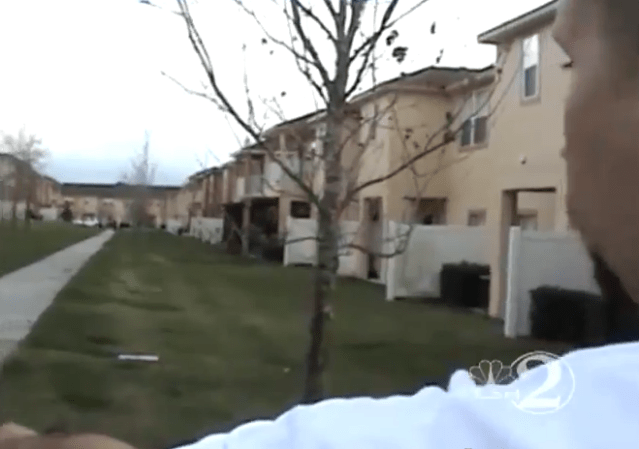
One particular item that stood out to me, however, was the defense’s failure to outline the specifics of Zimmerman’s self-defense claim. In his opening statement, West provided the jury with an aerial view of the infamous “T” junction where Trayvon died, and a timeline of various phone calls made by witnesses, the victim, and the defendant. But in describing where exactly the shooting occurred, West can only vaguely gesture to the general area, circling an approximately 1600 square foot area to indicate the location:

The reason for this vagueness is obvious: the precise location of where the altercation between Zimmerman and Trayvon began is going to be a significant problem for Zimmerman’s defense, as Zimmerman’s statements concerning how the fight began are not reconcilable with the actual crime scene.

I have included full excerpts and links to the relevant transcripts below the jump, but Zimmerman’s initial police statements and interviews are all clear, direct, and consistent with one another. Zimmerman states, in three separate statements given in the days following the shooting, that after Trayvon punched him in the nose he “immediately” “fell backwards.” Those statements were Zimmerman’s 2/26 written statement, (“the suspect punched me in the face. I fell backwards onto my back. The suspect got on top of me”), the 2/26 Singleton interview (“And he punched me in the nose. At that point I fell down.”; “I fell to the ground when he punched me the first time.”; “As soon as he punched me, I fell backwards, um, into the grass”; “He punched me in the face and I fell backwards”), and the 2/27 Serino interview (Zimmerman: “… And then he punched me in the face.” Serino: “Oh, so he said, OK, you have a problem now. OK, he punched and you fell?” Zimmerman: “Yes, sir.”; “He punched me in the face and I fell backwards.”).

On the afternoon of February 27, after the interview that occurred that morning, Zimmerman then performed a walkthrough with police. During that walkthrough, Zimmerman started to describe the altercation with Trayvon in the same way as in his first three statements. Zimmerman describes that he was on the west prong of the “T” junction, walking west towards his car, having hung up with the non-emergency number approximately 1.5 minutes prior. Zimmerman then describes that Trayvon was to the south of him, and walking north along the path towards the junction, towards Zimmerman.

Also of interest is the fact that this description directly contradicts Zimmerman’s prior claims that “[Trayvon] jumped out from the bushes.” There are no bushes Trayvon could have come out from, and Zimmerman never mentions the bushes again. But there is a bigger inconsistency with Zimmerman’s statement: as seen in the walkthrough video, Zimmerman’s claim that he “fell backwards” after Trayvon “sucker punched him” cannot be true.

This is where Zimmerman claims to have been standing when he was punched and fell backwards:

There’s a problem here. Trayvon’s body was found 40 feet south of where Zimmerman is standing in this screenshot – and in front of him, not behind him. Shown below (and please forgive the MS Paint diagramming) are two pictures of the “T” junction, demonstrating how Zimmerman claims he was punched. The blue block is where Zimmerman says Trayvon came from, and the direction he approached in. The red blocks are where Zimmerman says he was standing. In his statements, Zimmerman states that he was facing Trayvon when the punch occurred, and therefore facing south. The red arrows thus indicate the direction that Zimmerman alleges to have “fallen back,” in his prior interviews. Also marked in both photos is the location where Trayvon’s body was found, face down in the grass, several feet away from any concrete:

So in Zimmerman’s walkthrough interview on 2/27, when he started to repeat the same version of events he’d given in his earlier statements, it quickly became apparent to Zimmerman that he could not actually have fallen backwards, as he previously claimed. Zimmerman tries to compensate for this newly apparent discrepancy, and for the first time, Zimmerman changes his story of how Trayvon punched him. No longer does Zimmerman claim to have been punched, and then to have immediately fallen onto his back. Instead, confronted with the actual geographical setting of where Trayvon was killed, Zimmerman tells a new version of events: he was punched, and then he stumbled forward 40 feet, at which point he fell on his back (after having stumbled forward) and Trayvon then got on top of him. Significantly, even with this new version of events, Zimmerman’s walkthrough of the altercation still comes up 20 feet short of where Trayvon was actually shot.

Following the walkthrough interview, Zimmerman stops telling his initial version of events, given in the first three days following the shooting. Zimmerman instead switches to an amended, and much vaguer, story. In the 2/29 interview, the only interview to take place after the walkthrough, Zimmerman describes a version of events that is inconsistent with the version he gave the first three times he told the story. In describing what happened after Trayvon sucker punched him, Zimmerman states the following:

When he first punched me. I don’t know if I immediately fell down, he threw me down. I was stumbling, I ended up on my back.

The reason for the sudden change is obvious: after performing the walkthrough with the police, Zimmerman had realized it was impossible for his first version of events to be correct. He could not have “fallen backwards” after he was punched, so instead he claims that after he was punched, he fell down, was thrown down, or stumbled forward 40 feet. Zimmerman is unable to provide specifics as to how he was transported forty feet from where the first punch occurred — or whether he fell, was thrown, or stumbled to get there — but unlike his prior statements, it is vague enough to not be demonstrably impossible.

-Susan

Continue reading

How to Put a Computer in a Picture Frame

My home computer died last week, as a result of what appears to have been a suicide pact between my CPU and my motherboard. That’s my excuse for the lack of recent updates, anyway.

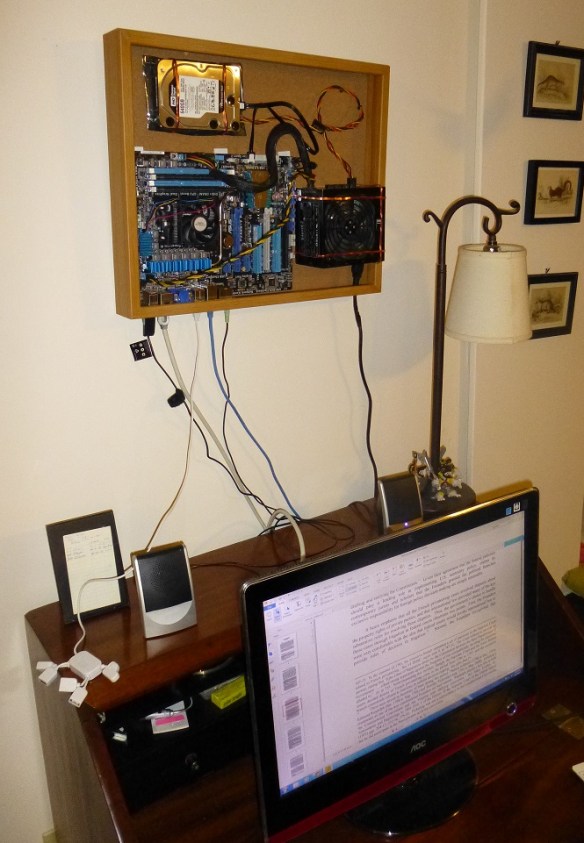
But while I didn’t have a chance to do any blogging, I did have a good excuse to rebuild my computer. Here’s the result:

Picture Frame Build 2

Space-saving, plenty of airflow, and no more reaching down to plug or unplug USBs. Also economical — it saves you from the expense of having to buy both a computer case, and also a picture to hang over your desk.

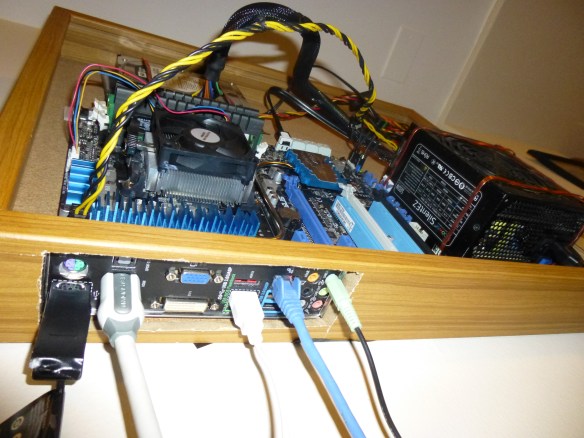
Of course, if I tried to make another one, there are definitely a few things I would do differently. Like use something other than a box cutter to cut out an opening for the front panel:

Picture Frame Build

A box cutter can cut through wood, as it turns out. It just takes a really, really long time.

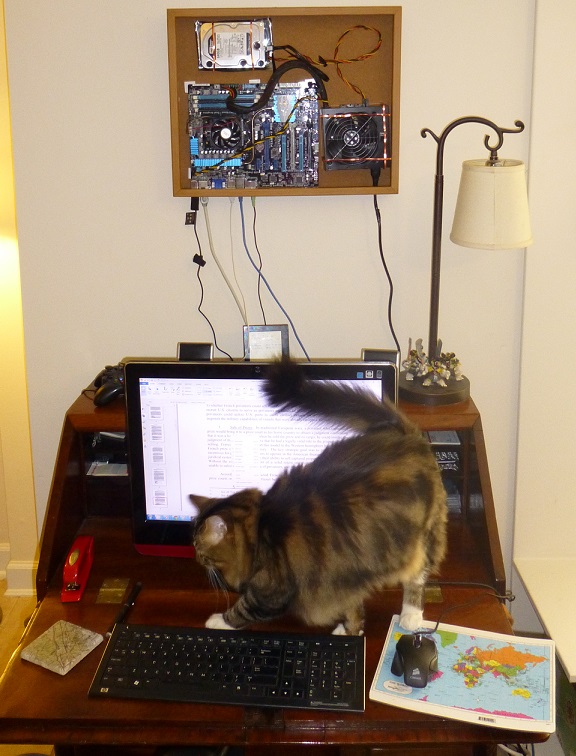
There is one small problem with having a wall-mounted computer that I didn’t consider before I put it up, though. And that’s the fact that my cat is convinced the computer fan and the wires were intended to be fascinating new toys for him to play with.

Picture Frame Cat

Maybe I’ll get some pigeon spikes for the top of my desk, that should fix the issue. Otherwise I’m pretty happy with it, as a prototype. There’s even room left over on the board for a new graphics card if I want to upgrade later.

-Susan

How EEOC v. Arabian American Oil Co. Invented the Modern Presumption Against Extraterritoriality

The presumption against extraterritoriality (“PAE”), like all canons of construction, is a shorthand rule of interpretation used by judges to determine how a statute should be applied. Under the PAE, where there exists ambiguity as to the geographical scope of a statute, the court is required to limit the statute’s application to acts which occur within the territorial limits of the United States. But the PAE, as originally construed in EEOC v. Arabian American Oil Co. (1991) (“Aramco”), and as elaborated upon in Morrison v. National Australia Bank Ltd. (2010) and, more recently, in Kiobel v. Royal Dutch Petroleum (2013), is of a relatively modern vintage for a judicial canon, as it did not exist in its current form until the second half of the 20th century. Prior to the 1950s, the PAE, as it is understood today, did not exist. The modern PAE is instead a conflation of two older canons of construction, and although both those canons are often described as ‘presumptions against extraterritoriality,’ neither canon functioned in the manner that the PAE does today.

These two prior canons, although related both to each other and the modern PAE, were used by the courts two answer two separate questions of statutory construction, and did not typically overlap in their application. The first of these canons, which for purposes of this post has been dubbed the presumption against absurdities (“PAA”), was a presumption that a statute does not provide for extraterritorial application when doing so or when such an interpretation would necessarily imply that the court possesses an unflattering opinion of Congress’ competence. The second canon, which will be referred to here as the presumption against universality (“PAU”), provided that when a statute uses words such as “any,” or “all,” or “every,” those words would not be presumed to have been intended literally when the statute’s context shows that Congress used those words with a more limited definition in mind.

Continue reading

Edmund Randolph Also Disagrees With the Supreme Court’s Decision in Kiobel

Oliver Ellsworth, as the primary drafter of the Judiciary Act of 1789, tends to get the lion’s share of the credit for the enactment of the Alien Tort Statute. Often overlooked in the history of the ATS, however, is the role played by Edmund Randolph, the first Attorney General for the United States.

Randolph was part of the congressional committee that drafted the original “recommendation to the states to enact laws for punishing infractions of the laws of nations,” in November 1781, which is frequently cited as a precursor to the ATS.
That resolution also contained a nascent version of the ATS’ grant of civil jurisdiction, providing “[t]hat it be farther recommended to authorise suits to be instituted for damages by the party injured” in the event of such a breach. During the Constitutional Convention, Randolph’s contributions demonstrated his continuing interest in the purposes served by the ATS. Randolph repeatedly criticized the failure of the Articles of Confederation to restrain states from engaging in “acts against a foreign power contrary to the laws of nations,” and argued that the federal government should have the power to redress violations of neutrality that might drag the U.S. into war. He also kicked off Article III’s inclusion of the Constitution, helped introduce the “to define … offences against the laws of nations” language in Article II, and advocated for the federal judiciary’s power over “questions which involve the national peace and harmony.”

He also tried to re-write the Judiciary Act of 1789, although he failed at that. But Washington appointed him as the United States’ first Attorney General, and in that capacity, he affirmed the extraterritorial effect of the ATS. In a memorandum provided to Thomas Jefferson regarding the slave abductions in Florida and St. Domingo, Randolph confirmed that although no criminal jurisdiction would extend to those acts, civil jurisdiction was plainly to be had in federal courts, where an alien brought a suit seeking damages for the Georgians’ violation of international law:

Neither of the two cases is cognizable in the U.S. criminaliter; because they arose within the local jurisdiction of Florida and St. Domingo. Generally speaking, Incendiaries, poisoners, and other very high offenders may be demanded by the sovereign from whose territory they fled; and ought to be delivered up, according to the law of nations. But no such power exists in the U.S., by which such a surrender can be made.

Civiliter, however, damages may be recovered in the courts of the U.S. under the jurisdiction established by the judicial law if an alien be a party; and the state courts, if both [plaintiff] and [defenant] be citizens.

The federal judiciary has also cognizance of offences against the law of nations, because that law is attached to the U.S. from the nature of the subject, without explicit adoption of it; and because offences cognizable under the authority of the U.S. are clearly subjected by the judicial law to the circuit court. This Mr. J[efferson] seems to doubt, and is therefore referred to the 11th section [of the Judiciary Act of 1789].

It is presumed that congress ought not specially to provide, (considering the circumstances of our country) for the surrender of the malefactors sheltered in the U.S. Nor can their definition be necessary; unless it be to define affirmatively those acts which perhaps may not be absolutely offences against the laws of nations yet are injurious to our harmony with foreign nations, if any such there be.

December 5, 1792

Randolph’s memorandum does no more than to restate the then-existing understanding of extraterritorial jurisdiction. There was a firm divide between the extraterritorial reach of criminal jurisdiction — which goes only to citizens on the high seas — and the extraterritorial reach of civil jurisdiction — which knew no such limitation. Although a U.S. citizen could not sue a U.S. citizen in federal court for an extraterritorial violation of international law, that was due to the lack of diversity jurisdiction, not because of a lack of extraterritorial effect. And, even if there was no federal jurisdiction, a U.S. citizen could still bring his suit in a state court, so long as process could be had on the defendant. But where an alien sued for damages, as in a civil suit, the ATS provided for that case to be brought in a federal court — and, to Randolph, and to Jefferson, the extraterritorial reach of that cause of action was as obvious as it was uncontroversial.

In 1792, the United States lacked the ability to proscribe crimes committed by its citizens within the territories of foreign sovereigns, and that was a source of some contention at the time. The Crimes Act of 1790 did proscribe some offences against international law, but only when committed within the jurisdiction of the United States. But to the founding fathers, the limits of a nation’s prescriptive jurisdiction with regard to criminal offences had little or no relation to a nation’s ability to provide for a cause of action, civiliter, for an extraterritorial tort. And, in light of the United States’ inability to provide a criminal remedy for extraterritorial violations of international, its ability to provide for a civil remedy was made all the more important.

-Susan

The Extraterritorial Effect of Respublica v. De Longchamps

The Supreme Court’s recent decision in Kiobel v. Royal Dutch Petroleum held that the presumption against extraterritoriality applies to common law causes of action under the ATS, and that there is no evidence the First Congress had intended the ATS to confer jurisdiction over extraterritorial torts. The Court’s conclusion was based, in part, on its claim that the ATS had been specifically enacted in response to two “domestic” breaches of international law: the Marbois-Longchamps Affair and the arrest of a servant in Ambassador Van Berckel’s household:

Two notorious episodes involving violations of the law of nations occurred in the United States shortly before passage of the ATS. Each concerned the rights of ambassadors, and each involved conduct within the Union. In 1784, a French adventurer verbally and physically assaulted Francis Barbe Marbois — the Secretary of the French Legion — in Philadelphia. The assault led the French Minister Plenipotentiary to lodge a formal protest with the Continental Congress and threaten to leave the country unless an adequate remedy were provided. Respublica v. De Longschamps [sic], 1 Dall. 111 (O. T. Phila. 1784).

The Court held that, because there are two known domestic incidents that contributed to the ATS’s enactment, when the First Congress drafted the ATS it must have only had in mind domestic causes of action:

These prominent contemporary examples — immediately before and after passage of the ATS — provide no support for the proposition that Congress expected causes of action to be brought under the statute for violations of the law of nations occurring abroad.

The Court’s claim that the First Congress was concerned primarily with these two incidents is based on assumption, not the historical record. More significantly, however, the Court’s claim that Respublica v. De Longchamps “involved conduct within the Union” is, quite simply, wrong. The Longchamps case was understood by all involved to be a case involving the extraterritorial application of the law.

Kiobel was correct that the Longchamps case involved “a French adventurer verbally and physically assaulted [Secretary] Marbois.” But the Court’s summary description of the case conflates two wholly separate charges. Longchamps, a French expat, was charged with a verbal assault and a physical assault aginst Marbois, but it was only the verbal assault that fell afoul of the laws of nation. The charge for the physical assault was not under international law, but under municipal law:

Longchamps was initially charged with two counts: (1) “unlawfully and violently threatening and menacing bodily harm and violence to the person of the honorable Francis-Barbe De Marbois, Secretary to the Legation from France, and Consul General of France to the United States of America, in the mansion-house of the Minister Plenipotentiary of France,” and (2) “for an Assault and Battery committed upon the said Secretary and Consul, in a public street in the City of Philadelphia.”

The jury had no difficulty convicting Longchamps on the second count, and the Pennsylvania Court “[t]he second offence charged in the indictment, namely the Assault and Battery, needs no observations.”

But the first count was more problematic. One of the reasons that the Marbois Affair caused so much diplomatic unease is that Longchamps’ violation of the law of nations occurred not on the street, as the assault had, but in the hotel of the minister plenipotentiary of France. There was a great deal of uncertainty among both members of the Federal Congress and the government of Pennsylvania as to whether such an extraterritorial offense was even cognizable by a Pennsylvanian court.

This was a very real foreign relations concern for the United States. Marbois himself was not that important, and it wasn’t his personal indignation that was causing the Framers’ a foreign relations headache. The true party in interest was the Chevalier de la Luzerne, the French Ambassador — and the United States cared very much about maintaining his good graces.

The offense to Luzerne occurred two days prior to battery that occurred on the Philadelphia streets, when Longchamps went to the French minister plenipotentiary’s house and gotten into a verbal altercation with Marbois. Longchamps’ insults to the secretary were quite scanadalous, at least by the contemporary standards. The specific insult Longchamps was said to have made to Secretary Marbois was, “I will dishonor you, you naughty rascal!”

And it was this insult — or rather, the location where Longchamps said the insult — that was the real point of contention. Such an act was deemed a violation of the laws of nations, and French minister Luzerne wanted recompense. Believing that it had been an insult to the French nation’s honor, Luzerne — and also his friend, Van Berckel, the Dutch minister, who would later be involved in the 1787 event also cited by Kiobel — threatened to remove their respective legations from Philadelphia if the U.S. failed to take appropriate action against Longchamps under the laws of nations.

In fact, at Longchamps’ trial in July of 1784, it initially seemed that only the assault charge under municipal law would stand, as the jury originally found Longchamps to be guilty of only that offense. After a little bit of coaxing from the judges, however, the jury finally got it right, and convicted him of violating both the law of Pennsylvania and the law of nations:

The Jury, at first, found the defendant guilty of the Assault only; but, the Court desiring them to re-consider the matter, they returned with a verdict against him on both Counts.

Longchamps’ defense attorneys contested the validity of the count chargining a violation of the law of nations, arguing that only the municipal law of Pennsylvania could apply, as that was where the offense was committed. This claim was rejected by the Pennsylvania Court, which concluded that the law of nations — and not the municipal law of Pennsylvania — properly applied to Longchamps’ offense, because the offense had been committed extraterritorially, outside of the territory of Pennsylvania, where Pennsylvania law did not apply:

It must be determined on the principles of the laws of nations, which form a part of the municipal law of Pennsylvania; and, if the offences charged in the indictment have been committed, there can be no doubt, that those laws have been violated. The words used in the Minister’s house, (which is to be considered as a Foreign Domicil, where the Minister resides in full representation of his sovereign, and where the laws of the State do not extend) may be compared to the same words applied to the Judges, in a Court of Justice, where they sit in representation of the majesty of the People, of Pennsylvania.

The Pennsylvania Supreme Court’s decision was based on then-existing conceptions of the inviolability of the premises of a foreign minister. Although the doctrine was discarded shortly thereafter, in the 18th century, at the time that Longchamps was decided, the concept of the Franchise de l’hôtel was still in effect. Under this doctrine, a foreign minister’s dwelling (or domicile) was conceived to be “extra-territorial” to the nation where it sat. The laws of the host state did not enter upon or apply to the minister’s domicile, and the host sovereign could not exercise jurisdiction — whether civil or criminal — over acts which occurred within it, because the foreign minister’s hotel was considered to be under the jurisdiction and sovereignty of his home state.

Unsurprisingly, this doctrine lead to a great deal of abuse by ambassadors, who used their extraterritorial status to their own financial benefit, by shielding criminals and smugglers of all types. In fact, in the 16th and 17th centuries, prior to the more limited Franchise de l’hôtel, the law of nations recognized the more expansive Franchise du quartier — the right of the ambassador to claim privileged status over his entire city quarter. Under the Franchise du quartier, Ambassadors could, from their residences, grant asylum, enter into contracts, or try and execute servants for criminal violations, all under the law of the sovereign nation to which the embassy belonged.

By the late 18th century, the extent of a foreign minister’s exterritoriality had diminished from its earlier peak. The modern view — which is that foreign embassies are entitled to an extensive list of privileges and immunities, but are nevertheless within the territorial sovereignty of the nation in which they are located — was not yet fully established, however. And at the time of Longchamps’ trial, the Pennsylvanian authorities, the French legation, and the Federal government were all very much of the belief that Longchamps’ crime against the French legation had been committed on French soil, not U.S. soil. In requesting advice from Congress on how to proceed against Longchamps, the Supreme Executive Counsel of Pennsylvania specified that the offense had occurred “in the hotel of the Minister of France,” finding the location of the infraction to be of great signficance. Luzerne also made much of the location of the insul; his position was that France was entitled to exercise jurisdiction over the offense, because it had been extraterritorial to the United States, and he therefore requested that Longchamps be repatriated to France so that he could be prosecuted there.fn2

Although France’s extradition request was denied, Chief Justice McKean ultimately agreed with Pennsylvania’s Attorney General, William Bradford. Bradford argued, on behalf of the prosecution, that Longchamps’ insults were an offense against the law of nations, and that Pennsylvania’s law did not apply, because it had occurred “where the Minister resides in full representation of his sovereign, and where the laws of the State do not extend.” Under Pennsylvania law, use of insulting language was not a crime, and he could not be convicted for calling Marbois a dirty rascal. Under international law, however, such an act was an offense. The Supreme Court of Pennsylvania agreed with Bradford that the offense had been extraterritorial, and Longchamps’ conduct was therefore a criminal offense. The Pennsylvania Court also found that, even though the offense was under international law and not Pennsylvanian law, Longchamps could still be convicted of the offense by a Pennsylvania state court. As Bradford had argued, “the law of nations, which makes part of the common law of all nations, requires no particular forms of legal proceedings, but always adopts those of the municipal laws of the different countries of where it is in force.” The Pennsylvania Court accordingly found that the Law of Nations provided the substantive law which made Longchamps’ conduct a criminal offense, and that Pennsylvania provided the forum and procedural law under which Longchamps could be charged and convicted.

Bradford, as the Attorney General for the United States, would also later reaffirm the view that a  foreign minister’s dwelling-house was extraterritorial to the jurisdiction of the state where it was located. In his Opinion of June 24, 1794, at 1 Op. 47, Bradford noted that, unlike an ambassador’s dwelling, a foreign warship in the United States’ territorial waters was subject to that state’s jurisdiction: “[t]he commander of a foreign ship-of-war . . . cannot claim that extraterritoriality which is annexed to a foreign minister and to his domicil; but is conceived to be fully within the reach of, and amenable to, the usual jurisdiction of the State where he happens to be.” This decision echoes the language used in Respublica v. Longchamps, and does not support the Supreme Court’s conclusion in Kiobel that Longchamps “involved conduct within the Union.”

-Susan

fn1. As a legal matter, the offence of assault and battery on a public street was unquestionably a crime under the municipal law, and not the source of any legal uncertainty. It is of interest to note, however, that there is reason to be skeptical of the factual basis of the charge, and there is evidence that Marbois, not Longchamps, was the initial aggressor.

fn2. Luzerne’s demand for Longchamps to be extradited caused its own political difficulties. Longchamps was not without supporters in the U.S., and his extradition would have been domestically unpopular. This is part of why the case became such a flashpoint; the U.S. officials could not extradite Longchamps without causing a domestic scandal, and could not fail to convict him for a breach of international law without causing a foreign relations disaster.