Brilliant People Agree With Orin

Here is a superb and extremely insightful post from Orin Kerr, the World’s Most Reasonable Person:

One of the consequences of confirmation bias is that we are overly impressed by ideas that we happen to share. It’s a natural instinct, if not watched carefully. If you read something that reflects or resonates with your own views, you’ll agree with it. Upon agreeing with it, you’ll think it is highly persuasive. And if it’s highly persuasive, it’s probably brilliant.

I agree with everything you have ever written, Orin. Except for maybe that one grade in Computer Crime, I think you were maybe a little tiny bit half-a-grade wrong then, possibly. But everything else you are right about.

-Susan

A Mosque in Manhattan

The 9/11 terrorists did not carry out a strategic assault aimed at weakening America’s military capabilites, but instead made an attack on the abstract concept of “Americaness” itself. The Twin Towers were the chosen target not because the World Trade Center was literally or factually involved in the United State’s perceived transgressions, but because they were an iconic symbol of America as a whole.

To the terrorists, it was irrelevant that the towers were full of people who were just going about their daily lives, 99.9% of whom did not have the slightest thing to do with America’s involvement in the Middle East beyond the fact they mostly happened to share a nationality with those who were.

I think that’s what kills me the most about the absurd sturm und drang that has sprung up around the construction of the so-called “Ground Zero Mosque.” Ignoring the most absurd parts of the debate — (1) The Muslim center is not actually in the Ground Zero area, but is several blocks away, and (2) Hello, anyone remember the First Amendment? — it’s the way that the anti-Mosque faction has adopted the same narrow mindset as the terrorist groups that is the most bothersome. For both groups, the thinking goes something like this:

The Twin Towers were a prominent symbol of the idea of America; certain American initiatives abroad were wrongful interferences with the affairs of other nations or were perceived as such by radical terrorist groups; ergo, the Twin Towers should be destroyed. A mosque is a prominent symbol of Islam; certain Islamic groups carried out horrific attacks on the Twin Towers; ergo, mosques are prohibited from ever existing in lower Manhattan.

The logic, or rather lack thereof, is the same in both cases.

That prominent American figures have bought into this political synecdochism is embarrassing and wrong-headed, and is costing us a rather excellent opportunity to show the world who the better man is. Americans have a Constitutional right to build a Mosque wherever construction of a similar structure would be permitted, but this goes beyond basic legal rights; the idea that the Cordoba House is to be punished merely because it happens to have the same descriptive label — “Muslim” — as some people who once did something bad to the U.S. is a fundamentally un-American belief. In contrast, I cannot imagine a better symbol for the American ideal than that of a Mosque, quietly co-existing with its neighbors, close to where the Twin Towers once stood.

-Susan

WikiLeaks Takes Out An Insurance Policy

Last week, WikiLeaks released the Afghan War Diary, a collection of 77,000 classified U.S. military documents regarding the campaigns in Iraq in Afghanistan. Pfc. Bradley E. Manning is the primary suspect in the leak, and has been accused of providing WikiLeaks with State Department diplomatic cables as well as a video of a U.S. army helicopter attack in which unarmed civilians.

A few days ago, WikiLeaks quietly added up a new file to its page, 1.4GB, heavily encrypted, and given the mysterious and intriguing title of “Insurance file.” Speculation has run rampant as to what exactly it contained in the file, when or if it will be decrypted, and what the purpose behind it is. It’s hard to tell, though, if this is all a high tech cloak-and-daggers kind of move, or if it’s just smoke and mirrors being used to simply keep the DoD and DoJ on their toes:

The file, “insurance.aes256,” is ten times the size of the seven other files combined. Appears to be encrypted with AES Crypt. Wonder if it includes the 15,000 Afghan files withheld, or the original raw files, or perhaps much more, pre-positioned for public release (“insurance”) against an attack expected to come from DoD and Justice or parties unknown. A passphrase to be distributed or published widely in case of a takedown.

The “15,000 Afghan files withheld” are the files that Julian Assange alleges were withheld in order to protect extra-sensitive information.

The best guess I have seen is that the Insurance file is a mirror of the whole of WikiLeaks. It’s a more boring explanation, but it does make a certain amount of sense — this way, no matter what government officials do, WikiLeaks will continue to exist in the form of thousands or even millions of mirror copies spread out on computers all around the world.

As for Assange, there’s been a manhunt on for him for months now, but Assange has avoided making any appearances in the United States. It’s pretty clear that if they ever do find him, the DoJ intends to take legal action against him — prosecution for various security violations does not seem unlikely.

-Susan

You Know How If You Repeat a Word Too Many Times it Loses All Meaning?

It turns out there’s actually a term for that: semantic satiation.

The explanation for the phenomenon was that verbal repetition repeatedly aroused a specific neural pattern in the cortex which corresponds to the meaning of the word. Rapid repetition causes both the peripheral sensorimotor activity and the central neural activation to fire repeatedly, which is known to cause reactive inhibition, hence a reduction in the intensity of the activity with each repetition. Jakobovits James (1962) calls this theory the beginning of “experimental neurosemantics.”

There is also a reverse but related phenomenon, semantic generation, which describes an increase in the intensity of meaning of a word when it is repeated:

It would seem at first that semantic generation and semantic satiation are contradictory phenomena, since at one time repeated exposure leads to an increase in the intensity of meaning and at another time to a decrease. This seeming paradox can be resolved by presenting a frequency law (see Jakobovits & Lambert, 1963, and Jakobovits & Hogenraad, 1967) which states that the relation between the intensity of a response and the frequency of exposure of the stimulus approximates an inverted U-shaped distribution. The rising part of the curve represents the semantic generation phase, indicating an increase in intensity of meaning during the initial stages of repetition. The falling part of the curve represents the semantic satiation phase, indicating a decrease in intensity of meaning as exposure continues. The point where the curve changes inflection is referred to as the “critical point” and marks the stage after which exposure results in an inhibitory rather than a facilitative effect.

-Susan

North Korea’s World Cup Team Faces Shaming, and the Coach Becomes a Political Prisoner

Probably no country on earth would be too thrilled with a World Cup team that strikes out with three straight losses, but while other teams with unsatisfactory performances in South Africa faced sanctions that included suspension from a few games, as the French squad was, the stakes were much higher for the North Korean team.

No, they weren’t executed. (It seems that a lot of people have been wondering about that, judging from the number of hits this blog gets from search terms such as “did they kill the North Korean soccer team”). Even North Korea would not be that stupid or brutal, I hope. And the players, at least, escaped being forced into prison camps.

But they were subjected to a six-hour shaming session:

The entire squad was forced onto a stage at the People’s Palace of Culture and subjected to criticism from Pak Myong-chol, the sports minister, as 400 government officials, students and journalists watched.

The players were subjected to a “grand debate” on July 2 because they failed in their “ideological struggle” to succeed in South Africa, Radio Free Asia and South Korean media reported.

It wasn’t quite the entire squad — the two North Korean players with Japanese nationality escaped the punishment, probably because they (quite astutely) did not return to North Korea, but instead went straight back to Japan.

The Chollima’s coach was not quite so lucky, though. The players were forced to publicly blame him for their loss, and to criticize his performance. The punishment did not end there:

The team’s coach, Kim Jong-hun, was reportedly forced to become a builder and has been expelled from the Workers’ Party of Korea.

This is putting it euphemistically. North Korea’s labor camps are every bit as harsh, as you might expect. I suppose North Korea could not put its best football players in the prison camps if it ever hoped to field a decent team again, but maybe they figure they will still be able to find someone willing to serve as a coach even under the threat of being sent away to a work camp.

The coach was punished for “betraying” Kim Jong-un – one of Supreme Leader Kim Jong-il’s sons and heir apparent.

It’s interesting, though, that the alleged “betrayal” was not of Kim Jong-il, but of his son. There has been a lot of speculation lately that North Korea’s recent impulsiveness and erratic behavior (well, more impulsive and erratic than even North Korea usually is) has been a result of a potential regime-shake up that is laying the path for Kim Jong-un’s eventual succession of his father.

Despite the harsh treatment the players and coach suffered, it is no surprise that North Korea did not have any staff or teammates defect in South Africa. In contrast with teams from nations such as Cuba, where such defections are relatively common, defections from North Korea are rarer — because North Korea holds hostage the family members of its nationals who go abroad. If a member of the North Korean team had tried to defect, he would do so knowing that his actions would essentially amount to a death sentence for his kin back home.

-Susan
A Nation’s HTML Source Code Doesn’t Lie — North Korea is STRONG

When I decided that, henceforth, sovereignty was to be determined through the Website Theory of Statehood, whether or not an entity qualified as a state was based upon the visual appearance of the would-be state’s online presence. Perhaps, though, the theory should be expanded to take a state website’s source code into consideration.

Case in point, North Korea. From The Daily WTF, check out the website coding behind North Korea’s homepage:

If North Korea throws in just a couple more <STRONG> tags, it will surely reach global super power status. Dear Leader is an Internet Genius.

-Susan

Paul, International Octopus of Mystery, Is Declared an Enemy by Iranian President

Poor Paul. Who would have guessed that a psychic cephalopod could have so many enemies?

Paul, a two year old Octopus vulgaris, acquired world-wide notoriety after he correctly predicted the winner of all seven of Germany’s World Cup games, as well as the final between Spain and the Netherlands. For this feat, he received death threats from the nationals of teams Paul predicted to lose, including, eventually, threats from fellow Germans after he correctly predicted their defeat by Spain.

Even after retiring from predicting the outcome football matches, Paul has continued to make enemies. Not least among these is the fearsome and blood-thirsty Team Edward, who turned on Paul after he declared his allegiance to Team Jacob.

And now Paul is being attacked by the nation of Iran. In a speech in Tehran, President Ahmadinejad declared that Paul is a symbol of Western corruption and folly, and that only nations that despise psychic octopuses are worthy of being global powers:

[T]he Iranian president accused the octopus of spreading “western propaganda and superstition.” Paul was mentioned by Mr Ahmadinejad on various occasions during a speech in Tehran at the weekend.

“Those who believe in this type of thing cannot be the leaders of the global nations that aspire, like Iran, to human perfection, basing themselves in the love of all sacred values,” he said.

This is not the first time that Paul has gotten involved with national politics. Although the results have been sealed until 2012, Paul has also predicted the outcome of Russia’s next presidential election.

Of course, not only Western nations have fallen under Paul’s spell. China has gone Paul-crazy. Chinese film-makers even made a movie about Paul and “how the octopus acquires the ability and discuss his possible fates.” Admittedly, it’s hard to tell if the movie is an homage or a threat: the title is ‘The Murder of Paul the Octopus.’

Not to spoil anything, but my guess is the lead suspect will be Mahmoud Ahmadinejad.

-Susan

Player Piano Roll Copying is Killing Music (And It’s Maybe Illegal)

The story of copyright law in the United States is, in many ways, one chapter after another about the entertainment industry’s hyperbolic overreaction to the latest developed technology.
Today, the dispute may be about the Kindle’s automatic audio-production of e-texts, or about a 30 second clip of a baby dancing to Prince on YouTube. Before that, the great new threat to the existence of music was Napster. And before that, the movie industry was convinced that the VCR would soon put an end to Hollywood, and it took the Supreme Court to keep home recording legal. And so on and so on.

But perhaps the great granddaddy of all modern day copyright disputes was the development of the player piano:

Yes, that’s right, that dastardly player piano, with its automated paper piano rolls that could play songs without musicians. The fear was so great that lots of lobbying was done of Congress, leading to the 1909 Copyright Act, which brought about compulsory licensing on mechanical rights. Of course, within about a decade, the infatuation with the player piano was gone, but compulsory mechanical rights were stuck in US law and no one ever thought to question if they were really needed.

The copying of player piano rolls may not cause the entertainment industry to sic its litigation team on you today, but copyright laws are impeding the preservation of musical history. Even songs that were in the public domain in Shakespeare’s time cannot today be copied from a player piano roll, because the copyright in the roll itself still exists. Here’s what one would-be infringer was told when he contacted a company that makes player piano rolls to ask about putting recordings on the internet:

A very nice and patient man answered the phone, and I explained what I wanted to do. I explained that I would be sure to use a song that was an ancient melodie which had to be out of copyright by now, and I only wanted to do a few songs, perhaps “Greensleeves” and some ragtime melody that used a mechanism in my player piano called the “mandolin”. The nice man replied that Greensleeves was indeed out of copyright, but that the artist’s rendition of my Greensleeves roll might not be out of copyright. I began to feel the hackles on the back of my neck stand up.

The nice man continued by saying that the rendition of Greensleeves had been put onto a roll of paper, and that too included a copyright, so other player piano roll manufacturers would not just buy one roll, copy it, and sell it to other player piano owners.

The only thing shocking about this story is the fact there is still a company out there that manufactures player piano rolls.

-Susan

Grove’s Tasteless Chill Tonic, a Household Necessity

While researching issues involving judicial notice, I came across one holding that caught my eye, mostly because I had never heard of the product referenced:

“[C]hill tonic is still considered a necessity in many households and it is a matter of common knowledge that it is almost an indispensable article in all commissaries.” Walter J. Bryson Paving Co. v. State, for Use of Lewis Bear Co., 111 Fla. 394, 149 So. 563 (1933).

It does raise an interesting point about judicial notice, though; how common must ‘common knowledge’ be for its proof to be assumed in the absence of any evidence? And how long does common knowledge continue to be common in the face of technological change? Grove’s Tasteless Chill Tonic was already in its twilight years by 1933, no longer as ubiquitous as it once had been, as is acknowledged in the opinion. Can information be adopted by the court through judicial notice when generations younger than the judges wouldn’t have a clue what they’re talking about?

Today Chill Tonic is an obscure bit of history, but it turns out Grove’s Tasteless Chill Tonic was the Band-Aid or Tylenol of its time. Malaria was still common in the South in the 19th and early 20th centuries, and Chill Tonic was a more palatable form of quinine, the only known malaria medication of the time:

Grove’s Chill Tonic may not have been exactly tasteless, but in 1878 he suspended quinine in liquid form. In other words, the ingredients in Grove’s Tasteless Chill Tonic were not soluble, but suspended in the syrup. The tonic became an overnight sensation and a household name for decades. …

Grove’s Tasteless Chill Tonic was created not as a cure, but as a preventative and relief of malaria and its resulting chills and fever. Those who remember taking the chill tonic did not agree with the “tasteless” billing, although it was better than taking straight quinine. Quinine has been used for more than three centuries and, until the 1930s, it was the only effective malaria treatment. The chill tonic was so popular the British army made it standard issue for every soldier going off to mosquito infested lands and, by 1890, more bottles of Grove’s Tasteless Chill Tonic were sold than bottles of Coca-Cola.

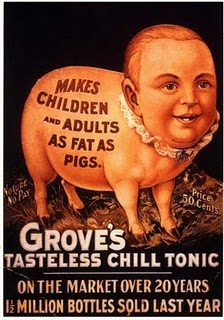
Grove’s brand of tonic also had an incredibly disturbing logo, pictured here. Somehow, I don’t see either the pig-baby logo or the slogan “makes children and adults as fat as pigs” doing all that well in a marketing campaign today.

Perhaps, though, there is a lesson for the modern day to be had from the story of Chill Tonic:

“I had a little drug business in Paris, Tennessee, just barely making a living, when I got up a real invention, tasteless quinine. As a poor man and a poor boy, I conceived the idea that whoever could produce a tasteless chill tonic, his fortune was made.”—E.W. Grove

And make a fortune he did, although while his chill tonic was still in the experimental stage, North Poplar Street neighbors in Paris sometimes became upset with Grove as odors drifted from his pharmaceuticals bubbling in a kettle outdoors. Ironically, some of these families, including the O.C. Barton’s, became millionaires after investing in Grove’s Paris Medicine Company.

Maybe Steptoe and Johnson should stop its war on delicious burgers and try investing in Rogue States instead.

-Susan

This is What a Forged Check for Half a Million Dollars Looks Like

There are quite a lot of scams out there that specifically target law firms. Most of them are variations on the 419 scam, and pretty obvious too boot — such as the business offers from wealthy princes in Nigeria — but apparently there is a slightly more sophisticated version going around right now. Here is a description of the how the scam starts:

The email memo arrives at the law office, and sounds like many others that arrive during the day soliciting legal services. A potential commercial client, albeit located overseas, needs some legal assistance collecting on debts from their customers located in the U.S. They may be willing to pay on a contingency fee basis or hourly basis. They explain that generally their slow paying customers will pay once counsel is obtained in the U.S. and a little bit of pressure is applied. It makes sense, the law firms sends off a client fee agreement and it comes back signed. Later names and addresses, and perhaps telephone numbers of several customers located in the U.S. arrive at the law office. Due diligence performed by the law firm on the internet indicates that the new client is a major manufacturer in Europe or Asia. The web pages of the customers are similarly impressive. A telephone call indicates that the slow paying customer is willing to pay the client via the law firm. The cashiers check arrives shortly. It seems to be a potentially lucrative client for the lawyer.

And apparently a few firms out there have fallen for it, or at least enough for the FBI to see fit to issue a warning about it.

This happened to my firm last week. We were contacted by a potential client who claimed something very much like the above — a foreign company was looking to collect on a Virginia company, and needed to retain counsel. We were immediately suspicious, primarily because it was a foreign client contacting us without a referral, but there was nothing to blatantly mark it out as a fraud. So the firm did respond, and we started up a correspondence with the company.

Of course, just a couple days later it was made abundantly clear that it was all a scam, when the “client” informed us that, after they had emailed the website bios of two of our attorneys to the would-be defendant, the company had been so thoroughly intimidated that that they immediately agreed to settle. For a million dollars. And that a check for the full amount would be arriving shortly.

Yeah, that sounds plausible. Really.

True to the scammer’s word, however, a check did in fact show up in the mail. Not for the full million promised, alas — the check was for just under $500,000. We were soon informed, however, that this was only half of the settlement amount, and that a second check for the rest of the funds was on its way.

But the forgery on the first check was pretty darn impressive:

I’m pretty sure that if I hadn’t known it was a forgery, I wouldn’t have picked it out as one.

-Susan