North Koreans Watch World Cup Live, Results Were Less Promising Than Expected

Ouch. Kim Jong-il must be regretting his decision to allow the first live showing of a North Korean soccer match for the national team’s game today against Portugal.

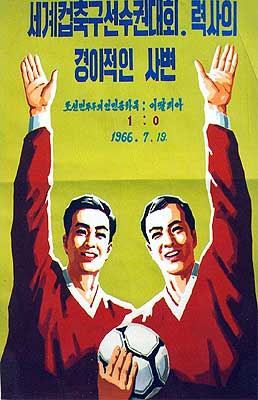
After the Chollima’s rather impressive 2-1 loss to #1 ranked Brazil, and after receiving a lot of praise from startled soccer fans worldwide, the North Korean government must have decided it was safe to allow the game to air in North Korea, un-filtered by the state. Most games, including the match against Brazil last week, are only shown a day or two later, after being safely sanitized for the public’s consumption.

I was only able to watch the first half of the game, after which score stood at a 1-0 lead for Portugal. That was still an impressive result for the Koreans, who were massively outmatched. I was shocked to see the final score sometime later, however: 7-0, for Portugal. Apparently, after I looked away, the game turned into a massive slaughter.

If I had to guess, sometime after the third or fourth goal, the live feed being broadcast to the DPRK got cut. Or I sort of hope it was, anyway. By all accounts, it was an exceedingly painful second half to watch, at least for anyone not from Portugal — and I can only imagine how much worse the reaction was in Pyongyang.

-Susan

American Exceptionalism: So Exceptional That We Are the Only Nation That Realizes Soccer Sucks

There is nothing more boring than Americans who find a personal sense of superiority in their disdain for soccer. Sadly, they are everywhere. Warning: reading these articles may be dangerous to your health, as they tend to induce extreme and uncontrollable episodes of eye-rolling. Particularly so when they start bragging about not understanding soccer. “The rest of the world likes this sport, but I can’t understand what’s going on or why it’s interesting! Res ipsa loquitur, America is better. And smarter. And prettier.”

And then there are the Theories. The convoluted, detailed explanations for both why soccer sucks and why Americans are the only ones capable of comprehending this great truth. All of the soccer haters have Theories:

More than having to do with its origin, soccer is a European sport because it is all about death and despair. Americans would never invent a sport where the better you get the less you score.”

Because the sport itself is so boring, so devoid of action, of physical contact, of life, it falls upon the hyped-up (and in many cases, liquored up) crowd to enact the action that it failed to witness on the field. The patriotic crowd shows up looking for blood, and ends up with a zero-zero tie. Simply put, it is because the sport is so lifeless, that the crowds are so prone to violence.

For sure, there may be a number of reasons that is the case but my suspicion is that the so-called “beautiful game” is not so beautiful to American sensibilities. We like, as good small “d” democrats, our underdogs for sure but we also still expect folks in the end to get their just desert. And, in sports, that means excellence should prevail. Of course, the fact that is often not the case when it comes to soccer may be precisely the reason the sport is so popular in the countries of Latin America and Europe.

Despite the heroic efforts of soccer moms, suburban liberals, and World Cup hype, soccer will never catch on as a big time sport in America. No game in which actually scoring goals is of such little importance could possibly occupy the attention of average Americans. Our country has yet to succumb to the nihilism, existentialism, and anomie that have overtaken Europe.

In fact, if Real Americans were in charge, the World Cup would never be broadcast in America. The media’s coverage of the World Cup is all part of a thinly disguised liberal plot to destroy America, and to force “multiculturalism” down our throats:

Part of the liberal sales pitch for soccer is its popularity with Hispanics. Liberals who fetishize race are eager to adopt a sport with a special appeal for a certain minority, and it would never occur to them that new arrivals to the country might be well served adapting to traditional U.S. pastimes. To the left, it’s America that must change.

Or maybe, as one commenter claims, the reason America doesn’t like soccer is because we already have freedom. Only people without freedom — i.e., the rest of the world — need to use soccer as a substitute for the real thing:

Most of the rest of the world find almost exclusively in soccer, what we enjoy in great measure in real life: Freedom within sound rules to achieve our own goals.

As you can see, it is Very Important to these people that everyone knows how much soccer sucks. Lest someone in this great nation enjoy the World Cup, they must proclaim to everyone the truth: that America is unique among nations in being able to realize that soccer is a deficient and boring sport.

Except there’s a problem with that. America is not, in fact, a special, soccer-scorning snowflake — we aren’t actually the only nation that, every four years, saturates the media with repetitive OpEds on why soccer sucks. Australia is our equal on that front.

And this is from a nation that believes cricket is a thrilling activity. Something is very wrong with that country.

But part of the U.S.’s dislike for soccer (and Australia’s too) is that our soccer teams just aren’t themselves particularly exceptional. Unlike in the Olympics, we aren’t reliably going to wind up on top.

Oh, the U.S.’s squad isn’t bad. And, truth be told, I kind of enjoy the opportunity to cheer for the home team and also be cheering for the underdog. But they’re no Dream Team, so it must be tempting for some sports aficionados to write off soccer as “not important” as a means of excusing the U.S.’s failure to dominate.

But our failure to be Number One isn’t the entire story. For instance, our women’s team is pretty phenomenal, but that has done little to increase the standing of the sport in this country. Of course, that has more to do with a cultural disdain for women’s sports than it does with soccer, but even if the men’s team did the unthinkable and won the World Cup this year, I doubt soccer would become the next big thing here.

Another reason soccer never took hold as strongly here is market saturation. In the States — and also in Australia — there are already plenty of non-soccer sports crowding the airwaves, and there’s little demand for yet another major pro-sports league. Also, soccer is less convenient in terms of advertising opportunities for broadcast tv, so the networks themselves have little incentive to try to increase soccer’s prominence.

Almost certainly, soccer (at least at the pro level) will never be as huge in the U.S. as it is overseas. And that’s okay — plenty of sports in America have a small but viable market presence, and are still respected for what they do offer. But for the Soccer Haters, the idea that soccer might be semi-popular in the U.S. is, essentially, the equivalent of burning the American flag.

As a nation, we really need to get over the idea that there is a special virtue in disliking soccer. If it’s not your cup of tea, that’s fine; I promise that the Liberal Inquisition has no plans on brainwashing you to make you enjoy it.

But your failure to understand soccer says a lot more about you than it does about soccer.

-Susan

Police Raids Conducted on Global Technical, Grosvenor, and Scandec — Will the Magic Bomb Wands Finally Be Stopped For Good?

There has been some good news today: it looks as if Gary Bolton and the rest of the UK Magic Bomb Wand Gang might finally be taken down. Police staged raids on three companies, targeting Global Technical, Grosvenor, and Scandec. Combined with the arrest in January of ATSC’s MD, that amounts to most of the UK’s magic bomb wand market [Edit: But ComsTrac, maker of the Alpha 6, is still out there!]:

Police have raided three companies suspected of selling ineffective hand-held explosives detectors to overseas markets, in a case that raises questions about whether Britain has done all it can to curb the much-criticised trade.

City of London police on Tuesday said they raided five properties and planned to interview a number of individuals as part of an expanding investigation into the sale of the devices, which critics say have endangered lives in Iraq and other countries.

The police action comes after Britain in January introduced a ban on the export of the devices, but applied it only to Iraq and Afghanistan because it said it lacked the power to extend it to countries in which UK and allied forces were not engaged.

The police said they executed five search warrants at premises in Kent, Devon and Nottingham linked to the companies Grosvenor Scientific, Scandec Inc and Global Technical, seizing a large amount of cash and several hundred detection devices and their component parts. A number of people were due to be questioned under caution on suspicion of fraud by false representation and other matters, the police said, adding that they were also investigating whether bribes had been paid to procurement agents in countries in which the probes had been sold.

Thank god. Good work, Overseas Anti-Corruption Unit, but a part of me can’t help but sadly wonder why it took you so long. The OACU said in another article:

“Our suspicion is that they are deliberately manufactured in the knowledge that they don’t work,” Det Supt Cowan says. “They are being sold overseas and we suspect that corruption is in the middle of that process.”

Sorry to be snarky, but “your suspicion” is that? Y’think?

Let’s hear from another expert, as well as Gary Bolton himself, on what exactly those bomb detectors he’s manufacturing are made of:

Explosives expert Sidney Alford took apart the “black box” of the GT200, which is supposed to receive signals from the detection cards.
He was surprised at what he found.
“Speaking as a professional, I would say that is an empty plastic case,” he told us.
Mr Alford also took apart a “detection card” and found there was nothing in it other than card and paper.
Gary Bolton from Global Technical told the BBC that the lack of electronic parts “does not mean it does not operate to the specification”.

It’s pretty safe to infer what Mr. Bolton’s mens rea was here, and it ain’t just willful ignorance.

As for the allegation that there is some serious government corruption going on to explain why so many foreign states have actually bought these useless devices, it’s been pretty obvious from the start that that’s what has been going on.

It looks as if maybe the private sector in Britain has finally realized, too, that the activities of Jim McCormick and Gary Bolton aren’t just a threat to foreign states, but could very much be a danger to Britain’s security and defense industry as a whole:

ADS, the trade association for the UK aerospace and defence industry, said it was “very concerned” that the “isolated case” could cause “unjustified damage to the UK’s hard-earned global reputation as a reliable supplier of world-class and effective products”.

It said: “This one regrettable case should be balanced against the enormous number of positive contributions that our industry has made to our armed forces and to security around the world.”

But this ain’t over yet. When it comes to Global Technical and ATSC, the mere occurrence of a police raid is not enough to ensure that they will be stopped for good.

If you are reading this and from the UK, do me a favor and contact your representative and tell them you want to see follow-through on the prosecution of the fake bomb detector crew. Keep up the political pressure. The ADE-651, GT200, and other devices should be banned from export to ALL countries, not just to Iraq and Afghanistan. As an initial matter, banning the export of dangerous devices solely to countries where British troops might be is pretty sick. But also, it’s completely ineffective. These bomb wand companies have foreign distributors all over the place, and it is no trouble for them to route the “bomb detectors” to Iraq or Afghanistan through other pathways.

Back in January, the British police arrested Jim McCormick, and I thought then that there would finally be a stop to this madness. But they let him out on bail, and Jimbo went right back to business as usual, opening up a new and improved version of the ATSC, Ltd. website, just as ready to sell fake bomb detectors as he was before. Despite the arrest, nothing happened, except ATSC got a new distribution network set up in Romania.

And now, in response to the raids earlier today, a UK agency has this to say, to excuse its complete failure over the past decade at stopping the fraudulent bomb detectors:

The Department for Business defended its earlier decision to impose only a geographically limited export ban on the ADE-651 and similar devices, describing the response as “proportional and appropriate at the time”. It added that it had notified other governments about its concerns.

What a load of self-serving rubbish. The Department of Business allowed the snake oil merchants to carry on with their activities, and by doing so, contributed to further death and injury around the world. There is absolutely no reason why the UK’s response should be more forceful now than it was in January — other than a couple dozen more deaths in developing countries around the world, there has not been any change of circumstances that would justify putting more extensive bans in place now that wouldn’t have justified putting the bans in place then.

For that matter, in case anyone in the United Nations Procurement Department is reading this, there’s a lesson here for you as well:  get off your butts and take Global Technical off your vendor list! For gods sake, Global Technical has a shiny “UNITED NATIONS REGISTERED” icon on its page. That might carry a lot of weight with potential customers who check out the GT200’s webpage and see that.  It needs to go, now — there’s no excuse for why they slipped onto your supplier list in the first place, but it’s time to fix the mistake.

-Susan

Rush Limbaugh, Stalwart Defender of Marriage Rights

Until today, I had never realized that Rush Limbaugh believed so strongly in marriage rights. But he showed how mistaken I was about his beliefs, when, yesterday, he celebrated his right to get married for the fourth and (potentially) final time. This was a bold move for Rush to make; by doing so, he took a strong stand in the name of the many rights that he believes all Americans are entitled to. These rights include:

(1) The right to get married, even though traditional values forbid it, or, at a very minimum, find your fourth “marriage” to be an example of moral depravity and an indication of underlying character flaws. So what, you’ve screwed up before. You’re a flawed person, everyone is. But now you have found someone you love, and you think this time you can get it right. Some people may call it immoral, but to you, it’s just love.

(2) The right to get married, and to have the state recognize your marriage even if certain religious traditions prohibit it. It is irrelevant that someone’s version of the Bible says that you are a sinner, and that your union is not recognized by god. Who cares if god recognizes it? You just want the state to.

(3) The right to get married, even if a lot of the public finds the idea of you and spouse getting married to be really kinda icky. Some people might object to your marriage, because, for a large segment of the population, the thought of your sex life makes their skin crawl. Too bad — if it grosses them out, they should just try not to think about it. The fact that you make them squeamish is not a valid reason for denying you the right to marry the one you love.

(4) The right to get married, even if by doing so you are setting a disturbing example for the nation’s children. By divorcing three times and marrying for a fourth, you are teaching children that marriage is a temporary and discardable institution, and that it is not a commitment to be taken seriously. Even if you are setting a terrible example, it’s not your problem. Although some parents may not want their children to emulate you and what they believe is your sinful behavior, that is not a valid reason for denying you the right to live your life in the manner you believe is best for you.

(5) The right to privacy, and to have marriage be a personal decision that is not regulated by the state. Rush has always believed that the federal government should not meddle in our personal affairs. It would be morally wrong if the government prohibited people from marrying more than three times, and, luckily, the government has not tried to regulate that yet. Additionally, Rush has firmly declared his right to privacy regarding his choice to get married. As he wrote in an email to the media, “We try to live our lives as normal people. We do not seek media attention. We do not want it, especially for this.” You tell them, Rush. This is your personal life — who do they think they are, trying to get involved in it?

    I wish the happy couple all the best. Their dedication to marriage rights is an inspiration to us all.

    -Susan

    Does the May Jobs Report Show Unemployment is Down and the Number of Jobs Has Gone Up? Think Again.

    The May Jobs Report was released today, and on the face of it, it indicates that 431,000 new jobs were created last month. Although this number was somewhat of a disappointment, as it did not show as much growth as had been estimated and hoped for, the result of the report was a flurry of media articles trumpeting that “May brings 5th straight month of jobs growth” and “U.S. adds jobs in May”, although, to be fair, the exuberance of these articles was tempered somewhat with somber commentary on the modest increases in private sector employment.

    But a closer look at the May jobs report shows a situation deeply more concerning than what the media is describing. (Alas, the stock market isn’t falling for the spin either, it seems.)

    Breaking the establishment report down, which is the source of the BLS’s number proclaiming job growth, we see the following:

    Total Increase in Jobs: 431,000.
    Total Government Job Increase: 390,000
    Total Private Sector Increase: 41,000

    But wait. We added a total of 411,000 census jobs in May — which means we actually lost 21,000 non-census government jobs. (Which means, not counting census jobs, there was only a net increase of 20,000 jobs total.)

    And it gets worse. In the private sector, the largest growth was found in a category called “temporary help services,” with an increase of 31,000 jobs. Perhaps this is merely reflecting a May increase in summer jobs that will be gone again in August, such as camp counselors and resort employees? At any rate, it is not a strong indication of job market stability.

    On the other hand, the unemployment rate at least has been reported as being modestly optimistic, falling from 9.9% to 9.7%, as shown in the household survey. It went from 15,260,000 unemployed in April to 14,973,000 in May, for a total swing of -287,000 unemployed persons. That’s good news, right?

    Not so fast.

    These two statistics — the decrease in unemployment and the increase in jobs — come from entirely different surveys. The figure showing a growth in jobs was taken from the establishment survey, while the May Job Report’s conclusion that there was a decrease in the unemployment rate comes from the household survey.

    But while the household survey does show a decrease in unemployment, but it also shows a decrease in total employment as well. In April, the household survey found 139,455,000 employed persons. In May, it found 139,420,000, i.e., it found a decrease in total employment of 35,000 persons. How is it possible for the survey to show both a decrease in jobs and decrease in employment, you might ask? Because it also found a decrease of 322,000 in the overall civilian labor force.

    Looks like there’s been some statistical cherry-picking here. Favorable numbers from each survey have been reported, and the unfavorable ignored.

    The discrepancy between the two reports can be explained in part because the two use different methods, and count slightly different types of data. For instance, the household survey looks at employed persons, while the establishment survey looks at number of employment positions on the payrolls, so a person with two jobs shows up once on the first survey, but gets counted twice on the latter.

    But the discrepancy between the two surveys is better explained by the fact that the alleged “increase” in jobs or “decrease” in unemployment are in fact meaningless, nothing more than statistical phantoms. As the BLS report states,

    BLS analyses are generally conducted at the 90-
    percent level of confidence.

    For example, the confidence interval for the monthly
    change in total nonfarm employment from the
    establishment survey is on the order of plus or minus
    100,000. Suppose the estimate of nonfarm employment
    increases by 50,000 from one month to the next. The 90-
    percent confidence interval on the monthly change would
    range from -50,000 to +150,000 (50,000 +/- 100,000).
    These figures do not mean that the sample results are off by
    these magnitudes, but rather that there is about a 90-percent
    chance that the “true” over-the-month change lies within
    this interval. Since this range includes values of less than
    zero, we could not say with confidence that nonfarm
    employment had, in fact, increased that month.

    At an unemployment rate of around 5.5
    percent, the 90-percent confidence interval for the monthly
    change in unemployment as measured by the household
    survey is about +/- 280,000, and for the monthly change in
    the unemployment rate it is about +/- 0.19 percentage point.

    Full disclosure: I haven’t taken a course that required me to do math since freshman year of college, let alone taken statistics. So I can’t comment too deeply on what’s going on here.

    But it looks to me like the May Job Report is largely a wash. Most of the increases or decreases are just a chance fluctuation, not a reflection on any actual underlying change in the data.

    The BLS report also states that “An over-the-month employment change of about 100,000 is statistically significant in the establishment survey, while the threshold for a statistically significant change in the household survey is about 400,000.” [Note: I’m assuming by statistically significant they mean the odds of it being meaningless are the usual 1-in-20 figure? Which is why these numbers don’t quite match up with the previous quote, which used a 1-in-10 figure.]

    So remember that net change in the employment rate of 287,000? Yep, turns out that doesn’t mean anything. There has been no actual decline in unemployment, as far as is shown by the BLS’s May Jobs Report — and ignoring the minor blip upwards in unemployment rates that happened in April, we’ve had essentially stagnant unemployment rates for all of 2010 so far.

    As for the establishment survey, true, the increase in jobs that it found is significant. But remember — 411,000 of the new jobs were from census positions, which will evaporate once the census is over. And that 41,000 uptick in private sector jobs? Illusory. This survey does not demonstrate any net increase in private sector jobs; the most positive thing that can be said about it is at least it doesn’t necessarily mean there’s been any decrease, either.

    Moral of the Story: If it were not coincidentally that time of the decade for the census, we would have zero job growth right now. Take out the census, and we only “gained” 20,000 jobs in May — a statistically meaningless number, under either of the BLS’s surveys.

    -Susan

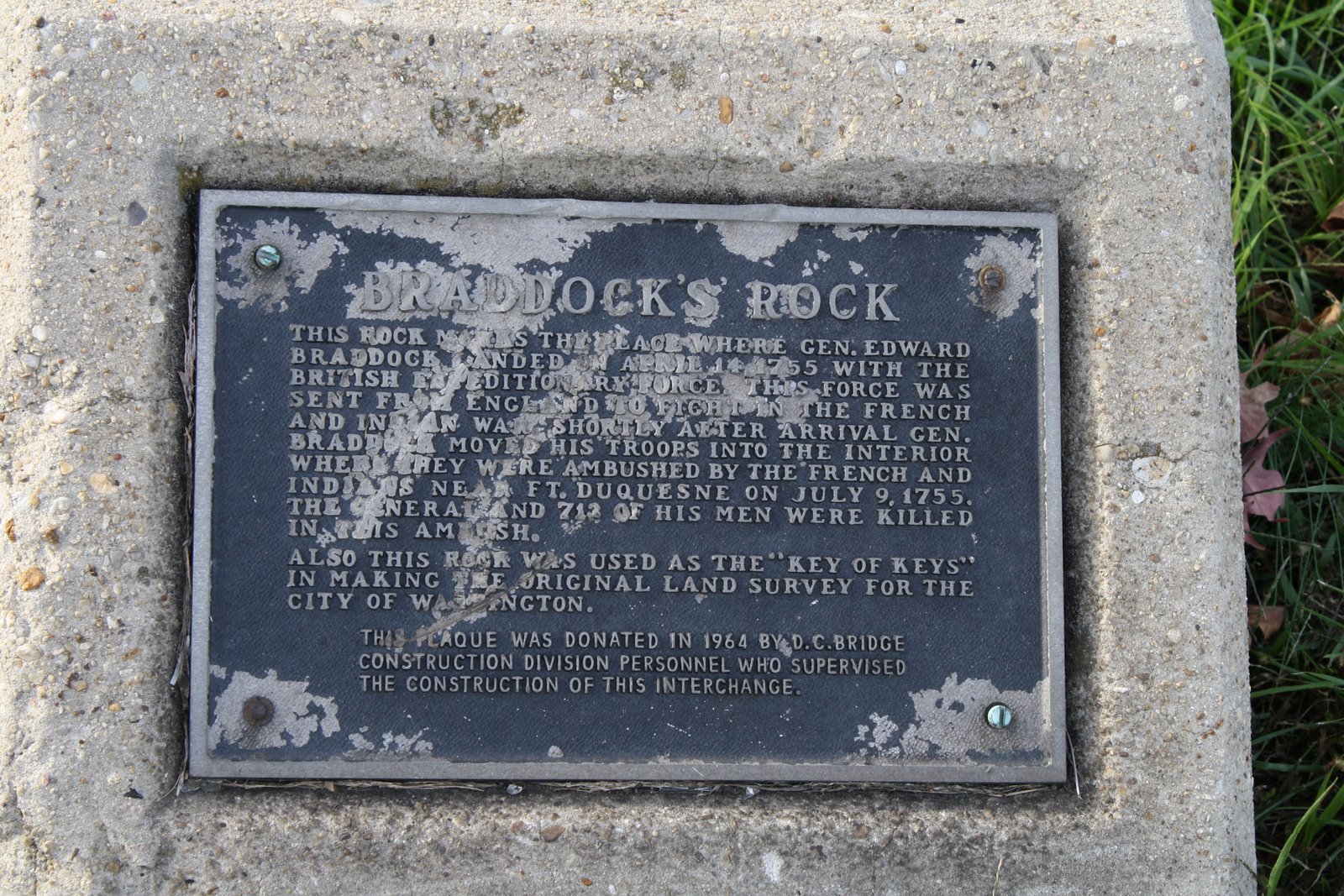
    Braddock’s Rock: The Key of All Keys, at the Bottom of a Well

    If you head across the entrance ramp to the Roosevelt Memorial Bridge,
    going along US 50 across to Virginia
    , if you look out the driver’s side window you can see an unassuming circular rock structure. It looks like it might just be nothing more than a sewer cover, but the little plaque in front of it suggests otherwise.

    For a few years now, I have wondered what the heck this thing is. I thought it might be some sort of historic site, but not one I had ever heard of, and not one I was able to find any information on. But I drive by this area a lot, and pretty much every time it I saw it, it bugged me that I didn’t know what it was.

    I did try Googling variations of, “round stone historical marker on US 50 just before Roosevelt Bridge,” but to no avail. A few times, while out playing softball near Lincoln, I have considered slipping away from the game to get a closer look. The rock is in an awkward spot, though, with no foot paths and a busy road with no crosswalks in the way, and I never got around to it.

    Braddock's Rock, as seen from Google Maps

    I was wondering about the rock again today, for no particular reason, and thought I would try to look it up on Google Earth. I hit pay dirt. Someone had taken a photo of the monument, labeled it, and linked it up to the spot on Google Earth where its located. Turns out, this is the marker for Braddock’s Rock, a memorial that pre-dates even the existence of the United States. An excellent compilation on the history of Braddock’s Rock can be found here, in the 1899 edition of The American Monthly Magazine.

    Braddock’s Rock got its name in commemoration of the landing of General Edward Braddock, at the beginning of his march to Fort Duquesne in 1755. [Spoiler Alert: It didn’t go well for him.] According to legend, anyway, the fleet carrying Braddock’s army — which included a young soldier named George Washington — tied up on the rock when it set up camp alongside the shore of the Potomac, while on its way to the Battle of the Monongahela.

    No, Braddock’s boat was not tied up to the round stone outcropping depicted here. Rather, Braddock’s Rock is located some 16 feet below, down at the bottom of the well and usually under a few inches of water. In 1755, however, this now submerged rock was in fact a notable outcropping, and “[t]he water, at the time of Braddock’s ill-fated expedition, was so deep that his vessels landed the troops at what was known as the ‘Big Rock,’ at the foot of ‘Observatory Hill.” As one account of Braddock’s Rock has it,

    Alexandria, then a colonial village, eight miles down the Virginia side of the Potomac, was the recruiting point of Braddock’s Army… [As the fleet headed up the river,] Braddock himself, with his own personal retinue, got separated from the remainder of his party and landed on this side of the river opposite Analostan Island [note: now known as Theodore Roosevelt Island], at what is now the foot of Twenty-fourth Street, Northwest, then a stretch of woods. Braddock’s vessel was drawn close up to shore and moored to a big boulder protruding from the bank[.]

    And another account:

    Braddock’s Rock is upon the site occupied by the British and provincial troops in April, 1755. The British troops landed here from their transports, the ‘Sea Horse’ and the ‘Nightingale,’ and here pitched their tents on April 14, 1755. It is a matter of tradition that Washington, then an officer of Virginia colonial troops, and later aide-de-camp to Braddock, was camped also on this very hill, and was so impressed with the beauty of the site and of the surrounding country that he was subsequently led to choose it for the location of the National Capital. This is the very spot which he, in 1796, designated as the location for the University of the United States.

    Braddock’s rock has been known by this name ever since the time of Braddock’s departure, and is still so known by old inhabitants of the vicinity, among whom are several who remember when it was touched by the waters of the Potomac, since diverted farther southward[.]

    Although there is some debate about how much truth there is to the legends of Braddock’s mooring, the rock predates the failed Braddock Expedition, and has been mentioned in historical writings from as early as 1632. Early accounts of the area described it “as a large rock lying at and in the river Potomack,” and it was commonly labeled on maps as the “Key of All Keys.” The promontory was also used as a starting point for surveys establishing property lines for early settlers along that stretch of the Potomac.

    The construction of Washington, D.C. marked the beginning of the end of Braddock’s Rock. The stone outcropping was a convenient source of rock for building the Capital, and in the early 1800’s it was blasted away:

    It is said to have furnished stone for the foundations of both the White House and the Capitol. Later, stone from Braddock’s Rock was used in the construction of the Chesapeake and Ohio Canal. About 1832, when the canal was extended below Georgetown to connect with the Washington City Canal, nearly all that was left of the original outcrop of Braddock’s Rock was blasted away. The riverside swamps have long since been filled and the land raised above the level of the original surface. All that remains of Braddock’s Rock can still be seen enclosed in a circular granite-lined well south of the grounds of the old Naval Hospital, amidst the approach ramps to the Theodore Roosevelt Bridge.

    What little remained of Braddock’s Rock was left standing when the Roosevelt Bridge was constructed. Although very few people will ever see it, a marker now sits next to it, giving a brief account of submerged rock’s historical significance:

    The Memorial Plaque at Braddock's Rock

    The Braddock’s Rock plaque is wrong, though. Braddock’s expedition wasn’t ambushed, they just got the snot kicked out of them. Braddock died four days after the battle, and only 456 of the British troops were killed. (Also, I know I’m being nitpicky, but saying “his men” were killed is also misleading. About 50 women marched with the expedition, too, and over 90% of them did not make it back alive.)

    -Susan

    North Korea Officially World’s Worst Place To Watch the World Cup

    Things are not looking good for North Korea’s football fans.

    After qualifying for the World Cup for the second time ever, and for the first time since 1966, the North Korean squad’s prospects took a nose dive when the draw for the tournament put it in the same group as Brazil, Cote d’Ivore, and Portugal — a.k.a. the Group of Death.

    And now North Korea might not even be able to watch the World Cup, as South Korea is threatening not to broadcast the games to the North:

    As part of a policy to improve ties with Pyongyang, [in 2006] the South Korean government picked up the bill for national broadcasters to relay live transmissions of the matches into the North.

    Since then, North Korea has conducted two nuclear weapons tests and shot a South Korean tourist in the back. Many here also suspect the North may have attacked a South Korean warship, the Cheonan, killing 46 sailors.

    Now that South Korea has concluded that North Korea is responsible for the attack on the Cheonan, North Korea’s access to World Cup broadcasts is likely in even greater jeopardy. The Cheonan, a South Korean warship, sank on March 26, with the loss of 46 lives. Serial numbers on the torpedoes that were recovered from the wreckage of the ship have since been identified as originating from North Korea.

    Even had North Korea managed to refrain from attacking its only source of World Cup coverage, however, it was already unlikely that the average North Korean citizen would have the opportunity to watch any of the matches. Kim Jong-il has already declared that games will not be shown live, and only footage from games which North Korea wins will be shown at all.

    As it turns outs, this means that whether or not South Korea is willing to broadcast the World Cup to North Korea is probably a moot issue. The North Korean team — nicknamed the Chollima, after Korea’s version of the Pegasus — is something of an underdog, facing (rather generous) odds of 350-to-1 against them winning the tournament. North Korea’s placement in the Group of Death, which means they will face Brazil (ranked #1), Portugal (#3), and Cote d’Ivore (#27) in the opening rounds, makes it extremely unlikely that they will win even a single game.

    North Korean citizens hoping to catch the World Cup won’t have the option of seeing it in person, either, thanks to North Korea’s policies regarding border security. It would not look good for North Korea, however, if it no fans showed up at its games. This presents Kim Jong-il with something of a problem: how can North Korea make sure it has supporters in the bleachers when the team heads down to South Africa?

    Answer: Buy them.

    Few North Koreans will be able to cheer their team at the World Cup in South Africa. So the country is recruiting 1,000 Chinese fans.

    The Beijing office of the North Korean Sports Committee is giving out tickets to the tournament, China’s state-run Xinhua News Agency reported.

    The Chinese fans will attend North Korea’s games against Brazil and Portugal, Xinhua said.

    Rather than watching the World Cup, North Koreans hoping to watch some soccer this summer may have to settle for Centre Forward instead. You can watch the the trailer for the movie on YouTube here, and see why critics have declared Centre Forward to be “the best North Korean football-themed movie of all time.”

    -Susan

    Arizona’s Ban on Ethnic Studies Doesn’t Actually Ban Anything

    When I first heard talk about Arizona’s HB 2281 — a.k.a. the anti-ethnic studies bill — I couldn’t decide if the law banned a majority of all social science classes, or if it banned nothing at all.

    After getting a chance to read the bill’s text, however, I think it’s clear that the answer is almost certainly the latter. The law is too vaguely written for it to be anything other than a disorganized attempt at populist rabble-rousing, resulting in a bill that lacks any teeth and has no actual legal effect.

    But saying that the bill has no real effect is not the same as saying that the bill is harmless. Chicken Little laws are not something to be encouraged, particularly where they invoke racial bogeymans that do not exist outside of legislature’s minds.

    Look, no one involved in passing HB 2281 is making a secret of what this bill is really trying to prohibit: a hypothetical high school class intended for Hispanic students which tells them to blame their problems on the people whom are euphemistically referred to today as “Real Americans.” That such a class does not actually exist is, apparently, an unimportant consideration.

    Tom Horne, the bill’s champion, is quite open about the fact that he is specifically attacking Latino studies courses. Although the Tuscon school district also offers courses in African-American studies, Native American studies and Pan-Asian studies, Horne claims he is not (yet) trying to get rid of those — Horne says that he’s studying those classes now to see whether they can stay, but that he “felt he [already] knew enough about Mexican-American studies” courses to advocate for their elimination. (As an Agnes Scott grad, I suppose I’ll just be grateful he hasn’t yet decided to target women’s studies.)

    Some people have argued there is an inequity in the fact that Arizona offers all these ethnic studies courses, and yet doesn’t offer “European-American studies.” The reason that class doesn’t exist, of course, isn’t because of some anti-European-American sentiment, but because in the context of American school curriculums today, a European-American course simply wouldn’t have any academic value; a majority of humanities courses are already approached from a predominantly European-American perspective, so there is nothing new to be gained from magnifying that focus even more.

    On the other hand, there are plenty of universities overseas that offer American studies classes, a course offering that is completely appropriate given that “American culture” is not the predominant theme of the rest of those universities’ curriculums. I’m sure Tom Horne or other supporters of the Arizona bill don’t find it objectionable that foreign schools offer courses in American studies, so why is it objectionable to offer studies of foreign cultures here in States?

    The ethnic studies courses in Arizona come in a variety of forms — there are offerings in history, sociology, and literature. As with all humanities or arts courses, these classes have selected a particular narrow segment of human civilization for special scrutiny. The usual theme in ethnic studies courses is a focus on a given subset of the population with common traits and historical backgrounds, be it a race, a nationality, or a culture. The courses then pick out relevant people, events, or books related to that category, which the students are then expected to learn about, discuss, and then do typical high school class tasks such as “analyze the unifying themes” or “identify similarities between the authors.” It’s not exactly rocket science, no, but it is a useful academic enterprise.

    Selecting “Latin American literature” as the lens through which the art of writing will be examined is no more or less legitimate than selecting “modern literature” or “Middle English literature” or “Shakespeare.” Selecting “African-American history” as the lens through which some segment of American history is to be examined is no more or less legitimate than selecting “history of American cuisine” or “history of the women’s movement” or “history of the Oregon Trail.” Ethnic studies classes simply are not different from other humanities courses in any manner which could create a legitimate government interest in banning them without banning all other humanities courses to boot.

    Luckily, however, the Arizona bill doesn’t actually ban anything at all. Ethnic studies courses are not in jeopardy in Arizona, or at least they aren’t threatened by HB 2281.

    Let’s take a look at the text. The law states in its Declaration of Policy that:

    The legislature finds and declares that public school pupils should be taught to treat and value each other as individuals and not be taught to resent or hate other races or classes of people.

    Ignoring the gratuitous use of political buzzwords, this isn’t too objectionable. Valuing individuals is good. Hatred is bad. Courses that teach the opposite don’t actually exist, but sure, why not, let’s prohibit them, just for funsies.

    After the O&P, we get to the actual prohibitions of the bill:

    A. A school district or charter school in this state shall not include in its program of instruction any courses or classes that include any of the following:

    1. Promote the overthrow of the United States government;

    Again, there is nothing particularly objectionable about this law, save for the fact it is tilting at windmills. Advocating the overthrow of the government already puts you on rather shaky First Amendment grounds, not to mention that First Amendment rights in public schools already can be restricted based upon legitimate pedagogical concerns — and those who fund public school systems can legitimately object to teaching that they should be overthrown by coup — so I can’t say I really disagree with this clause. But it doesn’t actually do anything, because no course in Arizona, or in all of the U.S., actually promotes such a thing.

    Just to be sure, however, I did go look for evidence of a case where a public school was advocating for the overthrow of the U.S. government. The closest I could find on all the interwebs was this video here. This video features a dude who is a teacher who is speaking on some steps somewhere, and he apparently has a crush on Che Guevara. However, he is speaking at night, so he is obviously not teaching public school course of any sort. Whether or not you believe that people who share the dude’s views on Che Guevara should be allowed to be public school teachers, this law would do nothing to address the issue either way.

    2. Promote resentment toward a race or class of people;

    I would love to see a court try to handle this section of the ethnic studies bill. How on earth do you ban middle and high school courses that “promote resentment?” That’s what middle schoolers and high schoolers do. They are essentially jackals that have acquired the rudimentary elements of speech; they spend their days resenting stuff and hating stuff, no matter what courses they are in. Gym makes them resent gym teachers and peers that are more athletic than they are. Calculus makes them resent Newton. English lit makes them resent the fact that Chaucer couldn’t just speak normal English like everyone else does. It can’t be helped.

    On a more serious note: how do you teach WWII without teaching students to resent or hate those who carried out the Holocaust? How do you teach the Civil War without promoting “resentment or hate” for the ideology that believed one human could own another? How do you teach about the suffrage movement without promoting “resentment” for those who believed two X chromosomes made you unqualified to vote?

    Unless Tom Horne has the balls to come out and actually re-phrase the law so that it specifically prohibits teaching student about anything bad that any white Europeans or Americans may have ever done to any Native American or Latin American, the Arizona statute is meaningless. This legislation cannot actually address the “problems” its framers are claiming its supposed to fix, or at least the bill cannot do so without simultaneously prohibiting the teaching of most of global history.

    3. Are designed primarily for pupils of a particular ethnic group.

    The Federal Constitution already prohibits any real problem that this portion of the law is aimed at, so it’s more or less redundant. Once again, I don’t agree that the problem is real, but to whatever extent this is an actual issue, I’m fine with the Arizona legislature prohibiting it. The greatest value to be had from any ethnic studies course is the same as it for any other humanities course — that is, exposing students to ideas and knowledge they had not encountered to before. An ethnic studies course designed only for students already of that ethnicity is needlessly crippling itself.

    4. Advocate ethnic solidarity instead of the treatment of pupils as individuals.

    This portion of the law would target subjects its framers never intended to. Any sort of pro-America message could conceivably be prohibited — because, after all, nationalism does not advocate the individualism of every special snowflake, but advocates a unity based upon shared passports.

    Not to mention, teaching “Asian studies” does not advocate “Asian solidarity” any more than “Philosophy of the Enlightenment” might advocate “Rationalist solidarity.”

    But all of the above aside, any potential bite that the prohibitions in the Arizona law may have had is completely eviscerated by parts E & F of the bill:

    e. This section shall not be construed to restrict or prohibit:

    1. Courses or classes for Native American pupils that are required to comply with federal law.
    2. The grouping of pupils according to academic performance, including capability in the English language, that may result in a disparate impact by ethnicity.
    3. Courses or classes that include the history of any ethnic group and that are open to all students, unless the course or class violates subsection a.
    4. Courses or classes that include the discussion of controversial aspects of history.

    f. Nothing in this section shall be construed to restrict or prohibit the instruction of the Holocaust, any other instance of genocide, or the historical oppression of a particular group of people based on ethnicity, race, or class.

    Pay special attention to e(4) and f. Because e(4) does not contain the “unless the course or class violates subsection a” language which is specifically enumerated in e(3), it very likely that e(4) would be interpreted to offer a blanket exemption for courses which include controversial aspects of history. As if that wasn’t clear enough, section f goes on to explicitly exempt from the prohibition the study of the Holocaust or any other oppression of a particular class of people. That pretty much gives a pass to every ethnic studies course in Arizona that doesn’t happen to be calling for a revolution. Which is, well, all of them.

    -Susan

    One Latin Cross in the Desert, Protected by the Extraordinary Efforts of Congress

    Salazar v. Buono [PDF] has been released — and the Sunrise Cross gets to stay.

    A Kennedy-Alito-Roberts plurality found that the lower courts were in error when they found that the Government’s transfer of the land to a private party was not permissible. I’ve only been able to read over the plurality and concurrences, and Breyers’ dissent, but here’s my initial take on it.

    Kennedy, writing for the three, is almost convincing. I’m not even sure I disagree with the legal analysis. But the factual findings that form the underpinnings of Kennedy’s argument — that no act of religious endorsement has occurred here — are not credible. Kennedy spends a great deal of ink arguing that legislation passed by Congress to protect an unconstitutional establishment of the Christian religion was not in fact religiously motivated. Instead, he insists, this was all a secular misunderstanding — Christianity is not even implicated here, it’s just a war monument! The message conveyed by the cross, and Congress’ decision to save the cross, “assessed in the context of all relevant factors,” signifies only respect for veterans, not respect for Christian sentiment. “One Latin cross in the desert,” Kennedy concludes, “evokes far more than religion.”

    I’m not buying it.

    Anyone who believes that that the extraordinary lengths undertaken by Congress to preserve the Sunrise Cross were motivated by anything other than a desire to protect Christian symbolism is being deliberately myopic. Would Congress have ever gone to similar lengths to protect a Wiccan alter on Federal land? No. Never. And if anyone else out there thinks otherwise, well, I’ve got some CDOs backed by subprime mortgages I’d like to sell you.

    But, to be fair to Kennedy, it’s true that Congress’ decision to transfer the cross to private land, taken by itself out of context, does not pose much of a threat to the Firth Amendment. But it is less the transfer itself, and more the institutional bias towards the protection of Christianity, that is the true problem here. That is where the government endorsement of religion comes from; that is what the harm under the Establishment Clause lies. As a legal matter, I have a hard time finding too much fault with Kennedy’s opinion — but I also believe there is a violation of the spirit of the Constitution here, even if not the letter. The single disputed act at issue in Buono might not mean much, but set into the cultural and institutional history of the United States, it is part of a widespread pattern and practice of religious establishment. Although Kennedy’s opinion focuses extensively on taking the Sunrise Cross “in context” of the surrounding circumstances to find that it is not really a religious symbol, Kennedy completely ignores that taking Congress’ efforts to preserve a cross “in context” with Congress’ wider history of religious protection shows a government whose religious preferences are at the heart of its decision.

    The abstract and non-concrete nature of the harm caused by the cross under the Establishment Clause, Chief Justice Roberts, in his one page concurrence. Roberts thinks that there is no dispute here that is worth the Court’s consideration, as it is all a dispute over symbolism and vague feelings of hurt, and not a dispute over any concrete, non-symbolic injury. As the Constitution “deals with substance, not shadows,” there is no First Amendment problem to speak of. And to a certain extent, I actually agree with Roberts’; the shadow-problems in Buono are not so much about a specific substantial and obviously unconstitutional violation of the First Amendment, but rather about pervasive governmental effort to protect shadows of Christianity over the shadows of all other religious beliefs.

    Alito’s opinion irks me the most. It is full of sentimental claptrap and light on legal reasoning. He uses heartwarming anecdotes to suggest that, because America is so wonderful and tolerant of diverse religious practices, there is no harm in giving the Government a little slack when it comes to showing a tiny bit of bias for Christianity. To do otherwise, he argues, would be “interpreted by some as an attesting symbol of a Government that is not neutral but hostile on matters of religion.”

    No, Justice Alito. It would have been interpreted by the voters of many Congressional districts to show a government hostile not to religion in general, but a government hostile to Christianity in particular. And hostility to Christianity is not an electorally popular platform.

    The First Amendment, however, does not permit the Government to engage in protection of religious symbolism that happens to be favorable to a Representative’s chances of reelection, while simultaneously declining to protect those religious symbols for which protection would be politically harmful or neutral.

    But Alito seems to think the fact that protecting crosses is so popular means it cannot be religious favoritism. “It is noteworthy,” he writes, “that Congress, in which our country’s religious diversity is well represented, passed this law by overwhelming majorities: 95-0 in the Senate and 407-15 in the House.”

    The whole point about having a Constitution, though, is that the popularity of a given legislative act is entirely divorced from whether or not it is constitutionally permissible. Not to mention, the idea that “religious diversity is well represented in Congress” is so laughable, I won’t even bother to debunk it here; there are plenty of other sites that have already taken care of that.

    In the end, it is the concurrence of the Scaliomas that comes closest to winning me over. While regretfully noting it would be a shame for the litigants to come all this way only for the Court to be unable to hear the dispute on the merits, their opinion would resolve the case on standing grounds alone. The harm to the plaintiff, they argue, is the presence of the cross on Federal land. The cross is no longer on Federal land. Ergo, no Article III case or controversy and no Supreme Court jurisdiction.

    Scalia argues that the real harm being argued in this case, the harm that the parties and the other Justices are focusing on, is the harm in having Congress selectively protect Christianity. However, Scalia points out, that harm is not the harm the original injunction addressed, and the injunction cannot expand. Because Buono initially claimed injury as a result of the cross’s presence on federal land, he cannot now argue before the Supreme Court that he is injured instead by Congress’ religious favoritism in passing the Sunrise Cross act.

    But in counterpoint to that argument, Breyers, too, limits his analysis to whether or not the injunction had been properly interpreted by the District Court. Unlike the Scaliomas, however, Breyers finds that the District Court was well within its rights to find that the Government’s actions violated the injunction that had been in place. Although I’d want to spend more time with it to make up my mind, right now I am definitely leaning towards Breyers on this one. True, my knowledge of injunction jurisprudence is pretty limited, so this based mostly on the premise that “parties should not be allowed to engage in creative subterfuge and sketchy dealings to avoid injunctions.” But as made-up legal doctrines go, that’s a pretty sound one to follow.

    -Susan