Despite the Suggestions of Financial Lobbying Groups, the Jurisdictional Basis of the Derivates Bill Is Not Particularly Questionable

Initially I thought this article, Derivatives bill could have international impact, might be interesting, because I’ve sort of been following the international jurisdictional issues that have popped up in the wake of the financial crisis. And that is what it pretends to be about:

Proposed legislation to regulate the $450 trillion privately-traded derivatives markets in the U.S. may allow regulators in the country to extend influence beyond their own borders, by setting capital levels for international banks in their home countries.

But the story is all smoke and no fire. “Extending influence beyond borders” is not, without something more to it, in violation of any principle of international law. So what exactly is the potentially improper legislative act that ‘industry groups’ are complaining about?

Some of the regulatory bills being proposed in the United States, however, have raised concerns among international banks they could allow U.S. regulators to impose capital requirements on European banks that operate in the country, on top of rules planned for the continent.

“The potential extra-territorial effect of this legislation has been an industry concern,” said Paul Forrester, partner at law firm Mayer Brown in Chicago.

International banks and industry groups want terms to be included in the legislation that would exempt overseas banks that are subject to comparable capital requirements in their home jurisdictions from also needing to meet U.S. rules.

So the complaint is, essentially, that “banks that operate overseas and also operate in the U.S. should not have to comply with U.S. rules because they also operate abroad.” Not very compelling stuff. U.S. banks also operate in the U.S. and abroad, and I am not sure if there are any proposals to give U.S.-based banks a break from European derivatives regulations.

There is no international legal objection for the derivatives bill’s planned regulation of foreign corporations that operate in the United States. The existence of prescriptive jurisdiction to regulate foreigners who are located on your territory and doing business is pretty straight forward, and as far as I’m aware, there is no true conflict alleged that would cause any domestic legal problems under Hartford Fire. And as far as policy goes, a regime in which corporations are regulated only by their nationality is not more coherent or desirable than a regime in which corporations are regulated by the laws of the state where they operate. To be overly simplistic about it, the former has a much greater risk of misallocating externalities than does the latter, as if a state’s laws are too restrictive or if they cause to much interference with transnational business operations, business will simply stay elsewhere.

-Susan

One Prerequisite For Being a Totalitarian Dictator Is a Failure to Comprehend Dramatic Irony

The Copenhagen Summit is a complex geopolitical issue, one deserving of critical thought and a careful consideration of the viewpoints of all the parties involved. And where better to find such a nuanced discussion of the topic than an op-ed article written by Fidel Castro?

As television channels have broadcast the footage, the world has been able to see the fascist methods used against the people in Copenhagen. The protesters, young people in the main, who have been repressed, have earned the solidarity of the peoples.

The young people in the main later told reporters, “Come and see the violence inherent in the system!”

Despite the manoeuvres and unprincipled lies of the leaders of the empire, the moment of truth is drawing closer. Their own allies are increasingly losing confidence in them. In Mexico, as in Copenhagen or anywhere else in the world, they will be met by the growing resistance of the peoples who have not lost the hope of surviving.

I’m not certain of it, but I suspect that Castro copied that last paragraph directly out of Les Misérables.

-Susan

Settlers of Catan is the New Golf

The Wall Street Journal had an article today on tech industry executives socializing over cut-throat games of Settlers of Catan: An Old-School Board Game Goes Viral Among Silicon Valley’s Techie Crowd.

I object a bit to the article’s title — can a board game that came out only in 1995 really be described as old school? — but entirely approve of its subject.

Auren Hoffman, chief executive of search start-up Rapleaf Inc. (no relation to LinkedIn’s Mr. Hoffman), regularly hosts Settlers shindigs at his San Francisco home. He recently held a Settlers night with Internet company StumbleUpon Inc. Facebook Inc. was scheduled to hold its own Settlers tournament on Wednesday, its second of the year. Mark Pincus, CEO of social-gaming start-up Zynga Game Network Inc., says he plays Settlers at his company as a way to meet new employees.

“Settlers is definitely the new live networking for our crowd,” says Mr. Pincus, whose start-up makes online games such as FarmVille. “It’s like our kind of golf game — none of us have time to play 18 holes of golf, but we can handle a pizza and a board game.”

I’m not sure that last statement is accurate, as, to be fair, I’ve had rounds of golf that were shorter than some Catan sessions. But, like golf, Catan gives people an excuse to gather together for a game that also has convenient lulls in the action, to allow the participants to talk or network between moves. And, unlike golf, you’re actually required to interact with the people you’re playing with, either to form (usually very temporary) cartels or to engage in extortionate trading. I’d be highly in favor of the legal industry adopting Settlers as the new networking event, anyway. Particularly as my Settlers skills are very much superior to my rather basic golfing abilities. (Also I am immature enough where it would secretly make me laugh to hear a bunch of attorneys repeatedly asking, “Does anyone have any wood?”)

At least for the Silicon Valley crowd, playing Settlers of Catan seems to be an effective business strategy:

When Glenn Kelman, chief executive of online real-estate start-up Redfin Corp., began raising venture-capital funding in September, he landed a meeting with venture firm Greylock Partners. Knowing that LinkedIn’s Mr. Hoffman — who is also a partner at Greylock — would be there, Mr. Kelman says he decided to say the “three magic words, Settlers of Catan,” in the hopes that it would help “form an incredible bond.”

Bingo. At the meeting, both men say, Mr. Hoffman’s face lit up when Mr. Kelman mentioned Settlers. Two months later, Redfin announced it had raised $10 million in venture funding, with Greylock as the main investor.

If it works in California, why not in D.C.? So hey, who knows, maybe in a couple years lobbyists on K Street will be inviting Congressmen over to try playing their new Cities & Knights expansion set. Now, if only I could convince some law school or firm to host a Battlestar Galactica: the Board Game networking event, I’d be set. I call shotgun on Starbuck.

-Susan

The Tyrant Alarm Clock: The (Almost) Perfect Commitment Device

Commitment devices are essentially a way to supplant your own faulty motivation drive with an external motivation source. Put another way, a commitment device is a way of improving your overall welfare by ex ante limiting the number of options available to you later. These kinds of self-imposed future enforcement mechanisms show up everywhere, from the national level, such as with economic policies that encourage states to live up to their foreign direct investment commitments, to the personal level, such as with weight loss strategies. (Perhaps not surprisingly, it is the commitment devices designed to encourage weight loss that are the most commonly discussed — perhaps because losing weight is the classic every day example of the tension between short term desires vs. long term desires.)

One problem with commitment devices, however, is that the most common form of them — i.e., announcing to people what your intended goal is, so you have the fear of being judged to spurn you into action — may actually be psychologically counter productive:

Tests done since 1933 show that people who talk about their intentions are less likely to make them happen.

Announcing your plans to others satisfies your self-identity just enough that you’re less motivated to do the hard work needed.

In 1933, W. Mahler found that if a person announced the solution to a problem, and was acknowledged by others, it was now in the brain as a “social reality”, even if the solution hadn’t actually been achieved.

Not to mention, telling others may not even be all that motivating when faced with making a short term choice. It is too easy to convince yourself that either your peer group won’t notice your failure to live up to your commitment, or that they will but it will not severely impact their feelings toward you.

So rather than telling others of a plan, another common form of a commitment device is to use a commitment device not based in social evaluations but in wagering a sum of money (or other desired resource) on your ability to carry through with the goal. For instance, writing a check to a political party you are not aligned with and vowing to mail it should you fail to stop smoking. A problem with these commitment devices, however, is that if you fall short of your goal, you might not carry through with inflicting the self-imposed penalty afterward either. As a way of remedying this problem, a couple of economists even started StrickK, a website that allows you to irrevocably commit to donating money to a specified charity if you fail to meet your desired goal.

That’s a good step, but it doesn’t completely limit your future choices, as it may well be too tempting later to simply lie to StickK and claim you lost those 15 pounds when you really didn’t. Without another human to evaluate your claims of success and to enforce the penalty if you have not, you have not sufficiently limited your choices ahead of time.

So the problem, in short: If (1) informing others of your plans won’t work because their possible vague disappointment in you is not a strong enough motivator, and because the act of telling your plan makes you less likely to carry through with plans, and (2) non-peer group based commitments are far too easy to fake (at least until we develop AI!) and carry a risk that the penalty will never be imposed, how can a commitment device be designed that is both hard or impossible to fake but also carries a concrete penalty?

The solution: a commitment device that irrevocably commits you to aggravating the ever-living daylights out of your friends if you fail to carry through. Say hello to the Tyrant Alarm Clock.

The Tyrant Clock, designed by Alice Wang has to be the meanest alarm clock concept ever invented. Some alarm clocks make a terribly annoying noise or require you to complete a physical task to shut them off. There’s even some now that will shake your bed until you’re up. Not the Tyrant Clock. This clock takes waking up into pure psychological warfare territory. You’re not going to hear many alarm clocks called pure diabolical evil but there you go, you just did.

The clock syncs up with your cell phone, randomly goes through your contact list, and then calls someone different every three minutes after your intended wake up time. It displays in a large size the name of the person who’s about to get their own wake up call from you. The potential for it to call someone and in some way completely ruin your life is huge. A disaster waiting to happen, which would make it the ideal alarm clock.

Sure, you may want to put the clock across the room (preferably next to a large pot of freshly brewed coffee) to keep you from turning it off and slinking back under the covers again. But once you account for that problem, this clock is a pretty effective way of ensuring that what’s in your best interest for your long-term utility (waking up on time) is in direct alignment with your short-term utility the next morning (not having a randomly selected friend hate your guts).

-Susan

Confederate NAACP President Threatens to Sue Atheist Councilmember

In North Carolina, a recently elected non-theist councilman’s ability to hold office is being questioned due to his lack of religious belief. Cecil Bothwell, who describes himself as “post-theist,” (although as one intrepid journalist uncovered, he is listed as atheist on his MySpace page. God, I love modern reporting), already had his atheism challenged during the election campaign, by mailers referencing his lack of religious belief. He won anyway, so now a suit is being threatened:

That has riled conservative activists, who cite a little-noticed quirk in North Carolina’s Constitution that disqualifies officeholders “who shall deny the being of Almighty God.” The provision was included when the document was drafted in 1868 and wasn’t revised when North Carolina amended its constitution in 1971. One foe, H.K. Edgerton, is threatening to file a lawsuit in state court against the city to challenge Bothwell’s appointment.

[Update: H.K. Edgerton, it turns out, is a few fries short of a happy meal. See below for more information on the Confederate NAACP president.]

Article 6, section 8 of the North Carolina Constitution prohibits from office “First, any person who shall deny the being of Almighty God.” Legally, though, Edgerton’s claims against Bothwell don’t have a leg to stand on.

Article VI, section 3 of the U.S. federal constitution provides that “no religious Test shall ever be required as a Qualification to any Office or public Trust under the United States.” Torcaso v. Watkins held that under the First Amendment (and incorporated by the Fourteenth), states could not use religious tests — whether or not Article 6 is applicable to the states or only the federal government is technically an open issue, but also rather moot. (Actually, this brings up a question I am sure has been brought up before but do not have time to research now… If the First Amendment was, originally, intended to be as broad as it is in today’s constitutional jurisprudence, why would the Founders have found it necessary to include the religious test clause to boot?). But Torcaso found that Maryland could not actually enforce a clause from its constitution that stated, “nor shall any person, otherwise competent, be deemed incompetent as a witness, or juror, on account of his religious belief; provided, he believes in the existence of God, and that under His dispensation such person will be held morally accountable for his acts, and be rewarded or punished therefor either in this world or in the world to come.”

From the language, the Maryland constitution, unlike the North Carolina one, seems to reflect more of a concern with assuring the veracity of witnesses or jurors rather than any direct concern for religion. Because if someone does not believe they will be held morally accountable in the next world, how could they possibly be concerned with being morally accountable in this world?

Anyway, North Carolina is not alone in having unenforceable religious requirements. The state constitutions of Maryland, Massachusetts, South Carolina, Tenessee and Texas also have language in their constitutions prohibiting non-religious (or possibly non-monotheistically religious) persons from carrying out certain state functions. Texas, for instances, places a requirement on officeholders being people that “acknowledge the existence of a Supreme Being.”

But why are these obviously unenforceable provisions still hanging around in the Constitution?

Provisions like North Carolina’s tend to stay on the books because lawmakers would rather not spend time weeding out outdated laws, said Duke University Law School Professor Joseph Blocher.

“I mean there are state laws against spitting in the street,” he said. “Why spend the time?”

I find this explanation rather unpersuasive. Sodomy laws, religious test clauses, and other unenforceable statutes or constitutional clauses remain on the books in state courts because legislators don’t wish to risk publicly coming out in favor of “allowing sodomy” or “letting atheists take office.” So they let the laws molder there, pretending they don’t exist, until someone or another goes on a moral crusade and tries, once again, to breathe life back into them.

Anyone who campaigned on a platform that included removing all of the vestigial and antiquated cultural baggage from our laws would have my vote. Even if they are not enforced, leaving them on the books can and sometimes does cause an unwarranted burden on citizens who, in a bygone era, would have faced heavier discrimination. Not to mention, it’s also pretty embarrassing for the state involved.

-Susan

ETA: Wait, hold the horses. Two quotes, from different articles about the guy threatening the lawsuit, caught my eye:

“If they go ahead, then the city of Asheville and the board of elections could be liable for a lawsuit,” said Edgerton, who is known for promoting ‘Southern heritage’ by standing on streets decked out in a Confederate soldier’s uniform and holding a Confederate flag.

“My father was a Baptist minister. I’m a Christian man. I have problems with people who don’t believe in God,” said Edgerton, a former local NAACP president and founder of Southern Heritage 411, an organization that promotes the interests of black southerners.

NCAAP president in cosplaying as a Confederate soldier? That’s a new one for me. Looking now, according to Wikipedia, Southern Heritage 411 “provides Southern viewpoints such as that there was great love between the African who was here in the Southland and his master and research on Black Confederate participation in the American Civil War.”

This is not the first time H.K. Edgerton has been in the news. I think this quote on Edgerton summarizes it best:

“His elevator doesn’t go all the way to the top,” Rev. Skip Alston, executive director of the North Carolina NAACP, told a reporter recently. “It doesn’t even reach the second floor. We don’t recognize anything that he’s doing.”

For Reported Civilian Fatalities, 7 and 21 are the Magic Numbers, Not 30

Security Crank and Moon of Alabama have has posts up recently noting how strangely often reports of U.S and NATO military actions claim that, as a result of collateral damage, precisely 30 civilians were killed. As Security Crank writes,

[T]he much more important point remains: how could we possibly have any idea how the war is going, here or anywhere else, when the bad guys seem only to die in groups of 30? The sheer ubiquity of that number in fatality and casualty counts is astounding, to the point where I don’t even pay attention to a story anymore when they use that magic number 30.

This L.A. Times Article, as noted by a post on the 30 phenomenon over on AlterNet, suggests that the magic number 30 could be a result of Pentagon protocols on “collateral damage estimates”:

We don’t know much about how it works, but in 2007, Marc Garlasco, the Pentagon’s former chief of high-value targeting, offered a glimpse when he told Salon magazine that in 2003, “the magic number was 30.” That meant that if an attack was anticipated to kill more than 30 civilians, it needed the explicit approval of then-Defense Secretary Donald H. Rumsfeld or President George W. Bush. If the expected civilian death toll was less than 30, the strike could be OKd by the legal and military commanders on the ground.

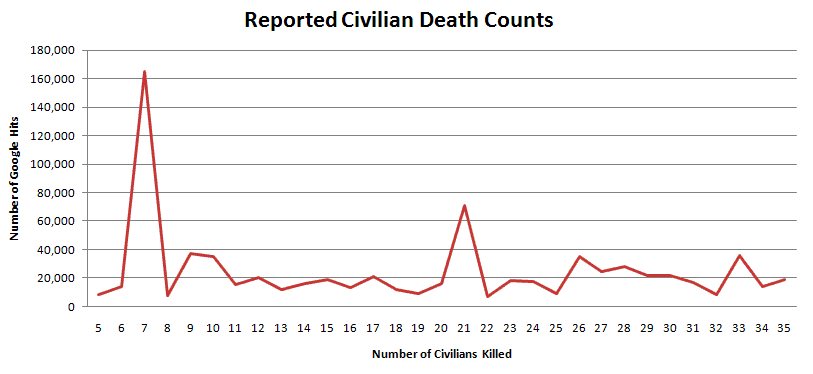
This all seems fairly telling, but given how many civilian deaths there are in the conflicts in Iraq, Afghanistan, and elsewhere, for any given number you choose, it’s fairly easy to pick out a list of articles all citing to that number of civilian casualties. So I did a very unscientific ’empirical’ test: the Google Hit Count. Using the phrase [“n civilians” + killed + US], I checked the number of results for civilian deaths from 5 – 30. Below 5, and the results don’t work as well because it seemed reporters more often used two or three instead of 2 or 3, and above 35, the numbers are not interesting and pretty steadily decrease or remain at low counts thereafter.

(Click on graph see full image)

Now, this does provide a little support for the idea that 30 is the magic number. If it is true that < 30 deaths requires less paper work, we would expect to see that, for close cases, commanders would have an incentive to determine that the number of civilian deaths is at or just under 30. Note that at 31 and 32 civilian deaths, there is a noticeable drop off, and that the number of deaths in the 25-30 categories is a bit higher than the usual range. This is consistent with the idea that commanders are quietly moving attacks with 31 or 32 deaths into the 30 or below reports. However, once there are 33 deaths, they don’t bother with trying to fudge it.

Still, any effect is a small one. The real question here is what on earth is going on with the number 7? And, to a lesser extent, 21? I know this survey is far from perfect, but the google returns for 7 deaths are so far out from the rest of the data set that it is hard to believe it is merely a random fluke. Looking at the Google results provides no obvious clues to explain the difference.

The number 21 also has an oddly high number of reports. This is a bit counter-intuitive, as if there was an attempt by the PR machine to make the numbers more appealing, I would guess that they would aim for 18 or 19 instead — you know, the old salesman’s trick of setting the price at $19.99.

I wish I had something clever to say here about what might be going on, but I don’t. Still, if we are going to be questioning the accuracy of military civilian death counts, the alleged ubiquity of the number 30 may be a red herring — 7 and 21 seem like much more promising anamolies to investigate.

-Susan

I Hear Dusseldorf, Japan is a Nice Place to Visit This Time of Year

Earlier today while I was in the car, I was listening to c-span radio, half-paying attention, and they were airing some debates in the Senate on health care reform. Someone — it was a senator, I am reasonably sure — was discussing pharmaceutical regulations and foreign pharmaceutical manufacturers. So he was droning on about “pharmaceuticals made in Paris France, pharmaceuticals made in Brussels, Belgium,” etc., etc., etc. He named about five or six different nations.

And then, while finishing up his haranguing, he declared, “And also pharmaceuticals made in Dusseldorf, Japan.”

Which, if I had to guess, was the most hilarious thing said on c-span all day, if not all week. (It’s not stiff competition.) And yeah, I actually cracked up laughing. But now I want to know who the hell it was that said that, and the internet is no help at all. I guess it’s possible I aurally hallucinated it? Don’t think so, though. I just want to figure out which senator it is that somehow thinks Dusseldorf sounds like it could possibly be located in Japan.

-Susan

Trivia Fact: This Blog is the #1 Result for International Law Lolcats

The past few days have seen a noticeable uptick in the number of google searches that direct to here for variations of either “law lolcats” or “alien tort statute hypos.”

Ahhh, that sounds like law school exam time, to me. Procrastination + dubious last minute study methods are a common MO.

Hint to all law students: If your prof happens to have a blog, it doesn’t hurt to give it a quick skim to get an idea of what sort of odd legal questions seem to catch their fancy, and thus are the sort of things they are drawn to basing fact patterns around. I swear to god this can actually pay off. Heck, checking Volokh can’t hurt either — I once inadvertently helped my roommate out by talking to her about a Volokh blog post on copyright and jazz music that turned up on her Copyright Law exam a few days later.

-Susan

Amanda Knox’s Conviction and What Not To Do About It

Some of the comments on the last post about Amanda Knox’s murder conviction made me want to clarify a few points.

First, the Italian court system is sometimes troubling, true, but the deeply problematic criminal justice system in Perugia should not be generalized to all of Italy. Perugia’s head prosecutor is not a good person, and this is not the first time the Perugian justice system has refused to let the truth get in the way of a good story. But by no means is Knox’s situation the Italian norm. It’s a crazy and unfortunate outlier.

The court system is not the only problem, either; even more pervasive are the biased and sensationalist media accounts. Perhaps even more so than Mignini, the media’s tabloid-style rumor mongering is in part responsible for Knox’s conviction, by convincing the public that baseless stories are grounded in some sort of proof, rather than sprung whole cloth out of peoples’ imaginations.

Second, staging an American boycott of Italian products or getting President Obama directly involved is the surest way to guarantee Amanda never sees the light of day again. Nations are — rightfully — extremely allergic to the idea of foreign entities interfering with their court system. Just think about how Texas and the rest of America flips their shit when the idea of the ICC is brought up, or when trivial things like multilateral treaties get in the way of us executing foreign murderers. Or about how we react to little issues like, say, LaGrand, Medellín, Avena?

If Italy thinks the U.S. government is trying to bully them into letting the vixen-murderess free, they will circle the wagons. The Italian court system will be pressured to uphold the conviction on principle, so as to not be seen as weak and catering to a foreign superpower. When I said “it’s time for the state department to bring out the big guns,” I was thinking more along the lines of behind the scenes diplomatic efforts that the rest of us never hear a word about. That way, Italy’s public officials will be able to act without taking a massive hit to their popularity, as would certainly occur if the fact the U.S. had asked them for help were publicized. And, I do think the U.S. Government has been exactly right so far in refusing to even acknowledge the case’s existence. Before Knox’s conviction, by far the best way that the U.S. could help her was by refusing to lift a finger in her defense.

If things get really desperate — and this would, unfortunately, be years down the line — I wouldn’t be against turning to multilateral international institutions for relief. It would deplete some of our foreign policy capital to be sure, but there are worse things to spend it on than freeing an innocent woman wrongfully convicted in an allied country.

Plus, you know, there’s that whole Italian conviction of 22 American CIA agents last month we have to deal with, too. We’re also going to have to sort out that mess. Unfortunately for Amanda, she’s going to be of secondary concern, if that, for the U.S. Government, and I doubt they’re going to offer Amanda too much assistance if it’s going to hinder other national security concerns.

Anyway, there is hope yet, and Italy’s domestic criminal procedures absolutely must be exhausted before any other action is contemplated. On appeal, the current bunch of Perugian officials will not be involved, which gives Knox a fighting chance.

-Susan

Injustice in Perugia: The Fraudulent Conviction of Amanda Knox and Raffaele Sollecito

My deepest sympathies go out to Amanda Knox and Raffaele Sollecito, as well as their families.

I don’t think I believed they would actually be convicted; I knew it was a possibility, given how shockingly corrupt the prosecution has been, but I was still stunned when I saw the guilty verdict.

The lead prosecutor in Knox’s case is Giuliano Mignini, a paranoid conspiracy theorist who has never displayed any concern for the truth of his allegations. Amanda Knox’s conviction makes for a great story — crazed American sexual deviant rapes and murders her roommate! News at 11! Also she does yoga, the evil little slut!– and that was enough to convince him of her guilt.

This article a few days ago in the New York Times Opinionater sums it up:

In closing arguments, Knox was described as a “Luciferina” and “a dirty-minded she-devil.” Preposterous, made-up sexual motives were ascribed to her. One prosecutor speculated before the jury what Knox may have said to Meredith Kercher before, he claimed, forcing an orgy that resulted in her death:

“You are always behaving like a little saint. Now we will show you. Now we will make you have sex.”

Nobody alleges that Knox said this to Kercher. But prosecutors asked the jury to imagine her saying such a thing.

What century is this? Didn’t Joan of Arc, the Inquisition and our own American Salem witch trials teach civilized nations a thing or two about contrived sexual hysteria with a devil twist?

The fact Amanda Knox is an American has undoubtedly played a role in her prosecution and conviction, as well; the jury was clearly influenced by the national identities involved, and at the reading of the verdict, six of the eight jurors were wearing red, white, and green sashes, the color of Italy’s flag.

The man who killed Meredith Kercher is in jail; Rudy Guede was fairly blatantly guilty from the beginning, with plenty of physical evidence plus his own confession to prove it. There is no coherent theory that can explain how he, Amanda, and Raffaele could have all been involved, even ignoring the fact there is zero believable evidence to show either Amanda or Raffaele alone were involved.

I suppose things could go well for them on appeal, but I don’t hold much hope for that. It’s time for the State Department to bring out the big guns, and do what they can to bring Amanda Knox home.

-Susan