Just How Certain Should an Expert Witness Be?

Via Barking Up The Wrong Tree, are uncertain experts more persuasive than experts who are firm in their convictions?

Experts are more persuasive when they seem tentative about their conclusions… But the opposite is true of novices, who grow more persuasive with increasing certainty.

In one experiment, college students were randomly assigned one of four variations of a restaurant review, praising a local Italian spot. In some versions, the reviewer was described as a famous food critic; in others, he was a technology worker at a local college with a penchant for fast food. Each of the critics expressed positive certainty about the restaurant’s virtues in one variation, and tentative praise in another. Asked to evaluate the restaurant, the students who read the expert’s review liked it much better when he seemed tentative; the opposite was true of the novice.

I wonder how this might play out with the use of expert witnesses in trials. In an expert witness showdown, both sides often seem to be lobbing absolutely-certain experts at one another, each with contradictory but adamantly endorsed opinions. For any case that is technically or scientifically complicated, it’s an open question about how much of the substance of the presentation that the jury really comprehends. Since by definition the witnesses are experts on the subject they’re testifying to, jurors probably will not have the expertise to judge the merits of their testimony, so it comes down more to the witnesses’ demeanor and authoritativeness.

Obviously, trial strategy should be based on something a lot more thoroughly researched than a stray psych study. But I think it is at least plausible that in a battle of the experts situation, having a (well qualified) witness who gives a more reserved endorsement would be more persuasive than an opposing expert who is willing to follow his testimony to the grave.

-Susan

Jim McCormick, Maker of the ADE651™, Has Finally Been Arrested — But Why Did It Take So Long, Why Are ADE-651s Still Being Exported, and Why Didn’t They Arrest Gary Bolton Too

Well, here’s at least a little bit of good news. Jim McCormick, the managing director of the company that makes the ADE-651 “bomb detectors,” has been arrested in the United Kingdom on suspicion of fraud. Perhaps more importantly, the devices have been banned from export to Iraq or Afghanistan.

A few months back, I posted about the worthless dowsing rods produced by UK companies and marketed as bomb detectors to developing countries looking for ways to prevent terrorist attacks. The ADE-651, produced by ATSC, Ltd., and the GT-200, produced by Global Technical, are the most frequently sold of these magic bomb wands, and they are responsible for bombings in Iraq and Thailand that have killed hundreds of people.

After complaints by the British Embassy in Baghdad, and a recent slew of negative press attention, McCormick was finally arrested. And I very sincerely hope McCormick’s arrest will be shortly be followed by the arrest of Gary Bolton, the director of Global Technical.

And although the UK is to be commended for finally taking action against the ADE-651, in many ways, it comes as too little, too late. To hear the British authorities tell it, the arrest of McCormick was the result of swift and decisive action on the part of the the Department for Business, Innovation and Skills:

It added: “As soon as it was brought to the attention of the Export Control Organisation and (business secretary) Lord (Peter) Mandelson we acted urgently to put in place export restrictions which will come into force next week.”

This is, quite frankly, a load of rubbish.

Bomb sniffing devices are not a new scam. ATSC, Ltd. has been operating over in the UK for a decade, and Global Technical had been falsely claiming since 1999 that the bomb detectors were given the approval of the British Military. Early last year, the UK government told Global Technical to stop claiming the GT200 had been given the Ministry of Defense’s approval– but other than requesting that their name not be used to endorse the product, they took no action.

Unfortunately, not only is the UK’s “prohibition” on exports of the ADE-651 device not particularly timely, it is not particularly comprehensive either:

“We will be making an order, under the Export Control Act 2002, banning the export of this type of device to Iraq and Afghanistan.

“The reason the ban is limited to these two countries is that our legal power to control these goods is based on the risk that they could cause harm to UK and other friendly forces.”

So essentially they are only banning the ADE-651 in places where it might kill NATO forces. But as for the citizens of Thailand, civilian and police alike, that have been killed as a result of reliance on the GT200? Well, they can just go on continuing to be killed by the fake bomb detectors, that’s just too bad for them.

According to the UK bureaucracy, “[a]s non-military technology, [the ADE-651] does not need an export licence,” and therefore the UK cannot place a blanket ban on exports. I’m not extremely familiar with UK export law, but this explanation seems pretty blatantly inadequate. No matter how the statute happens to be phrased, I have to imagine that any device that is marketed as a way to detect car bombs and IEDs could be classified as a ‘military technology’ under it.

-Susan

“Anybody from Minnesota is admitted.”

Earlier this morning, I was a reading a transcript from a hearing before the the District Court for the District of Colorado, and it included the following exchange:

MR. KELLEY: We also have motions pro hac vice for two other members of my firm from our Minneapolis office who are not admitted in Colorado.

THE COURT: Okay. Well, I am going to grant the motion for admission pro hac vice, but I do need to tell you it says that Mr. Liebman graduated from Yale Law School, and it’s my understanding it’s so hard to get there, that there isn’t one.

MR. LIEBMAN: I apologize for going there.

THE COURT: Don’t they just give you a degree once you get the admission standard?

MR. KELLEY: In redemption for or mitigation he is steeped in Midwestern values and only spent a brief period of time out there.

THE COURT: Anybody from Minnesota is admitted.

-Susan

The Automation and Outsourcing of the American Lawyer

Most industries in the U.S. have, at some point or another, faced some form of outsourcing or automation, resulting in a reduced need for human workers. Because of the nature of legal work, however, in the past attorneys have largely been immune to these forces, and their jobs have been secure from computers and foreigners alike.

This is all changing. The use of computerized discovery and the outsourcing of legal tasks to foreign lawyers are both rapidly becoming a viable option for a broad range of services which were, formerly, only conducted by U.S.-barred attorneys. It remains an open question at this point which will have the bigger impact on the U.S. legal market: outsourcing or automation?

I was about to self-mockingly title this post “The Scylla and Charybdis of the Contract Attorney,” because I am convinced that “Scylla and Charybdis” may possibly be the most aggravating and overused cliche out there, except I found the phrase was too annoying to even use ironically. Still, the phrase may have been apt here — it is hard to think of any niche left for U.S. contract attorneys to inhabit that could not eventually either be computerized or done cheaper abroad.

A recent study looked at the efficacy of computerized document review as compared with the traditional method of examining voluminous stacks of paper for responsiveness: lots and lots of attorney man-hours spent on doc review. The article, Document Categorization in Legal Electronic Discovery:
Computer Classification vs. Manual Review
[PDF], involved comparing two teams of human re-reviewers and two e-discovery services. (With a summary on the findings about computer assisted doc review here.)

The study’s conclusion?

On every measure, the performance of the two computer systems was at least as accurate (measured against the original review) as that of a human re-review.

It’s obvious why development of reliable e-discovery is such an intriguing possibility — in major cases, the costs of doc review alone can be astronomical, so any computer program that can cut down on the number of attorneys required would result in major savings.

The documents used in the study were collected in response to a “Second Request” concerning Verizon’s acquisition of MCI. The documents were collected from 83 employees in 10 US states. Together they consisted of 1.3 terabytes of electronic files in the form of 2,319,346 documents. The collection consisted of about 1.5 million email messages, 300,000 loose files, and 600,000 scanned documents. After eliminating duplicates, 1,600,047 items were submitted for review. The attorneys spent about four months, seven days a week, and 16 hours per day on the review at a total cost of $13,598,872.61 or about $8.50 per document. After review, a total of 176,440 items were produced to the Justice Department.

I was mostly struck, however, by just how inconsistent human reviewers are when it comes to doc review:

The level of agreement among human reviewers is not strikingly high.The two re-review teams agreed with the original review on about 76% and 72% of the documents. They agreed with one another on about 70% of the documents with corresponding kappa values in the low to fair range. Although low, these levels are realistic.

The computer methods had comparable results, finding agreement with the original review’s assessment 83.2% of the time for one system and 83.6% for the other.

FRCP Rule 26(g) requires only that discovery processes be reasonable and not unduly burdensome. Obviously what exactly qualifies as “reasonable” for discovery responses is a less-than-precise standard, but presumably the way we have been doing it for the past few decades qualifies. By that standard, then, e-discovery would seem to qualify as well.

Although we are still a long ways from automating legal services more complex than discovery tasks, legal services of moderate sophistication can and have been outsourced to attorneys in foreign nations. Although for a while now the legal industry has outsourced work similar in character to the tasks that computer systems are now being designed to do. Pangaea3, a legal outsourcing company based in India, is leading the charge for outsourced legal research and contract drafting:

[Attorney for Pangaea3] Ms Langstieh’s tasks include policing the misuse of clients’ trademarks on the internet and researching liabilities in different jurisdictions. She has been at Pangea3 for less than two years but has already travelled to Europe to meet clients and regularly speaks to customers in the West as part of her work.

This post by Timothy Corcoran concisely summarizes why outsourcing to India, a concept would seem utterly mundane to most businesses in America today, feels like a revolution in the legal industry:

Why such a furor? Simply because the work being outsourced isn’t the widely proclaimed mundane work of staff accountants, secretaries, mail room clerks and marketers, this is real legal work, the work of highly trained lawyers, that is being taken from top global law firms and moved to a heretofore unknown company with salaried lawyers! “What is the world coming to?!” is undoubtedly the cry in BigLaw law firm boardrooms everywhere. What, indeed.

-Susan

Haiti, Humanitarian Assistance, and Extrinsic vs. Intrinsic Motivation: Why an International Law of Humaniatarian Assistance Would Reduce Foreign Aid

Right now, thousands of individuals from at least a score of nations are in Haiti, having been rapidly deployed there to offer assistance to the millions of Haitians now homeless, injured, or worse, as a result of the recent earthquake. Hundreds of millions of dollars have been pledged in aid, with more donations pouring in every day.

In Haiti, as has been the case in the wake of many other recent natural disasters, the state practice of rendering aid to the devastated region is widespread and pervasive. However, as far as I am aware, not a single nation has announced that it is sending aid to Haiti because it believes international law requires that it do so. There is no opinio juris, but merely states acting on the basis of their own independent motivations. And yet, it seems that every state that can offer assistance is doing so — not to mention so is every international organization, NGO, and corporation out there. Sub-state entities are offering help, too; a search and rescue team from Fairfax, Virginia, has been sent down to Haiti to help victims trapped in the rubble. Hell, even tiny little Togo has offered aid, along with a number of other developing nations. For a more complete account of who is doing what, a very detailed listing can be found at Relief Web. The list is as impressive as it is diverse.

Although human rights play a very large role in today’s international law jurisprudence, I suspect that, at least in cases involving high profile natural disasters, placing an affirmative duty on states to provide humanitarian assistance would ultimately reduce the amount of aid rendered.

Simply put, there just is not a need to give such a principle the force of law. For many reasons, among them moral duty and political posturing, states are already adequately motivated to supply aid in times of humanitarian crisis.
Aid — in the form of money, food and water supplies, search and rescue teams, infrastructure support, medical personnel, and much more — was immediate and widespread. The difficulty in getting aid to Haitian citizens has nothing to do with foreign states failing to act in support and everything to do with the horrendous conditions on the ground.

But if rendering humanitarian assistance were made to be an affirmative duty under international law, all the reasons for which states now offer foreign aid would be vastly diminished, and the total amount of aid given would almost certainly decrease.

“Crowding out” — otherwise known as the motivation crowding effect, to distinguish it from other kinds of crowding out — holds that offering external rewards or punishments to encourage someone to perform a task can, somewhat counter-intuitively, actually reduce people’s incentives to act, as the extrinsic reward undermines their intrinsic motivation. Developed both by economists and psychologists, the motivation crowding effect theory is a widespread phenomenon that appears in many different situations: [PDF]

The basic idea that rewards, and in particular monetary rewards, may crowd out intrinsic motivation emanates from two quite different branches of literature in the social sciences. Thirty years ago in his book The Gift Relationship Titmuss (1970) argued that paying for blood undermines cherished social values and would therefore reduce or totally destroy people’s willingness to donate blood. Though he was unable to come up with any serious empirical evidence his thesis attracted much attention. A second literature stems from psychology. A group of cognitive social psychologists have identified that under particular conditions monetary (external) rewards undermine intrinsic motivation. The application of rewards for undertaking an activity thus has indirect negative consequences, provided intrinsic motivation is considered to be beneficial

[T]here exists indeed compelling empirical evidence for the existence of crowding out and crowding in. This conclusion is based on circumstantial evidence, laboratory evidence by both psychologists and economists as well as field evidence by econometric studies. The evidence refers to a wide variety of areas of the economy and society: children’s learning behavior; patients’ readiness to take prescribed medication; monetary and symbolic rewards for undertaking various laboratory tasks; the tendency to reciprocate in the laboratory setting reflecting work conditions in a firm; the amount of trust exhibited in a laboratory situation of incomplete contracts; the reaction of managers to various forms of supervision by their superiors; the preparedness to offer voluntary work; the observation of time schedules in daycare centers; the on-time flight performance in the airline industry; the readiness to accept nuclear waste repositories (and other locally unwanted sites); and the amount of civic virtue exhibited, in particular with respect to fulfilling one’s tax obligations (tax morale).

If offering humanitarian assistance to foreign nationals struck by disasters became a legally mandated duty, either as a part of customary international law or enshrined in treaties, I see little reason to believe that there would be any increase in the amount of aid rendered. In the wake of disasters, the citizens of states who were now obligated to send money to foreign countries would feel resentment, not generosity, towards those in need of aid. States could no longer compete for moral brownie points with one another, or use aid as a means of obtaining soft power to support their political agendas. All of these motivating factors are far more compelling reasons for states to give aid than would be international law, which is a notoriously flimsy motivator of state action.

States would likely still give aid, of course, if they believed they were required to by law. But they would give only enough to satisfy whatever their duty was, and would use clever lawyers to reduce the amount they were required to give, or to explain why a “humanitarian disaster” was not really a humanitarian disaster and therefore no duty to render aid existed.

-Susan

© 200 B.C.: Starbucks’ Encounter With Intellectual Property Rights in Historic Artifacts

After being notified by the Mexican government that its new line of mugs featuring images of pre-Hispanic archeological sites and artifacts was an unauthorized use of Mexican cultural intellectual property, Starbucks has agreed to pay up.
Starbucks said Thursday it regrets any misunderstanding, and “we are willing to pay the appropriate amount for the use of these images.”

Mexico’s government archaeological agency says the images of the Aztec calendar stone and the Pyramid of the Moon from the pre-Aztec ruins of Teotihuacan are the intellectual property of the nation. The agency will decide how much Starbucks should pay.

The existence of intellectual property rights on pre-Aztec artifacts makes the current terms for copyright in the U.S. seem quite reasonable in comparison.

It appears that it is the Mexican division of Starbucks at issue, so the company is of course required to comply with any Mexican laws regarding cultural heritage and intellectual property. Outside of Mexico, those laws would have no direct effect, and you’re free to place the Pyramid of the Moon wherever you want.

-Susan

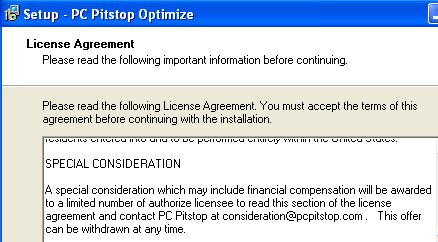
“By accepting these Terms, you agree to relinquish custody of your first born child to us.”

Perhaps I should make more of an effort to read Terms of Service agreements after all?

The image was hosted on PC Pitstop’s homepage, so they are clearly not concerned with it being publicized. But why would a company add such a term? There are two issues behind the inclusion of ‘Special Consideration’ clause that strike me as odd.

First, the clause itself is not enforceable — it is a classic illusory contract. Although it would pass as a unilateral offer and thus acceptable by anyone who actually read it, the last sentence negates any contract like quality it may have. “This offer can be withdrawn at any time” means that PC Pitstop has not actually committed itself to anything at all, and thus has given nothing up, and thus there is a failure of consideration.

Second, depending on how this clickwrap license is set up, the inclusion of the ‘Special Consideration’ clause could actually undermine PC Pitstop’s legal position. Although clickwrap licenses are far from black letter law, the basic theme behind them is that they are held enforceable where they are designed so as to provide reasonable notice and, generally, are assented to by the user’s affirmative conduct. However, by offering a gift in its Terms of Service (ToS), the company is effectively making a demonstration of how few people ever bother to read the ToS. It would by no means be dispositive proof, but if the ToS ever wound up in court, a user might be able to show how he in particular and users in general were not given an effective opportunity to review the terms, because 99.99% of them never tried to cash in on the offer.

As for clickwrap licenses more generally, I believe they provide a good example of how ill-suited old legal forms are when they are attempted to be grafted on to new technology. It is not a secret that no one reads the ToS forms — heck, I remember from 1L year, our contracts professor admitted that she herself never bothered to read them — and yet courts insist on using centuries old contracts principles to analyze them. As seen by Bragg v. Linden Lab, courts can find a term from a ToS ‘unconscionable’ when they do not want to enforce it. This threatens to result in an extremely inefficient system in which contracts are announced unilaterally by one party, never read by the second, and then treated as a “cafeteria contract” by the judge who picks which clauses she wants to keep and which clauses she wishes to discard. The judiciary of course has a little other option, but it would be nice to see the legislatures jump in and establish contract laws that are better suited for the unique online environment.

Unfortunately, given the nature of the internet, allowing state legislatures to direct the process is not an ideal solution either. Much as I reflexively dislike the idea of the federal government involving itself with contract formation, it may be necessary in order to create a more orderly, contractually agreed upon cyberspace.

-Susan

Legal Unemployment, Worldwide

In thirty years, China has gone from having six law schools to having 634. Predictably, this is not entirely good news for the graduates of those schools, as law is now the hardest profession to find employment in:

Law has topped the list of the 10 most difficult professions to land a job in the country for two consecutive years, taking the No 1 slot in 2008 and No 2 in 2007, according to a joint study released in June 2009 by China’s Academy of Social Science and Beijing-based consulting company Mycos Institute.

However, I found this even more curious:

The other majors [that are difficult professions to find employment in] include computer science, English, international economics and trade, business administration, clinical medicine, Chinese literature, art design, electronic engineering and accounting.

To be fair, ‘Chinese literature’ and ‘art design’ might be the Chinese equivalent of an American liberal arts degree, the kind everyone derides as being not good for much in the real world. But clinical medicine? Engineering? Accounting? Business administration? These are the sort of majors that sensible, job-oriented students take that are, in the U.S., supposed to leave graduates happily having their pick of employment, while their lowly English lit classmates are waiting tables.

It suggests to me, anyway, that there is nothing particularly unique about the plight of law grads in China, but that the market for highly educated labor in general is somewhat stunted.

Still, this could very much be a hindrance to China’s long-term development.

“Law graduates have the most difficulty in job hunting, which means the supply has exceeded the demand,” Wang said.

“If there is no adjustment in place soon, it is not good for the development of law in the long run.”

Unlike the U.S. — which, I might reluctantly concede, may simply have an overabundance of lawyers in general — China has come no where near to meeting the potential demand for lawyers, but rather the legal infrastructure that would support all those theoretical legal jobs has yet to materialize. The creation of a political climate that respects the rule of law necessarily requires the presence of lawyers, however. China’s fledgling legal system is characterized more by the rule of men, but there is, at least in theory, a legal system in place. A healthy bar that continuously engage in litigation to resolve disputes may or may not eventually result in a robust Chinese legal system, but nothing else has a chance of doing so.

In other law school related news from China, U.S. law grads may eventually get some competition from China, if the Peking University’s School of Transnational Law succeeds in its plan of becoming the first non-American school to be accredited by the ABA.

-Susan

Federal Jobs: A Picture Is Worth a Thousand Words

Here is a screen capture from the application page for a federal job I applied to today.

I presume this is intended as a test of applicants’ ability to control a mouse. On the plus side, I am pretty sure I qualified for the job. On the downside, all of the elephants and chimpanzees at the D.C. zoo qualified too, as well as half of the pandas.

-Susan

Security Measure Mishaps In Israel, the UK, and Denmark

Ever since the failed execution of the the Great Christmas Underwear Bombing, the blogosphere and print media have been abuzz with snarky criticisms of the new haphazard security measures enacted in response. My favorite comes from here:

I had a fantasy in which the Fed and the TSA (Transportation Security Administration) switched roles.

If a bank failed at 9 a.m. one morning and shut its doors, the TSA would announce that all banks henceforth begin their business day at 10 a.m.

And, if a terrorist managed to get on board a plane between Stockholm and Washington, the Fed would increase the number of flights between the cities.

But the U.S. isn’t the only one to be having some security missteps. In Israel, there are reports claiming that the military has developed a security program that involves training dogs to attack anyone who says “Allah hu akbar”, or Arabic for “God is great.”

Israeli Arab MK Ahmed Tibi on Monday told the Knesset plenum that at a canine unit ceremony held the day before, parents of the soldiers witnessed demonstrations proving these allegations.

“IDF dogs are trained to pounce and attack any Arab who shouts ‘Allah hu akbar,’ as a Pavlovian reaction,” said Tibi.

The IDF has denied any such training program is in place, and the denial is pretty believable given how ridiculously ineffective such a plan would be. The stated purpose of the training program is to have dogs who will attack suicide bombers who announce “Allah hu akbar” immediately before detonating explosives — but unless the K-9 force is staffed entirely by a bunch of Rin Tin Tins and Lassies, pretty much no dog is going to be able to reach a terrorist and neutralize them before they have the ability to press a button.

Over in the UK, government officials have hit a stumbling block in the implementation of their latest security technology, as the full-body scanners at airport check points violate child pornography laws:

The rapid introduction of full body scanners at British airports threatens to breach child protection laws which ban the creation of indecent images of children, the Guardian has learned.

Privacy campaigners claim the images created by the machines are so graphic they amount to “virtual strip-searching” and have called for safeguards to protect the privacy of passengers involved.

Ministers now face having to exempt under 18s from the scans or face the delays of introducing new legislation to ensure airport security staff do not commit offences under child pornography laws.

Finally, over in Denmark, Kurt Westergaard showed that “panic rooms” are not merely impractical Hollywood-style gizmos, but can actually be effectively employed to protect yourself during home invasions. Of course, the recommended use for panic rooms probably includes keeping your five year old granddaughter on the same side as the panic room wall as yourself, and not outside with the attacker:

He did not have time to collect the child from the living room before locking himself into a “panic room”, a specially fortified bathroom. He said the assailant had shouted “swear words, really crude words” and shrieked about “blood” and “revenge”, as he smashed the axe in vain against the bathroom door.

“I feared for my grandchild,” he told Jyllands-Posten, the newspaper that had commissioned the cartoon. “But she did great. I knew that he wouldn’t do anything to her.” He went on: “It was close, really close. But we did it.”

-Susan