Does Illegitimacy’s Status as a Quasi-Suspect Class Permit Prohibitions on Same Sex Marriage to be Evaluated Under Intermediate Scrutiny?

Although sexual orientation is officially not a suspect class, almost all U.S. courts that have considered the permissibility of discrimination based upon that particular criterion have applied, in practice, a rather more exacting examination of the legislative objectives behind the discriminatory legislation than is typically permitted under rational basis review, even while simultaneously denying that they are doing anything of the sort. This is what is typically referred to as “rational basis with teeth” — the unofficial fourth category of review under the 14th Amendment. And until sexual orientation is declared to be a suspect class, or until the classification system is replaced with a scale, the courts can do nothing else.

But at least in the context of same sex marriage prohibitions, could intermediate scrutiny be directly invoked on the basis of the Supreme Court’s prior illegitimacy jurisprudence? Illegitimate children are already a suspect class under the law; it is impermissible under the 14th Amendment to burden children whose parents were not married at the time of their birth simply in order to encourage future couples to get married before having kids. So why can the state require that the children of same sex couples be illegitimate in order to encourage opposite sex couples to make their children legitimate?

The argument does not appear to be a particularly common one, but I wonder now why it isn’t made more often. One of the reoccurring arguments touted as a justification for Prop 8, as well as other prohibitions on gay marriage, is that marriage is uniquely designed to encourage responsible procreation, and that access to marriage should therefore only be granted where it will serve as a deterrent to reproducing accidentally outside of marriage. Marriage is only for straight people, the argument goes, because only straight people produce kids the old fashioned way, and the best way to raise kids that were produced the old fashioned way in the context of a marital relationship.

This argument is inadequate in that it provides no explanation for why kids that were not produced on accident are not also best raised in the context of a martial relationship. Many gay couples do, very purposefully, create and raise kids, and if kids are best raised by married couples, then it is pretty damned spiteful to order that those kids should be denied the benefit of married parents just so that straight couples who get pregnant are more likely to have a shotgun wedding.

Beyond being spiteful, prior Supreme Court decisions have repeatedly indicated that the objective itself is impermissible. In Trimble v. Gordon, 430 U.S. 762 (1977), the Supreme Court rejected the argument that a law prohibiting intestate succession of bastards was constitutionally permissible, because

[i]n a case like this, the Equal Protection Clause requires more than the mere incantation of a proper state purpose. No one disputes the appropriateness of Illinois’ concern with the family unit, perhaps the most fundamental social institution of our society. The flaw in the analysis lies elsewhere. As we said in Lucas, the constitutionality of this law “depends upon the character of the discrimination and its relation to legitimate legislative aims.” 427 U.S. at 504. The court below did not address the relation between § 12 and the promotion of legitimate family relationships, thus leaving the constitutional analysis incomplete. The same observation can be made about this Court’s decision in Labine, but that case does not stand alone. In subsequent decisions, we have expressly considered and rejected the argument that a State may attempt to influence the actions of men and women by imposing sanctions on the children born of their illegitimate relationships.

Likewise in Weber v. Aetna Casualty & Surety Co., 406 U.S. 164 (1972), the Supreme Court refused to accept the argument that it is permissible to discriminate between legitimate and illegitimate children as a means of encouraging people to “shun illicit relations because the offspring [of those relationships] may not one day reap the benefits of workmen’s compensation.” 406 U.S. at 173. The Court found that the State’s interest in protecting “legitimate family relationships” may have been itself a legitimate objective, but it was not an end that could be promoted by inflicting hardship on those who happened to not be part of a traditional nuclear family arrangement:

[t]he status of illegitimacy has expressed through the ages society’s condemnation of irresponsible liaisons beyond the bonds of marriage. But visiting this condemnation on the head of an infant is illogical and unjust. Moreover, imposing disabilities on the illegitimate child is contrary to the basic concept of our system that legal burdens should bear some relationship to individual responsibility or wrongdoing. Obviously, no child is responsible for his birth, and penalizing the illegitimate child is an ineffectual — as well as an unjust — way of deterring the parent.

Almost all of the Supreme Court’s past opinions on distinctions based upon illegitimacy contain language that would be equally at home in the decision issued today by the 9th Circuit in Perry v. Brown. Gay couples are not responsible for the fact that straight people sometimes get knocked up — so why are they punished, and their kids forced to be illegitimate, on the chance that there could be a straight couple out there that would refuse to enter into any relationship that gay people were also allowed to enter? Punishing gay couples, and their children, by prohibiting them from entering into the contractual arrangement that the state has deemed the best for children to be raised in, does exactly what the Weber Court prohibited: it imposes disabilities on those who are not engaging in irresponsible procreation as a means of encouraging better behavior from those who are not being similarly responsible.

-Susan

Initial Thoughts on the Prop 8 Decision

The 9th Circuit published its opinion in Perry v. Brown today, with a 2-1 majority opinion by Reinhardt upholding the overturning of Proposition 8 on the narrowest possible grounds, and a dissenting opinion from Judge Smith — an outcome that pretty much no one is surprised by.

But even if it’s not a surprising outcome, I am still relieved the decision did end up being as narrow a holding as could be managed. But the majority knew what it was doing, of course, and it did its best to carefully shoehorn Perry into the precedent set down in Romer v. Evans. If gay marriage absolutely has to go in front of the Supreme Court, well, then I guess I’m glad it’s going to be in the context of the 9th Circuit’s opinion here, rather than a potentially more damaging vehicle.

I did end up being pleasantly surprised and impressed by Judge Smith’s dissenting opinion, and I agreed with many of his points over those of the majority far more often than I would have expected. It was certainly more faithful to the concept of rational basis review, anyway, and if it weren’t for two of its ultimate conclusions, I might’ve agreed overall with the dissent’s holding rather than the majority’s.

But there is no possible way I could ever accept the Proponent’s argument that “gay marriage should be banned because because only straight people can get accidentally knocked up, and straight people that accidentally get knocked up might not want to get married if those gay people who can’t accidentally get knocked up are allowed to get married too” with anything resembling a straight face, prior 14th Amendment jurisprudence be damned. Smith’s version of rational basis review would require that courts accept this argument, on the grounds that the government is permitted to (1) use irrational animus as a means of carrying out (2) policies that have no coherent content beyond an empty sound bite. And that’s two bridges too far, for me.

As for the first point, Smith’s footnote 8 does try to distinguish Palmore v. Sidoti by claiming that animus is only prohibited as a means of carrying out a law where that means is based upon creating a suspect classification. But if animus is banned as an end in all cases — rational basis through strict scrutiny — then what could possibly be the constitutional argument for banning animus as a means only in the case of strict scrutiny, but permitting it in all other circumstances?

And for the second point, Smith may be on firmer constitutional standing. But whatever precedent may be, I can’t go along with the argument that a law counts as being “rationally related” to an alleged purpose just so long as a grammatically correct sentence can be formulated which purports to support that claim. When it comes to rational basis review, yes, courts are required to accept a very hefty does of harebrained legislative ideas, no matter how stupid or ridiculous those ideas might be in practice — but even the most properly deferential court should not be required to accept an argument that is, as the majority put it, lacking any basis “on which th[e] argument [c]ould be even conceivably plausible.”

So even if I am skeptical of the strategic soundness of forcing a gay rights case through the courts now, I ultimately agree with the legal analysis of the majority’s opinion. No, it’s not perfectly faithful to past models of rational basis review. But if anything, Perry v. Brown is just another chip off of the slowly eroding concept of strictly tiered classifications under the Fourteenth Amendment. The current law school outline version of the law, which places everything that’s not currently an announced suspect or quasi-suspect class into the same rational basis bucket, just doesn’t match the reality of what is happening in the courts and in society at large. After all, we’ve had, what, two cases before the Supreme Court now, in which a law has been challenged on the basis that it was motivated solely by animus against gay people? And after Perry, it’ll be three. In the context of Supreme Court cases which challenged legislative enactments based on animus towards a specific group, that’s a pretty high number.

And with that kind of pedigree, it’s hard to justify the claim that “homosexuals” is not a class that has been repeatedly subjected to improper legislative discrimination — and even if its not legally recognized as such under the Court’s current classification scheme, as a practical matter, it is plain that a law that makes a distinction on the basis of sexual orientation is one that that warrants an extra dose of skepticism from the judiciary.

-Susan

A Critique of a Law and Economics Analysis of the Alien Tort Statute

A few days ago, I was interested to see a new draft paper out that discussed the law and economics perspective of corporate liability under the Alien Tort Statute. Corporate Liability for Extraterritorial Torts Under the Alien Tort Statute and Beyond: An Economic Analysis, by Alan O. Sykes, focuses on an important part of ATS litigation, and one which so far has been relatively neglected — the economic impact of ATS suits.

Unfortunately, I came away from the article a bit disappointed; although Sykes accurately summarizes some economic concerns that are theoretically raised by the ATS, there is close to no examination of actual corporate behavior. I was frustrated with its near total disconnect from any specific applications of the ATS, as only a single example from actual ATS litigation is used to illustrate the potential economic downsides of corporate liability: that of Talisman’s withdrawal from Sudan and replacement by Chinese corporations. Actual dollar figures associated with defending ATS suits, or total amounts of judgments or settlements that have been paid under ATS cases, are never brought up.

My major complaint would be that, because the article simply focuses on the theoretical costs caused by corporate liability under the ATS, with little or no evidence as to the actual costs that have been experienced in ATS suits, Sykes’ analysis is almost equally applicable to the question of multinational corporate liability in any situation, not just Alien Tort Statute case. In his article, Sykes identifies five general economic costs:

  1. Litigation is expensive
  2. This is a confusing area of the law, which means judges are likely to end up making decisions that are biased against big, faceless corporations
  3. Allowing multinational corporations to be sued for allegedly bad things they have done can piss off foreign governments, either where the MNC is headquartered or where the bad acts took place
  4. Allowing corporations with connections to the U.S. to be sued is harmful because it gives a competitive benefit to corporations that do not do business in the U.S., and so cannot be sued
  5. Allowing corporations with U.S. connections to be sued will cause them to engage in expensive restructuring to create subsidiaries that have the competitive benefit of not being able to be sued in the U.S.

These costs are not really unique to the ATS context. It is not that any of these costs aren’t real, but Sykes never discusses how each of these general economic concerns is particularly applicable in the context of the Alien Tort Statute. For instance, although the first point is an important consideration for any type of litigation, the article does not provide any evidence that the costs of ATS litigation are more concerning than the costs associated with, say, products liability, or Title VII cases. Plus, as Sykes himself admits, a large proportion of corporate ATS cases feature up to a dozen different claims in addition to any ATS -based claim for relief. If the ATS didn’t exist, it doesn’t mean these all the ATS cases would cease to exist as well — just that they woudn’t have brought ATS claims. And, other than in a handful of high profile exceptions, the ATS portions of those cases don’t cause any significant increase in the overall litigation costs. As Sykes also admits, U.S. Courts are already concerned with the potential costs of baseless litigation, and have implemented doctrines intended to curtail the expenses associated with such cases. I am all in favor of Twombly’s heightened pleading standard applying to ATS suits, but the record of ATS litigation thus far — with an overwhelming majority of ATS cases being dismissed — suggests that this is already occurring, and that litigation costs in ATS suits are no higher than for any other given type of litigation.

As for the second point, regarding the risk of judicial bias against corporations, there is zero evidence that this is a cost particularly likely to occur in the context of ATS litigation. Given the existence of a single plaintiff victory at trial in corporate ATS cases — and perhaps a dozen settlements, many of which heavily favored the corporations — the record would suggest that ATS suits do not feature any problematic bias against corporate defendants.
Continue reading

Ecopiracy in the Contiguous Zone

It’s been a relatively exciting week for international law of the sea. Not only has Iran been demonstrating the importance of territorial seas, why straight baseline measurements matter and when they are appropriate, and the differences between transit and innocent passage, but now three Australians are helping to illustrate the concept of contiguous zones, thanks to their unauthorized boarding of a Japanese whaling support ship:

The so-called “Sea Shepherd” activists — Geoffrey Tuxworth, Simon Peterffy and Glen Pendlebury — boarded the Japanese whaling vessel Shonan Maru II early Sunday morning off the southwest coast of western Australia.

….

The three men are members of an Australian environmental organization called Forest Rescue Australia and their mission was designed to prevent the Japanese whaler from tailing an anti-whaling flagship belonging to the Sea Shepherd Conservation Society.

Because this all took place about 16 miles off of the Australian coast, the men boarded the ship and were apprehended by the Japanese vessel within Australia’s contiguous zone. There now seems to be a dispute between the Sea Shepherd organization and the Australian government over the significance of this fact — with the Sea Shepherds believing, while the Australian government is stuck in the position of awkwardly noting that the three men who boarded the vessel are subject only to Japanese laws.

Although the Australian government did eventually work through diplomatic channels to arrange for the release of the three activists, its position was that Australia had no particular claims to jurisdiction over the incident, beyond the fact it involved Australian citizens:

[Federal Attorney-General Nicola Roxon] said consular officials were attempting to contact the men, and the Government’s priority was to ensure their safety and well-being, and return to Australia.
“It is a difficult situation. This incident happened outside our territorial waters, in our exclusive economic zone,” she said.
“But that doesn’t give us rights for Australian law to automatically apply.
“In fact, our advice is that Japanese law will apply because a Japanese boat is the one that’s been boarded.”

The Sea Shepherds do not agree with the Gillard Government’s view:

Capt [Paul] Watson said he had not expected the men to be taken to Japan and charged.

“Considering it was within the 24 miles contiguous zone, which is where the Australian immigration and Customs has absolute authority, we didn’t think the Australian government would allow the Japanese to take Australian citizens out of that area.”

He accused Attorney-General Nicola Roxon of “not doing her homework”, adding the vessel was only 16 miles off the beach.

“This is not some ordinary boat that was boarded, this is a criminal boat supporting a criminal operation.”

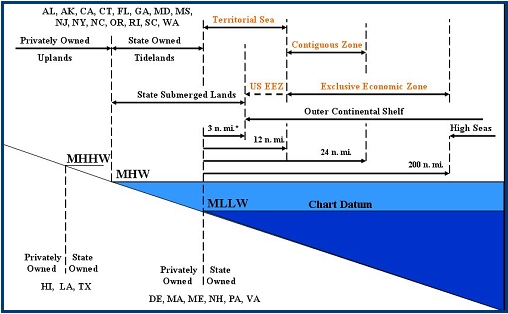
Unfortunately for the Sea Shepherds, however, their interpretation of international law is a bit misguided. The contiguous zone’s actual significance is pretty negligible in most contexts, and completely negligible here. The contiguous zone is the band of ocean territory just beyond a nation’s territorial waters, and overlapping with its EEZ. States are permitted to extend this zone up to 24 miles from their coast; this means, in the typical circumstance, a nation’s contiguous zone is a 12 mile band that begins 12 miles out at sea, where the state’s territorial sea ends.

Under Article 33 of UNCLOS,

1. In a zone contiguous to its territorial sea, described as the contiguous zone, the coastal State may exercise the control necessary to:

(a) prevent infringement of its customs, fiscal, immigration or sanitary laws and regulations within its territory or territorial sea;

(b) punish infringement of the above laws and regulations committed within its territory or territorial sea.

2. The contiguous zone may not extend beyond 24 nautical miles from the baselines from which the breadth of the territorial sea is measured.

And that is pretty much the extent of the contiguous zone’s importance, when it comes to a coastal state’s jurisdiction over foreign ships. Moreover, as the Shonan Maru II is not itself a whaling ship or a research ship — it’s basically a bodyguard for the whaling ships, engaged in counter-harassment measures against the Sea Shepherds — it was not even taking any actions which could have subjected it to Australian regulations at the time the Forest Rescue men boarded it. As for Australian criminal laws (even presuming that the Japanese could possibly have committed any violations), such laws are only enforceable in the contiguous zone to the extent that the enforcement was related to violations that occurred or were about to occur within Australia’s territorial sea. Here, all of the events concerned took place outside of territorial waters, and so Australia’s extended enforcement jurisdiction is inapplicable.

As such, if any criminal acts occurred with regard to the boarding of the Shonan Maru, the crimes were probably committed by the Forest Rescue activists rather than the Japanese whalers. In fact, an argument can even be made that, by forcibly boarding a Japanese vessel outside of Australian territorial waters with the intent of detaining it, or at least of diverting its course, the activists were engaging in an act of piracy, pursuant to UNCLOS Article 101. Although the Japanese whalers are hardly innocent when it comes to breaches of international law, in this case, it is the Sea Shepherds that are in the wrong.

-Susan

Is the Strait of Hormuz Governed by Treaty or by Customary International Law?

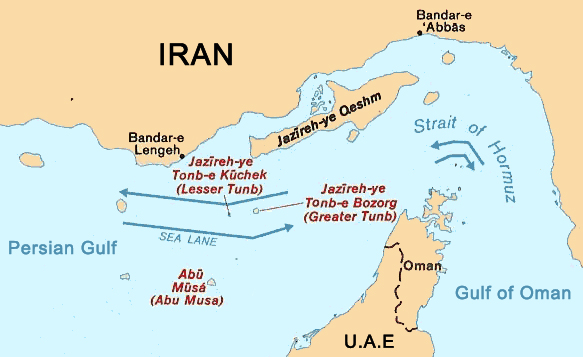
The Strait of Hormuz, as news articles in recent weeks have repeatedly stressed, is kind of a big deal when it comes to the global oil trade. The Strait, which is a mere 20 miles across at its narrowest point, connects the Persian Gulf and the Gulf of Oman — and also connects the rest of the world with 40% of its daily oil tanker traffic.

Which is why Iran’s recently renewed threats to close down trade through the Strait of Hormuz are risky for all concerned. Risky for the rest of the world, because any disruption would contain a severe economic toll. And risky for Iran, because if it ever actually did attempt to shut down the Strait, it would intensely piss off literally the entire world. So, while Iran periodically makes noises about taking such a move, the odds of it actually carrying out on its threats are minimal. Nevertheless, given the costs involved, the risk, however small, is taken extremely seriously by the rest of the world.

But ignoring the reality of the situation for a moment, and pretending as if international law actually possessed the power to effect state’s actions in the Gulf, would Iran actually have the legal right to carry out any of its threats?

For once, international law has a straightforward answer: no. Any attempt by Iran to close the Strait of Hormuz would be unambiguously illegal; the shipping lanes through the Strait of Hormuz, as laid out by the International Maritime Organization, lay within the territorial sea of Oman. Although the 12-mile territorial seas of Iran and Oman overlap at the narrowest points of the Strait, the deepest waters — and thus the shipping channels — lay to the south, within Oman’s territorial waters. As such, any military action by Iran to shut down shipping through Hormuz would inevitably impinge on Oman’s sovereign rights.

But Iran’s legal rights over the Strait of Hormuz vis-à-vis the rest of the world, and ignoring Oman’s sovereignty concerns, are a slightly more complicated question, although even there Iran’s claims are tenuous. The precise extent of Iran’s legal authority, however, differs based upon whether one applies the doctrine of innocent passage or transit passage to the Strait.

Both doctrines concern the passage of ships (as well as planes) through a nation’s territorial sea, which extends up to 12 miles from a state’s coast. The doctrine of innocent passage, which bears a greater claim to customary international law status, applies throughout all the territorial seas of the world. The concept of transit passage, in contrast, applies solely to those sections of territorial seas provide an exclusive link between two larger bodies of waters — i.e., straits.

The right of innocent passage, laid out in Articles 17 – 26 of the United Nations Convention on the Law of the Sea (“UNCLOS”), protects the right of ships in transit to pass through another nation’s territorial sea, subject to certain regulations that may be imposed by the sovereign. Passage is considered innocent “so long as it is not prejudicial to the peace, good order or security of the coastal State.” Innocent passage, however, can be subject to certain conditions imposed by the sovereign state, and may in fact be suspended temporarily in times of emergency.

In contrast, transit passage, which is regulated by Articles 37 – 44 of UNCLOS, is nonsuspendable, and not limited to innocent passage. The conditions that may be imposed by sovereign states are limited, and not subject to any real teeth. So long as a ship is not engaged in any nontransit activities and complying with certain traffic and safety measures, coastal States must permit ships to pass through their territorial seas.

So if the Strait of Hormuz is governed by transit passage, Iran’s legal ability to take any action to impede transport through the strait, even against an unfriendly foreign nation’s warships, is more or less nil. If, on the other hand, the regime of innocent passage applies, Iran has a fair bit more wiggle room to work with. Particularly in a situation where hostilities are shading towards war and the use of force, where a coastal state’s territorial waters governed by a regime of innocent passage, that state has a non-negligible claim to a right to enforce extensive regulatory control over the area, up to and including an ongoing suspension of all transit rights.

The question then is whether the Strait of Hormuz is subject to transit passage or not. Textually, it would seem clear that the Strait of Hormuz falls with Article 37’s scope, as it is a “strait[] which [is] used for international navigation between one part of the high seas or an exclusive economic zone and another part of the high seas or an exclusive economic zone.” Thus, under UNCLOS’s text, a strait like the Strait of Hormuz — which connects the Persian Gulf’s EEZ to the Strait of Oman’s EEZ, as well as the high seas beyond — is subject to transit passage. So why doesn’t that settle the question for good as to what transit regime applies here?

Well, for one, neither the U.S. nor Iran have ever actually gotten around to ratifying UNCLOS. Since neither state has ever entered the treaty, its terms can only apply if the terms are also obligatory under customary international law. And there, opinions differ, with no few authorities holding that the general right of transit passage has yet to be established outside of treaty-conferred obligations.

On the other side of that argument is the United States, which, despite its somewhat contentious and complicated relationship with UNCLOS, has long held that the bulk of UNCLOS’s provisions are merely a codification of customary international law. This includes UNCLOS’s provisions regarding transit passage, as U.S. authorities have repeatedly asserted these norms to be a component of CIL:

…the United States…particularly rejects the assertions that the…right of transit passage through straits used for international navigation, as articulated in the [LOS] Convention, are contractual rights and not codification of existing customs or established usage. The regimes of…transit passage, as reflected in the Convention, are clearly based on customary practice of long standing and reflects the balance of rights and interests among all States, regardless of whether they have signed or ratified the Convention… (Diplomatic Note of August 17, 1987, to the Democratic and Popular Republic of Algeria (intermediary for Iran)).

And,

…the regime [of transit passage] applies not only in or over the waters overlapped by territorial seas but also throughout the strait and in its approaches, including areas of the territorial sea that are overlapped. The Strait of Hormuz provides a case in point: although the area of overlap of the territorial seas of Iran and Oman is relatively small, the regime of transit passage applies throughout the strait as well as in its approaches including areas of the Omani and Iranian territorial seas not overlapped by the other. (Navy JAG, telegram 061630Z June 1998).

In contrast, Iran has consistently maintained the opposite view, holding that transit passage only exists among states that have agreed to submit to that regime via ratification of an international agreement. Although Iran has not ratified UNCLOS, it has signed the convention, and with its signature it submitted the following declaration:

Notwithstanding the intended character of the Convention being one of general application and of law making nature, certain of its provisions are merely product of quid pro quo which do not necessarily purport to codify the existing customs or established usage (practice) regarded as having an obligatory character. Therefore, it seems natural and in harmony with article 34 of the 1969 Vienna Convention on the Law of Treaties, that only states parties to the Law of the Sea Convention shall be entitled to benefit from the contractual rights created therein.

In other words, Iran viewed Article 38 of UNCLOS, concerning the right of transit passage through straits used for international navigation, to be an exclusively treaty-based obligation, and not one of customary international law. As Iran never got around to ratifying UNCLOS, the implication would be that Iran does not in fact believe itself to have acceded to any such treaty obligation. This position has been confirmed by numerous assertions by Iranian officials in the decades prior to and since UNCLOS’s entry into force.

Iran is not alone in this belief about transit passage’s status under international law, either. Oman, motivated by a similar interest in the Strait of Hormuz, also filed a declaration along with both its signature to and ratification of UNCLOS, which questioned the CIL status of transit passage, and also suggested that Oman did not intend to adopt the obligations of transit passage conferred by treaty, either. Its ratification statement indicated that it only recognized and agreed to compliance with provisions concerning the regime of innocent passage — and not that of transit passage. As such, Oman’s ratification was subject to the condition that “innocent passage is guaranteed to warships through Omani territorial waters, subject to prior permission.”

Although these declarations have never actually been enforced or acted upon by either Oman or Iran, making the bulk of state practice with regards to the Strait of Hormuz to be in conformity with the existence of transit passage through the Strait, it does not appear that either coastal state believes itself to be legally bound by a customary international law of transit passage, either. Moreover, state practice and opinio juris elsewhere in the world likewise fails to unambiguously confirm the existence of a customary international law of transit passage. As such, it cannot be automatically assumed that Iran does not possess a right to limit transit through the Strait of Hormuz, at least to the extent permitted by the regime of innocent passage.

While the practical effect of transit passage’s precise status under international law will likely (definitely) be minimal in shaping events in the Persian Gulf in the days and weeks to come, parties on both sides of the dispute will be likely to invoke the application of international law in their rhetoric, as they seek to imbue their military actions with the color of law. Still, as the Strait of Hormuz does not belong to Iran alone, and Iran’s sovereign claims over the Strait are limited by Oman’s own claims to its territorial seas, any action taken by Iran to close the entirety of the Strait will necessarily be an act of force prohibited by the UN Charter, and unquestionably a violation of international law.

-Susan

Protip: Don’t Register Your Copy of Microsoft Office Under a Ridiculous Name

Before sending out important documents in Word format, it might pay to double check the name you used to register your copy of Microsoft Office.

This tip comes courtesy of a law student who, earlier this week, sent me an email applying for an internship position. I can only assume that he, like a lot of people when faced with a software registration prompt, typed in a ridiculous name on a whim, and then never gave it a second thought.

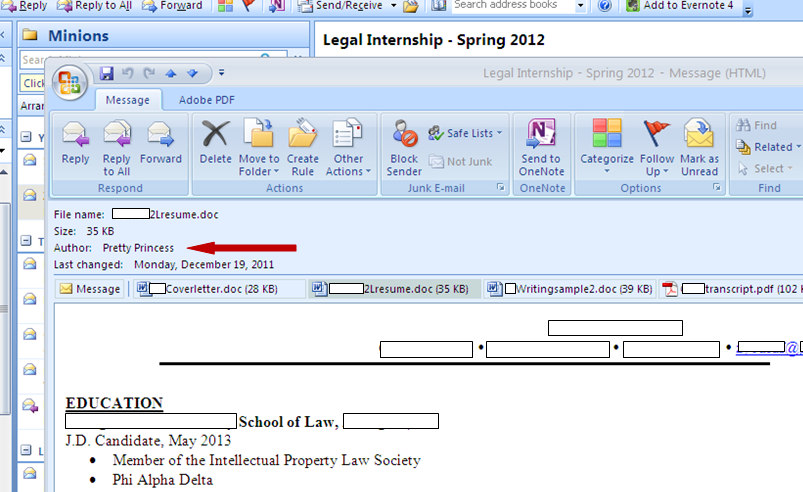
But unfortunately for this law student, when a Word document is viewed inside of Microsoft Office, the Author tag is fairly prominently displayed:

Poor dude. I’m guessing he doesn’t realize he’s been going around submitting a resume that claims to be written by Pretty Princess. (And I can only wonder how many times over the years I have made this exact same mistake myself…)

In case you’re wondering, you can find out how to change the author name for Word documents over here.

-Susan

The Gay Agenda on Trial: Glowacki v. Howell Public School District

Last year, Michigan high school teacher Jay McDowell kicked a student out of his classroom, for what the teacher described as disruptive behavior. Normally, the rest of the world would never have heard of this event; kids get kicked out of classrooms for being disruptive every day, and very rarely does it make headlines. McDowell, however, kicked a kid out of his classroom after the student, Daniel Glowacki, made statements to the effect that he found gay rights offensive, and that he would not accept gay individuals.

This was immediately seized upon as evidence of the homosexual agenda in action, with opponents of McDowell touting it as proof that “gay rights” are trampling religious freedoms across the land. McDowell’s defenders, on the other hand, described his decision to remove the student as appropriate, believing that the student’s behavior was disruptive and hostile to other students. The school board initially chose to suspend McDowell for one day without pay as a result of the incident, but later reversed its decision.

The matter had died away after that. Until last Friday, when the student’s mother, represented by the Thomas More Legal Center, a “public interest law firm dedicated to the defense and promotion of the religious freedom of Christians”, filed suit against McDowell and the school district over the incident, alleging that her sons’ Constitutional rights were violated. A copy of the complaint can be found here.

The purpose of the suit isn’t the plaintiff’s material gain, but rather a chance to get a court order prohibiting public schools from restricting students’ rights to make anti-gay statements while at school. Richard Thompson, president of the Thomas More Law Center, had stated that the purpose of the litigation is to defend “religious opposition to homosexuality”:

“This case points out the outrageous way in which homosexual activists have turned our public schools into indoctrination centers,” said Thompson. He said by utilizing the tyranny of political correctness, homosexual activists “are seeking to eradicate all religious and moral opposition to their agenda.”

Despite the media coverage surrounding the case, however, the plaintiff in Glowacki v. Howell Public School District is not actually asserting any claims based directly upon freedom of religion. Rather than invoking the Free Exercise Clause, the plaintiff is instead alleging (1) that the defendants deprived students of their First Amendment rights to free speech by punishing Glowacki for expressing his refusal to accept homosexuality, and (2) that the Defendants violated the Equal Protection Clause of the Fourteenth Amendment “[b]y favoring speech that approves of and promotes homosexuality over Plaintiffs’ religious speech.” (The EPC claim is based on an infringement of Glowacki’s fundamental Free Speech rights rather than his group membership, as “people who have a religious viewpoint critical of homosexuality” is not a class that can invoke the court’s heightened scrutiny.)

The reason Glowacki’s case is a free speech case and not a free exercise case is obvious: his claims are far more compelling when brought under the rubric of free speech than they are when presented as religious freedom claims. In places, the Complaint does in fact invoke the specter of religious freedom as support of his claim for relief, but they are the weakest portions of Glowacki’s pleading. In short, Glowacki’s case, to the extent that it is based on religious freedoms, is that, as a Catholic, he has “a duty and obligation to defend [his] faith in public, including a duty to speak the truth about homosexuality” (Complaint, at para. 46) — that ‘truth’ being that “homosexual acts [are] acts of grave depravity, [and] that homosexual acts are intrinsically disordered” (Complaint, at para. 45).

But this is not a “duty and obligation” that the Constitution recognizes. There is no special Constitutional protection for a religious belief that “compels” you to affirm your disapproval of your fellow classmates every time the subject of their identity is mentioned. For instance, someone who claimed his religious beliefs compelled him to believe that Jews deserved to be exterminated would not thereby acquire a right to announce such a belief every time the subject of the Holocaust came up in class.

And so Glowacki focuses on free speech, not free exercise. But although Glowacki’s free speech claims are legitimate under the facts he has alleged, his Complaint is still pretty appalling in many respects. For instance, it describes the school district’s anti-bullying campaign as “a day in which activists exploit the tragic suicidal deaths of homosexual teenagers to promote acceptance of homosexuality in the public schools.” (Complaint, at 26). It also refers to the “pro-gay agenda” seven times, and comes off sounding rather paranoid in the process. Worse still, it repeatedly describes the suicides of kids who were bullied due to their perceived sexual orientation as “teenagers who committed suicide because they were homosexual. ” (Id., at 39). The Complaint continues to win itself no favors when it alleges that “the purpose of the ‘anti-bullying day'” is “to shift the blame for the destructive lifestyle of homosexuals to those who believe it is wrong and immoral”. In other words: gay students deserve to be harassed, and any harassment they receive due to their sexual orientation is their own fault for being gay.

But as unpalatable as the Complaint is, assuming everything it says as true, Glowacki likely does have a case. That is a pretty big assumption to start from, however; although both Glowacki and McDowell do seem to agree on some of the central facts in the dispute, the parties are diametrically opposed as to what the general tone of the exchange was, or what the intentions of the parties were. And here, the tone of the exchange is everything.

Rather than breaking new legal territory, I expect this will ultimately be a heavily fact-based case. Comparing the claims of the two sides, however, gives an indication as to where this suit is headed:

Plaintiff Glowacki’s Story:

47. On October 20, 2010, during his sixth hour economic class in which Plaintiff D.K.G. was a student, Defendant McDowell explained to the students that it was the national “anti-bullying” day and that the students were going to watch a movie about teenagers who committed suicide because they were homosexual.
48. At the beginning of the instruction and in front of the entire class, Defendant McDowell confronted a female student who was wearing a Confederate flag belt buckle. Defendant McDowell directed the student to remove the article of clothing because he considered it offensive. The female student had worn this belt and buckle to class on several prior occasions without receiving a reprimand.
49. In light of Defendant McDowell’s opening remarks to the student about “antibullying” day and tolerance, Plaintiff D.K.G. raised his hand and asked Defendant McDowell why it was permissible to display a rainbow flag, which is offensive to some people, but not a Confederate flag, which Defendant McDowell found offensive.
50. Offended by the question, Defendant McDowell curtly responded by stating that the rainbow flag represents the gay community, but the Confederate flag “represents killing people and hanging and skinning people alive,” or words to that effect.
51. Defendant McDowell then asked Plaintiff D.K.G. whether he “supported” or “accepted gays,” or words to that effect. Plaintiff D.K.G. responded by stating that his religion does not accept homosexuality and that he could not condone that behavior. Angered by the response, Defendant McDowell told Plaintiff D.K.G. that his religion was “wrong,” or words to that effect, and ordered Plaintiff D.K.G. to leave his classroom under threat of suspension.
52. After ordering Plaintiff D.K.G. to leave the classroom, Defendant McDowell asked the remainder of the class whether anyone else did not accept homosexuality. A student raised his hand, and Defendant McDowell ordered him out of the classroom as well.

Defendant McDowell’s Story:

At the beginning of my 6th hour students asked what the “Tyler’s Army” t-shirts were about. This led to the beginning of a discussion about anti-bullying. It was a discussion about not bullying anyone due to race, ethnicity, gender, sexual orientation, or social status. One female student entered the class wearing a Confederate Flag belt buckle. This student knows that I have not allowed Confederate Flags in my class. She sits in the front row. I asked her to remove the belt buckle and she did so without incident. At this point, a male student raised his hand and asked why she had to remove the belt buckle. I explained that the Confederate Flag is often seen as a symbol of discrimination. The student then said “well Gays get to fly their rainbow flag.” This was a disruption to the classroom environment. I explained the rainbow flag is not a part of the discussion and that it hasn’t been associated with lynchings, mob violence, or discrimination in the way that the Confederate Flag has been. The student then said, “I don’t accept Gays.” Obviously this was an inappropriate thing to blurt out in class and had no place in the discussion. I told him he could not say that in class that it was inappropriate. He asked, “Why? I don’t accept Gays. It is against my religion. I am Catholic.” I said that was fine it was against his religion but that that statement was inappropriate to say in class. I became concerned at this time as there were students in the class that his comment would affect in an adverse way. There were at least ten students in the class wearing purple on that day. I related the situation to discrimination against African-Americans. I explained to the class that just as you can’t say, “I don’t accept blacks” in class you can’t say “I don’t accept Gays” in class. You can have whatever religious beliefs you want but there are statements that are inappropriate to say in class. I suspended him from class that day and wrote up a referral for unacceptable behavior. Another male student walked in at that moment and said loudly, “well I don’t accept Gays either can I leave.” I said, “yes get out.” Both students were insubordinate in class and caused a disruption of the class.

The accounts do overlap, but the differences between them are determinative. Under Glowacki’s version of the facts, he wins. Under McDowell’s version, he was in the right. So whose story is true?

It is not clear one way or another, at this stage of the proceedings. However — and while I am aware that my biases are now shining through bright and clear here — I have severe doubts about Glowacki’s ability to prove his version of events. Glowacki’s story just doesn’t pass the smell test: a kid that that speaks up to defend a classmate’s prerogative to display the Confederate flag in class is not a kid that then will follow up by opposing gay rights by demurely stating that “he could not condone that behavior.” In fact, the Complaint completely dodges away from identifying the actual language used by Glowacki in the exchange, leaving the student’s own words vague and unspecified. But note that the Complaint portray McDowell’s words as if they were direct quotes — only to then hide behind the disclaimer that McDowell’s statement might actually have just been “words to that effect,” rather than the actual words used. Meanwhile, the Complaint only paraphrases Glowacki’s own statements, thereby framing him in as inoffensive a manner as possible.

Although I do think it seems likely that McDowell overreacted in dismissing Glowacki from the classroom, my bet is that Glowacki was in fact being disruptive at the time, and was not merely expressing his religious views in a respectful fashion. It was Glowacki, remember, that initiated the exchange when he, unprompted, decided to equate a gay rights symbol with the Confederate flag. As a native Georgian, I am well aware that individual perceptions of the stars and bars can and do vary, but even the most charitable part of me is very skeptical that there is an innocent justification for a kid from Michigan to be defending the right to display the Confederate flag. Moreover, Confederate flags were not a neutral symbol to this student body — a year prior, a group of students at Howell had used school computers to create a racist facebook group that used a confederate flag as its icon:

The group’s Web page displayed an image of the Confederate flag along with this message:

“If you hate a certain type of anybody black, white, pink, yellow or polka dot (you) should join. This shows you are a rebel and proud of it.”

Given this background, I’d say Glowacki’s got an uphill battle in proving that his statements were as innocent and non-disruptive as he claims.

And the precise words Glowacki used — and the tone in which he said them — matters here, a lot. For instance, several unsubstantiated reports about the incident have stated that other students in the class reported Glowacki saying “those faggots” during the course of the exchange. The reports state that these statements were made only to classmates, however. But if, for example, McDowell had actually heard a student make statements to that effect, then the case would be open and shut. McDowell would have been on firm ground in removing Glowacki from the classroom, as schools are permitted to suppress vulgar and obscene speech, which “those faggots” would very arguably fall under. See Bethel School District v. Fraser (1986).

But assuming vulgar language was not used, the most obviously applicable precedent to this case is the Supreme Court’s decision in Morse v. Frederick (2007), a.k.a. the “bong hits 4 jesus” case. In Morse, the school was found to have a compelling interest in suppressing student speech that promoted illegal drug use. In Glowacki, the school could argue instead that its compelling interest was in suppressing speech that promotes bullying — a particular pertinent interest, given the recent attention bullying and teen suicide have received in the media in the past few years.

And discouraging bullying based on sexual orientation has already been found to be not just a compelling interest for school officials, but rather an affirmative obligation. In Flores v. Morgan Hill (2003), the 9th Circuit found that school officials were liable for failing to make any attempt to prevent persistent bullying of students that were perceived by their peers to be gay — and moreover, those school officials were not entitled to qualified immunity. Glowacki’s legal arguments, if correct, would therefore put public schools between a rock and a hard place; they would be required to protect students not only from the anti-gay animus of their classmates, but would also be required to protect students’ rights to express anti-gay animus in class.

Due to the similarities in the school official’s interests in both cases, Morse would seem to be highly determinative when it comes to Glowacki’s case. Re-wording Alito’s concurrence in Morse to change the compelling interest from discouraging drug use to discouraging bullying, you get a straight-forward defense of McDowell’s actions:

[D]ue to the special features of the school environment, school officials must have greater authority to intervene before speech [that declares gays to be “unacceptable”] leads to violence [and bullying]. And, in most cases, Tinker‘s “substantial disruption” standard permits school officials to step in before actual violence erupts.

Speech advocating [the ostracizing and disapproval of gay students] poses a threat to student safety that is just as serious, if not always as immediately obvious…. I therefore conclude that the public schools may ban speech advocating [anti-gay animus, in a disruptive fashion]. But I regard such regulation as standing at the far reaches of what the First Amendment permits

This is not to say that any speech that is pro-drug or anti-gay can be suppressed under the Morse framework; a paper advocating legalization of marijuana or arguing that Catholicism does not condone non-procreative sex could not be prohibited due to safety concerns.

This is why Glowacki v. McDowell will ultimately be decided on the facts, not the law. If Glowacki was being belligerent and hostile when he declared that gay rights were offensive to him, McDowell was justified in eventually removing him from the classroom under Morse when he continued to state that “I do not accept gays.” If instead Glowacki’s expression of religious belief was made in a non-disruptive manner, and particularly if his statement was made in response to a direct question from the teacher soliciting his views, then Glowacki should prevail.

So facts are everything, here. But luckily, as this all took place in a classroom, there should at least be quite a few eye-witnesses available to testify. I hope the Thomas More Law Center is looking forward to deposing a couple dozen teenagers — I bet that will be just loads of fun.

-Susan

An Inquiry Into the History of First-Person Shooter Video Game Villains, Pt. 3

The third and final segment! Continued from An Inquiry Into the History of First-Person Shooter Video Game Villains, Pt. 2.

4. Speculative Warfare (circa 2008 – present)

Because ultra-realistic FPS games are a marketing time bomb, and because of the awkward gameplay moments that will inevitably arise when your setting involves U.S. forces fighting against a real world enemy, ultrarealistic FPS games have now moved on to the fourth and present-day era: speculative warfare. Like the games of the two previous waves , speculative warfare games feature wars between real nations and real human organizations. However, instead of recreating past or current wars, these games are set in the present or near future, and involve hypothetical conflicts between existent nations.

As always, Russia is the common denominator. Even with the Cold War two decades dead, video games have no shortage of creativity when it comes to finding ways to, once again, make Russia the villain. Just like how the historical reenactment games rewrote history to make Soviets the bad guys, speculative warfare games warp modern day international relations into unlikely scenarios where Russia is the evil invading force. For instance, in Battlefield: Bad Company 1 (2008) and 2 (2010), the player is thrown into the midst of a modern day war between the Russian Federation and the United States, with little time wasted on explaining how such a conflict could ever come to pass. In contrast, Modern Warfare 1 (2007), 2 (2009), and 3 (forthcoming – 2011) at least try to give some plausibility to their story lines, by inventing the rebel Russian Ultranationalist Party to explain how Russia suddenly becomes an active world threat again. (Although the rumor mill falsely claimed MW2 had been banned in Russia, the developers did take out a scene allowing players to shoot civilians in the Moscow airport. Although shooting Russian civilians was deemed too much for the Russian market, simply having Russia be a villain is not a problem.)

Still other games go for the hybrid Russian villain, by mixing elements of historical military fears with modern day anxieties, and team Russia up with a more likely antagonist nation. For instance, in Frontlines: Fuel of War (2008), you have the Western Nations fighting against the “Red Star Alliance” — the mighty pseudo-superpower duo of Russia and China. Likewise, Rogue Warrior (2008) also uses Russia, but teams it up with North Korea and a nuclear weapons smuggling program.

Having Russia be the villain for speculative warfare plots opened the door for other nations to become the hypothetical villain. Russian markets never seem to mind when Hollywood or U.S. game developers choose them to be the bad guy, and the trope is so common as to be beneath notice by any diplomatic instruments. But Russia is sui generis, when it comes to the lack of controversy caused by casting it into the villain’s role. Having other nations fill in for the bad guy is not nearly so straightforward. It is not hard to see why — having major U.S. and other Western nation game developers declare that they can foresee ostensibly friendly or neutral nations as likely enemies in a U.S. military conflict necessarily carries some uncomfortable implications.
Continue reading

Kellogg’s Wrongfully Claims Ownership of All Depictions of Toucans Used in Commerce

There are more than 40 species of toucan in the world, featuring a diversity of sizes, feather patterns, and beak colorations. But the Kellogg Company, maker of children’s breakfast cereal Froot Loops, thinks that it owns the sole right to use toucans in commerce — any kind of toucan, no matter what it looks like. In fact, Kellogg’s believes that they are the only company allowed to even use the brand name “toucan”, or anything that even kind of vaguely sounds like “toucan.”

The Maya Archaeology Initiative's logo

The latest victim of Kellogg’s trademark overreach is the Maya Archaeology Initiative (MAI), a nonprofit that defends and promotes the study of indigenous Maya culture. Kellogg’s is opposing registration of MAI’s logo, claiming that its inclusion of a toucan is an illegal infringement on Kellogg’s Toucan Sam character.

The Maya Archaeology Initiative’s logo features a stylized keel-billed toucan in front of a Mayan pyramid.

In contrast, the Froot Loops mascot, Toucan Sam, is an anthropomorphic blue bird that has no immediately recognizable analog in nature, except possibly some kind of dodo bird/blueberry hybrid. The only toucan species that Toucan Sam bears even a plausible resemblance to is the plate-billed mountain toucan, which is a different genus all together from the more commonly depicted toco toucan or keel-billed toucan. Literally the only thing Toucan Sam has in common with the MAI’s logo is that in both cases the bird depicted is intended to be some kind of toucan.

Toucan Sam

Nevertheless, Kellogg’s has filed a Notice of Opposition to MAI’s registration of its toucan-and-pyramid logo, alleging that

Applicant’s TOUCAN BIRD DESIGN mark so resembles Opposer’s TOUCAN marks as to be likely, when applied to the goods of Opposer, including Opposer’s wide range of licensed goods, including clothing, to cause confusion or mistake or to deceive purchasers resulting in damage and detriment of Opposer and its reputation. In this regard, it should be noted that Opposer’s TOUCAN SAM Marks are frequently displayed in connection with depictions of a jungle theme including Mayan temples and surrounding vegetation. Thus, use of the Mayan pyramid in the Applicant’s TOUCAN BIRD DESIGNS is likely to further strengthen the public’s connection of Applicant’s design with Opposer’s famous TOUCAN equities.

Kellogg’s isn’t just claiming that it owns toucans. It especially owns toucans displayed in Mayan temples and vegetation!

Continue reading

Bush League Judicial Opinions

After seeing Michael’s post about Judge Spark’s order inviting counsel to a kindergarten party to teach squabbling counsel about how to resolve discovery disputes without oversight, I was curious about whether any other judge had ever used the phrase “kindergarten party” in a written opinion. While I agree with Michael that Judge Spark’s opinions go too far, and are too cruel and targeted to be appropriate, I do think there is a time and a place in judicial opinions for informal turns of phrase. Plus, it is always pretty entertaining when judges try and fail to sound “hip,” by wrongly employing the lingo that all the cool kids are using these days.

As it turns out, no one but Sparks has busted out the term kindergarten party, at least not in any reported order. So I looked into whether any similar phrases were in use, and found that no judge has ever sunk so low as to use the term “weaksauce” in a judicial opinion, and only one or two have referred to conduct as being “amateur hour.”

But I was pleased to see that quite a few judges have seen fit to use my personal favorite synonym for kindergarten party behavior, and have described litigants and attorneys alike as being “bush league.” Among those using the phrase are judges from the Mississippi Supreme Court (“I do not approve of what defense counsel did in this case, but compared to what happened in Cole, Darby’s lawyer is in a bush league. Darby v. State, 538 So. 2d 1168, 1178 (Miss. 1989)), the 7th Circuit (“But the confession was the beginning of the cooperation, for it was the confession that revealed that Rutledge was involved in more than bush-league drug dealing.” United States v. Rutledge, 900 F.2d 1127, 1131 (7th Cir. 1990)), and the 5th Circuit (“The betting began with bush-league sums in early June, 1970.” United States v. Burke, 495 F.2d 1226, 1230 (5th Cir. 1974)).

The 10th Circuit has joined in to — even accompanying its use of the phrase with a pretty terrible pun:

“Arguably, an etymologist would place the terms ‘slime’ and ‘sleazebag’ in the same league as ‘scum’; perhaps a bush league rather than a professional league, but nonetheless the same league.” Henderson v. Times Mirror Co., 669 F. Supp. 356, 361 (D. Colo. 1987) aff’d, 876 F.2d 108 (10th Cir. 1989).

Sadly, the 10th Circuit appears not to understand its own analogy, given that the whole point of having a bush league and a pro league is that the two are not, in fact, part of the same league.

And here’s a fairly scathing quote from a Massachusetts Superior Court:

“However, within my discretion, I find that a litigant’s right to access to the appellate courts is so important and so sacred that the blatant and transparently bush league contumacious conduct of Bruce D. Amster in attempting to avoid a creditor’s judgment doesn’t qualify for cutting off his appellate rights even though his conduct is flagrant[.]” John P. Kendall v. Hyannis Restorations International Sales, Inc., et al., Superior Court of Massachusetts

My new goal for the day: find an excuse to use the phrase “transparently bush league contumacious conduct”.

And here are some final quotes, attesting to the judicial popularity of describing kindergarten party antics as bush league moves:

“Absent that, the cataloguing of every instance of intense disagreement between the parties over the life of an investigation and trial, be it claimed Brady violations or bush league recess interrogation of the courtroom gallery, contorts the Hyde Amendment into a vehicle for Monday morning quarterbacking Congress simply did not intend.” United States v. Ali, 06-CR-200 (ENV), 2008 WL 4773422 (E.D.N.Y. Oct. 27, 2008)

“In comparison to some of the more notorious cybersquatters, Rayne’s registration of roughly thirty domain names might seem bush-league. See H.R. Rep. 106–412, at 13 (noting that certain cyberpirates have been known to warehouse hundreds, even thousands, of domain names).” Savin Corp. v. Rayne, 00-CV-11728 PBS, 2001 WL 34815751 (D. Mass. Mar. 26, 2001)

“Legal academia may have unwittingly contributed to the common failure of counsel to brief thoroughly state constitutional issues by sometimes viewing them as the bush league of constitutional law.” Davenport v. Garcia, 834 S.W.2d 4, 21 (Tex. 1992)

And saving the best for last, we have what must surely be the absolute worst pun that has ever graced a federal court’s opinion, courtesy of the district court for the Southern District of New York:

“Of the magazines cited by defendants as undermining the PLAYBOY mark, PLAYBIRDS has no significance. PLAYBIRDS is a sex-oriented magazine but its style and content is bush league compared to PLAYBOY. It consists essentially of a series of pictures of unclad women with their legs open, exhibiting with dull redundancy the organ that PLAYBOY strives to make mysterious and interesting through suggestive display.” Playboy Enterprises, Inc. v. Chuckleberry Pub., Inc., 486 F. Supp. 414, 422 (S.D.N.Y. 1980)

-Susan