A Quick Personal Note

I got married this weekend, and while to say it was amazingly awesome would be a vast understatement, having a wedding is also kind of exhausting. So it will probably be at least a week before I will get around to posting a more substantive update to the blog. In the meantime, however, I wanted to share a video that was made by two of my favorite people in the entire world — the officiant/bridesmaid Babs and groomsman Tyrone, along with the help of a lot of awesome Australians. If I was the kind of person who did weaksauce things like cry or anything like that, they would have succeeded amazingly well at that:

Also it’s possible that I just wanted to brag about the clip shown at 4:16 of the video. That pretty much sums everything up.

But it is hard not to be painfully aware of the fact that, by getting married, I am availing myself to a privilege that far more deserving couples are wrongfully denied. And it is, quite frankly, complete bullshit, that I of all people should be permitted to marry, when others are not. This reading was included in the ceremony, and it bear repeating here:

Marriage is a vital social institution. The exclusive commitment of two individuals to each other nurtures love and mutual support; it brings stability to our society. For those who choose to marry, and for their children, marriage provides an abundance of legal, financial, and social benefits. In return it imposes weighty legal, financial, and social obligations… Without question, marriage enhances the welfare of the community. It is a social institution of the highest importance. Marriage is at once a deeply personal commitment to another human being and a highly public celebration of the ideals of mutuality, companionship, intimacy, fidelity, and family. It is an association that promotes a way of life, not causes; a harmony in living, not political faiths; a bilateral loyalty, not commercial or social projects. It is undoubtedly for these concrete reasons, as well as for its intimately personal significance, that civil marriage has long been deemed one of the basic civil rights of man, fundamental to our very existence and survival. Because it fulfills yearnings for security, safe haven, and connection that express our common humanity, marriage is an esteemed institution, and the decision whether and whom to marry is among life’s momentous acts of self-definition.

But a special thanks goes out to my co-blogger Mike, who did a fantastic job at giving a reading during the wedding ceremony… despite the fact that I never actually got around to sending him a copy of the text ahead of time, and he saw what he would be reading for the first time during the ceremony itself.

And an extra special thanks goes out to Mike’s awesome fiancée, Andrea. For taking charge of the situation during the reception when I managed to spill a bottle of stout all over my dress, and seeing to it that I was properly blotted down with club soda before any more permanent damage could be done. Top notch job there, Andrea.

-Susan

Why Alan Dershowitz Is Completely Wrong About the Zimmerman Case

Prof. Alan Dershowitz has gotten a lot of media attention lately for his claims that Special Prosecutor Angela Corey ought to be criminally prosecuted for her actions so far in the prosecution of George Zimmerman. Specifically, Dershowitz believes that the Affidavit of Probable Cause that was filed in support of the State’s Motion for Pretrial Detention on April 12, 2012, was “a crime.” In the Fox News interview where he made the comments, Dershowitz went so far as to suggest that Special Prosecutor Angela Corey ought to be hiring a lawyer to defend herself from potential criminal charges.

But Dershowitz’s claims are, to put it simply, completely wrong. His overblown accusations of criminal conduct on behalf of the prosecutors are not supported by the law, and there is absolutely no basis under which anyone could be charged with wrongdoing due to the specific acts that Dershowitz complains of. Dershowitz does not even attempt to identify any specific statutes or rules which may have been violated by the prosecutors. Instead, rather than providing any actual explanations, his accusations of criminal conduct are based on nothing more than a few empty declarations to the effect that “this is the justice system” and “the truth, the whole truth, and nothing but the truth.”

Which sounds nice and everything, but making broad statements about principles is not the same as actually providing support for a specific claim. It is more along the lines of a cheap rhetorical trick than a legal argument.

Dershowitz’s Fox News interview was devoid of any intellectual content; unsurprising, perhaps, given the context — this was a primetime news network interview, not a law review article — but  many commentators are parroting the claims he made as if they were asserted by Dershowitz-the-legal-scholar, rather than Dershowitz-the-conservative-news-show-pundit. I am reasonably confident that Dershowitz would never put in an academic article many of those same claims that he was willing to say on national TV.  Although to be fair, even in the interview, Dershowitz did try to carefully qualify some of his more unsupported assertions — he had to have known that what he was claiming, left unqualified, was bordering on the ridiculous. But unfortunately, the careful nuance Dershowitz did include has been uniformly ignored, while his aggressive and unsupportable soundbites have been repeated a hundred times over.

So, what did Dershowitz get wrong? To start with, Dershowitz seems to be speaking out of a feigned ignorance for criminal law in general, as well as a complete ignorance for the specific Rules of Criminal Procedure enacted by the state of Florida. The prosecution’s handling of the initial pretrial detention hearing, along with the Affidavit of Probable Cause that Dershowitz calls “a crime,” was completely and utterly routine; the State was doing the same thing it does every day, for all of the defendants it charges with crimes, in all of the cases it handles.

The particular affidavit that Dershowitz ascribes so much profound significance to is in fact of little procedural significance and absolutely no substantive significance, and the prosecution is not required to do any of the things Dershowitz suggests in his interview. To clarify, an Affidavit of Probable Cause, submitted in conjunction with a pretrial probable cause determination under Rule  3.133 of the Florida Rules of Criminal Procedure: (1) is not a formal charge; (2) is not subject to normal evidentiary rules or standards; and (3) is not used to disclose the State’s case against the accused, and as a routine matter the State attempts to provide as little of the State’s evidence as possible in such affidavits, providing only what is necessary to demonstrate probable cause.

Simply put, “[a] preliminary hearing is for the purpose of determining if probable cause exists to hold one accused of a crime for trial. Such a hearing is not a critical stage in the proceedings.” Anderson v. State, 241 So. 2d 390, 392-93 (Fla. 1970). At these initial hearings, “the strict rules of evidence are not enforced … and no formal charges are existing or filed against the defendant. The whole proceedings partake of the nature of an inquiry and, outside of being conducted by a magistrate (perhaps in a court house), bears little or no resemblance to a trial.” Davis v. State, 65 So. 2d 307, 308 (Fla. 1953).

Contrary to Dershowitz’s unsupported claims, it is expected, normal, and proper for everything but the bare bones case for probable cause to be left out of a probable cause affidavit, whether it be in support of a warrant or a pretrial preliminary hearing. See Perry v. State, 842 So. 2d 301, 303 (Fla. Dist. Ct. App. 2003) (“Florida Rule of Criminal Procedure 3.133(a)(3) states that … the court should apply the same standard as is required for issuing an arrest warrant.”). The Probable Cause Affidavit filed against Zimmerman is in no manner unique or somehow lacking, as compared to the probable cause affidavits filed in every other criminal manner. In any matter where more than a modicum of investigation has been done, such affidavits essentially never include the State’s full case against the accused. So if Dershowitz was right about the State’s requirements in filing such an affidavit, it is not just Angela Corey that ought to be looking for an attorney; every prosecutor in the U.S. ought to be doing the same as well.

But of course that is not how it works. True, if the prosecution had put any fabrications in the Affidavit of Probable Cause, there would be a very real problem. But Dershowitz is not actually claiming that occurred — although he alludes to the existence of such fabrications or misstatements, i.e., announcing “you don’t indict based on false information,” his actual claims of prosecutorial wrongdoing focus on omissions from the affidavit only.

But the State is not, under any possible interpretation of the law, required to include all potentially exculpatory evidence at the initial pretrial probable cause hearing. The Florida Rules of Criminal Procedure are specifically geared towards a system where such pretrial detention hearings are brief, cursory, and exist only to establish probable cause prior to the court setting bail for an accused. These hearings are not intended to be anything more strenuous, and if the State was required to produce every scrap of evidence in a case within 24 hours of making an arrest — which, in a case like Zimmerman’s, is the amount of time provided after an arrest before the pretrial hearing must occur — the whole system would quickly break down. For most homicide cases where the accused is apprehended at the scene of the crime, by the time the probable cause hearing occurs the investigation is less than 24 hours old, and the investigators have only the bare bones of a case thrown together, if that.

So while the existence of misstatements or fabrications in a pretrial affidavit would definitely be a problem, the failure to give “the whole truth” in such an affidavit is a routine and unobjectionable matter:

 “[M]isstatements are fundamentally a different problem than omissions. Some omissions may be ‘intentional’ but also reasonable in the sense that they exclude material police in good faith believed to be marginal, extraneous, or cumulative. Such an exclusion is a valid and necessary part of the warrant process. Moreover, some omitted information is simply overlooked in the exigencies of the moment without intent to deceive or recklessness with respect to the truth. The State and the defense reasonably may disagree as to the import and effect of the large amount of information that necessarily will be omitted in the warrant process, since police routinely collect far more information than goes into the affidavit.” Johnson v. State, 660 So.2d 648 (Fl. 1995).

Omissions are only a potential issue where the state has withheld information that can absolutely defeat probable cause; evidence that is inconclusive, even if arguably supportive of claims that the accused may raise at trial, is not required to be included. It is not a 4th Amendment violation, or any other kind of violation, to leave out exculpatory but immaterial evidence from a probable cause affidavit. Exculpatory evidence is only considered material where the State can be presumed to have omitted such information because it knew that, were that evidence brought to light, probable cause would be destroyed. As Florida case law has held, “[t]he omitted facts are only material if there is a substantial possibility that had the magistrate been aware of the omission he would not have found sufficient probable cause for issuance of a warrant.” State v. Van Pieterson, 550 So.2d 1162 (Fla. 1st DCA 1989). See also Johnson, 660 So.2d 648 (finding that omissions in a probable cause affidavit can only amount to a constitutional violation where “[(1)] the omitted material, if added to the affidavit, would have defeated probable cause, and (2) … the omission resulted from intentional or reckless police conduct that amounts to deception.”).

So the next question is, were the omissions from the Affidavit of Probable Cause that Dershowitz objected to “material”?

Hardly.

Dershowitz’s first argument for why the affidavit was “a crime” is that it does not include the cellphone captured photo of Zimmerman’s head that was taken in the minutes following the shooting. Dershowitz states that “if [Prosecutor Corey] in fact knew about ABS News’ pictures of the bloody head of Zimmerman and failed to include that in the affidavit, this affidavit is not the truth, the whole truth, and nothing but the truth.” But the omission of this photo is about as ridiculously far from a material omission as it gets, for the following two reasons:

1. The prosecution does not appear to have seen the photo until eight days after the affidavit was submitted to the court. The Affidavit of Probable Cause was submitted to the court on April 12th, and was executed the day before on April 11th. The ABC News photograph of Zimmerman’s head was not released until the day of Zimmerman’s bond hearing, on April 20th. The photograph was taken on a cellphone by a friend or neighbor of Zimmerman’s, and there is nothing suggesting that the photo was released to investigators before it was given to ABC News.

2. Even if the prosecution did have the ABC News photo, there is absolutely no requirement that the photo be included in the Affidavit of Probable Cause. The photo Dershowitz harps on will likely be important at later stages of proceedings, but it is basically irrelevant as far as probable cause goes. The ABC News video shows that Zimmerman had blood on the back of his head after he shot Trayvon Martin. As the first police officer to respond to the scene had clearly noted in his report that he observed blood on the back of Zimmerman’s head, this is not evidence of previously undisclosed facts. It is further evidence in support of previously asserted facts. Moreover, there is nothing inherently shocking or probative about the fact that someone who was part of a hand-to-hand struggle, for over a minute, would be bleeding from a wound.

Zimmerman could easily have more extensive injuries than what is shown in the ABC News photo, so the photograph is not dispositive evidence that such injuries do not exist. However, the photo itself does not show the existence of life threatening injuries, let alone anything that could destroy probable cause. It just shows that Zimmerman was injured in a fight. Zimmerman being injured in a fight is not in any way inconsistent either with the State’s theory of the case or with the charges that have been brought against him, and therefore, even had the prosecution actually had the photo in their possession on April 12th, there was absolutely no purpose or reason for including it in the affidavit.

Not a single exhibit was attached to the Affidavit of Probable Cause. Nevertheless, Dershowitz has apparently decided it is “a crime” that this particular photo did not get included — even though there was no inculpatory documentation included either. Unsurprisingly, Dershowitz offers absolutely no legal authority to support his claim of criminal wrongdoing in this instance, because no such authority exists.

Dershowitz’s second argument for why the affidavit is a crime is that it fails to  “describ[e] the fact there is evidence that during the struggle, Martin may have been on top, Zimmerman on bottom.” This too is a baseless assertion, because such evidence — even if it were somehow a confirmed fact rather than yet another version of already conflicting witness accounts — would also not defeat probable cause.

But this omitted “fact” is not a fact at all. True, hearsay evidence is permitted at a pretrial detention hearing (so long as it is not the exclusive evidence), so theoretically evidence that Zimmerman was pinned by Trayvon could be admissible at this stage. However, the evidence that supports that theory comes from two sources — from Zimmerman himself and from the confused and contradictory reports of the six 911 callers. Zimmerman’s own testimony is obviously insufficient to defeat probable cause, or else we’d never be able to lock up any defendant. And the 911 callers’ testimony cannot possibly be said to defeat probable cause either, as the omission of a witness’s testimony that is contradicted by other witness’s testimony is not a material omission. That is, the fact that one out of six 911 callers saw Trayvon on top of Zimmerman does not eliminate a finding of probable cause, because it is only one possible testimony out of six available testimonies, the comparative veracity of which cannot be determined at this time.

Again: it is ridiculous to claim that it is criminal misconduct for a pretrial probable cause affidavit not to include to the specific details of every available witness’s statement about the incident.  Of those six calls, some can be interpreted to support Zimmerman, some to inculpate him, and others to show only that the callers were completely confused. Instead of reciting the specifics of each witness’s testimony, the affidavit of probable cause summarizes them all into an accurate but unspecific summary: “witnesses heard arguing and then a struggle.” The fact the specific testimony of each one was not included does not make the omission “material” in any respect, as the pro-Zimmerman witnesses are balanced out by the ones that support a finding of his guilt.

So, in conclusion, while I have tried to explain in this post why Dershowitz’s allegations of criminal misconduct are legally incorrect, I probably did not need to spend half so long in doing so — because, after all, Dershowitz has not made any attempt to actually defend his claims on legal grounds. Which is fine, because Dershowitz was speaking on Fox News as a commentator, not a legal expert — he was giving a statement of his beliefs about the equities of the situation, not his analysis of the law. The problem is that a lot of people appear to have taken Dershowitz’s comments as a pronouncement on Florida criminal procedure — when in fact he was not addressing anything of the sort.

Update, 6/8/12: A few days ago, Dershowitz wrote an article stating that Angela Corey called the Harvard Law School and spoke to the Office of Communications, where she “proceeded to engage in a 40-minute rant, during which she threatened to sue Harvard Law School, to try to get [Dershowitz] disciplined by the Bar Association and to file charges against [him] for libel and slander.”

Making such a call was both unprofessional and ill-advised on Corey’s part, no matter what discussion occurred, but I am somewhat skeptical of Dershowitz’s account of the incident. Not only was the call related to him by a third-party, leaving room for confusion over what she actually said, Dershowitz’s article lets his own petulant streak shine through, littering his claims with snide jabs such as “[s]he persisted in her nonstop whining” and “[s]he should go back to law school.”

But even though Corey was wrong in making the call, it does not change the fact that Dershowitz’s own credibility and judgment ought to be under scrutiny for his decision to double down on his false accusations against Corey. Dershowitz steadfastly refuses to provide any supporting evidence for his legal claims. In contrast, the only Florida criminal attorney I’ve seen that has spoken on the matter has stated that Corey’s actions are fully permitted under Florida law. It is, unfortunately, not from a totally unbiased source, but it is still the opinion of an actual practitioner, which is more than Dershowitz has provided:

Richard Kuritz, a former prosecutor who worked with Corey but now works as a defense lawyer, supported her position. Kuritz said Corey had no obligation to include exculpatory evidence in the affidavit.

Kuritz said some of the public that once praised her for arresting Zimmerman has now turned on her as evidence that may support the defense, as there is in most cases, is being made public.

“The only reason Dershowitz has an argument to make is because she’s doing everything ethically she’s supposed to do: She’s turning over the evidence she’s supposed to,” Kuritz said.

Dershowitz’s accusations about Corey “misleading” the judge are even less believable in such a high profile case as this one, as information regarding what evidence investigators did or did not find is all over the media. The judge was not oblivious to the facts that existed outside of the probable cause affidavit — indeed, the only reason Dershowitz knows about the facts that he alleges were “perjuriously omitted” is because they have been made publicly known. The judge was hardly unaware of them, although as they were irrelevant to the probable cause hearing, such extraneous information would not play much of a role in the judge’s decision making process.

Dershowitz has still failed to cite to even a single court decision, Florida rule of criminal procedure, or rule of professional conduct that would support his claims of prosecutorial misconduct. Instead, Dershowitz continues to engage in overblown grandstanding (“If Angela Corey doesn’t like the way freedom of expression operates in the United States, there are plenty of countries where truthful criticism of prosecutors and other government officials result in disbarment, defamation suits and even criminal charges.”) and false equivalencies (“The prisons, both in Florida and throughout the United States, are filled with felons who submitted sworn statements that contained misleading half truths.”). His attempt to equate Corey’s conduct with Zimmerman’s is particularly thin:

Ironically, Corey has now succeeded in putting Zimmerman back in prison for a comparably misleading omission in his testimony. His failure to disclose money received from a PayPal account requesting donations for his legal defense made his testimony misleadingly incomplete.

In her motion to revoke his bail, Corey argued that Zimmerman “intentionally deceived the court” by making “false representations.” The same can be said about prosecutor Corey. She too misled and deceived the court by submitting an affidavit that relied on a review of photographs and other reports that showed injuries to Zimmerman, without disclosing the existence of these highly relevant injuries.

Conspiring to make false claims to a judge for your own material benefit has absolutely nothing in common with failing to include the entirety of available evidence in a probable cause affidavit. Zimmerman did not give “misleadingly incomplete” testimony. Instead, he conspired with his wife to make false representations to the court, regarding the only material questions that are at issue at a bond hearing, which is the accused’s ability to pay and his risk of flight.

In contrast, the probable cause affidavit does not make any claim that would contradict the fact that Zimmerman had injuries when he was arrested. It also plainly notes that

[t]he facts mentioned in this affidavit are not a complete recitation of all the pertinent facts and evidence in the case but only are presented for a determination of Probable Cause for Second Degree Murder.

The probable cause affidavit did not speak of Zimmerman’s injuries for the obvious reason that it was a two-page summary of a case in which a simple review of the available data would easily requires hundreds of pages. There are thousands of things omitted in the probable cause affidavit — so why is Dershowitz focusing solely on the fact Zimmerman’s injuries were not mentioned? The probable cause affidavit provides that “a struggle ensued” and that witnesses heard “what sounded like a struggle.” As such, evidence that Zimmerman had injuries consistent with having been a participant in an unarmed struggle is not material evidence, and is fully consistent with the prosecution’s affidavit. If Zimmerman started the altercation with Trayvon, as alleged in the prosecution’s case, Zimmerman’s injuries are entirely irrelevant — if you start a fight and then get your nose broken, you are not entitled to shoot the other person and then raise the justification of self-defense. So even had Zimmerman’s injuries been briefed in full, the determination of probable cause could not have been affected.

I would say that, before Dershowitz makes any further false accusations of criminal conduct, he ought to check into what the law actually provides for regarding what is required to be disclosed in a probable cause affidavit. Except I am sure Dershowitz already knows exactly what the law requires in this area — but is choosing to indulge in attention-seeking rhetorical nonsense instead of providing his actual legal analysis of the situation.

-Susan

Entity Liability Under the TVPA and the ATS: Why the Supreme Court’s Decision in Mohamad Is Probably Irrelevant to Kiobel

Last week, the Supreme Court issued its opinion in Mohamad v. Palestinian Authority, et al., the TVPA case that was argued on the same day as Kiobel. The majority opinion, written by Justice Sotomayor, is a rather prosaic summary of Statutory Interpretation 101, and the opinion as a whole deftly avoids grappling with any of deeper questions of law that the TVPA could potentially implicate.

This is not entirely surprising, as the question before the court in Mohamad was relatively straightforward: does the TVPA’s authorization of suit against “[a]n individual” extended liability only to natural persons? The Court unanimously answered yes, citing the dictionary as its predominant authority for its conclusion. The Court also relies heavily on the perceived “ordinary usage” of the word ‘individual,’ noting that “no one, we hazard to guess, refers in normal parlance to an organization as an ‘individual.'”

Although Mohamad may be a heavily formalistic opinion, it is a hard to disagree with its conclusions. Given then TVPA’s structure, there just isn’t much need, or room, for nuance. Justice Breyer, in the decision’s only concurring opinion, did make a mild qualification of his decision, noting that the TVPA’s use of the specific word “individual” is insufficiently determinative by itself to justify a limitation on liability to natural persons. Breyer quickly moves to conclude, however, that the legislative history of the TVPA erases any doubt, and fully supports the Court’s ultimate decision.

In all likelihood, then, the decision in Mohamad will not give us much insight into how the Court will handle the question of corporate liability under the Alien Tort Statute. Although Mohamad v. Palestinian Authority, et al. and Kiobel v. Royal Dutch Petroleum have strong superficial similarities — a similarity plainly acknowledged by the Court through its decision to hear arguments for both on the same day — it seems likely that the Court’s ultimate decisions in those cases will have little relevance to one another. Sotomayor’s opinion in fact openly acknowledges the two cases’ dissimilar postures, noting that the ATS “offers no comparative value here regardless of whether corporate entities can be held liable[.]”

This is because entity liability under the TVPA, as addressed in Mohamad, involves a straightforward question of statutory interpretation. Entity liability under the ATS, in contrast, involves an extremely convoluted question of statutory interpretation coupled with an equally convoluted interpretation of  the law of nations. It doesn’t matter which side of the argument you take in Kiobel — for that, you’re never going to find the answer to prove your case in the pages of a dictionary.

And the statutory interpretation element is the less important prong, in examining the question of entity liability under the ATS. As the class of defendants is not defined by the ATS, the issue of corporate liability is not determined by reference to the legislator’s choice of language, but rather by reference to either Federal common law or to international law, or, more likely still, to some admixture of both.

Ultimately, the TVPA, unlike the ATS, is an almost purely domestic instrument. Although the TVPA indirectly incorporates international law in its definition of extrajudicial killing, and, in its preamble, specifically cites that the statute’s purpose is to carry out the U.S.’s obligations under international treaties, the TVPA is simply not a creature of the law of nations.

The TVPA was specifically designed by the U.S. Congress to accomplish certain specified domestic goals. If instead the TVPA had been drawn directly from international instruments, however, it seems very likely that a different conclusion would have been reached in Mohamad. In particular, Article 14 of the UN Convention Against Torture (“the CAT”) would seem to lobby in favor of vicarious liability in civil claims brought by torture victims:

 “Each State Party shall ensure in its legal system that the victim of an act of torture obtains redress and has an enforceable right to fair and adequate compensation, including the means for as full rehabilitation as possible.”

The CAT’s specification that states are to implement civil claims that provide for “an enforceable right to fair and adequate compensation” suggests that the CAT is concerned not simply with imposing punitive, quasi-criminal measures against torturers, but rather with implementation of an effective means for torture victims to be compensated for their injuries. A system of vicarious liability for torture is therefore more consistent with goals of the CAT as expressed in Article 14, as this would increase the likelihood of full reparations being made to torture victims. This is because vicarious liability is specifically geared towards making tort victims whole, whereas a system of pure individual liability emphasizes concern at seeing a wrong-doer punished.

Instead of incorporating this broad goal of repairing torture victims to the fullest extent possible, as articulated by the CAT, the U.S. Congress made plain its desire to see that only morally culpable wrong-doers were to be held financially culpable under the TVPA. This same legislative background is nonexistent when it comes to the ATS, however, making the Court’s analysis in Mohamad irrelevant to their ultimate determination of the similar question posed by Kiobel.

-Susan

The Statutory Basis of the Murder Charge Against George Zimmerman and His Available Defenses Under Florida Law

On April 11, 2012, over a month and a half after he shot and killed Trayvon Martin, George Zimmerman was charged with second degree murder for the 17 year old’s death. Zimmerman has since turned himself in to authorities, and is in custody pending a bond hearing. As an update to my earlier post on the timeline of events preceding Trayvon’s death, this post is a quick-and-dirty run through of the relevant statutory provisions that apply to the charges against Zimmerman, and the possible implications they may have.

Second Degree Murder vs. Manslaughter

To the surprise of many commentators, Zimmerman was not charged with manslaughter, as was widely predicted, but instead charged with second degree murder. Second degree murder, unlike first degree murder, does not require “a premeditated design to effect the death” of another person, but it still sets a higher bar than manslaughter:

Fla. Stat. Ann. § 782.04(2). Second degree murder.—

The unlawful killing of a human being, when perpetrated by any act imminently dangerous to another and evincing a depraved mind regardless of human life, although without any premeditated design to effect the death of any particular individual, is murder in the second degree and constitutes a felony of the first degree, punishable by imprisonment for a term of years not exceeding life[.]

Florida’s manslaughter provision is a general catchall for killings that are criminal, but don’t involve either the premeditation or the depraved mind of a murder charge:

Fla. Stat. Ann. § 782.07(1). Manslaughter.—

The killing of a human being by the act, procurement, or culpable negligence of another, without lawful justification according to the provisions of chapter 776 and in cases in which such killing shall not be excusable homicide or murder, according to the provisions of this chapter, is manslaughter[.]

The key distinction between the two is that the second degree murder charge requires a finding that Zimmerman killed Trayvon while engaging in an act “imminently dangerous to another and evincing a depraved mind regardless of human life.” Take that element away, and you still have the lesser included offense of manslaughter, so both charges are still theoretically on the table.

Unlike Murder 1, for a Murder 2 charge you do not need to show a premeditated plan, or a plan to kill that came into existence prior to the moment of the shooting. Murder 2 just requires that the defendant deliberately, and with so little justification as to be reckless, engaged in conduct that puts others at obvious risk of death or great bodily harm. To give a rough example, imagine an individual who, on a random whim, decides to throw a boulder off a cliff, when that individual knows that there is a path at the bottom of the cliff that people walk on. The individual could not have known if the boulder would kill anyone, and did not actually intend to cause anyone’s death, but could still be subject to a murder 2 charge if in fact someone was struck and killed.

But murder 2 still requires showing a level of recklessness that is difficult to show when the only survivor of the incident is the defendant himself. The fact that Florida is charging Zimmerman with second degree murder, and not manslaughter, is a strong indication that the prosecutor thinks there is some pretty compelling evidence out there in the state’s favor. Even ignoring the self-defense aspect of this case, it is dubious whether there is enough evidence that has been publicly confirmed to support a finding of a “depraved mind with no regard for human life.” So what might the prosecutor have to make them confident enough to bring a murder charge? Some possibilities:

  1. The autopsy of Trayvon Martin contradicts Zimmerman’s version of events. It is possible that the autopsy revealed that Trayvon was shot at from a distance and angle that does not support Zimmerman’s story. This strikes me as a little bit unlikely, but it’s possible. We know that Trayvon was shot at “close distance,” but perhaps the coroner’s report was somehow able to confirm that Trayvon was shot from two feet away — it is hard to reconcile Zimmerman’s story with such a finding, if one was made. Or, less likely but still possible, the angle of the bullet wound is inconsistent with Zimmerman’s story. However, if the two were fighting when Zimmerman pulled a gun and fired, my entirely uneducated assumption is that the bullet trajectory could have plausibly been any number of angles, due to movements and jerking and uncertainty about how far Zimmerman was able to draw his gun before firing.
  2. The prosecution has evidence that thoroughly discredits Zimmerman. Perhaps either through a combination of small but significant inconsistencies — e.g., if Zimmerman has no evidence of any significant injury, if Zimmerman’s known locations doesn’t support his version of how the encounter occurred, if Zimmerman’s claims that Trayvon was going for his gun were not part of his initial story to police — or through a major, so far unreleased discrepancy — some piece of evidence that has been withheld so far, with blows Zimmerman’s story out of the water — the prosecution believes it has enough evidence to suggest that Zimmerman knows that the killing was not actually in self-defense, and Zimmerman has deliberately crafted a false, alternative version of events to support his self-defense claim. Zimmerman is the only person alive who saw how the fight started — if the only evidence he has to support a claim of self-defense is his own testimony, and if his own testimony is shown to be false and misleading, then he has no self-defense claim to proceed on.
  3. The prosecution is confident that it can prove that the voice yelling “help” was Trayvon; or, failing that, they can prove it was not Zimmerman. This point is similar to point 2 above, but, if shown, it would be vitally important for the prosecution for several reasons, all of which would go a long way to helping the state make its case. If it can be proven to be someone other than Zimmerman yelling for help, then (a) Zimmerman loses his best chance of objectively proving a subjective state of mind at the time of the killing that supports his defense; (b) Zimmerman is shown to have had the presence of mind to, within ten minutes of the killing, tell an untruthful cover story, suggesting a depraved state of mind; and (c) it strongly suggests that Zimmerman had full awareness at the time of the killing that Trayvon’s screams for help were the screams of someone who was scared for the life and wants to end an altercation, not the screams of someone who is trying to kill someone else; in other words, Zimmerman subjectively knew, even during the fight, that Trayvon’s yells were not the yells of an equal participant in the fight.
  4. The prosecution does not have any evidentiary aces up its sleeve; instead, the state believes from the circumstances surrounding Trayvon’s death they can prove Zimmerman was acting dangerously, unreasonably, and with no regard for human life. The affidavit of probable cause would help support this theory, in that every allegation that has been added in to meet the depraved mind element is based only on facts of the case that have been widely reported in the media, i.e., Zimmerman perceived a threat where the objectively was none, as it was just a kid walking home from the 7/11; Zimmerman’s state of mind was that he was enraged about “those assholes” and “those fucking [punks/coons/goons]”; Zimmerman then disobeyed police dispatch instructions not to pursue Trayvon, presumably due to his apparently deep-felt desire to make sure this particular asshole didn’t get away. So, it’s possible that the prosecution thinks that alone would be enough to convict Zimmerman for a depraved mind killing. However, I am reluctant to draw too many conclusions from what is revealed in such initial documents. The prosecution is only trying to release enough of their case to actually meet the probable cause standard in these types of affidavits, while holding back enough to put them in better position for the trial. As such, the prosecutor here may have simply decided to base a case for probable cause of a depraved mind base solely on the publicly available evidence.

Zimmerman’s Available Defenses

For either a murder charge or a manslaughter charge, Zimmerman still has a few possible justifications and excuses that he could raise in his defense. Florida law has a half-dozen or so provisions which provide either a complete defense to a homicide charge, or have the effect of downgrading a homicide charge, in cases where the defendant was either acting in self-defense or had suffered sufficient provocation. The most basic is the provision providing that use of deadly force is not unlawful when used to resist an attempt to murder or to commit a felony against the one who used deadly force:

Fla. Stat. Ann. § 782.02. Justifiable use of deadly force.—

The use of deadly force is justifiable when a person is resisting any attempt to murder such person or to commit any felony upon him or her[.]

Although Florida does have an excusable homicide statute as well, it is not available here, because it may not be invoked where “any dangerous weapon [is] used” in the killing — in applies more to situations where two parties tussle, and, by unlikely accident, a fatal injury that could not have been reasonably predicted occurs:

Fla. Stat. Ann. § 782.03. Excusable homicide.—

Homicide is excusable when committed by accident and misfortune in doing any lawful act by lawful means with usual ordinary caution, and without any unlawful intent, or by accident and misfortune in the heat of passion, upon any sudden and sufficient provocation, or upon a sudden combat, without any dangerous weapon being used and not done in a cruel or unusual manner.

There is also a provision providing for “unnecessary” killings done to stop an unlawful act. This section does not define any new substantive crime, but rather is an exculpatory provision that serves to reduce what would otherwise be a murder charge to one of manslaughter, for any homicide committed while resisting victim’s attempt to perpetrate unlawful act:

Fla. Stat. Ann. § 782.11. Unnecessary killing to prevent unlawful act.—

Whoever shall unnecessarily kill another, either while resisting an attempt by such other person to commit any felony, or to do any other unlawful act, or after such attempt shall have failed, shall be deemed guilty of manslaughter, a felony of the second degree[.]

It presumably would not apply here, as the State’s theory of the case is that Trayvon’s struggle with Zimmerman was done in self-defense — which is not itself an “unlawful act.”

Finally, we have the infamous “stand your ground” law, which provides that:

Fla. Stat. Ann. § 776.012.—

A person is justified in using force, except deadly force, against another when and to the extent that the person reasonably believes that such conduct is necessary to defend himself or herself or another against the other’s imminent use of unlawful force. However, a person is justified in the use of deadly force and does not have a duty to retreat if … [h]e or she reasonably believes that such force is necessary to prevent imminent death or great bodily harm to himself or herself or another or to prevent the imminent commission of a forcible felony.

The distinction between § 776.012 and § 782.02 is simply that the former does not incorporate an examination of whether or not the defendant had the ability to avoid the encounter with no danger to himself or others. As has been discussed elsewhere, the technical language of the Stand Your Ground law is not of such great relevance to the Zimmerman case — but the presumptions and assumptions created by the law seem to have effected the initial prosecutor’s decision not to bring a charge.

But the “stand your ground” law won’t protect Zimmerman if it can be shown he was simply fending off a few punches from an unarmed teenager. The provision specifically notes that deadly force is not permitted merely to stop another’s use of unlawful force; you can’t shoot someone simply because you’re getting punched and decide you don’t like the way the fight is going. And the use of deadly force only becomes justified when “[h]e or she reasonably believes that such force is necessary to prevent imminent death or great bodily harm.” An unreasonable belief does not provide any right of self-defense, no matter how subjectively real the belief was. The fear of imminent death must be based on objective facts “such as would induce a reasonably prudent or cautious man to believe that the danger was actual and the necessity for taking life real.” Ammons v. State, 88 Fla. 444, 454, 102 So. 642, 645 (1924).

If Zimmerman was not actually getting his head deliberately bashed into concrete — which, from the lack of any genuine injuries and improbability of that scenario, would seem to be the case — then Zimmerman was not justified in using force against Trayvon, no matter what his actual beliefs were. Zimmerman may have had the adrenaline rushing through his blood, and may have perceived his opponent as a murderous thug gang-member rather than a skinny teenager because of the presence of a hoodie; it’s possible Zimmerman really did think that a wrestling match on the grass with a skinny teenager somehow put his life in mortal danger. But his hyperactive threat perception system does not excuse him.

An individual’s right to life is not contingent upon maintaining a constant impression of harmless frailty —  “men do not hold their lives at the mercy of excessive caution or unreasoning fear of others.” Ammons, 88 Fla. 444 (1924). Even if Zimmerman truly believed he was somehow in danger for his life, he was not thereby granted permission to kill Trayvon if his fears were the product of an unreasonable mind. And there is plenty to suggest Zimmerman was in fact acting out of excessive caution and unreasoning fear that night. His hyperactive vigilance, his willingness to see a boy returning home from a candy run to the store as a grave threat to his neighborhood, his professed fear for his life due to a tussle with an unarmed boy that he outweighed — if the jury finds from Zimmerman’s behavior that his fears were unreasonable, and that his fear for his life due to a couple bumps on the grass was not prudent, then the killing is not justifiable as self-defense.

Moreover, even the “stand your ground” law imposes a duty to retreat in cases where the defendant has caused the fight, even if he later finds himself on the losing end of it:

Fla. Stat. Ann. § 776.041. Use of force by aggressor.—

The justification described in the preceding sections of this chapter is not available to a person who… [i]nitially provokes the use of force against himself or herself, unless [s]uch force is so great that the person reasonably believes that he or she is in imminent danger of death or great bodily harm and that he or she has exhausted every reasonable means to escape such danger other than the use of force which is likely to cause death or great bodily harm to the assailant[.] (emphasis added)

If Zimmerman instigated the encounter, then, even assuming he could somehow conclusively prove that Trayvon was in fact trying to wrestle Zimmerman’s gun away from him, that still won’t necessarily provide an absolute defense to the killing. Zimmerman was the one who chose to arm himself while pursuing a teenager who was rightfully in the neighborhood and doing nothing wrong; Zimmerman was the one who chose to stand outside of his vehicle looking for the kid, even when he was told not to do so by police dispatch; Zimmerman was the one who created a situation where, if a shoving match occurred between him and Trayvon, he could then argue that the fact he was armed made an unarmed boy a potentially lethal threat that put Zimmerman in fear of his life, because Zimmerman knew he had a gun that the boy could theoretically steal. Because “[a] killing is not justifiable or excusable if the defendant brought about the necessity therefor through his own wrongful act or without being reasonably free from fault in provoking the difficulty in which the killing occurred.” Lovett v. State, 30 Fla. 142, 11 So. 550, 17 L. R. A. 705; Ballard v. State, 31 Fla. 266, 12 So. 865; Padgett v. State, 40 Fla. 451, 24 So. 145.

It is arguable that regardless of who threw the first punch, Zimmerman provoked the confrontation by, while armed with a gun, recklessly hunting down an innocent neighbor. Zimmerman could have easily avoided any confrontation with Trayvon — Zimmerman himself admits that the kid ran away from him when he first saw Zimmerman, trying to escape. If Zimmerman had not pursued Trayvon, and if Zimmerman had not brought a gun, thereby inserting the possibility of deadly force into the equation where previously there had been none, then Trayvon would be alive today, regardless of who shoved who first:

“A defendant may, as a reasonable man, have believed that he was in danger of losing his life, or of incurring great bodily harm, and yet the killing may not, under some circumstances, be justifiable or excusable.  One instance is where he has brought about the necessity without being reasonably free from fault.  Again, the circumstances of a case may at least make it a question for the jury whether a killing was not in pursuance of a previously formed design to kill, instead of having been the result of a mere purpose of self-defense, although at the time of the altercation the first overt act may have come from the person slain.”  Ballard v. State.

Will Zimmerman Have to Take the Witness Stand to Claim Self-Defense?

Perhaps the most interesting aspect of Zimmerman’s possible claim of self-defense is that, in order to raise it, Zimmerman may very well be forced to take the stand in his own defense. If the prosecution, in its case, declines to introduce Zimmerman’s claims of self-defense, he may have to do so himself. As previous Florida case law has held, “in order to be entitled to instruction on self-defense, there must be some evidence that the defendant acted out of self-defense. … In the present case, there is no evidence in the record that defendant shot her husband in self-defense. The defendant and her husband were the only witnesses to the shooting and the defendant did not testify.” Smiley v. State, 395 So. 2d 235, 236-37 (Fla. Dist. Ct. App. 1981). Getting Zimmerman on the stand would blow open up a huge new angle of this case, and would give the State an invaluable opportunity to meet its burden of proof. If the State gets to cross-examine Zimmerman, it will have the opportunity to discredit his story beyond any reasonable doubt — something the state is unlikely to be able to do based on an abstract and vague encounter in the dark between two individuals.

I am not a criminal attorney by any means, so this analysis should be taken with a grain of salt. But, from a quick read of Florida law, it seems like Zimmerman’s only route of guaranteeing that a self-defense instruction is made available to the jury is by providing his testimony on why self-defense was necessary. Zimmerman will likely not be able to raise a defense to the murder charge based solely his statements to police that it was so — for one thing, much of the second-hand reporting of what Zimmerman said will likely be inadmissible hearsay, leaving Zimmerman with few alternative routes for presenting evidence of his self-defense claim. And the hearsay exceptions that are likely to apply in this situation are stacked in favor of admitting statements tending to show his guilt, not exculpate him. When a defendant seeks to introduce his own out-of-court exculpatory statement for the truth of the matter stated, it is inadmissible hearsay. See, e.g., Ehrhardt, Florida Evidence § 801.3 (1998); Lott v. State, 695 So.2d 1239 (Fla.1997); Logan v. State, 511 So.2d 442 (Fla. 5th DCA 1987); Fagan v. State, 425 So.2d 214 (Fla. 4th DCA 1983). The prosecution is free to introduce these statements if it wishes to, but Zimmerman does not have the same ability. So although Zimmerman has, apparently, given some details of the encounter to the police, without his supporting testimony on the stand, that alone probably will not be sufficient to get him a jury instruction on the self-defense claim:

“[W]e conclude that the trial court correctly refused to instruct the jury on self-defense because, simply stated, there was insufficient evidence adduced below to support such an instruction. The sole evidence at trial on the issue was the testimony of a police detective who stated that the defendant made an oral statement to the police that, “ ‘I stabbed the victim in self-defense.’ That he was assaulted by group of males.” Plainly, this evidence was nothing more than an assertion of self-defense by the defendant and in no way explained the exact circumstances upon which the assertion was based. This being so, the trial court was not required to instruct the jury on self-defense based solely on the defendant’s bald assertion of self-defense.” Gaffney v. State, 742 So. 2d 358, 362 (Fla. Dist. Ct. App. 1999).

At the same time, if Zimmerman does testify, it means that the State will have to either produce a contradicting witness, or diminish any credibility in Zimmerman’s own claims, in order to prevent a successful claim of self-defense:

“The defendant’s direct testimony concerning the victim’s threats and his menacing approach together with the defendant’s assertion that he was in fear of his life made out a prima facie case of self defense[]. The state presented no evidence to rebut the defendant’s direct testimony that he acted in self defense nor was it able to diminish his testimony on cross-examination.” Diaz v. State, 387 So. 2d 978, 980 (Fla. Dist. Ct. App. 1980).

So maybe that’s what the prosecution is banking on. If Zimmerman does not claim self-defense, then the State has already met all the elements necessary to convict him of manslaughter, and has a good shot at proving second degree murder to boot. But if Zimmerman does want to claim self-defense, he may have to take the witness stand to do so — and perhaps the prosecution is confident that, if it comes to that, they can impeach his testimony into oblivion.

-Susan

Minute-by-Minute Timeline of Trayvon Martin’s Death

[Update, 7/5/13: For updated material concerning the ongoing trial of George Zimmerman, please see more recent posts concerning the undisputed facts at the conclusion of the prosecution’s case, the significance of Selene Bahadoor’s testimony, and Zimmerman’s inability to explain how he fell backwards but ended up 40 feet forward.]

[Update, 4/15/12: For an analysis of the criminal laws implicated by this case, please see my follow-up post on the specific criminal charges brought against George Zimmerman, and his available statutory defenses.]

[Update, 4/29/12: Having finally looked at a longer copy of the phone records for Trayvon Martin’s phone, I’ve revised portions of the timeline to reflect the new information contained there. However, I now believe that the T-Mobile call logs are hopelessly unreliable for giving call times with any accuracy more than + 59 seconds. I did some rough experiments with my own phone, since my cell plan is also through T-Mobile, and it appears to me that the recorded times on T-Mobile statements are not at all exact, and can be as much as 59 seconds off from the actual time at which a call was made. Calls were wrongly recorded both as occurring later and sooner than from when they were actually made, so the error isn’t due to T-Mobile’s clock being fast or slow — the times are just off.]

[Update, 5/28/12: Lot of new information has been released while I was out of town. Working now on going through it all and updating the timeline with the information obtained from the new docs.]

[Update, 7/20/12: This timeline of events has been superseded by the release of a great deal of discovery that was unavailable at the time that it was constructed. The time stamps on the various phone calls still stand, obviously, but some of the interpretations of that data have to be changed in light of the additional evidence.]

I wanted to write a more in depth post the death of Trayvon Martin and the possible criminal charges arising from it, but when trying to figure out how strong Zimmerman’s claim of self-defense might be, I got frustrated by the lack of any in-depth, detailed time lines of the events leading up to and immediately following Trayvon’s death. In order to get a better idea of what exactly happened, I’ve laid out here a chronology of the shooting based on (1) call logs of the calls to 911 and the police made that night; (2) recordings of the calls themselves; and (3) the police report and surveillance video that have been made available to the public.

The records show that less than ten minutes passed from Zimmerman’s first sighting of Trayvon, to Zimmerman’s shooting of Trayvon as they wrestled in a neighborhood walkway between houses. Where possible, I’ve included the times of events down to the second, but some events and phone calls were only recorded by the minute, making some guess work necessary.

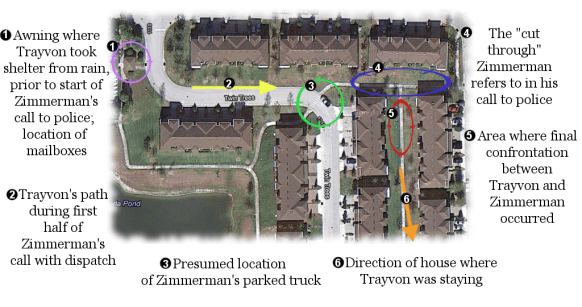
To start with, I’ve put together a quick diagram of some of the relevant locations that are referenced in the post. (Thanks for the image, Xie!)
Relevant Documents

Timeline of Events

6:22:08pm: Surveillance footage of the 7-Eleven near the Retreat View neighborhood shows Trayvon entering the store.

6:24:33pm: Trayvon buys a canned drink and a bag of candy, and departs the store. The clerk puts it in a brown plastic bag. That bag will later be found strewn near where Trayvon is shot.

6:54pm: Trayvon makes a call to “DeeDee,” a minor female that has been reported as his girlfriend. He is using a headset, walking home on his way back from the store after grabbing a snack and a drink, and he has been on the phone with DeeDee since he left there. According to DeeDee, it begins to rain, and he takes shelter at one of the buildings in the townhouse complex, while the two continue to chat. The referenced building is possibly the awning marked in purple on the above image.

7:04pm: An unknown individual makes a call to Trayvon while Trayvon is still talking to DeeDee. Unlike both Trayvon and DeeDee, this individual is not using a phone on a T-Mobile phone plan. Trayvon apparently puts DeeDee on hold, and then answers the new call in order to speak briefly to the new caller. This conversation lasts anywhere between 1 second and 59 seconds. After, Trayvon switches his call back to DeeDee. This phone call between DeeDee and Trayvon is recorded as having a duration of 18 minutes — which means from connection to termination, it was somewhere between 17 min, 0 seconds and 17 min, 59 seconds. Although the T-Mobile call times are imprecise, it would appear the call is disconnected at around 7:12pm.

7:09:34 pm: Zimmerman, in his truck, spots Trayvon. He calls the non-emergency dispatch number for the police, and the call log records his call as connecting with dispatch at 7:09:34pm. [Note: Relevant log begins on page 46.] He reports a suspicious black male in neighborhood. An recording of Zimmerman’s police call can be found here. Zimmerman states “The best address I can give you is 111 Retreat View Circle.” Zimmerman meant to say 1111 Retreat View Circle. It appears that Trayvon is around the clubhouse when Zimmerman’s call to police begins, at the intersection of Retreat View and Twin Trees. This is consistent with DeeDee’s claims that Trayvon was hanging out under a complex building to take shelter from the rain.

7:10:16pm: Forty-five seconds after the phone call begins, Zimmerman reports that Trayvon is “here now,” indicating possibly that Trayvon was moving while Zimmerman was not. It’s possible Zimmerman’s car was parked at all times during his phone call to the police.

  • Zimmerman: “He’s here now … he’s just staring.”

7:10:20pm: Zimmerman’s phone call to police indicates that at this time, Trayvon becomes aware of the fact that Zimmerman is watching him. The two stare at one another, and Trayvon keeps walking.

  • Zimmerman: “Now he’s staring at me.”

7:10:22 – 7:10:35 pm:

  • Dispatch: “OK, you said that’s 1111 Retreat View or 111?”
  • Zimmerman: “That’s the clubhouse.”
  • Dispatch: “He’s near the clubhouse now?”
  • Zimmerman: “Yeah, now he’s coming toward me. He’s got his hands in his waist band.”

It seems almost certain that Zimmerman was on Twin Trees Ln. at this point, since Trayvon’s path started at the clubhouse at the intersection of Retreat View and Twin Trees, and was heading towards the cut-through (circled in blue, above). It seems plausible that Zimmerman has been sitting in his parked truck, somewhere at the area marked in green in the image below, for the entire first half of his call to police. While watching from his truck, he sees Trayvon leaving the awning (marked in purple) and walking towards the cut-through, which means Trayvon’s path would’ve gone right past the car. Trayvon apparently noticed Zimmerman as he approaches, and keeps on walking.

This possible scenario, however, doesn’t completely fit with the timing from the call with DeeDee, which seems to indicate that Trayvon felt that he was being followed by someone at a time that would seem to be before Zimmerman exits the car — implying that Zimmerman may have been slowly following Trayvon while driving. My guess, though, is that the time stamps for T-Mobile’s call records and for the 911 logs are slightly off from one another, which explains any discrepancy between the two time lines.

7:11:14 pm: At this point, Trayvon appears to have walked past Zimmerman truck, possibly heading towards the cut through, where he would shortly be out of sight of Zimmerman.

  • Zimmerman: “These assholes. They always get away. … When you come to the clubhouse, you come straight in and you go left. Actually, you would go past the clubhouse.”
  • Dispatcher: “OK, so it’s on the left hand side of the clubhouse?”
  • Zimmerman: “Yeah. You go in straight through the entrance and then you would go left. You go straight in, don’t turn and make a left.

7:11:42 – 7:11:48pm: There is the sound of a car door opening at this point, immediately after Zimmerman says “he’s running,” and Zimmerman starts huffing; wind noises can be heard, and Zimmerman sounds slightly breathless. Zimmerman is able to see Trayvon plainly enough at this point to determine his direction, and believes he is going for the back entrance:

  • Zimmerman: “Shit, he’s running.”
  • Dispatcher: “He’s running? Which way is he running?”
  • Zimmerman: “Down toward the other [back] entrance of the neighborhood.”

The house where Trayvon is staying is directly between Trayvon’s approximate location at this time and the back entrance to the complex; Trayvon is probably actually running for his house. However, because both the house and the back entrance are to the southeast corner, there are two possible routes that Zimmerman could have seen Trayvon take off towards: (1) Trayvon stays on Twin Trees Ln., bolting south down the road; or (2) Trayvon runs for the cut-through, heading east, so that he can then turn and head south either on Retreat View or through the sidewalk between the rows of houses. Because Zimmerman’s reaction to Trayvon running is to get out of his car, it seems that scenario 2 is more likely — Zimmerman can’t follow in his car, he has to go on foot.

Approx. 7:12pm [+ or – 59 seconds off of 7:12pm, from the time as recorded by Zimmerman’s call to police. Exact time unknown]: The original phone call that Trayvon made to Dee, which lasted 18 minutes, is disconnected. Almost immediately after that phone call ends, DeeDee calls Trayvon  back. He answers, and DeeDee reports that he says to her, “I think this dude is following me.” She says that she tells him “Run!” and that Trayvon responded that he’s not going to run, he’s just going to walk fast.

The timing is close enough to suggest, but not perfect enough to say for sure, that when Zimmerman reports that “[Trayvon’s] running,” it’s at the same time as when DeeDee advised him to do just that. If so, it’s possible Trayvon was not telling the complete truth when he told her was just going to “walk fast,” perhaps to seem braver, but in reality had started running. Alternatively, Trayvon really did only start to “walk fast,” but Zimmerman, clearly worried about yet another asshole getting away, interprets this as “running” in his call to dispatch.

7:12:08 pm: After conversation about Zimmerman’s contact details, Zimmerman states to the dispatcher, “he ran.” From the general context, it seems that Zimmerman has now lost sight of Trayvon. The running/wind noises on the recording also cease abruptly at this point, and Zimmerman’s voice evens out. If this is the case, then Zimmerman has stopped his on-foot, running pursuit of Trayvon approximately 20 seconds after he began.

7:12:44pm:

  • Dispatcher: “Alright, where are you going to meet with [police] at?”
  • Zimmerman: “Um, if they come in through the gate, tell them to go straight past the clubhouse and, uh, straight past the clubhouse and make a left and then go past the mailboxes you’ll see my truck.”

I’m unclear where the mailboxes Zimmerman refers to are, but it appears from Google street view that they could be in the awning that Trayvon’s girlfriend says he took shelter in from the rain. If so, however, it’s hard to understand why police would “make a left and then go past the mailboxes.” But it makes more sense than anything else I can find, so it’s possible Zimmerman just misspoke again.

7:12:59: Zimmerman states that his truck is parked at “a cut-through” so he doesn’t know the address. The cut-through is the blue-circled area in the image, so Zimmerman’s truck is presumably in the vicinity of the green circled area. It may have been parked here from the very beginning of his call to police.

7:13:14pm: Zimmerman has lost Trayvon. He doesn’t want to say his address out loud because “I don’t know where this kid is.” Nine seconds later, Zimmerman tells dispatcher to have police call him when they arrive rather than meet at specific place, indicating that Zimmerman plans to keep moving, and doesn’t know where exactly he’ll be when police arrive.

7:13:41pm: Zimmerman’s phone call with dispatch ends.

7:14pm: There is approximately a one minute, thirty second period for which we have very little information about what occurred, from around 17:14:00 until 17:15:30. Zimmerman apparently keeps searching for Trayvon during this time period, and phone records show that Trayvon is still on the phone with DeeDee. Also during this period of time, neither party moves particularly far from their estimated locations at 7:13:00pm; it appears that they were either (1) walking extremely slowly, (2) had stopped somewhere before resuming movement, or (3) were taking non-direct paths. It’s possible that Trayvon, like Zimmerman when he refused to give his house number out, was worried about the stalker following him home and figuring out where he lived, so Trayvon did not run straight back, instead feinting one way before looping back around. Another possibility is that Trayvon, thinking he’d lost Zimmerman, was dawdling on his walk back home in order to finish his phone call with DeeDee — possibly because Trayvon, like most 17 year olds, generally prefers to have his phone calls with his significant other out of ear shot of his parents. The other two possibilities are that (1) Trayvon bolted on a pathway in the wrong direction from his house, in order to escape Zimmerman, after Trayvon initially started running/walked fast; he was then making his way back to his correct route when he encountered Zimmerman again; or (2) Trayvon, still on the phone with DeeDee, had in fact managed to start running on a direct path towards home, but decides to loop back to find Zimmerman again, in order to start a fight with the guy who dared to follow him.

Some small, extremely circumstantial evidence to suggest why Zimmerman may have been expecting Trayvon to run out the back entrance, and why Zimmerman may have tried to cut Trayvon off from going in that direction, comes from the police call logs. We know from Zimmerman’s previous calls to police that he had on at least two prior occasions called in to report that suspicious black males were hanging around the “back entrance” of the housing complex. (See pgs. 39-40 of the police dispatch logs.) On both those occasions, as with the call he made about Trayvon, Zimmerman stated that he believed the person he was watching had committed recent break ins in the neighborhood. On the two prior occasions, Zimmerman reported that the suspicious persons were at or headings towards the back entrance, and on one occasion, Zimmerman advised dispatch that the “subjects will run into the subdivision next to this complex,” and advised that law enforcement enter through the back entrance to meet him. It seems possible that if Zimmerman was going to follow Trayvon and lost him, his assumption would be Trayvon would be heading in that direction.

Approx. 7:15:30 – 7:15:45pm: Zimmerman and Trayvon encounter each other for the final time, in the area circled in red in the diagram above. At this point, all evidence from eye witnesses and police reports indicates that a fight between the two began and ended there, and that the parties did not substantially change position during the course of the struggle. Reports on the exact location of Trayvon’s body have varied, but it has been established it was somewhere in the grass in the row between the houses, closer to the north side than the south..

There are a half dozen different versions of how the altercation between Zimmerman and Trayvon occurred and what happened during the course of it.

7:15 – 7:16pm, DeeDee’s version of events: Trayvon tells DeeDee that he thinks he has lost the dude that was following him. DeeDee then hears voices, as if Trayvon and his pursuer have run into each other again. She says something like the following exchanged occurred between the two individuals:

  • Trayvon: “Why are you following me?”
  • Zimmerman: “What are you doing here?”

At that point, it sounds to DeeDee as if one party shoves the other. DeeDee thinks she hears Trayvon’s headset fall off, and the phone call cuts out at approximately 7:16pm, four minutes after it starts. It is my suspicion that the T-Mobile records are about 30 seconds slower than the time kept by the police dispatch’s clock– which would mean that the phone call started at 7:11:30, and ended at 7:15:30, a timeline that would mean that DeeDee’s description of events pretty much precisely matches up with the times as recorded by various 911 and police calls, down to the second. If her phone call with Trayvon instead ended at 7:16 on the police department’s clock, then the first 911 call from a neighbor came in 11 seconds or less after the fight initially started — that doesn’t seems plausible.

7:15 – 7:16pm, Zimmerman’s version of events: Zimmerman has not given an “official” version of his story, and the versions that have been reported by other sources are somewhat inconsistent, with some of the versions being extremely implausible. One initial report alleges that the confrontation began while Zimmerman was still in his truck, and that Trayvon approached the parked truck to ask Zimmerman why he was following him. Zimmerman “rolled down his window” to say he wasn’t, and Trayvon left, only for the fight to later occur on the cut through. This story has not been repeated since, and if Zimmerman really did initially give this version of events, he’s not sticking with it any longer.

The most consistent report that is alleged to be Zimmerman’s version of the encounter provides roughly the following: Zimmerman had gotten out of his car to check on an address, to tell police where to go. [This itself makes little sense — Zimmerman’s car was in front of the houses, where house addresses are visible and displayed, whereas behind the houses there are only porches and no visible addresses.] Zimmerman was then “returning to his truck,” [although still 150 ft. away, if his truck is in fact parked in the green circled area] but Trayvon approached Zimmerman from behind and confronted him. Either Trayvon (somehow) reaches around from behind to sucker punch Zimmerman in the nose, or else the two have a verbal confrontation and turn to face each other before the first punch is thrown. Zimmerman falls to the ground, and Trayvon jumps on him, punching Zimmerman and slamming his head into concrete. Zimmerman eventually is able to pull his handgun free from its holster and fires once at Trayvon, who is pinning him down. Trayvon is hit in the chest and dies.

7:15 – 7:16pm, Trayvon’s father’s recounting of how police described Zimmerman’s initial report to them:

  • Trayvon: appears from behind a building, approaches Zimmerman, and says, “What’s your problem, homie?”
  • Zimmerman: “I don’t have a problem.”
  • Trayvon: “You do now.” He then punches Zimmerman, knocking him to the ground, pinning him down.
  • Trayvon: tells Zimmerman, “Shut the fuck up.”
  • Zimmerman: while being beaten by Trayvon, pulls his gun and fires one shot at close range into Trayvon’s chest.
  • Trayvon: “You got me.” Falls over, dead.

7:15 – 7:16pm, Zimmerman’s father’s version of events: Zimmerman is walking along the sidewalk (area circled in red?) in order to “find an address.”

  • Trayvon: walks up to Zimmerman, says, “Do you have a fucking problem?”
  • Zimmerman: “No, I don’t have a problem.” Zimmerman starts to reach for his cell phone to call police, but Trayvon punches him in the nose. Zimmerman’s nose is broken and he is knocked to the concrete.
  • Trayvon: gets on top of Zimmerman and punches him repeatedly. While punching Zimmerman on the ground below him, Trayvon sees Zimmerman’s gun.
  • Trayvon: “You’re going to die tonight.”
  • Zimmerman: draws his pistol while on the ground, and shoots Trayvon once in the chest.

7:15 – 7:16pm, Zimmerman’s brother’s version of events: Zimmerman’s brother states that Zimmerman was not patrolling the neighborhood; rather, he was driving to Target when he noticed a suspicious looking person in his gated community, and called the police to report it. Zimmerman’s brother alleges that Zimmerman stopped following Trayvon when the police dispatcher told him to. Zimmerman then then lost sight of Trayvon, and about a minute later, the following occurs:

  • Trayvon: sneaks up on Zimmerman.
  • Zimmerman: tries to grab his phone to call 911 and intends to say to police “Well, this person who I lost sight of and was not pursuing has now confronted me.” Zimmerman is unable to complete this call because Trayvon broke his nose with a punch, and began slamming Zimmerman’s head into the sidewalk.
  • Trayvon: sees Zimmerman’s gun and tries to grab it.
  • Trayvon: says to Zimmerman either (1) “You die tonight,” or possibly (2) “You have a piece, you die tonight.”
  • Zimmerman: screams for help, but then grabs gun and shoots Trayvon when Trayvon tries to muscle it away.

Zimmerman’s brother adds in that there is a witness that saw what happened, “from the first blow.” The brother does not explain why this witness did not help Zimmerman, who he is, or why he was around to see the fight in the first place.

7:15 – 7:16pm, version of events attributed to “Zimmerman’s parents”: An unidentified female neighbor and friend reports that Zimmerman’s parents are strongly maintaining that the shooting was in self-defense: “What [Zimmerman’s parents] told us is that he was reaching for his cell phone and Trayvon Martin saw his gun and reached for the gun and there was a struggle.” This story is somewhat reminiscent of Zimmerman’s brother’s story, regarding Zimmerman going for a phone, which ignited the physical struggle.

7:15 – 7:16pm, unidentified law enforcement official’s version of events: The Daily Beast quotes an unidentified individual with the Sanford Police Department who is not involved in the case but apparently had some exposure to the investigation. According to him, Zimmerman’s statement to police was that after losing track of Trayvon, Zimmerman “went around a townhouse to see where he was.” This supports two things: first, that Zimmerman was actively hunting for Trayvon at the time of the altercation, and second, that Zimmerman was not following the sidewalk routes, but ducking through gaps in houses. This is possible support for the theory that Zimmerman unexpectedly cut off Trayvon, who was on the sidewalk routes. It also puts the “Trayvon was in hiding waiting to attack Zimmerman” theory in doubt, because it’s not clear how Trayvon’s could have anticipated Zimmerman’s unusual path.

The law enforcement official also reports that Zimmerman’s story is that Martin confronted him, and then knocked him to the ground with a punch. Zimmerman then said that “when he was on the ground, Martin straddled him, striking him, and then tried to smother him.” This ‘smothering’ claim is a new detail that has not been repeated before, and it’s somewhat confusing. If Trayvon was in fact on top of Zimmerman, perhaps Zimmerman interpreted the weight on his chest as an attempt to “smother” him, but the idea that any attacker in Trayvon’s situation would try and use “smothering” as an attack does not make much sense. The law enforcement official’s report goes on to state that:

Zimmerman claimed that he yelled for help, and that various neighbors who peered out to see the fight from their backyards didn’t get involved. Zimmerman…  told officers he was so paralyzed by fear that he initially forgot he had a gun, but he said that after Martin noticed his 9mm pistol, Zimmerman pulled it out of his belt holder and fired one round, a hollow-point—the round that killed Martin.

Zimmerman also told police that, after being shot, Trayvon’s last words were “Okay, you got it, okay, you got it,” and then Trayvon turned and fell face-down on the ground. Although these words sounds similar to what Trayvon’s dad were told his last words were — i.e., “you got me” — even assuming Zimmerman is telling the truth as he knows it, my assumption is that he misheard Trayvon. Someone seconds from death from a hollow point bullet wound to the chest is not going to be enunciating clearly or making dramatic statements. The more likely scenario is that Trayvon said something like “you shot me… you shot me,” in disbelief and shock.

Finally, the last new information from the Daily Beast’s source is that “Zimmerman told police he didn’t realize that Martin was seriously injured, and that he lunged to get on top of him after the teenager fell to the ground.” This would seem to match one of the 911 caller’s statements to the 911 dispatcher which, although confused, reported seeing Zimmerman on top of Trayvon after the shooting. Although it should have been obvious that a point blank shot to the chest with a hollow point bullet is going to be a serious wound all of the time and a fatal wound most of the time, it is believable that, with the adrenaline pumping, Zimmerman wasn’t thinking clearly. However, this is also another indication that Zimmerman’s subjective interpretation of events should be treated with cautious skepticism — Zimmerman was plainly not thinking completely logically or coherently, if he thought the bullet to the chest was not a “serious injury.” The fact Zimmerman thought it necessary to try and restrain Trayvon and “lunge to get on top of him” after shooting the kid in the chest shows Zimmerman’s threat detection systems were on overload,.

7:16:11 pm: The first of six 911 calls is made by a neighbor whose house is immediately adjacent to where the shooting occurred. A high pitched, desperate male voice can be heard yelling “help” repeatedly, from the very beginning of the phone call, and continues on for some time — there are occasional pauses, and occasional nonsensical yells, but for the most part the voice is consistently yelling “help” “help” “help” over and over again.

7:16:56 pm: Forty-five seconds into the first 911 call, a gunshot is heard. The last cry of “hel-” seems to be cut off simultaneously with the shot. Assuming that the first 911 caller took at least 15 seconds to hear sounds of fighting, recognize what it was, and pull out a phone to make a 911 call, this means that the physical struggle between Zimmerman and Trayvon went on for a minimum of one minute. The first 911 caller was still quick on the draw, however, and is unlikely to have taken more than 30 seconds to make the call. This gives a maximum fight duration of perhaps a minute and a half. Estimate time of the fight’s beginning is therefore 7:15:35 – 7:15:55pm.

7:17:55 pm (estimated): By around 17:17:55 – 17:18:07pm, several 911 callers report seeing a “man with a flashlight” outside, followed by a second flash light approximately one minute, fifteen seconds later. These are almost certainly Officers Smith and Ayala, who were first on the scene.

Officer Smith, the first officer to arrive, parks his car at 2821 Retreat View Circle. Officer Smith has been dispatched to respond to police calls made by Zimmerman twice before in recent weeks, once on January 29, 2012, and once again on February 6, 2012. He likely has encountered and spoken to Zimmerman before, although this has not been officially confirmed. Per the police report of the incident, when he arrives on scene on the night of February 26, a few seconds before 7:18pm, he cuts through the houses on the Retreat View side of the walkway, and into the area circled in red. He sees Zimmerman walking around and Trayvon lying “face down in the grass.” Zimmerman states to Smith that he shot the individual on the ground, and that he was still armed. Smith immediately moves to remove the gun, and observes that Zimmerman has a wet back and appears to be covered in grass, “as if he had been laying on his back on the ground.” He observes blood on the back of Zimmerman’s head, and on his nose. He removes from Zimmerman’s “waist band” the handgun and holster — it is not clear if the handgun is in the holster, or if both the holster and handgun are tucked into the waistband. He puts Zimmerman in the back of his squad car.

Officer Ayala arrives about a minute after Officer Smith, and observes Trayvon laying face down. His police report indicates that he observed that Trayvon “had his hands underneath his body.” Ayala begins emergency response treatment, but Trayvon never becomes responsive. He will be pronounced dead 11 minutes later.

The later-released police reports state that when Officers Raimondo and Ayala approached Trayvon’s body to attempt first aid, Trayvon “was lying on his stomach with his head oriented in the general direction of north.” In contrast, Officer Santiago, who arrives later on the scene, reports that Trayvon’s head “to the west.” It’s unclear if Trayvon’s head was actually oriented northwest, and both officers are right, or if Trayvon was rotated during the course of CPR.

Photos of the crime scene seem to show Trayvon’s body laying in the grass approx. 5-6 feet from the sidewalk. Trayvon was rolled over by police when they attempted to give first aid, so it’s possible he was originally laid out approx. 4-5 feet from the sidewalk. Either way, it does bring Zimmerman’s “head being bashed into concrete” story into doubt.

At autopsy, Trayvon’s cause of death is determined to be a single gunshot to the chest, which struck Tayvon’s heart and a lung, “1/2 inch below the nipple.” The direction of the gunshot is reported as “directly from front to back,” and was shot from “an intermediate distance.” The only other injury reported to Trayvon is 1/4″ by 1/8″ inch small abrasion to the left fourth finger.

The ME report also states that “Witnesses observed the two fighting in the yard and then the resident fired a handgun at the male striking him In the chest. The male fell to the ground.” It would appear the ME was given incomplete or inaccurate information regarding how the shooting took place, which was then incorporated into the report.

7:19pm: An unidentified civilian described only as “the photographer” takes a picture of the back of Zimmerman’s head. ABC News reports that file details show it was taken on location “three minutes after the shooting[,]” although the exact time is not specified. The photograph clearly shows the blood that was reported by Officer Smith, and it appears that the blood is coming from a wound on Zimmerman’s head, and did not originate from another source. This photo is useful in that it eliminates all outlier possibilities regarding Zimmerman’s head wound — that is, we can rule out the possibilities that either no wound existed, or that the wound was so great that, as Zimmerman’s brother reported, his head was a bloody pulp — but it is impossible to tell from this picture alone the exact extent of the wound. There isn’t enough blood for there to have been a serious gash, but for head injuries, a gash is going to be a far less serious problem than are non-visible internal injuries. On the other hand, the SFD’s actions,  in treating Zimmerman’s injuries, do not indicate that they any apparent concern for a brain injury of any type.

The wound is also very high up on Zimmerman’s head. I’m not entirely sure what to make of that — I think the wound pretty much has to have originated from Zimmerman’s head contacting the ground, but it’s not where I would expect it if it came from either a fall or from a deliberate attempt to smack someone’s head into the ground.

The ABC News “photographer” also states that gunpowder marks were clearly visible on Martin’s hooded sweatshirt. Using my CSI training, a.k.a., by doing some quick google research, gunpowder residue will be somewhat apparent on a target that was shot from a range of around three feet or less, but heavy concentrations show up at shooting ranges of under 12 inches. If the gunpowder marks were clearly visible on gray fabric, in night time viewing conditions, then I think it is a fair assumption that Zimmerman shot Trayvon from a distance of 12 inches or less.

7:22pm, onwards: Zimmerman is taken into custody and cuffed by Officer Smith shortly before Officer Ayala arrives. As Ayala is giving CPR to Trayvon, Smith puts Zimmerman in the back of the police cruiser. Zimmerman receives first aid from the Sanford Fire Department while sitting in the back of Officer Smith’s car. At some point, Zimmerman announces, unasked, “I was yelling for someone to help me, but no one would help me.” No questioning is performed at this time, and he is transported to the police station.

Police appear to have immediately accepted Zimmerman’s version of events. When one witness/911 caller gave a statement to police about an hour later, she started crying and stated she wished she could have helped. The officer responds, “If it makes you feel any better, the cries for help were not the person that died.” It’s clear that the police poisoned the witness statements by instructing the witnesses as to details they had not witnessed or did not know themselves, which likely contributed to the recent witness reversals and contradictions in testimony.

While performing first aid on Trayvon, Officer Raimondo finds a “large, cold can” of Arizona drink in Trayvon’s hoodie pocket. Officer Santiago reported that a cell phone was found “near the area of Martin”, but does not give precise details. The packet of skittles are also located in the hoodie pocket, and have traces of blood on them.

Investigators at the scene also find a key chain with a Honda remote key on it, which reportedly belongs to Zimmerman, near the “T” junction of the pathway between the houses. The key chain has a small silver flashlight-key chain attached to it, and the flashlight has been reported as still being on when police located it, suggesting Zimmerman was using it at the time of the altercation.

There is also a black flashlight found ~30 feet from the Honda key chain, closer to Trayvon’s body; this black flashlight had blood residue on it. I’ve seen the 6″ black flashlight described as belonging to Zimmerman, but I have seen no confirming reports for this. The black flashlight is also described as a “tactical” flashlight that could be used as a weapon; this may suggest it came from a responding police officer rather than Zimmerman, but the proximity to the keys could suggest it was Zimmerman’s, and dropped along with the keys when the confrontation started.

If the flashlight belongs to the police, the blood evidence found on it is insignificant and easily explainable. If it belongs to Zimmerman, however, it is a somewhat incongruous finding, as the flashlight if several feet away from where the “main” physical altercation is reported to have taken place, and is at least 10 feet away from where Trayvon was shot. If Zimmerman simply dropped the flashlight and keys before the fight started, there would not be blood on the flashlight — this possibly suggests that Zimmerman was still holding the tactical flashlight when he received the injury to his nose. But if so, why did Zimmerman not use it to defend himself against Trayvon? The tactical flashlight was Zimmerman’s, and during Zimmerman’s non-emergency call, you can hear him banging it to try and turn it on. Zimmerman seems to have had it in his hands during the altercation, but Zimmerman’s recounting of the fight is unclear about how he managed to carry it with him throughout the fight.

Although the keychain flashlight/Honda keys were found closer to the sidewalk on the “T” than was the tactical flashlight and the body, the shell casing from the shot that killed Trayvon is found ~40 feet from the “T”, and several feet away from the sidewalk. It appears to be located close to where Trayvon’s body ultimately ended up, but this is difficult to confirm from the released photos. above his head and slightly to the left.
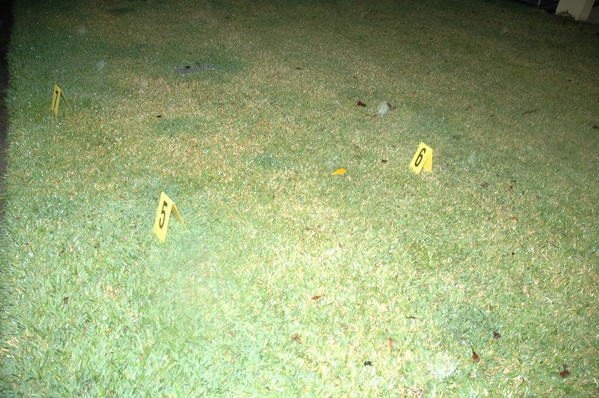
The shell casing is marked by the yellow arrow, just left to the #6 marker. The #7 marker is Trayvon’s phone, while the #5 marker is the black tactical flashlight.

7:52pm: Time stamp on start of surveillance video of Sanford police department showing Zimmerman’s arrival in squad car. Zimmerman’s shirt is neatly tucked in, and he is moving without any apparent impediment beyond the handcuffs. Police allow him to move freely, aside from the cuffs. There is no visible blood, and police officers use no protective equipment; they can be observed inspecting Zimmerman, as well as manually handling him as they look him over. One policeman touches Zimmerman, and then wipes his hand off on his trousers. A small head wound on the upper back portion of Zimmerman’s head may be visible.

Photos taken before the blood was cleaned up from Zimmerman’s scalp show blood draining in small rivulets down his skull, rather than gushing. It may be significant that the rivulets uniformly tend to drain towards Zimmerman’s face, which means whenever Zimmerman was bleeding, his head was facing towards the ground. It is unclear when this bleeding occurred, however.

Back at the station, Zimmerman gave his story to police at least three times before being released. Police say his story remained consistent throughout, although we have not been provided with the precise contours of what that story consisted of. Zimmerman also made at least one of those statements while being video recorded.

Notes and Observations about the Timeline

In no particular order, here are some assorted observations about what implications the above timeline has on Trayvon Martin’s death.

The eye witness reports should not be relied upon. It was dark, there was bad weather, it was a brief and frantic fight, and no one knows what they saw. Eye witnesses get things wrong even under the best of viewing conditions, and the conditions at the time of Trayvon’s death were anything but that, in terms of expected reliability of witness recall. The 911 calls are themselves full of real-time descriptions from witnesses to the immediate aftermath of the shooting — and even when describing what they were seeing at the exact same time as they were seeing it, their descriptions do not match reality. One witness, for instance, describes that “there is a black male standing over” the deceased victim after the shooting had occurred, which is obviously an incorrect description of the scene. Another witness describing the fight states that “the guy on top has a white t-shirt” — an article of clothing which neither Zimmerman nor Trayvon were wearing at the time. (Zimmerman’s t-shirt was gray, but it was under a red (orange) jacket. Trayvon’s hoodie was gray as well, but it was long sleeved and not a t-shirt.)

In short, the witnesses can prove next to nothing about what happened here. The recordings of the 911 calls that they made, on the other hand, are far more useful in piecing together what happened.

[Update, 5/28/12: By now, at least five witnesses have been reported as changing their stories. This is unsurprising, particularly as it has become clear that the police who took the witness statements improperly coached and/or unintentionally tampered with the witness’s recollections, by telling them facts and events they could not know in order to “correct” or “clarify” their testimony. In short, it has become even more clear that no definitive conclusions should be drawn about any of the events in this cases on the basis of eyewitness testimony alone.]

Zimmerman’s testimony is not being publicly disclosed, but will be an important source of impeachment evidence at trial. The State’s 5/24/12 Motion for Protective Order revealed a key element of the State’s case: Zimmerman’s statements to the police have been inconsistent, and are not fully supported by the available physical and eye witness evidence: “Defendant (Zimmerman) has provided law enforcement with numerous statements, some of which are contradictory, and are inconsistent with the physical evidence and statements of witnesses”. At this point we don’t know what Zimmerman’s version of the story is, but it looks like there’s at least more than one version he has been telling police, and it has some holes in it.

The crime scene does not support Zimmerman’s claim that Trayvon was pounding his head into the sidewalk. Trayvon was unarmed. Perhaps to make up for this fact, Zimmerman’s claim for why he was in imminent fear of death or grave bodily harm — and therefore why Zimmerman was allowed to kill Trayvon in self-defense — is that Trayvon was pounding his head into the concrete sidewalk. Although there is a sidewalk running through the middle of where the shooting occurred, the claim that Zimmerman’s head was being bashed into it does not make sense, because: (1) Zimmerman’s back had grass on it. Assuming that Zimmerman and Trayvon encountered each other while on the sidewalk, how could Zimmerman have fallen so that his legs and back were off the sidewalk, while his head was still on it? (2) Zimmerman was a bouncer for illegal house parties; during the course of a 1 minute long fight with a kid thirty pounds lighter than him, there is no possible explanation for how Zimmerman was able to move enough to get his back and legs onto grass, but not his head. In order to pound someone’s head into the ground while they are pinned down, you would literally have to pull their head up with one hand and before shoving it down again — and a one-armed pin is far easier to break. If you are pinning someone down with both arms, there is no way for you to repeatedly slam their head down, short of physically picking them up by the shoulders (while you’re sitting on their waist).  (3) Trayvon’s body was found face down in the grass, with his arms underneath him. According to his father, Trayvon’s legs were on the sidewalk, while his head and torso were perpendicular to the sidewalk, on the grass. If Trayvon was shot in the chest while pinning/punching Zimmerman on the ground, his body would presumably have crumpled down to where it was found — which was in the grass, and not on the sidewalk. If Trayvon had Zimmerman pinned, face to face, how did his head ultimately come to be far away from the sidewalk, if just before he was shot he was pounding Zimmerman’s head into the sidewalk?

How Zimmerman got out from underneath Trayvon after shooting him, without rolling Trayvon onto his back, is another mystery. It also contradicts at least one report of what Zimmerman said happened, which is that Trayvon “fell back” saying “you got me” after the shooting. The best explanation for how Trayvon’s body was found that I can think of is that Trayvon, after being shot, fell on his back, or was pushed off of Zimmerman onto his back/side. Zimmerman, who witnesses have described as “standing over” the victim immediately after the shooting, then turns Trayvon onto his stomach, perhaps to check for an exit wound or in a clumsy attempt to see if he was still alive. This would plausibly cause at least one of Trayvon’s arms to be pinned under his body, and possibly the second. Or perhaps only one arm was pinned under Trayvon’s body, and Officer Ayala did not correctly see the positioning of the second arm.

Voice analysis of the first 911 call will be the single most important factor in this case. Listening to the first 911 call, it is painfully clear that whoever can be heard shouting for help is in imminent fear for their life. This isn’t the scream of someone in a wrestling match — it’s the wild, animal panic of someone who believes that they are about to die. If the voice shouting “help” is in fact Zimmerman’s, then, whether or not such a fear was objectively reasonable, his subjective fear that Trayvon was about to kill him would appear to be entirely genuine.

However, if the voice is in fact Zimmerman’s, then it also shows that Zimmerman was in control enough of the fight to have the breath to scream and plead for help, and that his shouts for “help” were not cut off by Trayvon “slamming” his head into the sidewalk. It is not the scream of someone “nearly unconscious,” as Zimmerman’s brother and father have alleged. And, whether it was Trayvon or Zimmerman screaming, the mere existence of the screams is inconsistent with the verbal exchange between the two as recounted by Zimmerman. No one is yelling “time to die” or “you got me” — they are yelling “help,” and nothing else.

This brings into question Zimmerman’s statement, while being given first aid in the back of the squad car, that “I was yelling for someone to help me, but no one would help me.”  First, this slightly contradicts the claims given by both Zimmerman’s father and brother, which is that a more coherent conversation was going on. Second, Zimmerman would have every motivation to make this claim. If it was Trayvon yelling for help, Zimmerman would have known that neighbors in the nearby houses were likely to have heard it. He would have known he would need to explain the existence of the calls for help, and that, if it were known it was Trayvon screaming, it would look very bad for him.

But Zimmerman probably would not have considered the possibility his fight with Trayvon had been recorded in the background of a 911 call — the odds were against someone being that fast on the draw with their phone. So Zimmerman would not have had any reason to think it likely that his claims that it was him yelling for help, and not Trayvon, could be credibly challenged. It seemed like a completely safe — and completely necessary — claim at the time that he made it, but, if proven to be false, that statement could ultimately damn him by showing he was aware that what he had done was wrong and that he needed to lie to protect himself.

Zimmerman was in handcuffs less than 1.5 minutes after he killed Trayvon. In the police surveillance footage of Zimmerman arriving at the police station a half hour after Trayvon was killed, Zimmerman is shown being frisked and lead to an interview room. There is no sign of blood on him, although a possible wound on the upper back portion of his head may exist. Perhaps the oddest part of the surveillance video, however, is that Zimmerman’s shirt is tucked in, there are no visible scuff marks on his clothes, and nothing appears out of place. Zimmerman received cursory medical treatment while sitting in a squad car, hands cuffed behind him. The SFD likely dabbed up some blood, but they certainly didn’t tuck Zimmerman’s shirt in for him.

So, in the 90 seconds between shooting Trayvon and Officer Smith’s arrival on the scene, at which point Zimmerman was immediately handcuffed, did Zimmerman actually bother to nicely tuck his shirt in again? Or did Zimmerman’s shirt manage to stay perfectly tucked in for a one minute period while Zimmerman was punched to the ground and pinned down by someone who was on top of him in a fight?

Neither option is particularly plausible, especially combined with the absence of any blood or plain wounds. Zimmerman’s story is severely lacking in corroborating physical evidence — and if there were still photos taken of Zimmerman to support his claim that he was beaten up, why hasn’t someone leaked them by now? Or the medical records for the ‘broken nose’? The photo of Zimmerman showing blood on his face is not blood from a broken nose, but rather blood from two tiny cuts on the very point of Zimmerman’s nose — likely a result of kickback from Zimmerman firing the weapon, as no blood (or other DNA from Zimmerman) was found anywhere on Trayvon.

It’s likely that Zimmerman did in fact suffer a bump to his head, and maybe his nose, during the initial struggle with Trayvon. Zimmerman did hit the ground at some point, and Trayvon and Zimmerman were wrestling with one another for at least a minute. It’d be surprising if Zimmerman hadn’t picked up a bump or two from the tussle. But nothing about this indicates the injuries were anything but minor. My guess is that Zimmerman, in trying to explain his actions, took whatever reasons he could to claim he was in danger — and thus the bloody nose becomes a broken one in his re-telling, and a grazing would on his head that he got when he fell down becomes someone bashing his head into the sidewalk.

-Susan

Why Royal Dutch Petroleum is Wrong About the Liability of Pirates, Inc.

During the Kiobel oral arguments, following a discussion between Breyer and counsel for the Respondents Royal Dutch Petroleum/Shell regarding whether corporations could ever be liable under international law, the example of “Pirates, Inc.” was predictably trotted out for a hypothetical test drive. Justice Breyer asked Shell whether Blackbeard could have avoided liability for any claims on his booty from pirate victims bringing civil actions against him, simply by turning his pirate enterprise into an incorporated entity. Respondents answered with an emphatic “yes,” claiming that damages for a tort alleging piracy in violation of the law of nations were limited to the value of the ship that carried out the piracy:

JUSTICE BREYER: […] Do you think in the 18th century if they’d brought Pirates, Incorporated, and we get all their gold, and Blackbeard gets up and he says, oh, it isn’t me; it’s the corporation — do you think that they would have then said: Oh, I see, it’s a corporation. Good-bye. Go home.

MS. SULLIVAN: Justice Breyer, yes, the corporation would not be liable.

[…]

JUSTICE BREYER: What source have you for that proposition?

MS. SULLIVAN: [L]ook to Justice Story in U.S. v. Smith, cited in the Respondents’ brief at footnote 12. It looks to piracy. And piracy is allowed — in rem actions. You could seize the ship with which the piracy was committed, as you could later slave trading ships. But you could not seize another ship, and you could not seize the assets of the corporation.

But Royal Dutch Petroleum was mistaken in its account of civil liability for piracy; both international law and U.S. law have repeatedly held that just the opposite is true.

As an initial matter, Respondents’ citation to U.S. v. Smith is inapposite. In rem jurisdiction plays no part in that case; rather, it concerned jurisdiction to define the crime of piracy.

But Respondents were also wrong in asserting that civil liability for piracy was limited to the value of the ship that made the illegal capture. Yes, in rem jurisdiction did play a part in admiralty and prize law, but not in the context Respondents are asserting. Eighteenth century U.S. case law is clear: the owners of ships that violate international law are liable to the full extent of the damage caused. You could indeed seize another ship beyond the one that engaged in the piratical act, and any other assets of the principal besides, to recover for damages caused by the torts of an agent.

In any event, Pirates, Inc. is a poor hypothetical for considering questions of corporate liability, because the way 18th century law dealt with pirates was a rather strict affair, leaving little room for derivative liability to play a significant role: when you captures pirates, you don’t sue them, you simply kill them and claim their booty for your own. A better example would be Privateers, Inc. — because such entities did in fact exist in the 18th century, and owners of privateers were frequently sued for the acts of the privateer’s captain. As discussed in a previous post, New York state law authorized the incorporation of privateer enterprises, and before that, the Dutch West India Company, unlike its cousin the Dutch East India Company, was a notorious 17th century example of a corporation whose primary source of profits was privateering, not trade. Privateering, although legal, was regulated by the law of nations, and unauthorized captures were a violation of that law, and a frequent source of disputes. Moreover, in many cases, ships that portrayed themselves as “privateers” while in port often had little compunction about turning pirate on the high seas, if a tempting enough opportunity were to arise. And whether it involved incorporated privateers or unincorporated groups who owned or held shares in privateers, owners’ of privateers were frequently held to have derivative liability for their privateers’ breaches of the laws of nations.

The law in this regard was not uniform, and there was some deviation in domestic practice, but the overwhelming weight of authority provided for agency liability for violations of international law. Bynkershoek, for example, in Questions of Public Law (1737), Book I, Chapter 19, discusses a decision that reached an opposite conclusion. He then goes on, however, on to state that such a holding was plainly incorrect, as owners of privateer ships that have made a wrongful capture “are to be held liable until complete reparation has been made.” Although bondsmen — whose only role is to post a security bond for the privateer at the start of the voyage — cannot be liable beyond the amount of their bond, the owner of a ship in violation of the laws of nations is liable in full:

[I]f the owner sent the captain out to take prizes, and he carries out his commission wrongfully, the owners are liable to the full amount of the damage caused. The captain who takes prizes under a commission is appointed for that purpose, and he who appoints him is by the act of appointment liable for all, whether good or bad, that his appointee does under the commission. Thus we permit an actio institoria against the owner of a shop who has placed an agent in charge of it, and if the agent has made a contract we do not distinguish in what manner he has made it. In the same way we give an exercitorian action against the owner of a vessel for the act of a captain, provided the captain was acting in a matter for which he was engaged; for if he was not, he does not bind the owner, as Ulpian has fully explained. The appointment is the sole cause why owners of shops and of ships are bound: that is to say, they are liable if the act was committed in the performance of a task for which the agent was appointed, but not otherwise. He who has placed a captain on a privateering vessel, knows that the captain’s duty was to make captures, and if the captain performs this task improperly, the fault lies with the owner who employed an unskilful and dishonest man for the task. If a captain, having borrowed money for the repairing of his ship, applies it to his own use, Ofilius properly says: ‘the owner is liable, and must impute it to himself that he employed such a person.’ With this agrees the opinion of the States-General expressed in their decree of October 22, 1627: ‘that the shipowners must take care to employ good captains.’

If owners of shops and of vessels are responsible for the acts of their agents, it is evident that they are responsible to the full extent of the damages, and that they are not discharged by the surrender of the shop or the vessel in question. I do not remember that I have ever read an opinion contrary to this; nor would such an opinion be reasonable, since those who are responsible for the acts of their agents are responsible to the full extent; hence owners of vessels are liable to the full for unjust captures made by their captains.

See also Blackstone, Book I, Ch. VII (“Therefore, to encourage merchants and others to fit out privateers or armed ships in time of war, by various acts of parliament, the lord high admiral, or the commissioners of the admiralty, are empowered to grant commissions to the owners of such ships; and the prizes captured shall be divided according to a contract entered into between the owners and the captain and crew of the privateer. But the owners, before the commission is granted, shall give security to the admiralty to make compensation for any violation of treaties between those powers with whom the nation is at peace.”).

And Justice Story, in The Amiable Nancy, 3 Wheaton 546 (1818), contrary to Respondents’ assertions regarding Smith, outright rejected the idea that the wrongful acts of a privateer are limited to in rem damages. Story did agree, however, that punitive damages, being intended as a punishment, may only be issued against the moral actors responsible for the conduct:

Under such circumstances, the honor of the country and the duty of the court equally require that a just compensation should be made to the unoffending neutrals, for all the injuries and losses actually sustained by them. And if this were a suit against the original wrong-doers, it might be proper to go yet further, and visit upon them, in the shape of exemplary damages, the proper punishment which belongs to such lawless misconduct. But it is to be considered, that this is a suit against the owners of the privateer, upon whom the law has, from motives of policy, devolved a responsibility for the conduct of the officers and crew employed by them, and yet from the nature of the service, they can scarcely ever be able to secure to themselves an adequate indemnity in cases of loss. They are innocent of the demerit of this transaction, having neither directed it, nor countenanced it, nor participated in it, in the slightest degree. Under such circumstances, we are of opinion that they are bound to repair all the real injuries and personal wrongs sustained by the libellants, but they are not bound to the extent of vindictive damages.

This rule had previously been laid out by the Supreme Court in Del Col v. Arnold, 3 U.S. 3 Dall. 333 (1796):

[T]he right of seizing and bringing in a vessel for further examination, does not authorize or excuse any spoliation or damage done to the property, but that the captors proceed at their peril, and are liable for all the consequent injury and loss. On the third point, that the owners of the privateer are responsible for the conduct of their agents the officers and crew to all the world, and that the measure of such responsibility is the full value of the property injured, or destroyed.

James Kent, in his Commentaries on American Law (1826), likewise agreed that the American rule required Privateers, Inc. to be liable to the full extent of damages caused, although in his view this was a rule that could be modified by domestic law:

It has been a question, whether the owners and officers of private armed vessels were liable in damages for illegal conduct beyond the amount of the security given. Bynkershoek has discussed this point quite at large, and he concludes that the owner, master, and sureties are jointly and severally liable, in solido, for the damages incurred; and that the master and owners are liable to the whole extent of the injury, though it may exceed the value of the privateer and her equipment, though the sureties are bound only to the amount of the sums for which they become bound. This rule is liable to the modifications of municipal regulations; and though the French law of prize was formerly the same as the rule laid down by Bynkershoek, yet the new commercial code of France exempts the owners of private armed vessels in time of war from responsibility for trespasses at sea, beyond the amount of the security they may have given, unless they were accomplices in the tort. The English statute of 7 Geo. II. c. 15, is to the same effect, in respect to embezzlements in the merchants’ service. It limits the responsibility to the amount of the vessel and freight, but it does not apply to privateers in time of war; and where there is no positive local law on the subject (and there is none with us), the general principle is, that the liability is commensurate with the injury. This was the rule as declared by the Supreme Court of the United States, in Del Col v. Arnold; and though that case has since been shaken as to other points, it has not been disturbed as to the point before us. We may, therefore, consider it to be a settled rule of law and equity, that the measure of damages is the value of the property unlawfully injured or destroyed, and that each individual owner is responsible for the entire damages, and not ratably pro tanto.

In short, Pirates, Inc. and Privateers, Inc. would both have been civilly liable for their agents’ torts in violation of international law. Although they would not have been morally culpable if they had not personally authorized the violation, and were therefor immune from punitive measures, they nevertheless remained civilly liable in cases where domestic principles of agency law would attribute liability to them.

-Susan

Shell’s Activities in Nigeria and Kiobel’s Underlying Claims

There were a million things I wanted to write about after oral arguments this morning in Kiobel v. Royal Dutch Petroleum, but I’ve forgotten half of them by now, and I’m too tired to say everything I wanted to about the rest.

So this post is not about the whether the ATS provides jurisdiction for the Kiobel plaintiffs’ claim; instead, it’s about the underlying claim itself.

It was made unexpectedly clear to me today that, despite all of my interest in ATS litigation as an academic question, I have little idea about any of the underlying events that gave rise to those cases. After all, most ATS cases get kicked out at the Motion to Dismiss stage, if not sooner — and facts do not matter at that point, beyond what is alleged in the complaint, so why bother?

But this morning I caught a cab to the Supreme Court for the Kiobel arguments, and after debating the relative merits of Papa John’s pizza vs. Pizza Hut pizza with the cab driver, he asked about what I was going to see at the Court. So I told him it was a case about international law, for claims that had been brought against Shell for its activities in Nigeria.

And he said, “Oh, I know about that. I’m from Ogoniland, the oil companies have done a lot of things there too.”

Well, damn. It turned out he’d been born in Ogoniland, although he’d moved with his parents to somewhere in eastern Nigeria when he was young, before later moving to the U.S. as an adult. He hadn’t heard about the Kiobel case, though, or at least not this particular version of the litigation against Shell, but he seemed to know just about everything there was to know regarding Kiobel’s underlying events.

He talked about the Abacha regime, and what Nigeria had been like under him, and also about Ken Saro-Wiwa, and the books Saro-Wiwa had written, and what his death had meant. His summary of the events surrounding the execution of the Ogoni Nine was bleak: “Saro-Wiwa had an education, and he thought things could be changed. So Abacha had to kill him.”

It was hard not to be conscious of the jarring contrast between the cab driver’s summary of the events preceding Kiobel, and the attorneys’ sterile arguments before the Court a short time later regarding the exact same matter. So, instead of reading more about the ATS today, I’ve largely been looking into Shell’s involvement in Nigeria instead. There is far more out there than can possibly be summed up in a single post, but what does exist looks pretty ugly for Shell. Unfortunately, it’s impossible to tell at this point precisely how much culpability Shell bears for the human rights violations in Nigeria under the Abacha regime, as much of the relevant documentation has not been released into the public record. But based on what is publicly available, it seems pretty likely that, regardless of whether Shell was committing human rights abuses, Shell certainly didn’t oppose them, just so long as there was no resulting interference with its business operations.

Consider this memo from a security officer in Rivers State, where Ogoniland is located:

OBSERVATIONS: […]

  • SHELL OPERATIONS STILL IMPOSSIBLE UNLESS RUTHLESS MILITARY OPERATIONS ARE UNDERTAKEN FOR SMOOTH ECONOMIC ACTIVITIES TO COMMENCE. […]

FINANCIAL IMPLICATIONS: […]

  • PRESSURE ON OIL COMPANIES FOR PROMPT REGULAR IMPUTS [sic] AS DISCUSSED.

Ouch. Even if Shell didn’t think it was lining the pockets of Nigerian officials, the Nigerian officials seem to have been expecting a different arrangement. Not to mention, shortly before that memo was written, records show that Shell had paid that same officer an “honorarium”, along with the rest of his squad, for an armed conflict they had engaged in on Shell’s behalf.

Even in incidents where it cannot be shown than Shell was acting as an aider and abettor of human rights abuses, it is obvious that Shell was an opportunistic player who was happy to use the humanitarian crisis for its own benefit, when it was able to do so. For instance, Brian Anderson, a Shell exec and defendant in a prior ATS case, openly promised aid to Ogoni activists in exchange for their cooperation with Shell’s policies. In a memo regarding a conversation with Ken Saro-Wiwa’s brother, after Saro-Wiwa’s arrest and three months before his execution, Anderson wrote the following:

“I offered Owens Wiwa [Saro-Wiwa’s brother] the possibility that we would be prepared to put in some humanitarian aid in exchange for the undertaking by his brother to soften their official stance … you will recall the response was a frosty one (martyrdom rather than concessions).”

True, that memo is hardly damning in terms of international law violations, but it goes a long ways towards showing Shell’s general attitude to the human rights abuses that were occurring at the time. Anderson, in his Motion to Dismiss the ATS suit, tried to spin this into a claim that “Mr. Anderson engaged in ‘quiet diplomacy’ to attempt to secure fair treatment and ultimately clemency for Mr. Saro-Wiwa and the rest of the Ogoni Nine,” but the only documentary records from Shell expressing any concern with Saro-Wiwa’s fate are memos discussing the PR implications of his execution.

No wonder Shell fears engaging in American-style discovery. I doubt it would be pretty for them.

-Susan

Eight Predictions on the Court’s Decision in Kiobel

With Supreme Court oral arguments on Kiobel v. Royal Dutch Petroleum set for tomorrow, it will still be a while yet before the Court releases its opinion. In the meantime, however, here are my predictions on what the outcome of the case will be. Once the Court has actually gotten around to issuing an order, I’ll check back to see if I managed to get any right.

  1. The Kiobel plaintiffs will lose. Either directly on the Supreme Court’s ruling, or after being kicked back to the lower courts with a directive to make findings that spell doom for the plaintiffs, the case against Royal Dutch/Shell will ultimately be dismissed.
  2. But not because of a finding that corporations cannot be liable under the Alien Tort Statute. The ATS was enacted as a mechanism allowing aliens injured by acts violations of international law to recover damages directly from the party who caused them harm, rather than having the U.S. itself make reparations to the victims. The ATS’s concern is not punishment, but in the financial reparation of damages. And, to that end, from the precedent set by prize law, marine torts, and other areas of the law which, in 1789, regularly featured civil claims for violations of the law of nations, there is plenty for the Court to draw from in finding that principles of agency law apply when ascertaining the entity liable for the damages under the ATS. Sosa already made it clear the Court is going to pay close attention to history in making pronouncements on the ATS’s scope and function, and an enquiry into the historical purpose of the statute necessitates a finding of corporate liability.
  3. Instead, Kiobel will be dismissed under principals of comity. If I had to bet, this is the battleground on which Kiobel will be fought. The hubris of allowing a suit brought by aliens against foreign companies for foreign torts will be too much for the Supreme Court to look past, and they will find that international comity requires that U.S. courts decline to exercise jurisdiction in the situation presented. The defendants are corporations based in and operated out of the United Kingdom and the Netherlands, and none of their corporate holdings in the U.S. had any direct involvement with Shell’s abhorrent practices in Ogoniland. Allowing suit against these companies in the U.S. is one step short of having U.S. federal courts declare themselves to be an international tribunal competent of adjudicating foreign state’s violations of the law of nations, and the Supreme Court just isn’t going to go there. Bonus prediction: look to see Charming Betsy invoked to explain why the Founders only intended the ATS to be limited to cases with either (a) a sufficient U.S. nexus, whether it be based on territorial concerns or personality jurisdiction, or (b) universal jurisdiction. If Justice Breyer gets his way, part (b) will be expansive and include Really Super Bad Awful Acts. Otherwise, it’ll be limited to piracy and any other crimes in the jurisdictional void.
  4. And possibly for failing to meet exhaustion requirements. The requirement that a plaintiff exhaust all domestic remedies before proceeding in a foreign forum was not a consideration in Sosa, but the Court noted then that “[w]e would certainly consider this requirement in an appropriate case. ” It’s also an issue that cropped up frequently in amici briefs submitted by foreign sovereigns in Kiobel, so the Court may consider it again now, assuming it doesn’t stop once it gets to the comity issue. Although I expect the Kiobel plaintiffs won’t be required to have filed suit in Nigeria in order to meet exhaustion requirements, their failure to pursue suits in the Netherlands and the UK may prove fatal. Particularly so for the UK — the fact that many of the plaintiffs, including the Kiobel family, are themselves UK citizens or residents puts the inappropriateness of a U.S. forum into stark relief.
  5. The Court may also look into the Second Circuit’s decisions regarding aiding-and-abetting liability. The “knowledge and purpose” standard for aiding and abetting liability under the ATS may get some dicta thrown its way, but as Kiobel can be decided without reaching the question of secondary liability, I would guess that it will not feature prominently in the Court’s decision. There may be some discussion, though, about aiding and abetting as a substantive violation vs. agency liability as a theory of recovery, and whether both are decided under domestic law, neither are, or one is but not the other.
  6.  Justice Scalia will author a very terse opinion dissenting in part.  Expect it to feature scathing but memorable descriptions about the purported ridiculousness of the Court exercising jurisdiction under the ATS.
  7. Justice Thomas will join Scalia’s dissent.  True story.
  8. Ultimately, even though the specific plaintiffs in this case will lose, the Court’s decision in Kiobel will strengthen, not weaken, a global regime of corporate liability for international human rights violations. The Court’s opinion will signal its intention to respect both international comity and international human rights. As such, one day, in a different case, with different facts, where the U.S. is a proper forum from which a judgment should be issued, Kiobel will ultimately provide support for a finding of corporate liability for violations of international law. And aside from that, the simple fact that the highest court in the U.S. will have gone on record acknowledging that the activities of corporations are indeed cognizable under international law will be a small but significant step in shaping global norms regarding corporate human rights abuses.


-Susan

Privateer Corporations and Agency Liability: A Response to the Cato Institute’s Amicus Brief in Kiobel

The Cato Institute’s amicus brief in Kiobel v. Royal Dutch Petroleum, along with a couple of other amici, repeatedly enact a straw man (straw law?) version of international law as it existed prior to 1789. The ATS, they argue, should be applied in the context of the law of nations of the Enlightment era, which is conceived to have been a limited, formalist creature, with no concern for individuals, dealing only with kings vis-à-vis kings. This idealist version of international law is then contrasted with international law as it exists today, which, in their view, is apparently some kind of bloated, sovereignty-munching leftist obsession with human rights. But while it is the case that international human rights law did not exist prior to the 20th century, Cato’s idealist version of international law ignores the fact that, for many centuries, the law of nations was an omipresent force of domestic legal systems in a manner which today’s domestic courts would scarcely be able to recognize. Domestic enforcement of private claims under international law was far more prevalent in 1789 than it was in 1989.

The Cato amicus’ delicate selections of quotes from Grotius are particularly inept at proving that international law in the 17th century matched Cato’s positivist depictions of it. Cato goes so far as to argue that in Kiobel “the Second Circuit employed an analysis based on the principles enunciated by Grotius,” which is that “under the law of nations corporations are not answerable in tort.” It is exceedingly unclear what precise “principles” Cato is referring to here, because Grotius certainly never made any direct assertions to that end. Grotius fully recognized that sub-sovereign entities were subject to rights and obligations under the law of nations, corporate entities included. In fact, Grotius got his start working as counsel for the Dutch East India Company, defending the company from claims that it had taken Portuguese prizes in violation of international law. His early works in particular were more advocacy pieces than treatises, intended as a defense of the Company’s right to engage in trade in the East Indies, and its powers to wage private war and take prizes.

In On the Law of War and Peace, which Cato quotes from, Grotius repeatedly acknowledges that private entities are capable of violating the law of nations, and can further be personally liable for those violations:
Continue reading

Could the State Constitutionally Prohibit Dual-Income Marriages?

At least in legal academic circles, most of the sturm und drang generated by Perry v. Brown has resulted from disagreement about whether Proposition 8 can legitimately be struck down under the exceedingly deferential rational basis review that, ostensibly, the 9th Circuit applied in deciding the case.

But rational basis review is the funhouse mirror standard for evaluating the constitutional permissibility of legislation. Courts do not actually analyze reality, the world as it actually exists, when analyzing a specific case under rational review. Instead, while implementing a steadfast suspension of disbelief, the court is analyzing a legal fiction. Rational basis review requires the court to squint sidelong at the challenged legislation, and pretending to believe in the white lies and polite excuses provided by the State in its defense. So long as the resulting revisionist version of the law that the court comes up with is not itself offensive to the Constitution, then the court will pay no mind to the man behind the curtain.

So could the 9th Circuit correctly claim that Proposition 8 doesn’t meet even this lenient standard for constitutionality? Probably not. Even though all of the arguments in favor of Prop 8 are — objectively speaking, mind you — entirely asinine, a hefty dose of absurdity has never been a bar to legislation passing muster under rational basis review.

But it’s difficult to place the blame on the 9th for deviating from some idealized “true” rational basis standard when the Supreme Court has repeatedly indicated that we are no longer playing by that same rulebook. “True” rational basis is still applied today to abstract economic or administrative regulations, it is not a dead letter in all respects, but it hasn’t been applied to an intimate associations case since around the time of Bowers v. Hardwick.

There are a number ways in which the Supreme Court could choose to synthesize the line of cases leading up to Perry. The most obvious and straightforward method would be to simply go ahead and recognize sexual orientation as a quasi-suspect class, full stop. But that is not a politically feasible outcome, nor would it necessarily result in the fullest integration of existing precedent.

Looking from Skinner to Griswold, to Eisenstadt, Tremble, Moreno, Lawrence, and now Perry, the formulation that I would suggest is this: there is no legitimate state interest in imposing disabilities on individuals that are members of non-traditional family arrangements because they are members of non-traditional family arrangements. Whether interpreted as recognition of a broadly defined quasi-suspect class or as a fundamental right to be free from illegitimate interference with the choices central to personal dignity and autonomy, the result would be the same. While applying something well below a strict scrutiny evaluation, the U.S. Supreme Court has nevertheless repeatedly recognized that legislation which singles out “non-traditional” family structures for disfavored legal status cannot be rationally based upon (1) the State’s unsupported assertion that the family arrangement it is endorsing is preferable because of the arrangement’s ‘traditional’ character or inherent moral superiority; or (2) a marginal benefit to a legitimate objective that, either due to the de minimis amount of the benefit or its dubious probability, is so disproportionate with the scope of the harm imposed on the disfavored family structure as to compel the conclusion that the surmised benefit is not the actual purpose of the law.

In other words, a summary of the Court’s prior case law in this area it looks a fair bit like Perry.

But this is by no means limited to the question of same-sex marriage. The protections applied in Perry are equally applicable to protections enjoyed by heterosexual couples, even if for political reasons it is gays and lesbians that are more often the target of infringing legislation. If rational basis review were truly applicable to legislation in this realm, however, the State would have broad powers to eliminate or prohibit any union it thought not ideal, gay or straight, so long as the prohibition was not based on a class protected by strict scrutiny.

Consider a situation in which the State has enacted a law known as “the Homemaker Act,” which mandates that, henceforth, in order for any marriage to be recognized, or continue to be granted recognition, one partner must act as the primary caretaker of the home while the other partner is the breadwinner. The law would not make any distinctions based on gender — it doesn’t matter whether the wife or the husband stays home to tend the hearth, as long as someone does.

Is there any reason, under the arguments advanced by Prop 8 proponents, that such a law could be constitutionally invalidated? Not that I can see.

After all, this is a well established traditional conception of marriage. The purpose of marriage is to permit couples to engage in an efficient division of labor while assuring a certain minimum degree of security to all parties involved, so that a married couple can have one parent stay home and personally raise children — which is the optimal environment for a child to be raised in — instead of shipping the kids off to day-care to be raised by strangers. By making the working spouse obligated to support the non-working spouse for life, the non-working spouse will have sufficient assurance of future support to be able to forgo any ability of generating income for themselves, and is able to focus all efforts on raising children without the risk of being left destitute. Marriage exists because a spouse that stays home to raise children is thereby put in an extremely vulnerable position — one which the state has mitigated through the series of legal obligations known as marriage.

In other words, if you are in an intimate personal relationship with another person, but both parties are working, you have absolutely no need for the protections offered by marriage. The State has no interest in legally recognizing a couple where both parties have adequate incomes so that neither is reliant upon the other. Although it’s true that dual-income couples can and do reproduce, because neither party has been made financially vulnerable by the arrangement, marriage does not provide any additional benefit to the couple’s ability to raise children, and it is unnecessary to grant privileges where it will do nothing to support the State’s objectives. Moreover, because of “the state’s legitimate interest in promoting the family structure that has proven most likely to foster an optimal environment for the rearing of children,” as one Amici in Perry put it, the State can offer incentives to couples that have adopted this ideal family structure — which are the only couples that benefit from this incentive anyway — while denying it to couples that are not providing the ideal family structure. Allowing all couples to get married would, after all, undermine the social understanding of marriage as an enterprise dedicated to the rearing of children.

Although a hypothetical Homemaker Act would be politically unfeasible at the present time, the sentiments behind it would undoubtedly have been endorsed by prior generations. And it wouldn’t be hard to find a modern politician or two that would endorse a more limited version of such an enactment. Rick Santorum has, in fact, already gone on the record advocating that the government should discourage two-income households:

In far too many families with young children, both parents are working, when, if they really took an honest look at the budget, they might find they don’t both need to.

What happened in America so that mothers and fathers who leave their children in the care of someone else — or worse yet, home alone after school between three and six in the afternoon — find themselves more affirmed by society? Here, we can thank the influence of radical feminism…

Sadly the propaganda campaign launched in the 1960s has taken root. The radical feminists succeeded in undermining the traditional family and convincing women that professional accomplishments are the key to happiness.

The enactment of a much diluted version of the Homemaker Act — one with the same goals although lesser penalties — is not inconceivable. And it would pass constitutional muster under a “true” rational basis review, as it is rationally related to an objective that has been repeatedly declared to be legitimate. All of the arguments that were advanced by the Prop 8 proponents would apply equally in this circumstance, resulting in the conclusion that a mandatory-homemaker statute is a valid, constitutional enactment, because it is based upon traditional notions of marriage and is rationally related to the State’s interest in promoting the optimal family structure for the upbringing of children.

Although it would pass rational basis review, such a law would be a deep infringement upon the right of private association. Luckily, for close to two decades now, rational basis review has been applied to laws like Proposition 8 or the Homemaker Act in name only — and, in practice, the courts have consistently recognized stronger protections for laws that infringe upon private family relationships.

-Susan