Thomas Jefferson Disagrees with the Supreme Court’s Decision in Kiobel

In 1792, Thomas Jefferson, as the first Secretary of State, made note of complaints that had been lodged against the U.S. by both Spain and France. In different incidents, citizens of Georgia had breached international law by trespassing into Florida (then a part of Spain) and into the territorial waters of Santo Domingo for the purpose of recapturing and kidnapping slaves. In examining the remedies that might be available to the United States to prevent this situation from reoccurring in the future, Jefferson affirmed the Alien Tort Statute’s extraterritorial reach, taking it as obvious that the statute conferred jurisdiction over acts that took place in a foreign sovereign’s territory:

XXX. — Opinion relative to a case of recapture, by citizens of the United States, of slaves escaped into Florida, and of an American captain enticing French slaves from St. Domingo.

December 3, 1792.

Complaint has been made by the Representatives of Spain that certain individuals of Georgia entered the State of Florida, and without any application to the Government, seized and carried into Georgia, certain persons, whom they claimed to be their slaves. This aggression was thought the more of, as there exists a convention between that government and the United States against receiving fugitive slaves. The minister of France has complained that the master of an American vessel, while lying within a harbor of St. Domingo, having enticed some negroes on board his vessel, under pretext of employment, bought them off, and sold them in Georgia as slaves.

1. Has the general government cognizance of these offences? 2. If it has, is any law already provided for trying and punishing them?

1. The Constitution says .. that Congress shall have power to “define and punish piracies and felonies committed on the high seas, and offences against the law of nations.” These offences were not committed on the high seas, and consequently not within that branch of the clause. Are they against the law of nations, taken as it may be in its whole extent, as founded, 1st, in nature; 2d, usage; 3d, convention? So much may be said in the affirmative, that the legislators ought to send the case before the judiciary for discussion; and the rather, when it is considered that unless the offenders can be punished under this clause, there is no other which goes directly to their case, and consequently our peace with foreign nations will be constantly at the discretion of individuals.

2. Have the legislators sent this question before the Courts by any law already provided? The act of 1789, chapter 20, section 9, says the district courts shall have cognizance concur rent with the courts of the several States, or the circuit courts, of all causes, where an alien sues for a tort only, in violation of the law of nations: but what if there be no alien whose interest is such as to support an action for the tort? — which is precisely the case of the aggression on Florida. If the act in describing the jurisdiction of the Courts, had given them cognizance of proceedings by way of indictment or information against offenders under the law of nations, for the public wrong, and on the public behalf, as well as to an individual for the special tort, it would have been the thing desired.

The same act, section 13, says, the “Supreme Court shall have exclusively all such jurisdiction of suits or proceedings against ambassadors, or other public ministers, or their domestics or domestic servants, as a court of law can have or exercise consistently, with the law of nations.” — Still this is not the case, no ambassador, &c., being concerned here. I find nothing else in the law applicable to this question, and therefore presume the case is still to be provided for, and that this may be done by enlarging the jurisdiction of the courts, so that they may sustain indictments and informations on the public behalf, for offences against the law of nations.

[A note added by Mr. Jefferson at a later period. ]

On further examination it does appear that the 11th section of the judiciary act above cited gives to the circuit courts exclusively, cognizance of all crimes and offences cognizable under the authority of the United States, and not otherwise provided for. This removes the difficulty, however, but one step further; — for questions then arise, 1st. What is the peculiar character of the offence in question; to wit, treason, felony, misdemeanor, or trespass? 2d. What is its specific punishment — capital or what? 3d. Whence is the venue to come?

As these offenses had taken place in the territory of other sovereigns — and not upon the high seas, which is the geographical extent of Congress’ authority to prescribe “piracies and felonies” — Jefferson concluded that the Constitutional authority for acting against the Georgians’ incursions came from the “offences against the law of nations” clause. Jefferson then considered whether Congress had previously, pursuant to this authority, provided for any laws that might reach the challenged conduct and, in examining the section now known as the Alien Tort Statute, finds that Congress had. Unfortunately for Jefferson, the ATS would not protect the U.S.’s interest in this instance, leading him to  lament the apparent lack of federal jurisdiction for such a case to be heard before the federal courts: “what if there be no alien whose interest is such as to support an action for the tort?”

But Jefferson implicitly accepted that, under the ATS, an alien possessed an individual cause of action for an extraterritorial tort. The Attorney General at that time, Edmund Randolph, concurred with Jefferson that a civil claim could plainly exist over the slave abductors, even though the exercise of criminal jurisdiction under those circumstances was more questionable.

And although no plaintiff existed to have standing in the cases of the Florida and St. Domingo slave abductions — and thus no claim under the ATS was available — the permissibility of civil jurisdiction over the defendants was, to Jefferson, obvious. Constitutional authority to provide a cause of action over the offence was authorized under the “offences against the law of nations” clause; subject matter jurisdiction in the district courts was provided for by section 9 of the Judiciary Act of 1789; and personal jurisdiction was to be had over the defendants owing to both their presence in the state of Georgia and their status as U.S. citizens. No ‘presumption against extraterritoriality’ would have applied, under Jefferson’s understanding, because such a judicial construction would have directly undermined the congressional purpose underlying the ATS.

-Susan

Kiobel’s Bowman Problem: Where the Legislature Has Enacted Laws to Defend the U.S. Government’s Interests, the Presumption Against Extraterritoriality Does Not Apply

Last week, in Kiobel v. Royal Dutch Petroleum, et al., the Supreme Court deviated from its prior two decisions under the ATS, and held that the ATS does not confer jurisdiction over violations of the law of nations that occur within a foreign territory. The ATS, the Court can concluded, can be presumed to apply to activity on the high seas, but nevertheless cannot be presumed to apply to activity that occurs outside of both U.S. territory and the high seas:

the presumption against extraterritoriality applies to claims under the ATS, and that nothing in the statute rebuts that presumption. ‘[T]here is no clear indication of extraterritoriality here,’ and petitioners’ case seeking relief for violations of the law of nations occurring outside the United States is barred.

Although I fully agree with the Court’s conclusion that jurisdiction did not exist over the claims being asserted by the Kiobel plaintiffs, the majority’s reliance on the presumption against extraterritoriality to reach this holding is ill-placed. The Court’s claim that the ATS was not intended to apply abroad is ahistorical, as the legislature is not required to specifically define a locus for statutes enacted to defend the U.S.’s security interests. The nature of the statute is itself proof that it was intended to apply outside of U.S. territory.

Kiobel acknowledges that the First Congress’ intent in including the ATS in the Judiciary Act of 1789 was, at least in major part, in order to “avoid[] diplomatic strife” by ensuring there would be a federal forum in which the citizens of foreign states could be provided relief for violations of the laws of nations. If such relief was not made available, and an alien’s injuries were not remedied, then the United States could itself be liable for a breach of international law. Because a private individual’s violation of international law could endanger the United States’ national interest, and require the United States to offer restitution for the offense, an ATS suit was a matter of public, and not private, concern.

Given that background, it seems incongruous to hold that the ATS does not evidence an intent to apply extraterritorially. In fact, the Court’s own case law has already reached that same conclusion, finding that the presumption against extraterritoriality does not apply to laws which “are enacted because of the right of the Government to defend itself” — the precise purpose for which the ATS has been enacted. United States v. Bowman, 260 U.S. 94 (1922).

Bowman found that the presumption against extraterritoriality did not apply to a federal statute prohibiting “conspir[ing] to defraud a corporation in which the United States was and is a stockholder,” even though no extraterritorial locus specified in the statute’s text. Nevertheless, the Supreme Court reversed the district court’s holding that it lacked jurisdiction over the offense — which had taken place on ships in the high seas and in the territory of Brazil — because the crime had been “committed without the jurisdiction of the United States or of any State thereof and on the high seas or within the jurisdiction of [a foreign state].” Therefore, the Court concluded,

We have in this case a question of statutory construction. The necessary locus, when not specially defined, depends upon the purpose of Congress as evinced by the description and nature of the crime and upon the territorial limitations upon the power and jurisdiction of a government to punish crime under the law of nations. Crimes against private individuals or their property, like assaults, murder, burglary, larceny, robbery, arson, embezzlement and frauds of all kinds, which affect the peace and good order of the community, must of course be committed within the territorial jurisdiction of the government where it may properly exercise it. If punishment of them is to be extended to include those committed outside of the strict territorial jurisdiction, it is natural for Congress to say so in the statute, and failure to do so will negative the purpose of Congress in this regard.

But the same rule of interpretation should not be applied to criminal statutes which are, as a class, not logically dependent on their locality for the Government’s jurisdiction, but are enacted because of the right of the Government to defend itself against obstruction, or fraud wherever perpetrated, especially if committed by its own citizens, officers or agents. Some such offenses can only be committed within the territorial jurisdiction of the Government because of the local acts required to constitute them. Others are such that to limit their locus to the strictly territorial jurisdiction would be greatly to curtail the scope and usefulness of the statute and leave open a large immunity for frauds as easily committed by citizens on the high seas and in foreign countries as at home. In such cases, Congress has not thought it necessary to make specific provision in the law that the locus shall include the high seas and foreign countries, but allows it to be inferred from the nature of the offense.

Although Bowman concerned a criminal statute, and not a civil act, the Court’s reasoning in that case applies to the ATS with equal force. It was not necessary for Congress to make specific provision for the ATS’s jurisdictional reach, because the ATS could be presumed to reach any act which might endanger the U.S.’s national interests, so long as such jurisdiction could be exercised in conformity of international law. (And if the U.S. was prohibited under international law from exercising jurisdiction over a particular offense, then the ATS’s purpose would not be implicated anyway, because in such a case the U.S. would not be at risk of breaching international law by failing to provide a forum or remedy.)

Bowman also refutes Kiobel’s holding that the ATS could be implied to cover piracy even in the absence of a specific provision noting that Congress intended the statute to apply to the high seas. Although the majority conceded that the ATS extended to acts that took place outside the U.S. — which is precisely the sort of statutory construction that the presumption against extraterritoriality prohibits — the Court was unconcerned by this inconsistency. The majority swept this issue aside by stating, “We do not think that the existence of a cause of action against [pirates] is a sufficient basis for concluding that other causes of action under the ATS reach conduct that does occur within the territory of another sovereign[.]” But as Michael noted in a previous post, this distinction between ‘high seas’ and ‘foreign territory’ is a wholly new creation, unsupported by prior case law. This decision is also inconsistent with Bowman, in which the Court noted that, for statutes to which the presumption against extraterritoriality has been held to apply, it applies equally to acts committed on the high seas as to acts committed on foreign territories. Prior to Kiobel, when a statute failed to specify a locus, there was no basis by which a statute could be held to differentiate between the high seas and foreign territories — either both were out or both were in, absent a specific Congressional directive that such a distinction be made.

-Susan

Defending Prohibitions on Interracial and Same-Sex Marriages: The More Things Change, the More They Stay the Same

Earlier this week, the Supreme Court heard two cases concerning the government’s ability to prohibit same-sex marriages. In Hollingsworth v. Perry, the Court considered the state of California’s ability to prohibit same-sex marriages under Proposition 8. In U.S. v. Windsor, the Court examined the federal government’s ability to act in a similar fashion, through the Defense of Marriage Act.

After reading through the parties’ briefs and the transcripts of the oral arguments for Perry and Windsor, however, I started wondering about the arguments that were advanced in Loving v. Virginia in support of anti-miscegenation laws. How exactly did the attorneys for Virginia try to defend the constitutionality of their doomed cause? The statutes at issue in Loving — criminal anti miscegenation statutes that had originally been legislated through an Act with the familiar-sounding title of  “A Bill to Preserve the Integrity of the White Race” — seem indefensible in today’s world.

It turns out that the arguments made by the anti-miscegenation side in Loving were far more similar to the arguments made by the anti-gay marriage side in Perry and Windsor than I had expected, even given the cases’ obvious parallels. But the overlap is striking.

In the the Commonwealth Virginia’s Brief in Loving v. Virginia, and in the arguments advanced in the transcripts of the oral arguments before the Supreme Court, the Commonwealth did everything it could to distance itself from the anti-miscegenation law’s racist origins, and appealed to the Court to adhere to traditional notions of the separation of powers. Interracial marriage, the Commonwealth argued, is not a settled science, and the United States’ centuries-long history of permitting only intraracial marriages precluded the Court from establishing a new constitutional right to interracial marriages.

Below, I’ve included excerpts of the Commonwealth’s arguments in Loving, albeit with slight modifications to place the arguments in the modern context:

That there is a rational classification, setting so far as the [Californian] population is concerned, for preventing marriages between [two individual of the same sex], and that this is supported by the prevailing climate of scientific opinion.

We take the position that while there is evidence on both sides of this question, when such a situation exist it is for the legislature to draw its conclusions and that these conclusions are entitled to wait and unless it can be clearly said that there is no debatable question that a statute of this type cannot be declared unconstitutional.

We start with the proposition, on this connection, that it is the family which constitutes the structural element of society and that marriage is the legal basis upon which families are formed.

Consequently, this Court has held, in a numerous decisions over the years, that society is structured on the institution of marriage that it has more to do with a welfare and civilizations of the people that any other institutions and that out of the fruits of marriage spring relationships and responsibilities with which the state is necessarily required the deal.

Text writers and judicial writers agree that the state has a natural direct and vital interest in maximizing the number of successful marriages, which lead to stable homes and families and in minimizing those which do not.

So: given the existence of (1) scientific uncertainty; (2) historical traditions; and (3) the state’s vital interest in stable marriages, then the state necessarily is entitled to prohibit marriage between certain classes of citizens. This passage could have been transplanted, almost verbatim, into the briefs of Prop 8’s defenders.

[I]f the statute equally forbade [women] to marry [women], and [men] to marry [men], then in the opinion of the Framers that that was not a violation of equal protection or due process. In other words, the classification itself was not a violation.

To do the same with a similar passage from Plaintiff’s trial brief in Perry: “Because the [antimiscegenation laws] do[] not treat [whites] and [Negroes] differently, every federal court, and nearly every state court to address the issue has determined that this definition does not discriminate on the basis of [race].” Each race and sex has equal but opposite rights — so the classification based on race or sex is not a violation.

[H]istorically, the regulation of marital relationship was within the States and it was no intent on the Fourteenth Amendment to have any effect at all upon the States’ power over marriage. …

No one has been found who has analyzed this problem, who has suggested that it was the intention of the Framers of the Fourteenth Amendment or the understanding of the legislatures which ratified it that the Fourteenth Amendment affected to any degree the power of the States to forbid [same-sex] marriages. … Our reading of the legislative history is sufficient to lead us to believe that if anybody had suggested that it would have that affect, the entire first section of the Fourteenth Amendment would have been lost. No one, the proponents would never have suggested that the Fourteenth Amendment was going to abolish the power of the States to forbid [same-sex] marriage.

Won’t someone think of the originalists? As Justice Scalia phrased this same argument on Tuesday: “I’m curious, when did it become unconstitutional to exclude homosexual couples from marriage? 1791? 1868? When the Fourteenth Amendment was adopted? Some time after Baker, where we said it didn’t even raise a substantial Federal 8 question? When did the law become this?” If wasn’t unlawful in 1791 or 1868, how could the Court find it unlawful now?

It is clear from the most recent available evidence on the psycho-sociological aspect of this question that [same-sex] marriages are subjected to much greater pressures and problems then those of [traditional] marriages, and that the state’s prohibition on [same-sex] marriage for this reason stands on the same footing as the prohibition of polygamous marriage or incestuous marriage, the prescription of minimum ages at which people may marry, and the prevention of the marriage of people who are mentally incompetent.

Interracial and same-sex marriages are just like marriages in which parties lack the capacity to consent? This argument didn’t work in 1967, but the proponents of DOMA and Proposition 8 aren’t quitters — they’ll keep trying to make it stick.

It is a statistical study of over 5000 marriages which was aided by the computers of the Harvard Laboratory of Social Relations and the MIT Computation Center. This book has been given statistical form and basis to the proposition that from the psycho-sociological point of view, [same-sex] marriages are detrimental to the individual, to the family, and to society.

I do not say that the author of this book would advocate the prohibition of such marriages by law but we do say that he personally and clearly expresses his view as a social scientist that [same-sex] marriages are definitely undesirable that they hold no promise for a bright and happy future for mankind.

And that [same-sex] marriages bequeath to the progeny of those marriages, more psychological problems than parents have a right to bequeath to them.

As I say, it was published in 1964 and some of the statements which made in it based upon the statistical and demonstrable greater ratio of divorces and annulments in [same-sex] marriages than in [opposite] sex marriages.

Computers at Harvard, people. You can’t argue with this kind of compelling science.

[Counsel for Appellee]: [This scientist] has stated it as his opinion, and it is my conviction, that [same-sex marriages] are definitely wrong because they are most frequently, if not solely, entered into under the present day circumstances by people who have a rebellious attitude towards society, and who are statistically more likely to have a high degree of self-hatred, neurotic tendencies, immaturity and other detrimental psychological factors.

Justice []: You don’t know what is causing and what is affecting, assuming the validity of these statics, I suppose one could be argued that one reason that [same-sex] marriages are sometimes unsuccessful is the existence of the kind of laws that are in issue here and the — and the societal stigma that these laws reflect, is that correct?

[Counsel for Appellee]: I think it is more the latter, that these inherent characteristics of [same-sex] marriages are reflected by the legislature’s decision to enact the laws we have.

The state’s interest in restricting marriage to the union of [one man and one woman] is born from centuries of tradition, and the collective experience of prior generations demonstrates that the best family environment for a child is to have one mother and one father.

[When a child is deprived of a mother and a father, and instead is raised by two members of the same sex,] it causes a child to have almost insuperable difficulties in identification, and that the problems which a child of [gay parents] faces are those which no child can come through without damage to himself.

Now if the state has an interest in marriage, if it has an interest in maximizing the number of stable marriages and in protecting the progeny of same-sex marriages from these problems, then clearly, there is scientific evidence available that this is so. It is not infrequent that the children of [same-sex] parents are referred to not merely as the children of [same-sex] parents, but as the victims of [gay] parents, as the mascots of [same-sex] parents.

Marriage is a vital human institution. And that’s why the government gets to decide which of its citizens are worthy to enter into such a union. Everyone knows gay people have Issues, so the government has every right to discourage them from acting out on their antisocial tendencies.

It’s not bigotry, it’s science.

And we have pointed out in further appendices to our brief … the recent statements of Professor Engel, professor of physiology at Chicago University in which he cautions against [same-sex] marriages on the ground, not of any specific finding of his own, but on the grounds that there has not been sufficient scientific investigation of this matter for a physiologist at least to determine the true effects, physiologically speaking of [same-sex] marriage, and therefore cautions against it.

And it is perfectly clear that the libraries are filled with criticisms and research studies of the cautionary nature which advised against it on a biological and genetic point of view.

Until the question is so firmly settled that no disagreement exists from any academic sources, then societal prejudices can be enshrined in the law. That’s how it is in America. We didn’t prohibit racial discrimination in our laws until there were no longer any racists in our universities.

And on that point, we have said that a — this Court has clearly said that a statute is not unconstitutional simply because it does not reach every facet of the evil with which it might conceivably deal. Would a statute, which did not undertake to regulate marriages between [infertile couples] or [couples that chose not to have children] be unconstitutional, simply because it didn’t regulate a relationship which [does not implicate the state’s primary interest in the marital relationship]? Now, the fact that there are only few [heterosexual marriages] who does not, you cannot inflate this minority group into constitutional significance when you’re talking about the Legislature dealing with the problems with which is it likely to be faced. The statute doesn’t have to apply with mathematical precision. It is sufficient if it reasonably deals with what the Legislature can reasonably apprehend to be an evil and with 99% of the population in [California], the danger of [same-sex] marriages so far as [California] is concerned is the danger of [heterosexual couples who choose not to get married], not the danger of the marriage of either [infertile heterosexual couples] or [heterosexual couples which do not intend to have children], which for all intents and purposes hardly exist, as one of the text writers which they have cited in their brief.

Look, the fact that we only banned gay marriages, but didn’t ban all those straight marriages that can’t produce children, is totally a coincidence, all right? It is too much work to ban all those other infertile couples, that’s all. It was a rational decision. It’s not because we think any less of gays or anything.

It will suffice to indicate by a brief survey of the materials that there are may arguably be sufficient evidence on both sides of the controversy to afford some basis for a legislature to take either side. [A] large number of studies and research projects have concluded that [same-sex marriage] is undesirable. [A dissenting opinion in a prior case considering this question] ha[s] cited to 10 authorities, one of which itself cited 10 additional authorities which would support a legislative finding that [same-sex marriage] is inimical to the public welfare.

[This opinion] says that these studies were frequently made by notable scientists and it reached that conclusion.

[The judge] then goes on and says the authorities’ finding that [same-sex parenting] has no harmful effects are also quite numerous and he considers that authorities available on that point, including the UNESCO statement and he concluded, “Nonetheless, there is still a considerable debate in comparatively recent studies as the desirability of [same-sex parenting]. Thus, even today, a legislature can find some scientific support for the position that [same-sex parenting] should be banned.” He then goes on to say that of course the sociological evidence is even more persuasive in support of a policy against [same-sex marriages].

And in the later portion of the article, he takes the position that even if the presumption of the validity of the statute should be reversed and the State were required to carry the burden of justifying the statute as a piece of social legislation, he says that the social harm argument would present a closer case.

He said, “But again, it is not likely that the State could prove that the social difficulties of the children of [same-sex] couples are exceptional enough to overcome a presumption against [gender] categorization.”

He is assuming here that the presumption is against the State.

Concrete evidence of the effect upon such children would be difficult to obtain particular since [same-sex marriage] is not widespread. The State then could not present any definite estimate of the potential of the evil it is attempting to prevent.

The State then could not present any definite estimate of the potential of the evil it is attempting to prevent. A State might produce a strong case by investing in research, but that would involve considerable time and expense

The reason the petitioners in Perry couldn’t produce any evidence to support their claims was simply because it is too expensive for the state to do this kind of research, and anyway there aren’t enough gays for the scientists to get a big enough sample size to study. And also, gay marriage is too new — newer than cellphones and the internet, even — so we shouldn’t force states to spend money on science just to prove what we already know from tradition.

If the presumption in favor of the legislation is permitted to prevail, then there is arguable evidence on both sides of this question and the Court is not justified in overturning the legislative determination on this point. If the presumption is against us, we say that despite the fact that this article would seem to indicate that the State couldn’t carry the burden, he said the particular difficulty would be in the absence of evidence of a sociological nature which we say is now at hand and which clearly shows that the State has a justifiable and overriding interest in preventing [same-sex] marriages.

Of course, we go fundamentally to the proposition that for over hundred [and fifty] years since the Fourteenth Amendment was adopted, [] the majority of the States [] have been exercising this power without any question being raised as to the authority of the States to exercise this power.

So you can’t reach the conclusion that this statute infringes, a right under the Fourteenth Amendment without examining evidence on behalf of the State to show that the infringement is a reasonable one, just as reasonable as far as we can determine, as far more evidence of the reasonableness of a ban against [same-sex] marriage than there is against polygamous or incest marriages so far as the scientific proposition is concern.

But I cannot conceive to this Court striking down the polygamy or incest statute on the basis of scientific evidence, and I submit that it would be no more appropriate for this Court to invalidate the [Proposition 8] on that basis.

As Scalia would put it: “there’s considerable disagreement among sociologists as to what the consequences of raising a child in a single-sex family, whether that is harmful to the child or not.” (Or as Johnnie Cochran would put it: “if the sociologists do not all agree, then gay marriage can be prohibited constitutionally.”)

If Your Honor please, there are several decisions handed out by States which again point out the [animus against homosexuals] concerning these laws.

The Missouri laws bottomed on State v. Jackson which basically held that if the progeny of a [same-sex] marriage, married the progeny of a [same-sex] marriage, there’d be no further progeny. That’s a fundamentally ridiculous statement.

Maybe it wasn’t for those men in that day and age, but it certainly is now, and Georgia has an equally ridiculous basis for the laws. In Scott v. Georgia, they held that from the daily observances, they see that the offspring of such [same-sex] marriages are feminine.

So, let me see if I have this straight: (1) Interracial marriage will lead to the destruction of society because the children of such unions will be mules who are unable to reproduce, and also the children of such unions are feminine, and (2) Gay marriage will lead to the destruction of society because the children of such unions will all be gay and unable to naturally reproduce, and also the children of such unions are feminine.

Hmm.

As we view the matter, marriage is a status controlled by the states, and statutes prohibiting [same-sex marriage] or [same-sex parenting] in no way violate the Equal Protection clauses of the state and federal Constitutions. A state statute which prohibits intermarriage or cohabitation between members of [the same sex] we think falls squarely within the police power of the state, which has an interest in maintaining [marriage as a traditional institution] and in preventing the propagation of [] children [by same-sex parents]. Such children have difficulty in being accepted by society, and there is no doubt that children in such a situation are burdened, as has been said in another connection, with ‘a feeling of inferiority as to their status in the community that may affect their hearts and minds in a way unlikely ever to be undone.’ …

Inasmuch as we have already noted the higher rate of divorce among the intermarried, it is not proper to ask, ‘Shall we then add to the number of children who become the victims of their [same-sex] parents?’ If there is any possibility that this is likely to occur — and the evidence certainly points in that direction — it would seem that our obligation to children should tend to reduce the number of such marriages.

Because discrimination is okay when it protects children.

This judicial position has given rise to the of-repeated mandate that the courts can have no concern as to the expediency, the wisdom, or the necessity for the enactment of laws. As has been said, the courts do not sit to review the wisdom of legislative acts. It is not for the court to decide whether a law is needed and advisable in the general government of the people. Where the legislative purpose has been declared in plain and unmistakable language, it is not within the province of the court to interpose contrary views of what the public need demands, although as individuals the members of the court may hold convictions contrary to those of the legislature.

The basic principle already mentioned applies here with full force. The constitutionality of legislative acts is to be determined solely by reference to the limits imposed by the Constitution. The only question for the courts to decide is one of power, not of expediency or wisdom; and statutes will not be declared void simply because, in the opinion of the court, they are unwise.

For protection against unwise legislation within the limits of recognized legislative power, the people must look to the polls and not to the courts. It is very important to discern constantly that the scope of judicial inquiry in deciding the question of power is not to be confused with the scope of legislative considerations in dealing with the matter of policy. Whether an enactment is wise or unwise, whether it is based on sound economic theory, whether it is the best means to achieve the desired results, whether, in short, the legislative discretion within its prescribed limits should be exercised in a particular manner are matters for the judgment of the legislature, and the earnest conflict of serious opinion does not suffice to bring them within the range of judicial cognizance.

Tl;dr, who cares if we can’t prove if there is a good reason for banning gay marriage or interracial marriage? Judicial activism is wrong.

Just as no individual needs to explain his desire to live, so it would seem to me that neither races of man nor religious or ethnic groups need offer apologies for their desire to perpetuate their [long-standing traditions and moral convictions]. I believe that the tendency to classify all persons who oppose [same-sex] marriage as ‘prejudiced’ is, in itself, a prejudice.

That’s right, it’s the supporters of marriage equality who are the true bigots.

It is my conviction that same-sex marriage is definitely inadvisable. It places a greater stress and strain upon marriage than is ordinarily true when persons of similar religious views are married. We need not guess about this. In every case of interfaith marriage that we have examined, the facts about the greater strains involved have come to the fore. The fact that divorce an separation rates are higher in these interfaith marriages serves also to support this view.

The statistical evidence incorporated in this study makes it clear that the ‘odds’ do not favor same-sex marriages, in that almost two to four times as many same-sex marriages as traditional marriages end in divorce, separation, or annulment. This is a highly significant fact. It is objective and utterly free from emotion-inducing factors. It ought, therefore, to be considered and weighed most carefully.

‘Objective and utterly free from emotion-inducing factors.’ I do not think those words mean what you think they mean.

It is difficult to comprehend how any other conclusion could have been reached. Marriage, as creating the most important relation in life, as having more to do with the morals and civilization of a people than any other institution, has always been subject to the control of the Legislature. Upon it society may be said to be built, and out of its fruit spring social relations and social obligations and duties, with which government is necessarily required to deal. Moreover, under the Constitution the regulation and control of marital and family relationships are reserved to the State, and the regulation of the incidents of the marital relation involves the exercise by the States of powers of the most vital importance. The [California] statute here under attack reflects a policy which has been the law of those land for well over two centuries, and which is still the law in [forty-one] states. These laws have stood, compatibly, with the Fourteenth Amendment, though expressly attacked thereunder since that Amendment was adopted. Under such circumstances, it is clear that the challenged enactments infringe no constitutional right of the appellee. Counsel for appellee submit therefore that [Proposition 8] is not violative of the Fourteenth Amendment to the Constitution of the United States and that the judgment of the Supreme Court of [California] in the case at bar should be [reversed].

This is not about civil rights, or equality, or discrimination. This is about mawwiage, the most important relationship in life, which has more to do with the morals and civilization of a people than any other institution. And the gays don’t understand these kinds of things, that’s all.

In light of this uncertainty [regarding the desirability of same-sex unions], there are reasonable grounds for concern that [permitting same-sex marriages] would necessarily entail a significant risk of adverse consequences over time to the institution of marriage and the interests it has always served. Indeed, a large group of prominent scholars from all relevant academic fields recently expressed “deep[] concerns about the institutional consequences of [same-sex marriage] for marriage itself.” …

[Proposition 8] seeks to channel [] procreative conduct into stable, enduring relationships, where that conduct is likely to further, rather than harm, society’s vital interests in responsible procreation and childrearing… [Proposition 8] thus plainly bears a close and direct relationship to society’s interest in increasing the likelihood that children will be born to and raised by… stable and enduring family units.

Oh wait, my bad. That one wasn’t from Loving, it’s from Perry.

And last, but not least:

[In debating the enactment of the Civil Rights Act of 1866,] Hon. L. H. Rousseau of Kentucky expressed the fear that under the proposal a minister might be arrested for refusing to solemnize marriages between whites and negroes.

Marriage equality: threatening religious freedoms since 1866.

-Susan

Identifying Dogs by Name: The Supreme Court’s Unequal Treatment of Aldo and Franky

This term, the Supreme Court handed down two opinions regarding whether a dog’s sniff is constitutionally admissible evidence. Although the sample size is small, there is an apparent distinction between the two opinions with regards to how the Court has handled the identities of the narcotics dogs that were responsible for the underlying sniffs: dogs who sniff in a constitutional manner are named, while dogs who violate the Constitution with their sniffing are not.

In Harris v. Florida, the Supreme Court sided with the canine, finding that the Constitution does not guarantee a right to cross-examine a narcotics dog to assess its reliability. A dog’s sniffing skills cannot be impugned on the basis of a few false positives — because, after all, drugs have great noses, so the doggy was probably just detecting trace amounts of the defendant’s past crimes, or something. And in the 9-0 Harris opinion, the Court waits only until the second paragraph before naming case’s the four-legged protagonist:

William Wheetley is a K–9 Officer in the Liberty County, Florida Sheriff’s Office. On June 24, 2006, he was on a routine patrol with Aldo, a German shepherd trained to detect certain narcotics[.]

Good boy, Aldo.

But in the opinion handed down today, in Florida v. Jardines, the Court was much less pleased with the dog in question. That dog, the Court concludes, was prone to knocking people over; his sniffing was very impolite, too, and involved the dog running and “‘tracking back and forth,’ … ‘back and forth, back and forth.'” (The dog’s behavior was even contrasted, unfavorably, against the polite behavior of Girl Scouts and trick-or-treaters.) In the end, the Court held that it constitutes a ‘search’ within the meaning of the Fourth Amendment for the government to use nameless, hyperactive police dogs to investigate a home and its immediate surroundings.

In contrast, Justice Alito’s dissenting opinion in Jardines adamantly disagreed with the majority, finding that the drug dog in Jardines was, in fact, a very good boy. In doing so, the dissent immediately identifies the dog in question:

According to the Court, however, the police officer in this case, Detective Bartelt, committed a trespass because he was accompanied during his otherwise lawful visit to the front door of respondent’s house by his dog, Franky.

Justice Alito thereafter remains on a first-name basis with Franky throughout his dissent. Rather than referring to what “the dog” did, as does the majority opinion, Alito carefully notes that “Franky remained on respondent’s property”, “Franky approached the front door”, “Franky was on the kind of leash that any dog owner might employ”, and that Franky’s handling officer “wait[ed] for Franky to find the strongest source of the odor”.

Alito’s personification (so to speak) of Jardines’ drug dog is entirely absent from the majority’s opinion. Scalia, writing for the majority, not only fails to name poor Franky, but in fact goes out of his way to constantly stress what a bad dog Franky was, noting that the dog had to be “on a six-foot leash, owing in part to the dog’s ‘wild’ nature,” as well as that the other detectives present at the drug bust were at risk of being “knocked over” by Franky’s antics. Poor Franky.

-Susan

R v McCormick: The ADE651 on Trial

James McCormick, the British businessman behind ATSC Ltd. and its phony bomb detectors, was finally brought to trial this week in London, facing charges of criminal fraud for his role in selling the ADE651. McCormick is only the first of six individuals who will be tried for their involvement with at least three different companies that have been involved in the distribution of fake bomb detectors. I have been following the activities of these companies for some years now, and although it is is depressing it took so long for these scams to be shut down, this will hopefully be the end of the ADE651, the GT200, the Alpha 6, and the XK9.

…this will hopefully be the end of the ADE651, the GT200, the Alpha 6, and the XK9.

The manufacturers of all four of those devices are among those currently facing charges that have been brought under the Fraud Act (2006). I hope, although I have not been able to confirm, that some of them will also face charges under the UK’s Bribery Act (2010), as these devices appear to have been primarily sold through kickback schemes arranged with foreign officials who were aware of the device’s inability to operate as advertised. Jim McCormick’s devices, the ADE651 and its predecessors, were frequently sold to foreign government agencies in countries that included Iraq, Niger, Georgia, and Bahrain. Other devices, such as Gary Bolton’s GT200, specialized in markets in Thailand, Kenya, and Mexico. At a price tag of up to $60,000 per a device, then, Bolton and McCormick had plenty of overhead to allow them to pay out a bribe to foreign officials, and still make a sizable profit.

The kickbacks do not appear to have been insubstantial, however. In Iraq, the Special Inspector General for Iraq Reconstruction (SIGIR) reported in the January 2011 Report to Congress that, of the $122 million spent by the Iraqi government on the ADE-651 devices, McCormick paid as much as $92 million of that back to Iraqi officials in bribes:

This quarter, Iraq’s IGs continued to examine allegations of corruption within their ministries. SIGIR reported in October that an investigation into the MOI’s purchase of ineffective bomb detectors from a British company was quashed by the invocation of Article 136(b)of the Iraqi Criminal Procedure Code, which allows for a minister to halt judicial inquiries into the activities of personnel working in that ministry. This quarter , the MOI IG announced his intention to conduct a joint investigation with British authorities into the circumstances surrounding the acquisition of these devices. According to the MOI IG, 75% of the value of the contract went to kickbacks received by GOI officials.

The harm caused by the ADE-651 has not been merely financial, however. The ADE-651 continued to be used by Iraqi forces for years after the scam was publicized, and in SIGIR’s October 2010 report, it was noted that “many lives have been lost due to the wands’ utter ineffectiveness.”

In Thailand, where Global Technical’s GT200 and Comstrac’s Alpha 6 are more widely prevalent, deaths have also resulted when the devices failed to detect bombs that later exploded. The devices have also been used to carry out widespread human rights abuses, and hundreds of individuals have been imprisoned based on the devices’ “detection” of their possession of unlawful substances. In Thailand, the fake bomb detectors were slightly cheaper than they were in Iraq, selling at up to $48,000 US dollars a piece — but the price paid for individuals devices varied widely among different Thai government agencies, with some agencies paying up to 150% more than others. (Corruption in Mexico would appear to be cheaper — GT200s bought by Mexican agencies appear to have been sold for around $20,000 each. In contrast, GT200s that were apparently sold to purchasers that were duped and not bribed, including a UN program, were sold for as little as $5,000 a piece.) In Thailand, there were also widely reported “procurement irregularities” associated with the acquisition of the GT200 and Alpha 6, which were bought by Thai military agencies using “special funds” with little to no political oversight.

Leaked cables from the U.S. Embassy in Thailand also noted the ineffectiveness of the GT200 devices, as well as the corruption surrounding their procurement:

Criticism of the GT200 came to a crescendo in Thailand in January when the British government banned export of the device after arresting an executive from the manufacturer of another bomb detection device on fraud charges. [Thai Prime Minister] Abhisit also ordered an investigation into the purchase of the GT200 by various state agencies, following Thai press reports that some agencies had paid more than twice as much for the units as others (note: the first Thai purchases of the GT200 occurred by the Thai Air Force in 2004, when Thaksin Shinawatra was PM). …

Thai human rights activists and their political allies, including Democrat Party deputy leader/MP Kraisak Choonhavan, have been raising the alarm about the GT200 for months, and had engaged us in mid-2009 to see if there were any way we could share US bad experience with such equipment. Kraisak’s primary concern was that innocent civilians were being detained and in some cases charged with assisting insurgent efforts solely based on GT200 readings….

To most people, the GT200 appears to be a glorified dousing rod: it claims to detect explosives at long range, powered by static electricity from the user, without any more complicated sample analysis conducted. The bomb detection squad in Yala told us that they never thought it worked, but they were ordered to use it. The squad passed the GT200 to Emboff to hold; it looked and felt like a toy. In contrast, the GT200’s defenders insist the device was effective when used by properly trained personnel. Failures of the device have been explained away as a byproduct of user error; operators were too tired, sick, fatigued, or otherwise impaired to operate the device properly.

At trial against McCormick, the prosecution provided evidence that McCormick’s original inspiration for the ADE651 was not a bomb detector, but rather a gag gift that purported to locate lost golf balls:

The first device marketed by Mr McCormick, the ADE100, was not the result of extensive research and development but a relabelled golf ball finder on sale in the US for less than $US20, the court heard.

A brochure for the ball finder found at Mr McCormick’s farmhouse home said: “Please don’t ask us for the theory of its operation. We just know it works for most people when used properly. It’s a great novelty item that you should have fun with.”

The businessman bought 300 of the “golf-finders” in 2005 and 2006 and rebadged them as the ADE (advanced detection equipment) 100 with the claim that they could detect drugs and explosives, the court heard.

Mr Whittam said: “In reality, save for a different sticky label, the items are indistinguishable.”

Although the Golfinder was not quite as sophisticated of an enterprise as its British bomb-detector variants were — and lacked the use of technical mumbo-jumbo terms such as “electromagnetic attraction” to explain how the device operated — the essential premise of the business was the same. The devices also looked strikingly similar:

golfinderACTUALLY IT’S A DEVICE THAT HELPS YOU LOCATE YOUR GOLF BALLS. DON’T LAUGH! IT WORKS WHEN USED PROPERLY. ACTUALLY WE UNDERSTAND THE SCIENTIFIC PRINCIPLES INVOLVED. MANY SKEPTICS AND DISBELIEVERS TO WHOM WE HAVE SHOWN IT TO ACKNOWLEDGE IT WORKS IF THE INSTRUCTIONS ARE FOLLOWED CLOSELY. …

IT IS NOT COMUPTER DRIVEN, CONTAINS NO CHIPS OR ELECTRONICS. IT USES YOUR NATIVE ENERGY TO ENERGIZE ITS ACTION. PLEASE DON’T ASK US FOR THE THEORY OF ITS OPERATION THAT’S OUR BUSINESS AND THE MAIN REASON WE HAVE NOT APPLIED FOR PATENTS WHICH WOULD EXPOSE THE TECHNOLOGY. WE JUST KNOW IT WORKS FOR MOST PEOPLE WHEN USED PROPERLY. IT’S ALSO A GREAT NOVELTY ITEM THAT YOU SHOULD HAVE FUN WITH ESPECIALLY FOR THE GOLFER WHO HAS “EVERYTHING”!

The manufacturer of the original Golfinder had other handy products for sale as well — such as its ground microwaving Microwave Units, which could be used either to defrost cemetery plots for easier digging or to nuke fire ant nests. The abilities of these fantastic machines, it would seem, are only limited by the creativity of their manufacturers.

…proving that McCormick originally bought his ‘bomb detectors’ from a company that sold ‘golf ball detectors’ … demonstrate[s] that McCormick was fully aware that his devices were completely incapable of operating as advertised.

In any event, proving that McCormick originally bought his ‘bomb detectors’ from a company that sold ‘golf ball detectors’ will provide a convenient way for the prosecutor to demonstrate that McCormick was fully aware that his devices were completely incapable of operating as advertised. McCormick’s attorneys might try and raise the defense that McCormick was a fool rather than a charlatan, and that he genuinely bought into the hocus pocus of his own product, but that is going to be a hard sell. His devices were so ridiculous in their design that McCormick, who designed the ADE651 and arranged for its manufacture, could not have thought that they might actually work.

Unfortunately for McCormick, he will not be able to try to spin that to his advantage, by trying to claim that his devices were so absurd that there is no possibility that any of his customers genuinely believed the devices worked. Because McCormick was not charged with committing fraud, but rather with “[m]aking or supplying articles for use in fraud”.

The UK probably brought charges relating to the use of fraudulent devices — rather than fraud through use of misrepresentations — because most of McCormick’s customers seem to have been foreign officials who either received kickbacks from McCormick in exchange for arranging for procurement of the fake bomb detectors, or received some similar compensation for their role in the distribution of the devices. As such, McCormick’s acts of fraud by misrepresentation may have been outside the jurisdiction of the Fraud Act (2006), at Section 15, concerning the Act’s “Commencement and extent”:

(2)Subject to subsection (3), sections 1 to 9 and 11 to 13 extend to England and Wales and Northern Ireland only.

(3)Section 8, so far as it relates to the Armed Forces Act 2001 (c. 19), extends to any place to which that Act extends.

In the UK, then, the crime of fraud for misrepresentation applies only to domestic crimes, and does not have any extraterritorial reach. In contrast, per Section 15(3), in cases of fraud arising from “[p]ossession etc. of articles for use in frauds” or “[m]aking or supplying articles for use in frauds,” criminal liability “extends to any place to which [the Armed Forces Act 2001] extends.” The territorial force of the prohibition on possession or supplying of fraudulent devices would therefore extend to “where any body of the [UK] regular forces is on active service” — i.e., Iraq and Afghanistan.

So to the extent that McCormick’s crimes occurred overseas, his sales to Iraq and Afghanistan were still unlawful under UK law.

-Susan

Thinking Like a Lawyer and the Inverted Scientific Method

In Michael’s last post, he covered Brian Leiter’s histrionic reaction to an e-mail that challenged Leiter’s knowledge of what it means to “think like a lawyer,” due to Leiter’s lack of experience at actually being a lawyer. But, as has been noted elsewhere, nowhere in Leiter’s response did he actually address the e-mail’s subject: can a non-practicing law professor know how to “think like a lawyer?”

But before you can answer that, there’s a more definitional question that needs to be resolved first: how does one “think like a lawyer,” anyway? There is rarely a concrete definition provided for this phrase; it is usually given the Justice Stewart treatment, in that one simply knows it when they see it. What is the thought process, then, that evokes this description?

In my own experience as an attorney, I have often had clients accuse me of “thinking like a lawyer.” Good-natured accusations, of course; after all, that’s what they’re paying me for. I was also once accused of “thinking like a lawyer” by a judge — but the judge, unlike my clients, did not intend it as a compliment. (More the opposite, really.) And I’ve gotten accused of “thinking like a lawyer” by other lawyers, too, albeit most often when I’ve come up with a legal theory that is too clever by half.

And from thinking back on my own experiences, and trying to identify the common thread in all of those incidents, the best definition I can come up with is this: to “think like a lawyer” is to engage in an inverted version scientific method. It is the art of identifying the plausible, and then portraying it as the logical. In short, people accuse you of “thinking like a lawyer” when you find a way to depict a given set of facts and law, in an accurate but deliberately emphasized fashion, so that the data compels a conclusion that has been pre-established by the lawyer.

It is an inversion of the scientific method, in that the data does not — and, I would argue, cannot — compel the conclusion. The conclusion is predefined, and the lawyer’s job is to sift through the data and construct an explanation that results in the conclusion. But the steps followed in the scientific process are not all that different from the steps of the legal process, it is just that the legal method follows those steps in a slightly different order.

In defining the scientific method, Wikipedia provides the following methodological process:

  1. Define a question
  2. Gather information and resources (observe)
  3. Form an explanatory hypothesis
  4. Test the hypothesis by performing an experiment and collecting data in a reproducible manner
  5. Analyze the data
  6. Interpret the data and draw conclusions that serve as a starting point for new hypothesis

Both the scientific method and the legal method begin at the same place, and Step 1 for both methods is the same: define the question. For the legal method, the starting point is, What is my client trying to achieve? What is the client’s win condition? (Or, if you happen to be a law professor: what is a journal article conclusion that is likely to be published?)

But after the first step, the scientific and legal methods diverge sharply. Whereas the scientist proceeds to Step 2, the lawyer instead skips right ahead to Step 6: what are the possible results of the legal process that come the closest to achieving my client’s objectives? There are almost always a few different legal outcomes that would satisfy at least some of the goals of the representation, although there are usually trade offs between them. Luckily for the lawyer, she is not hindered by the scientist’s need for a single, unified result. The lawyer can have multiple possible results, and, at least if you are litigator, there isn’t even a requirement that those results not be mutually exclusive results.

Once you have your result(s), the lawyer then goes back again, and moves on to Step 2. Although, for the lawyer, Step 2 is actually a two-parter: Step 2(a): gather and identify all the relevant facts, and Step 2(b): gather and identify all the relevant law. “Relevant” in this context means “could be useful,” either for the lawyer or the lawyer’s opponent. Trying to efficiently identify the most important factual and legal data is a skill in itself, but as a starting point, you need to establish the important factual matters that can be proven by admissible evidence, and then to determine the statutes and case law that will be directly relevant to the case.

And then it is on to Step 3 — and the point in the legal method where “thinking like a lawyer” really kicks in. In the legal method, the lawyer examines the relevant facts and the relevant laws, and identifies all the plausible methods by which the two can combined to achieve one or more of the results that was defined previously in Step 6.

Luckily for attorneys, law is not science; it is not defined by reference to a pre-existing reality, and it is not limited to formulations that are consistent with this pre-existing state. It only has to be consistent within itself. Which means there are lot of plausible ways that those facts and laws can be combined. The question for the lawyer, then, is what are the possible hypotheses that might be consistent with the relevant factual record? You are not looking at what did happen, you are looking for everything that could have happened. Then, taking the resulting class of possible hypotheses, you examine each of them in turn for their consistency with the results defined in Step 6.

And, also luckily for attorneys, “consistency” in this context is defined broadly. Oftentimes, a given statute can be both consistent and inconsistent with a desired result, depending on how you emphasize a word or two in its provisions. “Consistency” can also mean constructing a revisionist version of history — leaving aside what an actor’s subjective motivations were, what are all of the plausible explanations for that actor’s behavior given the post hoc data set you have established?

Then it is on to Step 4, which is creating experiments to test your arguments — or, as we call them in law school, hypotheticals. In short, you test the plausibility of your own explanations, by examining their consistency with existing case law, and by comparing the plausibility of your explanations against the plausibility of your opponent’s, and trying to make sure your explanations are always the more plausible option. And, finally, we arrive at Step 5. For the scientist, Step 5 is analysis; for the lawyer, Step 5 is advocacy. The scientists examines the data they have acquired from Steps 2-4, and then determines how that data might contribute to our understanding of the world, and so arrives at Step 6. The lawyer does not need to bother with that part, because they’ve already established Step 6; to the lawyer, Step 5 involves demonstrating why your explanation of the data is more believable than everyone else’s rival explanations.

And that, in a very large nutshell, is how I would describe the process of lawyering.

So, now that I’ve provided my own definition of what it means to “think like a lawyer,” we return to the original question that so enraged Prof. Leiter: can a law professor who has never been a practicing attorney “think like a lawyer?”

Absolutely. The basic method of thinking like a lawyer is the same for both a law professor and a lawyer. The primary distinction is that the two have very different objectives, but the process they use is more or less the same.

The law professor is different from the lawyer in that — at least ideally — the law professor’s motivation is to identify the most plausible construction of the data that supports a conclusion intriguing enough to be published, whereas the lawyer’s motivation is to identify a plausible construction of the data that best supports their client’s win conditions. In other words, because the law professor’s Step 1 is less bound to the goal of achieving a specific real-world objective, the law professor has a lot more wiggle room on how to define the possible results at Step 6 of the legal method.

So Prof. Leiter was right in that the ability to “think like a lawyer” is not limited to practicing lawyers. Unfortunately for Prof. Leiter, he was not himself thinking like a lawyer when he chose to respond to the e-mailer’s question by being a sesquipedalian bully, instead of by following the legal method and constructing an actual argument.

-Susan

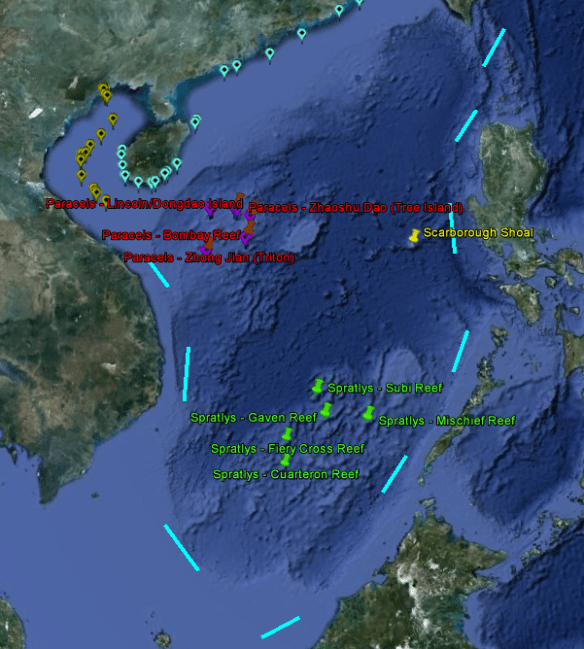
Google Earth Collection of the Disputed Territorial Claims in the South China Sea, East China Sea, and the Sea of Japan

Trying to keep track of all the contested territorial claims in the South China Sea and East China Sea can be difficult. There are hundreds of islands, reefs, rocks, and submerged shoals that are in dispute, and the relevant coastal states don’t always agree on which of those categories is applicable to each specific maritime feature. To make matters worse, most of those features also have at least three different common names in use, which reflects the myriad of competing territorial claims throughout the region.

So in order to have an easy reference source regarding the locations and identities of the disputes rocks, reefs, and islands, I’ve created a Google Earth collection with place markers for China’s disputed maritime claims.

South China Sea Dispute

Right now, this Google Earth file provides indicators for (1) the geographical coordinates declared by China as its baselines for measuring the breadth of its territorial sea,  pursuant to Article 16 of UNCLOS, for (i) China’s mainland territories; (ii) the territorial sea and EEZ divisions agreed upon in the 2000 treaty between China and Vietnnam; (iii) China’s claimed territorial baselines in the Senkaku Islands; and (iv) China’s claimed territorial baselines in the Paracel Islands; (2) the submerged features, rocks, and islands of the Paracel Islands which form the basis of China’s claimed territorial sea baseline; (3) the submerged features and rocks in the Spratly Islands and in the Scarborough Shoal that are identified as areas of dispute in the Philippines’ Annex VII arbitration against China; and (4) China’s Nine-Dashed Line Map, outlining China’s nonspecific territorial claims in the South China Sea.

Using Google Earth to view the disputed territories is also helpful in that it provides access to a large collection of user-uploaded photos of the disputed maritime features — which is handy for getting a better idea of just how rock-like many of these “islands” are, or for what a “low-tide elevation” really looks like. It also allows you to play around with the various distances involved, which puts into perspective the tenuousness of some of the territorial sea and EEZ claims that are being asserted.

-Susan

Annex VII Arbitration, Annex V Mandatory Conciliation, and China’s Nine-Dashed Line

There are nine states that have coastline along the South China Sea: the People’s Republic of China, the Philippines, Malaysia, Brunei, Indonesia, Singapore, Thailand, Cambodia, and Vietnam. There have been ongoing disputes for decades between those nations concerning their competing claims of sovereignty and jurisdiction over the South China Sea, as well as the islands and reef features it contains, and most of those disputes have involved China.

The reason for China’s leading role in these disputes can be fairly understood from a review of China’s infamous Nine-Dotted Line. This map, a version of which was submitted by China to the UN in 2009, is China’s depiction of what a fair and equitable division of jurisdiction over the South China Sea should look like:

China alleges that the extent of its claims of sovereignty over the South China Sea are based solely on its historically established territories and its lawful jurisdictional entitlements under UNCLOS and international law. The fact that these historical and legal claims provide China with self-proclaimed sovereignty over 80% of the South China Sea is, one assumes, merely a coincidence.

China’s coastal neighbors have, understandably, objected to China’s overreaching in its territorial claims under the Nine-Dotted Line, and it has been a frequent point of diplomatic contention in recent decades. Previously, however, none of the disputes concerning the South China Sea territorial claims have been successfully adjudicated by an international tribunal.

That streak may now be coming to an end. On January 22, 2013, the Philippines — perhaps finally realizing it has little to lose from taking legal action over China’s encroachments on their territories, and potentially a lot of diplomatic street cred to be gained — the Philippines filed a Statement of Claim instituting arbitration against China under Annex VII of UNCLOS,

“with respect to the dispute with China over the maritime jurisdiction of the Philippines in the West Philippine Sea, the Government of the Philippines has the honor to submit the attached Notification under Article 287 and Annex VII of the 1982 United Nations Convention on the Law of the Sea (UNCLOS) and the Statement of Claim on which the Notification is based, in order to initiate arbitral proceedings to clearly establish the sovereign rights and jurisdiction of the Philippines over its maritime entitlements in the West Philippine Sea.”

China was less than impressed with the Philippines’ notice of arbitration, and promptly returned the claim to the Philippines, stating that it declined to participate in the arbitration. In refusing to participate in the mandatory and binding arbitration procedure, China is taking a gamble. Not participating in the arbitration will greatly increase the odds of the arbitration tribunal rendering an unfavorable result. China is still hoping, however, that its usual rhetoric will prevail, and that the Philippines will stand down from the legal proceedings:

“The Chinese side hopes that the Philippine side keeps its word, not to take any action that magnifies and complicates the issue, responds positively to China’s proposals on establishing a bilateral regular consultation mechanism on maritime issues, resumes the operation of the Confidence Building Measures Mechanism (CBMs) as established between the two countries, and reverts to the right track of settling the disputes through bilateral negotiations.”

The reason for China’s refusal to play ball is obvious: China’s claims are devoid of any support under any customary international law or treaty. The longer China can go without having the unlawfulness of its claims officially decreed, the better China’s chances are at having its non-lawful claims take on the color of lawful action by dint of longstanding practice. As such, China has zero interest in allowing any tribunal, binding or unbinding, to render a legal decision concerning the validity of its maritime territorial claims.

China can, and has, found a way to somewhat legally assert its indefensible claims without facing legal challenge, through bullying any states that object into agreeing to submit the dispute to diplomatic negotiations rather than legal recourses. Article 280 of UNCLOS provides that “Nothing in this Part impairs the right of any States Parties to agree at any time to settle a dispute between them concerning the interpretation or application of this Convention by any peaceful means of their own choice.” As long as China can convince (or coerce) its maritime neighbors to agree to never-ending rounds of “bilateral negotiations” and “consensus building,” then the actual lawfulness of its claims will never be tested.

But in bilateral negotiations (conveniently, China always insists on bilateral, not multilateral), the strength of each party’s bargaining position is dependent on the weight of its political resources, not the weight of its legal arguments. This is precisely what the territorial divisions and corresponding dispute resolution procedures of UNCLOS were designed to avoid. UNCLOS’s provisions reflect a core goal of the parties in entering into the Convention, which was divorcing maritime sovereignty from maritime strength. Under UNCLOS, all coastal states, no matter the size of their GDP or their military, are, theoretically, entitled to the same breadth of their territorial seas and Exclusive Economic Zones (EEZ). UNCLOS was designed this way, in part, to prevent larger and more developed states from going on a maritime territory claiming rampage, done solely for the purpose of establishing a historical claim to occupation and use, with the goal of fully exploiting these territories at a future date. In short, there is no “use it or lose it” clause, under UNCLOS — developing states are not at a risk of losing the natural resources in their EEZ through inaction, and so do not need to divert resources towards shoring up their claims of sovereignty. The resources are theirs, and will be their waiting once a state’s economy develops to the point where it is able to harness and use those resources for itself.

China, in contrast, has subscribed to the exact opposite philosophy when it comes to maritime claims. China’s actions are consistent with its belief that, by virtue of its size and military power, it can claim any part of the ocean that is not actually within another state’s territorial seas. China often uses the language of law in asserting its maritime claims, but China’s actions indicate that it believes its claims are, in actuality, supported by the force of its military and not by the force of law.

In filing its Statement of Claim, the Philippines is now hoping to force China into either conforming its actions with its legal claims, or else be plainly shown to be a hypocrite who is not acting within the bounds of international law. It is not as if that would come as a surprise to anyone, but in terms of drumming up global support and united opposition against China’s maritime aggression, it could go a long way in the Philippines’ favor.

But whether or not the Philippines can lawfully bring its claims before an international tribunal is not a straightforward matter. True, Part XC of UNCLOS does provide for mandatory dispute resolution procedures, either through ITLOS, Annex VII arbitrations, the ICJ, or some other adjudicative body. But under Article 298, of UNCLOS, a limited exception is provided, and “a State may, without prejudice to the obligations arising under section 1, declare in writing that it does not accept any one or more of the procedures provided for in section 2 with respect to one or more… categories of disputes.” China did in fact file a written declaration, dated August 25, 2006, which invoked the opt-out clause of Article 298, providing that “[t]he Government of the People’s Republic of China does not accept any of the procedures provided for in Section 2 of Part XV of the Convention with respect to all the categories of disputes referred to in paragraph 1 (a) (b) and (c) of Article 298 of the Convention.”

Of the three categories of disputes in Article 298, it is the category described at 298(1)(a)(i) that is likely most relevant here: “disputes concerning the interpretation or application of articles 15, 74 and 83 relating to sea boundary delimitations[.]” Although the Philippines attempted to artfully draft its Statement of Claim to avoid implicating any of the disputes within Article 298’s categories, it is likely that at least some — though not all — of the Philippines’ claims would in fact encroach on the interpretation or application of articles 15, 74, and 83.

But this doesn’t mean the Philippines cannot have all of its claims decided by an international tribunal. China’s declaration under Article 298, regarding Section 2 of Part XV, does not affect China’s obligations under Section 1 of Part XV. This means China is still bound by Article 284’s conciliation requirements:

“A State Party which is a party to a dispute concerning the interpretation or application of this Convention may invite the other party or parties to submit the dispute to conciliation in accordance with the procedure under Annex V, section 1, or another conciliation procedure …

If the invitation is not accepted or the parties do not agree upon the procedure, the conciliation proceedings shall be deemed to be terminated.”

So why didn’t the Philippines opt for mandatory conciliation? Likely because conciliation, even when mandatory, is non-binding on the parties, and the Philippines would prefer to get a judicial order in its favor. On the other hand, it is possible conciliation was already tried, and failed. In the Philippines’ Statement of Claim instituting an Annex VII ad hoc arbitration against China, the Philippines stated:

“Most recently, during a series of meetings in Manila in April 2012, the Parties once again exchanged views on these matters without arriving at a negotiated solution. As a result of the failure of negotiations, the Philippines later that month sent China a diplomatic note in which it invited China to agree to bring the dispute before an appropriate adjudicatory body. China declined the invitation.” (emphasis added)

I have not been able to locate a copy of the note, and cannot determine what the “appropriate adjudicatory body” was. It is possible that the Philippines did invite China to conciliation — but presumably, if it had, the Philippines would have specifically noted it. If the Philippines has invited China to conciliation, and China has refused the request, this would strengthen the Philippines’ claims considerably. Because UNCLOS provides for mandatory conciliation for disputes that fall within Article 298(1),

a State may, without prejudice to the obligations arising under section 1, declare … that it does not accept any … of the procedures provided for in section 2… provided that a State having made such a declaration shall, when such a dispute arises subsequent to the entry into force of this Convention and where no agreement within a reasonable period of time is reached in negotiations between the parties, at the request of any party to the dispute, accept submission of the matter to conciliation under Annex V, section 2[.]

So even if China has exempted itself from the (immediate) force of Part XV, Section 2, China is still obligated to engage in mandatory conciliation under Annex 5, Article 11:

Any party to a dispute which, in accordance with Part XV, section 3, may be submitted to conciliation under this section, may institute the proceedings by written notification addressed to the other party or parties to the dispute.

Any party to the dispute, notified under paragraph 1, shall be obliged to submit to such proceedings.

If that is what happened here — if the Philippines did give written notification to China that it wanted the parties to engage in conciliation, and China declined — then the Philippines may have some argument that it was entitled to immediately proceed with an Annex VII arbitration, and that China cannot now validly object to the arbitration tribunal’s jurisdiction. This isn’t a watertight argument — the Philippines could have proceeded with mandatory conciliation, per Art. 12 of Annex V, even if China refused to participate — but the “provided that” language of Article 298 could be read to imply that Article 298’s opt-out procedures only apply on the condition that the party accepts submission of those disputes to mandatory conciliation. If China declined to comply with the condition precedent of Article 298’s opt-out provision, then perhaps the Philippines was entitled to proceed under Section 2 of Part XV.

Additionally, the Philippines does have a viable argument that its dispute with China (or at least part of it) is not within the class of disputes that is covered by China’s Art. 298 declaration. Mandatory conciliation might not have been required in this case at all. However, given the ambiguous and unsettled question of whether an Annex VII arbitration could exercise jurisdiction over the dispute submitted by the Philippines, it should be no surprise that the Philippines selected Rüdiger Wolfrum, the former president of ITLOS, as its designated arbitrator. Judge Wolfrum has already gone on the record stating that he believes UNCLOS tribunals have the jurisdiction to hear maritime delimitation disputes that arise in the context of UNCLOS provisions that do not directly concern delimitation, but may indirectly affect it:

there can be no doubt that disputes concerning the interpretation or application of other provisions, that is, those regarding the territorial sea, internal waters, baselines and closing lines, archipelagic baselines, the breadth of maritime zones and islands, are disputes concerning the Convention (see articles 3 to 15, 47, 48, 50, 57, 76 and 121).

Although far from conclusive, it does suggest Judge Wolfrum may be willing to find that a maritime delimitation dispute of the type brought by the Philippines arises under UNCLOS pursuant to articles other than 74 and 83. If so, that would give the Philippines at least one potential vote on the arbitration panel — and a persuasive one, at that — in favor of an Annex VII tribunal finding in favor of its own jurisdiction to adjudicate the Philippines’ claims.

-Susan

A Brief History of the Solemn Salute Under International Law, and the Competence of an Annex VII Abritral Tribunal to Award a Salute as Satisfaction

In my previous post on Argentina’s procedural victory over Ghana in the ARA Libertad case, I talked about how Argentina used the UNCLOS’ dispute resolution procedures to get an expedited provisional measures order from the International Tribunal of the Law of The Sea — and how, in effect, that provisional decision operated as an adjudication of the merits. Argentina’s victory was, in part, attributable to its success in convincing the Tribunal that awarding Ghana to release the ARA Libertad would not be a resolution of the case in full. In reality, however, the Tribunal’s provisional order made the underlying dispute moot, and that a decision on the merits would never be reached.

Judge Paik, in his Separate Opinion, reasoned that ordering the release of the ARA Libertad was not the same as awarding Argentina the principal relief it was seeking, because “the various forms of relief sought by Argentina in its Application instituting the Annex VII arbitration are obviously broader than those sought in the request for provisional measures.” But, as I pointed out in my last post, through the Tribunal’s provisional measures order,

Argentina did receive, in substance, all of the relief that it actually sought — because the “obviously broader” “various forms of relief” that Judge Paik makes reference to were largely superfluous demands that the arbitral tribunal would not have even had jurisdiction to grant. In fact, I suspect that Argentina was fully aware that no tribunal would ever grant the superfluous forms of relief it demanded in its original Statement of Claim — but that it deliberately through a few bogus demands into its claims anyway, so that, when it made a request for provisional relief, Argentina could argue that the “provisional” measures it was seeking were not identical to the relief it sought in its Application.

In particular, two of the remedies Argentina sought were bogus claims for relief; these requests were guaranteed to be left unawarded and unaddressed by ITLOS in its provisional ruling, guaranteeing that there would be, at least in theory, a question ‘on the merits’ to be decided by the Annex VII arbitral tribunal. As stated in Argentina’s Statement of Claim, here are the four forms of relief that Argentina was seeking to be awarded:

Thus, Argentina requests the arbitral tribunal to assert the international responsibility of Ghana, whereby such State must:

(1) immediately cease the violation of its international obligations as described in the preceding paragraph;

(2) pay to the Argentine Republic adequate compensation for all material losses caused;

(3) offer a solemn salute to the Argentine flag as satisfaction for the moral damage caused by the unlawful detention of the flagship of the Argentine Navy, ARA Fragata Libertad, preventing it from accomplishing its planned activities and ordering it to hand over the documentation and the flag locker to the Port Authority of Tema, Republic of Ghana;

(4) impose disciplinary sanctions on the officials of the Republic of Ghana directly responsible for the decisions by which such State has engaged in the violations of its aforesaid international obligations.

The first request, for the release of the ship, is restitutionary relief, which is the most fundamental form of reparation under international law. As stated in Art. 35 of the Draft Articles on Responsibility of States for Internationally Wrongful Acts, “[a] State responsible for an internationally wrongful act is under an obligation to make restitution, that is, to re-establish the situation which existed before the wrongful act was committed.”

Restitution, through the release of ARA Libertad, was the fundamental aim of Argentina’s institution of arbitration against Ghana. It is also precisely what Argentina was awarded by the International Tribunal of the Law of the Sea in provisional measures order.

Request number two is a straight-forward request for monetary compensation, in accordance with Art. 36 of the Draft Articles. Where restitution is insufficient relief to not repair a state’s breach in full, an award of monetary compensation — equivalent to a civil damages award — may be appropriate, to “cover any financially assessable damage.” In the Tribunal’s provisional award, Argentina did not receive compensation from Ghana — and to that extent, the Tribunal is correct that Argentina did not receive the full relief it sought. But Argentina’s financial damages were relatively limited, largely consisting of the costs of flying home a few hundred Argentinian cadets. The financial cost was not the state’s primary concern, and would not, in itself, have motivated an international arbitration.

In contrast to Argentina’s first two requests, the third and fourth requests made in its Statement of Claim 3 and 4 are demands for satisfaction, as described in Art. 37 of the Draft Articles:

Article 37. Satisfaction
1. The State responsible for an internationally wrongful act is under an obligation to give satisfaction for the injury caused by that act insofar as it cannot be made good by restitution or compensation.
2. Satisfaction may consist in an acknowledgement of the breach, an expression of regret, a formal apology or another appropriate modality.
3. Satisfaction shall not be out of proportion to the injury and may not take a form humiliating to the responsible State.

There is reason to think that the inclusion of these requests in Argentina’s Statement of Claim was calculated; satisfaction in general is not a favored form of relief, and the satisfaction Argentina sought was phrased in a more insulting manner than was necessary. This may be because Argentina included these requests not because they actually wanted to receive what they were asking for, but because they wanted to convince the Tribunal — and as in fact it did convince Judge Paik — that there was daylight between Argentina’s demands for provisional relief and Argentina’s demands on the merits.

Argentina’s demands for satisfaction were not legitimate requests for relief, and they are not within the jurisdiction of any Annex VII arbitral tribunal to award. Although both the request that Ghana be forced to offer a “solemn salute” to Argentina’s flag and the request that the arbitral tribunal “impose disciplinary sanctions” against individual Ghanaian officials are illegitimate requests for satisfaction, in this post, I’ll only focus on why an Annex VII arbitral tribunal could not have rightfully awarded the relief sought.

Continue reading

Argentina’s Sham Annex VII Arbitration and ITLOS’ Provisional Ruling on the Merits of the ARA Libertad Case

Libertad_1On October 2, 2012, the Ghanaian government detained an Argentinian “warship”, the ARA Libertad, that had been docked at the Ghanaian port of Tema while on a cadet training mission.

As a matter of domestic law, the detention of the ARA Libertad was a routine court action, nothing more than an ex-parte injunction order, duly issued by a Ghanaian civil court, for the purpose of preserving an asset that might be used to pay off a potential judgment against the asset’s owner. The plaintiff in that action, a Cayman Islands investment fund, was attempting to collect on a one billion dollar judgment against the Republic of Argentina — and had decided that one way of doing so would be to seize Argentinian ships had sailed into foreign jurisdictions.

As a matter of international law, however, the detention of the ARA Libertad was not quite so routine. NML Capital, the Cayman Islands investment fund responsible for the proceedings, might have thought it was being clever in targeting Argentina’s ships to collect against the judgment, but using a foreign sovereign’s judicial power to seize another nation’s “warship” — even if that warship is just an unarmed training boat — is not something that is going to go down well, diplomatically speaking.

And after diplomatic measures failed to resolve the dispute, Argentina responded by notifying Ghana, on October 29, 2012, that it was submitting the dispute to arbitration pursuant to Annex VII of the UN Convention on the Law of the Sea. Although both states are parties to UNCLOS, Ghana has not, in accordance with Article 287 of UNCLOS, declared a preferred venue for the settlement of disputes, which means that the forum for dispute resolution between Ghana and Argentina defaulted to UNCLOS’ arbitration procedures, at Annex VII.

As it turns out, this situation worked out very well for Argentina. As a result of its procedural handling of its claims concerning the ARA Libertad, in a mere six weeks of international litigation, Argentina was able to (1) secure the release of its vessel and (2) created a procedural posture which would likely result in the effective termination of any further related judicial proceedings, no matter the venue.

This result is due, in part, to the fact that the submission of a dispute to an Annex VII arbitral tribunal doesn’t actually do anything, other than serve as notice. The institution of proceedings under Annex VII is accomplished by a simple written notification to the opposing party, and once that is accomplished, nothing further happens until the parties decide upon a list of five arbitrators to sit on the panel. When Argentina notified Ghana that it was submitting the dispute to arbitration, Ghana was “supposed” to respond by appointing its own freebie arbitrator within 30 days of receiving the notification. But if Argentina does not thereafter force the matter by submitting a request for the President of ITLOS to make the remaining appointments, then the “arbitral tribunal” would simply never get off the ground.

And that appears to be what happened here.

Two weeks after instituting the Annex VII arbitration, on November 14, 2012, Argentina instituted proceedings before the International Tribunal on the Law of the Sea by requesting that the Tribunal issue a provisional ruling ordering Ghana to release the ARA Libertad. Argentina’s request was made pursuant to Article 290(5) of UNCLOS, which provides that “[p]ending the constitution of an arbitral tribunal to which a dispute is being submitted under this section, any court or tribunal agreed upon by the parties or, failing such agreement within two weeks from the date of the request for provisional measures, the International Tribunal for the Law of the Sea… may prescribe, modify or revoke provisional measures.” Because the request for provisional measures was made in its initiation of the arbitration panel, in the letter to Ghana, Argentina was able to request a provision ruling from ITLOS a mere 14 days after it notified Ghana that it wanted to convene an Annex VII arbitration panel.

Of note, this sort of speedy provisional ruling could not have been requested in a case that was actually before ITLOS on the merits — although 290(1) allows ITLOS to issue provisional measures where it feels they are necessary, it does not explicitly allow a party to request them. Only by initiating an Annex VII arbitral tribunal could Argentina proceed with the request for provisional measures.

Four weeks later, on December 15, 2012, the Tribunal issued an order awarding Argentina all of the relief it requested in its Application for Provisional Measures:

Ghana shall forthwith and unconditionally release the frigate ARA Libertad, shall ensure that the frigate ARA Libertad, its Commander and crew are able to leave the port of Tema and the maritime areas under the jurisdiction of Ghana, and shall ensure that the frigate ARA Libertad is resupplied to that end.

In its Application for Procedural Measures, at paragraph 70, Argentina stated that “[t]o date, Ghana has not appointed a member of the arbitral tribunal and has not reacted to the invitation of Argentina to enter into discussions with it for the purpose of appointing the other members of the Annex VII arbitral tribunal.” This was somewhat premature at the time, as Ghana had until November 29, 2012 before it was required to appoint its own arbitrator, and Argentina had simply proceeded with filing its Request for Provision Measures at its earliest available opportunity.

But, as far as I can ascertain from the available records, Ghana never did get around to appointing an arbitrator. And, thereafter. Argentina never requested that the ITLOS President, pursuant to Article 3(e) of Annex VII, step in to make those appointments on the parties’ behalf. Although, pursuant to Article 3(b) of Annex VII, Argentina did appoint a single arbitrator to be on the arbitral tribunal (it could hardly have avoided doing so), there is no indication that Argentina has taken any further actions with regard to the arbitration panel it instituted. Having received “interim” relief that gave it everything it wanted, the Annex VII arbitral tribunal is now forgotten.

In other words, Argentina “initiated” an arbitration proceeding it did not intend to follow through on. The result is that the Tribunal’s Art. 290(5) provisional measure will, in effect, operate as a decision on the merits, and no further adjudication of this dispute will occur. The arbitral tribunal appears to have been stillborn, and the domestic suit also appears to have been abandoned. On December 19, 2012, the Ghanaian Supreme Court ordered that the ARA Libertad be released, in accordance with the Tribunal’s ruling, and the case was thereafter abandoned. After all, with the ARA Libertad no longer available for attachment, NML Capital had no reason to continue its Ghanaian collection action.

In short, Argentina’s use of procedural maneuvers enabled it to secure a fast-tracked award of its requested relief without any consideration as to the merits of its case. Heck, Argentina didn’t even have to prove that an Annex VII arbitration panel would even have jurisdiction to hear its dispute — it just had to convince the Tribunal that it had met, in the words of Judge Paik, the “rather low threshold of prima facie jurisdiction.”
Not a bad result at all.

At least for Argentina, anyway. The Tribunal’s award of provisional relief in the ARA Libertad case raises serious concerns about the effectiveness of UNCLOS’s dispute resolution procedures, however. Because, having received the provisional relief it requested from the Tribunal, Argentina seems to have the Annex VII arbitration that Argentina initiated seems to have been discarded.

The Tribunal’s judges are not unaware of this problem. In fact, three of the four separate opinions that were issued along with the Tribunal’s order in the ARA Libertad case make direct reference to the judges’ concerns regarding the Order’s lackadaisical approach to the issue of jurisdiction under Article 290(5). After noting their concerns, however, all three of those opinions then promptly fall over themselves in coming up with convoluted explanations for why, despite the significant jurisdictional problems in Argentina’s case, they nevertheless were ultimately in agreement with the Tribunal’s decision to award Argentina its requested relief.

Judge Wolfrum and Judge Cot, in their separate opinion, actually agree with Ghana that an Annex VII arbitral tribunal would not have jurisdiction to hear Argentina’s claims. The Tribunal’s decision to issue provisional relief to Argentina, they argue, would not be consistent with the purposes behind of Article 290, which is to ensure that a meaningful decision on the merits can be reached. As such, “[p]rovisional measures may only be requested and decided in the context of a case submitted on the merits. Provisional measures are meant to protect the object of the litigation in question and, thereby, the integrity of the decision as to the merits.” Granting provisional relief in the ARA Libertad case is troubling, even if it was done to protect Argentina’s own sovereignty, because “[i]t should always be borne in mind that the prescription of provisional measures constitutes an infringement of the sovereign rights of the responding State.”

But despite this acknowledged jurisdictional problem, Wolfrum and Cot don’t let that stand in the way of them concurring with the Tribunal’s ultimate decision:

Although we disagree with the finding of the Tribunal that the arbitral tribunal under Annex VII has jurisdiction in accordance with article 288, paragraph 1, of the Convention, in our view, Ghana is estopped from opposing the proceedings at this phase. … The Tribunal cannot accept the submission of Ghana “to reject the provisional measures filed by Argentina on 14 November 2012”. Ghana is estopped from presenting any objection on the matter, whatever the validity of the arguments presented to that effect.

In other words, according to Wolfrum and Cot, maybe the Tribunal doesn’t have jurisdiction to adjudicate a dispute between two sovereigns — but that’s okay, because, really, this is just a default judgment case, anyway, so there isn’t any real sovereignty violation going on.

Judge Paik, too, thinks that the Tribunal’s jurisdiction in the ARA Libertad case may be a little shake. Like Wolfrum and Cot, Judge Paik’s separate declaration to the Tribunal’s Order acknowledges that provisional rulings should not function as a decision on the merits:

As provisional measures are prescribed without there being any need to prove the conclusive existence of jurisdiction or the validity of claims, a request for measures that would result in virtually resolving the dispute should not be accepted. The Permanent Court of International Justice emphasized this point when it stated that any request ‘designed to obtain an interim judgment in favour of a part of the claim formulated in the Application’ should be dismissed.

Judge Paik ultimately decided that the Tribunal’s cavalier approach to jurisdiction was justified due to the fact that the Art. 290(5) ruling didn’t really give Argentina everything it wanted, it only mostly did:

In the present case, the relief sought by Argentina in the request, which is the unconditional release of the warship ARA Libertad, comes close, in substance, to the principal relief sought in the claims submitted in its Application. However, this fact alone should not preclude the Tribunal from considering the measures sought by Argentina. In addition, the various forms of relief sought by Argentina in its Application instituting the Annex VII arbitration are obviously broader than those sought in the request for provisional measures.

But Judge Paik’s justification for the Tribunal’s award is unsatisfactory. Because Argentina did receive, in substance, all of the relief that it had sought in its Application — as the “obviously broader” “various forms of relief” that Judge Paik makes reference to in his opinion were largely superfluous demands that the arbitral tribunal would not have even had jurisdiction to grant if it wanted to. In fact, I suspect that Argentina was fully aware that no tribunal would ever grant the overreaching demands it made in its original Statement of Claim. Rather, Argentina was fully aware that it would never succeed in having Ghana be ordered to give a “solemn salute” to Argentina’s flag, but it deliberately through the bogus demand into its claims anyway — so that, when it made its play for provisional relief in front of the Tribunal, Argentina could argue that the “provisional” measures it was seeking were not identical to the relief it sought in its Application.

The third separate opinion, from Judge Lucky, echoed all the same concerns as did Wolfrum, Cot, and Paik. Like them, Judge Lucky noted that “[w]hen a party to a dispute seeks the prescription of provisional measures, the Tribunal has to consider whether by granting the Request, it prevents the parties from taking any action that would render the final decision on the merits otiose.” But, in his explanation for why he nevertheless agreed with the Tribunal’s result, Judge Lucky provided perhaps the most honest assessment of the basis of his decision:

I think that international law and the relevant articles in the Convention should be considered as a whole and in these circumstances article 32 can be deemed to include internal waters; not only because it does not explicitly exclude the immunity of warships in internal waters, but because it should be read in congruence with other rules of international law which guarantee such immunity. Therefore, where the law is silent a tribunal ought to take a pragmatic approach and, bearing in mind the circumstances of the case, interpret and construe the law accordingly.

In other words, the Tribunal’s decision to award provisional relief to Argentina was justified for “pragmatic” reasons, and in accordance with well established norms of international law that exist outside of narrow scope of UNCLOS’s subject matter jurisdiction. While the ARA Libertad case undoubtedly put the Tribunal in an uncomfortable position — and I can understand the Tribunal’s reluctance to be complicit in one state’s unprovoked seizure of another nation’s military vessel — in order to avoid that result, the Tribunal arguably engaged in an overly expansive interpretation of its own jurisdiction.

If that is what happened here, then the Tribunal’s order was a short-sighted one. Judges Wolfrum and Cot, in their separate opinion, give warning of the long-term consequences of such an approach:

Any attempt to broaden the jurisdictional power of the Tribunal and that of arbitral tribunals under Annex VII going beyond what is prescribed in article 288 of the Convention is not in keeping with the basic philosophy governing the dispute settlement system of the Convention. It undermines the understanding reached at the Third UN Conference on the Law of the Sea, namely that the dispute settlement system under the Convention will be mandatory but limited as far its scope is concerned.

In the end, however, the true loser in the ARA Libertad case isn’t the Tribunal. It isn’t even NML Capital, the thwarted judgment creditor that kicked off the dispute in the first place — they’ll likely just find a new scheme for how they can get their billion dollars back from Argentina.

The real loser is Ghana.

Ghana didn’t even have a stake in this fight, initially. It was Ghana’s bad luck that NML Capital ultimately decided to use Ghana’s domestic judicial system to try and collect against Argentina. By not finding some judicial excuse to deny NML’s request for an injunction, Ghana’s judiciary dragged the whole state into an international dispute that was never its to fight in the first place. It was Ghanaian tax payers that bore the brunt of the costs, too; the Ghanaian port authority lost a reported $7.6 million as a result of the ARA Libertard proceedings.

But maybe Ghana won’t be totally out of luck — and perhaps the litigation over the ARA Libertad affair isn’t entirely over. As of December 2012, anyway, the Ghanaian Port Authority was considering going after NML Capital to recover its losses.

-Susan

Update, 2-26-13: Looks like Argentina was more serious about this arbitration than it initially appeared. Argentina had requested that the President of ITLOS appoint three arbitrators for the arbitration panel. Presumably, then, Ghana did nominate its own choice of arbitrator, but the parties were unable to decide upon the remaining three. It will be curious to see whether Argentina continues to prosecute this action.