
Recovery, Orange Juice, and Cotton

Global trade sees fastest rise for five years: Well, here’s some moderately hopeful news.

Global trade rose at its fastest rate in more than five years in July, suggesting the economic recovery is feeding through into commerce.

An index compiled by the Bureau for Economic Policy Analysis, a Dutch research institute, showed the volume of world trade rising 3.5 per cent in July after a revised increase of 1.6 per cent in June.

The numbers suggest the fall in trade over the past year, steeper than during the 1930s, was mainly caused by lack of demand rather than a breakdown in the trading system.

Brazil-US Relations and the WTO: Minor new updates from Friday on ongoing trade disputes with Brazil. A panel’s been established to look into Brazil’s latest complaints about U.S. antidumping duties on Brazilian orange juice. It’s another zeroing case, which sort of just bores me to tears, so here’s something more interesting: How Brazil Became the Saudi Arabia of Orange Juide.

The fall out from cotton subsidies case is going to be much more fun, thanks to the possibility of Brazil engaging in IP cross-retaliation against the United States. The cotton war has been going on forever, but recently Brazil won a key victory. However, the WTO decision didn’t much clarify things in the way of hard numbers:

While Brazil had sought $2.5 billion in annual retaliatory trade sanctions, the US, after delaying compliance with a WTO ruling decision that found it had violated trade rules, had claimed that a figure of $20-30 million would meet the case. Last fortnight’s ruling does specify annual sanctions that can be imposed by Brazil but the ruling allows wide differences of interpretation as a result of which the two sides have come up with their own estimates of what the sanctions should cost.

Brazil says that it is entitled to about $800 million in sanctions, including $340 million of cross-retaliation against IPR or services. The US, for its part, believes the sanctions should amount to no more than $300 million, and that any retaliation on the patents front is unlikely in the near future.

I’m not even going to try to talk about the IP cross-retaliation aspect — that’s more Michael’s gig — but Brazil is now asking the U.S. to cough up information on exactly how much subsidizing its been doing, and I’m more interested in seeing how or if the U.S. is complying with the request. All I’ve seen so far is that in response to Brazil’s requests for numbers on cotton subsidies for 2009 (from first link),

Washington did not address the question in its statement at the closed-doors meeting, but said it would be open to discussing a possible out-of-court settlement with Brazil.

What sort of powers or diplomatic strategies does Brazil have to force the U.S. to give up the info? I think I might spend some time looking that up tomorrow, but for now I don’t really have a clue.

-Susan
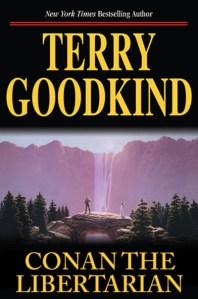
The Economic Agendas of Sci-Fi and Fantasy Authors, Vol. 2 — Terry Goodkind

conanlibertarianTerry Goodkind

I realized that there is one author, at least, who I am totally competent to critique even without the benefits of having his books before me: Terry Goodkind. That’s because you don’t actually need to read The Sword of Truth series to understand what they’re about, you can just go type “libertarian porn” into google and you will probably get the same experience.

Okay, they’re not quite that bad. After all, I did read all of them, and at ~800 pages a pop times 11 novels, that’s 8,800 pages I bothered to get through. Admittedly, that was over the course of 12 years, beginning in seventh grade when I first picked them up because I got bored waiting for Robert Jordan to crank out his next book, and finally ending this past summer when I was studying for the bar, and therefore procrastinating with a Terry Goodkind novel was marginally less frustrating than the BarBri books I was actually supposed to be reading.

But in between the decent chunks of sword-and-sorcery fantasy in The Sword of Truth, Terry Goodkind seizes every possible opportunity to turn his characters into hoarse mouthpieces for the Libertarian War Against Communism. It’s kind of funny, the first dozen times it happens. And then it starts getting annoying, when you find yourself wondering if the speeches were simply copied and pasted from a speech that same character gave two books ago. And then finally by about book 6 or so, every time you see a character launch into a major speech, you just skip ahead six or seven pages until you find where the quote marks stop and everyone goes back to stabbing bad guys.

A rough synopsis of the series [SPOILER ALERT] is that Hank Roark Richard Cypher, a simple woods guide, is actually the leader of the D’Haran Empire, and the beautiful Dagn- Domini- Kahlan has been sent to fetch him. After securing his title as Supreme Commander of the Old World, he then must fight the rampaging horde of liberal democrats in the New World that wish to destroy individualism and promote the idea of from each according to his ability, to each according to his need.

Anyway, they all live in a world where it is possible to conquer the forces of evil simply by demonstrating to them your noble, liberty-loving spirit and your adamant refusal to live your life for another.

Read More: In Libertarian Land, you can always tell which women love freedom the most. It’s the hot ones »

Public Service Announcement: No, You Have Not Seen a Goatsucker.

This is coming a bit late, but in case anyone missed it, here is a debunking of the ‘Panamanian Blue Hill Monster’. It’s a sloth, people. A friggin’ sloth.

And you know all those Montauk Monsters that were popping up on lake shores last year? Raccoons. All of them. Raccoons that had taken too long of a soak in the bath.

I hate how news outlets go crazy whenever someone spots a fox with mange and starts yelling that they found a chupacabra. At least the pulsating sewer alien from North Carolina was completely awesome in its own right, even if not an alien.

Read the rest of this entry: Now, to make up for the poor dead Blue Hill Monster… »

Now I really want to find a global McMap.

Via Strange Maps, there’s a visualization from here showing the lower-48, as depicted by McDonalds locations.

The most McIsolated location in the contiguous U.S. is just north of Glad Valley, South Dakota, and is 145 miles by car to the nearest McNuggets six piece.

I love how you can see U.S. settlement patterns just from a map of McDonalds locations. The major cities are obvious hubs, but even cooler are the gaps — you can distinctly see the Okefenokee as a small gap in Southern Georgia, and then at the bottom edge of Florida, just above the Key West McDonalds, you can see where the Everglades are.

As for the gap midway up the east coast, I guess that’s maybe Albermarle sound, in North Carolina? You can very clearly follow down the coast from New York-Pennsylvania-Baltimore/D.C.-Richmond-Virginia Beach, so south of that, at the point that juts out most eastward, would be about right. Plus the little pinchers that stick out around the gap would be the barrier islands around it. I find it curious you could see Albermarle Sound clearly, though, while Chesapeake Bay, which is much bigger, is barely a thin wriggle.

You can also see a big gap in the West Virginia mountains (the Monongohela?), the only McGap of its size anywhere on the east. You’ve also got a gap at the Adirondacks farther up north, and below that, there’s a jutting squiggle… It’s about the right place for the Allegheny National Forest, but the shape of it doesn’t seem quite right, so not entirely sure what explains the lack of Maccas there.

Unfortunately, I’m not familiar enough with the west portion of the U.S. to really pick out any features, but it is cool how you can very clearly see the skeleton of the interstate system dotted out. You can see a few on the east, too — check out 1-20 stretching out east from Dallas towards Atlanta, and I-81 between Knoxville and Richmond — but they’re not as clear.

And around North Dakota, it totally starts to look like a bunch of cells in the midst of mitosis. Maybe that’s how McDonalds chains reproduce.

-Susan

The Economic Agendas of Sci-Fi and Fantasy Authors, Vol. 1 — Jack London

Note: I wanted to write a series of posts about the economic and political beliefs found in the science fiction and fantasy novels of China Meiville, Isaac Asimov, Terry Goodkind, Robert Heinlein, and a few others, but I found I was having a hard time doing it purely from memory. Unfortunately, most my books are back home in Atlanta, and Jack London was the only author outside of copyright protection and thus the only one whose works I could find online. So Jack London is first. For the rest, I’ll either settle for writing posts from memory, or wait until I’m back home for Thanksgiving to pick up the books. (Actually, Cory Doctorow will probably be next — thanks to the fact he’s happy to give up on restrictive copyright protections, his work is out there for free too.)

Jack London:

Although most famous for his Alaskan wilderness fiction, Jack London also wrote a fair collection of science fiction short stories and four scifi novels. I grew up on Call of the Wild and White Fang, and obsessed over his  short stories (it’s a good thing I didn’t end up naming my first dog Bâtard!), but it wasn’t until much later that I started paying attention to his non-wolfdog-based fiction.

And so I never realized as a kid that Jack London was very much a socialist. And not the fluffy kind, either. In his resignation from the socialist party, he wrote:

I am resigning from the Socialist Party, because of its lack of fire and fight, and its loss of emphasis upon the class struggle. I was originally a member of the old revolutionary up-on-its-hind legs, a fighting, Socialist Labor Party. Trained in the class struggle, as taught and practised by the Socialist Labor Party, my own highest judgment concurring, I believed that the working class, by fighting, by fusing, by never making terms with the enemy, could emancipate itself.

Since the whole trend of Socialism in the United States during recent years has been one of peaceableness and compromise, I find that my mind refuses further sanction of my remaining a party member. Hence, my resignation.

These views very much influenced his fiction. And although London is beyond a doubt one of my favorite authors of all time, my love for his stories is often tempered with uneasiness with the themes they are promoting.

Far less forgivable than his socialist views is his embracing of Social Darwinism and Rudyard Kipling-style racial paternalism.  (I’m being charitable here; at times, his racism was much more severe than that, and he was not opposed to eugenics.) His opinion of women was little better, and in London’s fiction, females are often very much fungible goods. If you lose one, just find another — or better yet, steal it. The number of instances of wife-stealing in his stories is staggering.  His tepid support for women’s rights was not based upon any belief in their equivalency to men, but rather as a way to bring about an end to alcohol. In John Barleycorn, the memoir opens with London announcing that he voted for women’s suffrage — not because he agrees particularly with the idea that women should vote,  but rather because “[w]hen the women get the ballot, they will vote for prohibition[.]”

But because discussing economics is more fun than detailing the moral failings of a historical figure I still have respect for, I’m going to ignore his social views and instead focus instead on two of his speculative fiction short stories with communist themes: Goliah and Strength of the Strong.

Continue reading

I bet if you said to the protesters “Hey, let’s go protest the G-77!” they’d probably yell back “Yeahhh!!”

I have no truck with G-20 protesters. They have less coherency than a Paulian Tea Party and dumber catchphrases than Saturday morning cartoons. Seriously, “No borders, no banks”? Wait, are you claiming that if we don’t have borders, we won’t have banks? Or that you don’t want either borders or banks? Or that G-20 countries are somehow a bigger fan of borders than any other nation? And let’s not even get into “We all live in a fascist bully state” sung to the tune of Yellow Submarine.

But I do kind of love this little film clip of a bunch of protesters getting a canister of what press reports claim to be pepper spray thrown at them.

It’s hard to tell from the footage if throwing the pepper spray was actually justified; elsewhere, there are reports that protesters were throwing trashcans at cops and breaking police car windows, so it’s unclear. And I’m more than willing to believe there were encounters with the protesters where the police were unnecessarily aggressive.

But look at the protesters. They’re laughing. They get freaked out for a moment, then laugh and whip out cell phones, while cheering like it’s smoke from Fourth of July fireworks. Probably amazed at their coolness — damn, to be honest, if I’d been at a protest that got gassed, I’d probably feel like a bad ass too. But you just know they all went home after that to write a twitter post about it.

And in some ways, even more than their ill-planned protest signed or questionable clothing choices, that’s the biggest obstacle to their protest being taken seriously. That we live somewhere they can protest, and police presence isn’t a danger to them but instead makes for a cool story for the dorm room later.

C’mon, protesters, try a little harder, please. If you’re using the police action at the G-20 protest today as proof that ‘we all live in a fascist bully state,’ it’s no wonder your whole cause is DOA.

-Susan

I have a hard time trying to imagine two more random countries getting into a catfight than Libya and Switzerland.

After hearing about the amazing Libyan resolution before the United Nation calling for the dissolution of Switzerland (because “it’s a world mafia and not a state”), I started noticing a lot more random, petty incidences Swiss-hatin’ by Libya. And while writing the last post, I came across an article on how complying with Libyan requests intended to further a boycott against Switzerland would not violate export laws.

What the heck could Libya have against the neutral-as-beige Swiss? It was bizarre enough to be worth looking up, and coincidentally, just a couple hours ago there was new Libya-Switzerland drama unfolding, as Libya announced it has essentially kidnapped and detained two Swiss citizens:

For more than a year, Switzerland has known that two of its businessmen have been prevented from leaving Libya. But they are now being held “for their own security” because there is a “threat that Switzerland might free them militarily,” the Swiss Foreign Ministry quoted a Libyan letter as saying.

It turns out it all stems back to a 2008 incident:

Police were called to the five-star Hotel President Wilson on July 15 after two hotel employees, from Tunisia and Morocco, accused Hannibal Qaddafi, 32, and his expectant wife, Aline, of beating them with a belt and a coat hanger.

Qaddafi spent two days in custody, while his pregnant wife was under police supervision in a clinic in Geneva. They were released on $490,000 bail two days later and left Geneva.

Qaddafi, who is a skilled grudge-holder, is now waging a one-nation campaign against Switzerland. Meanwhile, an arbitration panel is being established to examine the circumstances surrounding Hannibal’s arrest.

And the Swiss incident wasn’t Hannibal Qaddafi’s first time acting like a punk while in Europe. “In 2004 he was arrested in Paris for driving along the Champs Elysées at 140 km per hour. The following year, also in Paris, he was convicted and fined for assaulting his then girlfriend, a Lebanese model.” At least he hasn’t charged into Italy on elephant-back yet?

-Susan

Shocking News Break: Saudi Arabia Still Doesn’t Like Israel

The Export Administration Regulations (“EAR”) prohibit U.S. persons from cooperating in any boycotts of foreign states that the U.S. does not support. The primary purpose of these regs is to attack the Arab League’s boycott of Israel.

The Jerusalem Post recently came out with an article showing that, despite these antiboycott provisions, attempts by Saudi Arabia to gain compliance from American businesses with it boycott activities are on the rise.

A review of US Commerce Department data conducted by the Post found that the number of boycott-related and restrictive trade-practice requests received by American companies from Saudi Arabia has increased in each of the past two years, rising from 42 in 2006 to 65 in 2007 to 74 in 2008, signifying a jump of more than 76 percent.

In addition to being a violation of domestic U.S. law by American businesses, this is also pretty clearly a violation of Saudi Arabia’s commitments to the WTO:

In November 2005, the desert kingdom pledged to abandon the boycott after Washington conditioned Saudi Arabia’s entry into the World Trade Organization on such a move. A month later, on December 11, Saudi Arabia was granted WTO membership.

The WTO, which aims to promote free trade, prohibits members from engaging in discriminatory practices such as boycotts or embargoes.

It looks like the Jerusalem Post article might be spurring Congressional action:

[Democrat and Chairman of the House Foreign Affairs Committee Howard] Berman declared that he would take action on the issue.

“I intend to pursue this matter with the administration,” he said.
Across the aisle, Congressman Mike Pence of Indiana, who chairs the House Republican Conference, also criticized Riyadh for its duplicity.

“Saudi Arabia’s disregard of its 2005 pledge to end the boycott against Israel is unacceptable,” Pence told the Post.

“Congress and the administration must hold Saudi Arabia accountable. The United States cannot stand by and continue to witness this mistreatment towards the peace-loving people of Israel,” he said.

Over at International Trade Law News, there’s a graph up showing boycott activity among Arab League nations in 2008. Saudi Arabia ranked fifth among boycott requests, while Jordan remained alone in having no reported boycott activity.

-Susan

The Saga of the Arctic Sea Continues

The Arctic Sea has gone missing again, though this time under Russian control and presumably heading for Russian port. Spain never let the ship into Las Palmas due to the presence of military personnel on board.

Meanwhile, although 11 of the 15 Russian crew members were eventually released, the remaining 4 are still on board the Arctic Sea — and according to their wives, being held captive there:

Captain Sergei Zaretsky and three crew members have not been allowed off the Arctic Sea more than a month after a Russian warship seized the vessel from eight suspected pirates.

Their wives appealed to the International Red Cross and the governments of Spain, Malta, Finland and Russia to intervene, saying that the men were in poor health two months after the Arctic Sea was supposedly boarded by an armed gang in the Baltic Sea.

I can’t figure out exactly what sort of help the crews’ wives are asking for, but at any rate they are very unlikely to receive it.

Back in Russia, the lawyers for the hijackers are now portraying this as some sort of National Lampoon’s Russian Spring Break. The hijackers — ecologists, in reality — got their boat swamped, and the Arctic Sea just happened to be passing by. The crew of the Arctic Sea offered them a lift, and they all then sailed down to Cape Verde, cavorting in the sun and playing in their pool. The poor ecologists had no idea the ship was missing or even that they were now off the coast of Africa, except that it was getting “warmer,” so they assumed they’d sailed south. Alleged hijacker Dmitry Bartenev, on crew-pirate relations:

“The crew were very friendly. When they realised we were Russians, they took us to the saloon bar and cracked open a bottle of vodka. There was a lot of booze on the Arctic Sea: whisky and strong alcohol of all kinds.”

-Susan