Interconnected World

I love this map. Via NewScientist, Where’s the Remotest Place on Earth?


[Larger version available here.]

roads_2The map shows the travel times from anywhere on earth to the nearest city with a population of 50,000+. Taking into account roads, navigable waterways, and shipping lanes, the map shows how less than 10% of the earth’s (non-Antarctica) surface area is more than two days travel time away from an urban area. Also cool is how they calculated the travel times, as shown by this chart.

The remotest place of all is located on the Tibetan Plateau (34.7°N, 85.7°E). From this location, “it is a three-week trip to the cities of Lhasa or Korla – one day by car and the remaining 20 on foot.”

-Susan

The Security Paradox: Visible Security Measures Decrease Social Cohesion

From the “unintended consequences” files, apparently the presence of surveillance cameras in urban environments does not reassure citizens, but rather increases people’s anxiety and apprehension of crime:

People are no more fearful of crossing a street with a young male skinhead in it than they are a street with a smartly dressed woman present, unless, that is, a CCTV camera is overhead. The new finding appears to undermine one of the key justifications for Britain’s network of 4.2 million surveillance cameras: that they provide reassurance to the public. It seems that the sight of a CCTV camera can have the opposite effect, cueing the perception of a threat.

The CCTV camera by itself did not cause apprehension, nor did a skinhead on his own. But shown images of both the skinhead and the CCTV, people’s stereotypes of skinheads became primed, and they displayed an increased fear of crime that does not occur when merely witnessing a skinhead without any other external cues to suggest a threat.

The CCTV/apprehension effect isn’t just limited to the UK. A similar phenomenon has been documented in the U.S.:

Where pre-existing anti-social stereotypes may be primed, or no pre-existing sense of threat and immediate need of security are evident, the presence of formal deterrence measures like CCTV, when noticed, may in fact come to represent a proxy symbol of the threat that others pose. Interestingly, Schweitzer et al. (1999) also found that the density of ‘neighbourhood watch’ [sic] signs increased FOC (fear of crime) within American urban locations, so this process may not be specific to CCTV, but part of a general response to environmental features that can indicate the ‘trustworthiness’ of others when making FOC-related appraisals.

I’d imagine a similar effect is caused by the presence of police officers. The idea of the “neighborhood cop,” a familiar police presence who has worked closely with a community, might provide reassurance to a small neighborhood area, but most cops on the streets are anonymous faces, serving more to remind people of the disembodied, lurking threats of urban life rather than inspiring confidence and feelings of safety.

There is no theoretical reason why such things as covers to protect other people seeing the entry of pin numbers for card payments, remote entry systems to flats, swipe card keys, barbed fencing, toughened barriers in shops, and even the armed officer within an airport, could not all play the same role. In essence, in respect of FOC for a given location and trust in the ‘other’, noticeable situational deterrence measures may be a double-edged sword.

The physical and practical measures used to increase a city’s security and its citizen’s welfare might also cause a corresponding decline in social cohesion and trust. That, in turn, could increase the need for security measures in the first place. Individual criminal acts do cause a net welfare loss to society, but an even bigger loss may be caused by the fear and apprehension crime engenders. If CCTV’s or Neighborhood Watch signs increase societal fear of crime beyond the “optimum level” — that is, cause a level of fear greater than what is needed to encourage people to take sensible precautions — then they should be replaced with less visible security measures.

-Susan

And thus, through the Richmond Hellmouth, 1,000 new lawyers were unleashed upon the world.

Your esteemed bloggers here at LL2 took this morning off from their rigorous blogging schedule to drive to Richmond, so we could be admitted to the Virginia Bar. Today has now been the third time for someone to inform us that, “Today you are finally a lawyer!”, the previous two occasions being when we graduated from law school and when we passed the bar. At any rate, I am pretty sure that by whatever measure you’re going by, there is now no question that we are officially 100% actual real live little baby lawyers.*

-Michael & Susan

*Unless, of course, someone asks if we are lawyers in DC, in which case we are required by law to inform them that we are not in fact lawyers.

The Oxymoronic Concept of ‘NATO Intelligence’

In 2008, a FOIA request resulted in the release of a (redacted) version of a 1984 CIA article: NATO Intelligence: A Contradiction in Terms.

The report is pretty scathing:

“Since its inception, NATO has essentially opted out of the intelligence business. The command structure is almost totally innocent of any inherent capability for detecting or analyzing what is really going on. An almost pathetic aspect of the situation is the occasional effort by well meaning national officers to find ways to feed the very life blood of a viable defense system (intelligence) into a virtual corpse.”

The report places most the blame for the failure of NATO intelligence on the compartmentalization of national intelligence services — that is, an institutional structure that relies on each state serving its own intelligence needs rather than relying on coordinated intelligence gathering. “[W]hile it may have made sense in the late 1940s to designate intelligence as a national responsibility because of broad similarities in intelligence gathering capabilities among the nations, the matter is much less clear today. The United States, with its global systems, backed by an intelligence budget exceeding the total defense expenditures of most of the other members, has developed systems for supporting its tactical forces that the others can never hope to match. And still they must all be prepared to fight a common enemy on a common battlefield.”

The report describes the failure in NATO intelligence as a failure to apply the concept of relative advantage to the realm of multinational intelligence gathering. With the U.S. supplying 90% of all of NATO’s intelligence, with the rest of NATO combined making up the remaining 10%, “NATO’s practice of treating intelligence as a national responsibility—as though each of the members could serve the needs of its own forces in war as well as in peace” appears to be a gross misuse of resources. By operating under compartmentalized national intelligence services, the coalition forces are simply adding their individual efforts together, rather than allowing states to benefit from strengths of the others so as to improve the quality of each nation’s military capabilities. Such an approach to NATO lies upon “the very dubious proposition that the combat effectiveness of Dutch forces, for example, served by Dutch intelligence, is the best we can expect from the Netherlands.”

This failure to coordinate intelligence strategies is, of course, ultimately not just a problem for spooks, but a very real dilemma on the battlefield, when multinational forces are employed. By not sharing intelligence information with other national forces, we either maintain “rigid adherence to the integrity of national formations at the corps level, which could mean collapse of a front while units of a different nationality stand idly by,” or else put U.S. troops at unnecessary risk by depriving them of the of vital U.S. intelligence whenever a U.S. division serves subordinately to the command of another NATO nation’s military.

In the 25 years since the article was published, its primary arguments have not become outdated. Despite attempts to achieve greater cooperation between NATO members regarding intelligence resources, compartmentalization remains the default rule. NATO’s failure to coordinate intelligence services neutralizes what could be the alliance’s most significant contribution, particularly with today’s ‘war on terror.’ Asymmetrical warfare is also asymmetrical in the sense of the relative amounts of intelligence vs. brute force required. During the Cold War, large amounts of both multilateral intelligence and multilateral military force were necessary. Today, the amount of physical military force required to attack targets is, comparatively, exceedingly low — a single nation’s forces are more than capable of taking out a terrorist base. The capabilities of NATO’s combined military force are of less practical use, therefore, than NATO’s combined intelligence gathering capabilities could potentially be.

This asymmetry, however, is also why achieving an efficient division of labor in the intelligence field is close to impossible, even if in theory it would increase net military ability. It is because the power to shape world policy is not divided equally among the various roles to be carried out: “As the result of the ‘revolution in military affairs’, [PDF] the United States will find itself unable to interoperate with lesser forces, and NATO will find itself providing various forms of follow-on support, from medical services to military policing. In other words, the information and technology gap will relegate NATO to washing the dishes.” Because a single country has the ability to fulfill most or all of its force requirements (to the point where multilateral forces are carrying out a political strategy of avoiding unilateralism, rather than any military strategy), the gains to be had from sharing intelligence with other nations accrue overwhelmingly to the state that is using the intelligence to carry out military operations. The states specializing in “dish washing” will improve NATO’s ability to carry out its objectives, but forfeit much of their ability to decide what NATO’s objectives should be. This is not a trade-off most if any will agree to:

“Some might argue that in military terms such a transatlantic division of labour could make sense. European states have been proud of their specialist skill-sets right across the field of low-intensity conflict, counterterrorism, peacekeeping and humanitarian aid. All these activities are accompanied by specialist types of intelligence support and intelligence cooperation. Human intelligence, as much as technical systems, is at a premium in these situations. When the British troops arrived in Kosovo, Richard Holbrooke exhorted them to do what they had done successfully in Northern Ireland. More recently, in Afghanistan, the United States has done most of the invading while the Europeans have been bequeathed the task of nation-building. Yet while this arrangement may be pragmatic, such a stark separation of roles will quickly corrode transatlantic solidarity.

Specialization of services when it comes to joint military operations does not, unfortunately, promise the same benefits for national security as trade specialization does for the global economy. It is much easier (though not easy!) for states to agree to a common goal of ‘increasing net economic gain for everyone by specializing in particular goods’ than it is for states to agree to ‘increase net intelligence capabilities of NATO forces by letting the U.S. control the show and having everyone else provide background support.’ So although NATO intelligence is a contradiction in terms, greater integration of NATO members’ intelligence resources in unlikely to be achieved.

-Susan

“Even conceding these points, such an appointee would not stay young and attractive for ever and later on could well become a problem.”

Via Letters of Note, Why Women Should Not Be Trade Commissioners. The following document was written in 1963 to the Director of Trade Commissioner Services as a protest against the possible appointment of a woman as an Australian trade commissioner.

Although the woman, Beryl Wilson, was later appointed, the Deputy Director of the Department of Trade and Industry (now DFAT) stressed that her appointment should not be treated ‘in any sense as a precedent.’


The Australian government has made the letter available here. Go to the cut below for a transcript of it.

I am absolutely fascinated that something like this could have happened as late as 1963; it feels like a relic from a time beyond current human memory, or from my grandparents’ era at the very earliest, but instead it was written while my parents were very much alive. In only 45 years, Australian (and American) culture has changed so much that the document not only reads like satire, but that if it were penned today, the writer would most likely be fired for it.

In particular, I love how the letter frankly states that the only woman who could possibly-maybe-conceivably-potentially be of any remote use is a “young and attractive one,” but because she will turn into a nasty old battleaxe eventually, that could be a problem.

Also interesting from the letter is point vi, “If we engaged single graduates as trainees, most of them would probably marry within five years”, is a reference to the Public Service Act 1901, which prohibited married women from working in Public Service. (See for instance Ruby Payne-Scott, one of the early developers of radio astronomy, who worked for the Commonwealth Scientific Industrial Research Organization until her secret marriage was discovered and she was discharged.) The Australian Federal government did not repel the marriage bar until 1966.

My favorite line (that is, aside from the absolutely amazing “battleaxe” comment) is this one: “It is difficult to visualise them as Trade Commissioners, firstly because they could not mix nearly as freely with businessmen as men do. Most mens clubs, for instance, do not allow women members[.]” It forthrightly recognizes that such men’s-only spaces are a barrier to women in the work place — which is itself correct, though of course the letter writer draws the conclusion that this means women should go and that the discriminatory institutions should remain.

Click here to see a transcript of the letter

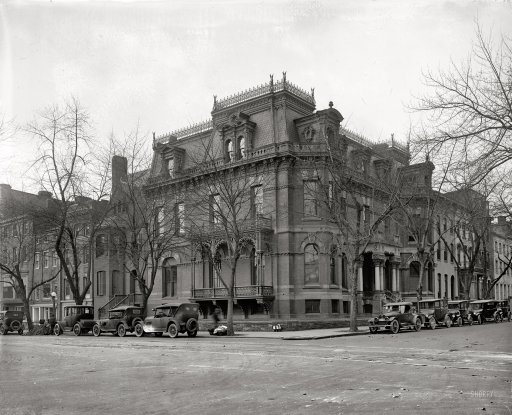
17th and Eye, Then and Now

Shorpy is one of my favorite sites on all of the intertubes, probably in part because a large number of the photos are from the Washington, D.C. area. And also because the commenters on Shorpy may possibly be the most polite and informative commenters of any website ever, so along with the cool pictures you get random smatterings of history, personalized by the photos. (Like the photo here, accompanied by an explanatory newspaper article: “‘Do parties in individual marriages believe in birth control?’ asked the interviewer as a final question. ‘I do,’ said Miss Taylor, frankly, as she bent over her desk to resume her work.”)

Anyway, I’ve walked by 17th and I probably hundreds of times since moving to D.C., because the Farragut metro is located there, so seeing this picture of it from 1922, beside a picture of how it currently looks, was pretty jarring.

Then:

seventeenth and I

Now:

seventeenth and I today

(The full size photo of the 1922 picture is worth looking at, it’s incredibly detailed.)

Maybe one day they’ll have a Google Street View Time Traveler. Same as the current street view, only wherever there’s a photo of the location from a given time period, it crops up alongside the modern street view. I would waste so much time on a site like that.

As a bonus cool thing for the day, while writing this post, I happened to come across a page on Shorpy, the mining boy, whom the website was named for: What we know about Shorpy Higginbotham, 99 years after his photo was taken.

-Susan

Sometimes, Seeing Hidden Messages in a Political Text Does Not Make You a Crazy Person

It’s old news now, but still hilarious: Governor Schwarzenegger tells California Legislator “Fuck You” in Coded Message. Gov. Schwarzenegger proves that the key to getting away with doing socially inappropriate things is originality:

gal.fu.gu

Schwarzenegger’s spokesperson called the message a “coincidence.” Both the awkwardness of the phrasing (“but the legislature just kicks the can down the alley”?) and and statistical unlikeliness of such a happenstance suggests, however, that Schwarzenegger’s spokesperson is a liar.

So, what are the odds of the first letters of each line of a message neatly forming the phrase “fuck you”? At the very best: 1 in 8,031,810,176.* However, add in first letter frequencies into the calculation, as well as the odds of the Governor’s message happening to contain just enough lines to tell off the California State Assembly?

Well, it’s 1 in a number much higher than the total California debt, which is currently somewhere north of 66 billion.

-Susan

* The View From LL2 disclaims any representation or warranty concerning the accuracy or reliability of any mathematical calculations that may appear on this site.

Mission Report: Agent Mittens Was Terminated by a Russian Sleeper Operative Disguised as a Taxi Driver

Operation Cornflakes may have seemed pretty silly, but it was nothing compared to Operation Acoustic Kitty. The plan involved wiring up a cat so that it could be used as a mobile recording device. Unfortunately, due to the fact that cats are cats, and they do not take orders from the CIA, they had to turn him into Frankenfeline to make the scheme even partially operational:

“They slit the cat open, put batteries in him, wired him up. The tail was used as an antenna. They made a monstrosity. They tested him and tested him. They found he would walk off the job when he got hungry, so they put another wire in to override that.”

They then took the $20 million dollar tabby, and put him out on Wisconsin Ave. to go spy on some Russians. The cat promptly got run over by a taxi, and Operation Acoustic Kitty came to a premature end.

From the CIA memorandum [PDF]:

“We have satisfied ourselves that it is indeed possible [REDACTED]. This is in itself a remarkable achievement. Knowing that cats can indeed be trained to move short distances [REDACTED] we see no reason to believe that a [REDACTED] cat can not be similarly trained to approach [REDACTED]. Again, however, the environmental and security factors in using this technique in a real foreign situation force us to conclude that for our [REDACTED] purposes, it would not be practical.”

So, it took twenty million dollars and a dead Frankenkitty to conclude that although a cat will do simple tricks if it suits the cat’s purposes, cats do not make ideal secret agents. That is some ground breaking research right there. I think the CIA would have been better off re-investing in Skinner’s Project Pigeon.

-Susan

OMG!!1 Arrested!~!!

omg-consulting

Ever since Bates v. State Bar of Arizona, 433 U.S. 350 (1977), a limited constitutional right for lawyers to advertise their services has been recognized. Even now, legal advertising remains subject to a million rules and requirements, in an attempt to “maintain the dignity of the legal profession” (because advertising is only something those baser, non-legal professions engage in).

I suspect the ad above is the sort of thing regulators feared would result if legal advertising were permitted. When I saw it, my first instinct was that it was a photoshop. Googling the attorney involved, however, brought up his blog and confirms the ad’s existence.

The ad does not violate any of the Model Rules 7.1-7.5, so it is not legally unethical, but I’m sure the ABA Commission on Advertising would feel it is in extreme violation of their Aspirational Goals for Lawyer Advertising. Among other things, these goals state that advertising should avoid “inappropriately dramatic music, unseemly slogans, hawkish salespersons, premium offers, slapstick routines or outlandish settings.” ‘Unseemly slogan’ and ‘slapstick routine’ might apply here. (However, the ad actually seems to comply perfectly with another ABA goal: “Lawyers who advertise should use marketing professionals to target audiences and present clear messages.” I’d say “OMG!! Arrested?” is both finely targeted at the intended clientele, and is, through brief, extreme clear in its message.) But violating an ABA goal is not the same as being in breach of professional conduct standards:

Among professionals, there is a difference between what one may do, without violating a rule, and what is seemly:

Simply because free speech allows us to make fools of ourselves is no reason we should avail ourselves of the opportunity. For then, sadly, it is the whole profession that suffers. In re Kotts, 364 N.W.2d 400, 407 (Minn. 1985).

While it’s not going to be winning the “ABA Award for Dignity in Lawyer Advertising,” I actually really like the ad; I imagine it is very effective marketing for the frat boy DUI scene, and it’s cute in an “aww, look, old people trying to be trendy!” kind of way.

One final note though: the ad’s first listed means of contact is texting. To me, that’s the only shocking part about this ad. You can obtain legal representation via text? Damn. What about through instant message? Do law firms have AIM screennames now?

And if you get arrested and the cops let you make one phone call, can you opt to send one text instead?

-Susan

The Biochemical Economics Revolution, or How A Spot On Our X Chromosomes Caused Us To Buy a Nintendo Wii on Credit.

In addition to biophysical economics, from this paper it looks like there may also be biochemical economics: “The MAOA Gene Predicts Credit Card Debt”.

The study behind the article compared rates of credit card debt — i.e., having any credit card debt at all, not the amount of it — and found it to be associated with the presence of certain forms of MAOA. As far as the authors are aware, “this is the first article to show a specific gene variant is associated with real world economic behavior.”

MAOA is a gene that does something scientificky to brain chemistry. Variants of MAOA that are less efficient in the way they metabolize serotonin and other compounds have been associated with increased impulsiveness, aggression, and addiction. MAOA is basically one of the only genes I can actually name, because it crops up in pop science news articles every other month or so. (The only other gene I can name is sonic hedgehog, but that’s for more different reasons). Among many other attributes, MAOA’s been linked to increases in likelihood of joining a gang, or if in a gang using a weapon, rates of alcoholism, and suspecpability to sugar pills.

And now, possibly, it’s also been linked to rates of credit card debt. From the study:

Because credit card debt is a relatively expensive form of debt, our prior intuition is that, all other things being equal, it would be used more by those individuals seeking immediate gratification, displaying less consideration of future consequences, and reduced information processing. Hence, we hypothesize that people with less transcriptionally efficient alleles of the MAOA gene are more likely to accrue credit card debt.

The study concludes that “the results presented here refute the blank slate theory of economic behavior.” By ‘blank slate,’ the authors are not referring to the traditional blank slate theory, which holds that humans have more or less no natural imprinting, but rather to economic approaches that treat all humans as having the same natural imprint — the idea that we are all phenotypically Homo economicus.

While the idea sounds very tidy in theory — a gene that controls the rate of future discounting! I bet we can link this to the financial crisis somehow. Quick, someone check the DNA of Wall Street traders! — I’m not quite converted yet. It strikes me as being way too likely to result in the flourishing of the same just-so stories that evolutionary psych always falls prey too. Confirming that “impulsive people have more credit card debt” just isn’t particularly revolutionary. While linking it to a specific gene gives it an added dimension of coolness, it doesn’t actually add anything to economics on its own anymore than linking impulsive behavior to unstable childhoods does. So it’s neat, but economists don’t need to be rushing out to get their PhD’s in molecular biology any time soon.

-Susan