
Sex Reassignment Surgery and De Morgan’s Laws

Via Language Log, “Sex-change surgery and universal grammar”, a post on a decision of the Tax Court that was released earlier this month. The decision addressed the question of whether medical expenditures undertaken in the course of sex reassignment surgery are deductible under the U.S. Tax Code.

Although simmering beneath the surface of the opinion is a barely restrained argument on sexual morality and gender essentialism (although with plenty of snide jabs and confidential asides on the quality of other judge’s arguments tucked away in the footnotes), the concurrences and dissents treat the debate, at least on its face, as a matter of linguistics. The opinion is, overall, a pretty fascinating one, with many potential points of interest, but I liked the angle Language Log pointed out: the kerfuffle over using rules of grammar and logic in statutory construction, i.e., “the dispute about how to interpret disjunction under negation—i.e., how to interpret expressions such as I don’t know anything about linguistics or tax law (with don’t signaling negation and or signaling disjunction).”

Section 213(d)(1)(A) of the Tax Code “allows a deduction for expenses paid during the taxable year for medical care that are not compensated for by insurance or otherwise and to the extent that such expenses exceed 7.5 percent of adjusted gross income.”

In turn, ‘medical care’ is defined as the amount paid “for the diagnosis, cure, mitigation, treatment, or prevention of disease, or for the purpose of affecting any structure or function of the body .” However, medical care does not include cosmetic surgery (or any “similar procedure”), which the Code defines as “any procedure which is directed at improving the patient’s appearance and does not meaningfully promote the proper function of the body or prevent or treat illness or disease.”

In O’Donnabhain v. Commission, the IRS was presenting the losing argument that Gender Identity Disorder (GID) was not a ‘disease,’ as it lacks any known organic basis, was rejected, given that mental disorders without an unknown organic cause have been accepted as a disease for IRS purposes for half a century. The IRS also argued that GID was “social phenomenon” that had been “medicalized,” but this characterization was also rejected in light of the medical evidence presented.

The tax court found for the petitioner and that sex reassignment surgery is in fact a deductible expense under the Tax Code. The IRS had also wanted to deny any deduction for the petitioner’s hormone therapy, arguing that hormone therapy, when intended to alter someone’s appearance, is a “similar procedure” that falls under the cosmetic surgery exclusion. (The court did, however, deny the deductions for the petitioner’s breast augmentation surgery — because petitioner had achieved some breast tissue from the hormone therapy alone, the augmentation was in fact cosmetic.)

Language Log describes the linguistic disagreement present in the opinion:

On the majority’s interpretation, the boldfaced language above means that an appearance-improving procedure doesn’t count as cosmetic surgery if it either promotes proper bodily function or prevents or treats illness or disease. The dissenters, on the other hand, argued that for such a procedure to be excluded from the cosmetic-surgery category, it has to both promote proper bodily function and prevent or treat illness or disease.

Judge Halpern’s concurrence cites to De Morgan’s laws:

In formal logic, there is a set of rules, De Morgan’s laws, relating the logical operators “and” and “or” in terms of each other via negation. E.g., http://en.wikipedia.org/wiki/De_Morgan’s_laws. The rules are:

not (p or q) = (not p) and (not q)
not (p and q) = (not p) or (not q)

According to Halpern, “I believe the better view is to presume that Congress is careful in its drafting and drafts in accordance, rather than in conflict, with the rules of grammar and logic,” and therefore, the statute should be interpreted in light of De Morgan’s laws.

In his dissent, Judge Foley responded that “Judge Halpern’s mechanical application of De Morgan’s laws is not prudent. Simply put, congressional intent is not subservient to De Morgan’s laws.” As much as I disagree with the rest of Foley’s opinion, he does have a point here. For more on the validity of Halpern’s reliance on rules of logic to interpret language, read the rest of the post over at Language Log.

There were two further points of minor interest from the O’Donnabhain decision that caught my eye. The first was a citation by the court to Judge Posner, from an opinion of his holding that psychotherapy alone was ineffective:

The cure for the male transsexual consists not of psychiatric treatment designed to make the patient content with his biological sexual identity–-that doesn’t work-–but of estrogen therapy designed to create the secondary sexual characteristics of a woman followed by the surgical removal of the genitals and the construction of a vagina-substitute out of penile tissue.

I was curious to see the use of the informal “doesn’t” in a judicial opinion — I don’t think I have seen Posner take that tone before, but maybe he uses it as he has here, when he wants to come across as frank and authoritative about a potentially sensitive subject. The second comment was in Judge Holmes’ concurrence, which Halpern referred to somewhat dismissively as a “Brandeis brief.” Homes critiqued the majority’s opinion for deciding more than may have been strictly necessary, stating that:

It is not essential to the holding and drafts our Court into culture wars in which tax lawyers have heretofore claimed noncombatant status.

This struck me as an odd statement to make. Given the structure of our tax code and kinds of deductions provided for, it is impossible to administer our tax system is a way that avoids entering the “culture wars.” Moreover, the medical expenses deduction has often been a lightning rod for controversy; this is hardly the first time there has been a dispute on sensitive social and cultural matters related to it. How could it be otherwise? ‘Medical care’ is not in itself inherently scientific, clinical, and objective, as Holmes seems to imagine. The phrase “promote the proper function of the body” cannot be defined in anything but a normative fashion — for instance, can birth control or abortion be said to be part of “the proper function of the body”? What about gastric bypass surgery?

-Susan
Eliminating the Twelfth Grade (Or At Least Making it Optional) Is An Obvious Move

A few days ago, I was pleased to run across this report on a plan in Utah to eliminate 12th grade. And then today, the New York Times followed suit with an article on a plan by multiple high schools in eight different states to allow students to opt into college as soon as the end of their sophomore year.

I am very strongly in favor of such proposals, even if, as is the case for Utah, they are intended as a cost cutting measure rather than a way to improve the educational system. Plans allowing for students to enroll in college when they are ready to do so should have been implemented long before now.

There is nothing magical about the age of 18 or about completing 12th grade that makes students suddenly ready for college. It is empirically obvious that students do just as fine starting college a year or two sooner or later than the current standard age — for instance, in Australia, at least in Queensland, almost all students matriculate from their final year of high school at around age 17, with no ill effects there. Students in other jurisdictions around the world regularly graduate from secondary educational systems at 19 — again, with very little difference in overall results.

Yes, there are advantages to providing four years of high school over three. Then again, there would be advantages to having five years instead of four. Both come with their own costs, too, in lost opportunities. It is hard or impossible to draw an arbitrary line and say “this amount of secondary education is good for everyone,” so a plan allowing for students to opt into college at their own pace is ideal.

Although I do tend towards the belief that the senior year of high school is largely irrelevant and a waste of education resources, I much prefer the plan outlined in the NYT than the blanket proposal in Utah to eliminate the 12th grade. Although I dislike the former program’s reliance on testing, it is more flexible in its approach:

Its backers say the new system would reduce the need for community colleges to offer remedial courses because the passing score for the 10th-grade tests would be set at the level necessary to succeed in first-year college courses. Failure would provide 10th graders with an early warning system about the knowledge and skills they need to master in high school before seeking to enroll in college.

The NYT plan has the benefit of allowing for self-selection, and letting students decide when is the best time for them to start tertiary education. Where I strongly disagree, however, is the idea that students receiving their diploma after the 10th or 11th grades are to be shuttled to community colleges, before starting a traditional four year program a year or two later. Once students have their diploma, whatever year they achieve it in, the entire usual milieu of tertiary opportunities should be available to them.

As things currently stand, the largest impediment to students opting to begin college before finishing the 12th grade are bureaucratic rules with little practical purpose. Currently, some colleges, particularly public ones, flat out refuse to accept any students without a high school diploma. Even for those students who do attend colleges or universities that accept them before they have finished checking off whatever arbitrary graduation checkpoints their jurisdiction requires, there are still regulatory hurdles caused by a lack of a HS diploma that should be eliminated — for instance, many scholarship programs are not available to those who did not graduate high school, even if they are enrolled in college.

Individual students are in the best position to know what will best meet their particular educational needs. For many students, their senior or even junior year of high school really just amounts to killing time — a period more concerned with social milestones than educational ones. Removing the bureaucratic strictures that prevent students from choosing the educational path best suited to their own needs is a policy change that should’ve been made long before now.

-Susan

The International Politics of Sport

Due to being distracted by snow in the first half of this week, and to being sick and cranky in the second half, this blog has been a bit neglected lately. However, I think I am finally over the worst of the Cold of Doom, or whatever it was I was laid up with, so hopefully LL2 will now be back to its regularly scheduled programming.

To get back on track, and in the spirit of the Winter Olympics, here’s a quick post on how international sporting events are all too often a mere continuation of politics by other means.

The Africa Cup of Nations wrapped up earlier this month (Egypt won. Again.), but the controversy over Togo’s ban from future Cups continues on. FIFA has assigned an Interim Caretaker Committee to the the Togo Football Federation, and earlier this week the Committee appealed the ban to the Court of Arbitration of Sport in Switzerland. A provisional ruling is expected within a few days, or at least sometime before the 20th, when the draw for the 2012 Africa Cup is scheduled.

Back in January, before the start of the tournament, the Togolese squad, while en route to their hotel in Angola, was attacked by a group of Cabindan terrorists. Three people were killed, and several players were injured. As a result of the attack, the Togo team left Angola and returned home.

The Confederation of African Football (CAF), in a striking display of callousness, later banned Togo from the 2012 and 2014 Agrica Cups, in addition to issuing the team a $50,000 fine. According to CAF’s press statement on the decision, the punishment was warranted due to “political interference” by the Togolese government:

At that time [of the attack], CAF said they have understood perfectly the decision of players not to participate in the competition.

Meanwhile, following a decision taken by players to participate in the competition, the Togolese government decided to call back their national team.

The decision taken by the political authorities is infringing CAF and CAN regulations. Therefore, a decision has been taken to suspend the Togo national team for the next two editions of Africa Cup of Nations, with a fine of $50,000.00 handed to the Togolese national football association, in conformity with article 78 of Africa Cup of Nations Angola 2010.

Article 78 allows for sanctions to be imposed when “A forfeit [is] notified less than twenty days before the start or during the final competition…” Technically, I suppose, Togo’s decision to not rejoin the cup may count as a ‘forfeiture,’ but because I’m feeling too lazy to read all the fine print, I am going to assume there is something in the CAF regulations that can be used to excuse dropping from a tournament due to fatal terrorist attacks.

“The CAF (Confederation of African Football) was warned repeatedly that this was a country at war. They had documents explaining this, but they wouldn’t heed the warnings. They must take responsibility. We are not rebels, but a military and political movement originating in Cabinda. We’re not rebels, but resistance fighters. Cabinda is a territory illegally occupied by Angola, and we are fighting for its liberation.

“This operation was just the beginning of a series of targeted actions that will continue constantly throughout Cabinda’s territory.”

Previously on this blog, Cabinda has had the dubious distinction of being nominated for the Worst Website by an Unrecognized State. Although the Cabinda liberation movement is not particularly organized, the attack on Togo shows they are still capable of carrying out terrorist strikes. The attack on the Togolese team seems like an odd choice for a group focused on liberation from Angola, but it was, more or less, a political statement intended to garner some attention to their cause and to announce to the world that their claims to independence from Angola were serious. Although Cabinda has no particular dispute with Togo, attacking a foreign soccer squad has been shown to be a pretty good way to solicit media coverage.

CAF’s ban on the Togo Football Federation, like the terrorist attack that resulted in the ban’s imposition, has political implications for African nations, as well. The President of ECOWAS has gotten involved in the controversy, pressuring CAF to change its stance: “The ECOWAS Commission wishes to note that the African Union, in its recently concluded Summit in Addis Ababa, expressed sympathy and condolences to the players, the Government and people of Togo over the tragedy. It is strange that CAF has chosen to remain apathetic to the general African feeling towards the Togolese predicament.”

It seems likely that the Court of Arbitration for Sport will overturn CAF’s ban on Togo, but stay tuned for more updates later this week on CAS’ ruling.

-Susan

The Snowpocolypse Is Lousy Proof That Nothing Has Changed

I have no interest in wading into the global warming debate, and for purposes of this blog (or at least this post) I am happy to remain entirely agnostic as to whether its happening or what the causes would be. The whole “yes it’s real” “no it’s not” “is too!” “is not!” discussion just doesn’t appeal to me.

That said, I find one argument that is commonly advanced by climate change skeptics to be about a hundred times more aggravating than any other argument made by either side of the issue. And that is the “gee, it’s cold out there, so much for global warming!” meme.

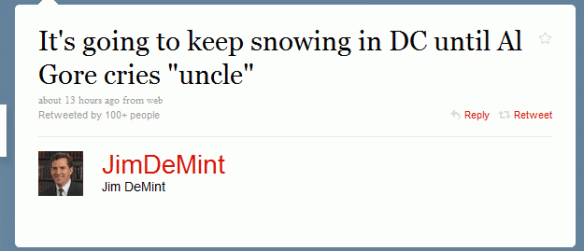
Senator Jim DeMint (R-SC) shared the following deep thought with the world today, via Twitter:

First, the joke is very plainly not funny any more. If Global Warming Is Real Then Why Is It Cold offers a collection of a few hundred or so political cartoons containing variations on the same tired theme. Oh, and, DeMint? Senator Jim Inhofe already beat you to it, and at least his take is marginally more clever.

But second, and more importantly, much like the beliefs of creationists and anti-vaxxers, the belief that an unprecedentedly cold winter disproves some form rapid global temperature change is so asinine, it feels almost like a personal affront that anyone could believe something so stupid. Weather is the stereotypical example of a complex system; we are not yet capable of predicting with any long rage accuracy the effects of one weather system on another. To take the most common example, we know that El Niño, for instance, can cause Canada to be drier, South America to be rainier, the northern part of the U.S, and the Southeastern states to be colder. A single weather input can cause a wide variation in weather outputs elsewhere in the world — we wouldn’t expect to see a uniform, unidirectional change.

This may in itself be an argument against the reliability of any research on the long term effects of global warming, but its even more of a reason to discard the idea that an extreme and unprecedented weather event is an indication that things are business as usual with the world’s climate.

-Susan

Things That Weren’t On the Virginia Bar Exam

Somehow, I have lived in D.C. for the past three and half years, and yet remained unaware until now that Virginia is one of those few U.S. states without an open container law.

The National Highway Traffic Safety Administration (NHTSA) withholds funding from states that do not comply with federally “suggested” scheme in the Transportation Equity Act for the 21st Century, which would prohibit any open alcoholic containers in a moving vehicle. (Note: TEA-21 did have the foresight to exclude Drunk Buses from this prohibition. Bachelor/ette parties everywhere remain thankful.)

Currently, only eight states lack state-level open container laws. In addition to Virginia, they are: Arkansas, Connecticut, Delaware, Mississippi, Missouri, Tennessee, and West Virginia. But note that Mississippi takes it a step further — so long as they stay below the legal BAC limit, even the driver is allowed to drink.

That being said, having an open alcoholic beverage in a car in Virginia is still a very poor idea, and I would very strongly recommend against it. First, sub-state laws may say something entirely different, so don’t rely on the state code. Second, Virginia has a rebuttable presumption scheme not favorable to open containers:

§ 18.2-323.1. Drinking while operating a motor vehicle; possession of open container while operating a motor vehicle and presumption; penalty.

A. It shall be unlawful for any person to consume an alcoholic beverage while driving a motor vehicle upon a public highway of this Commonwealth.

B. A rebuttable presumption that the driver has consumed an alcoholic beverage in violation of this section shall be created if (i) an open container is located within the passenger area of the motor vehicle, (ii) the alcoholic beverage in the open container has been at least partially removed and (iii) the appearance, conduct, odor of alcohol, speech or other physical characteristic of the driver of the motor vehicle may be reasonably associated with the consumption of an alcoholic beverage.

Any cop that spots an open alcoholic beverage during a traffic stop is going to use that as an excuse for a more invasive search. And you just know that no cop out there will have a problem concluding that there is something about the driver of a vehicle that is “reasonably associated” with the consumption of alcohol.

Question, though. What about jello shots? Do those qualify as an “alcoholic beverage“?

-Susan

Customary Domestic Law

Something that has bugged me since, literally, the first class of the very first International Law course I ever took, is the emphasis on “customary international law” as if it were a distinct phenomenon unique to the formation of international law.

It’s just not. CIL is a specific term for a general phenomenon that occurs at all levels of law making everywhere.

I was reminded very much of that today, while making an early morning excursion into the heart of the Snowpocolypse. I was allegedly “going to get milk for the coffee,” but we really were stocked up on supplies, and I just wanted the excuse to venture out onto the streets.

D.C. was beautiful and desolate and exactly how I imagine the end of the world will look. And the most striking thing was the utter disregard for the normal rules of daily urban life.

Pedestrians walked openly down major downtown streets. People walking dogs waited on the dead middle of K while their dog did its business, and people on skis slid their way across 14th and U. The roads were easier to traverse than the sidewalks, so everyone used them instead.

I passed two cars during my whole walk. One was a Hummer that was stuck in a snowbank and spinning its wheels, and I laughed. The other was a police cruiser, that skirted around me as I walked openly down the middle of 14th, and the policeman waved.

There is not a statute somewhere that says, ‘Hey, when there’s a blizzard, it’s actually okay to disregard traffic laws.’ What almost everyone outside did today was blatantly illegal, and forbidden, and subject to numerous penalties and fines and who knows what.

But under D.C. Customary Law, when the Snowpocolypse hits, you can do whatever the hell you want when you’re trying to make your way down the street. Everyone — from the pedestrians to the police force — simply intuitively knows this, and makes no effort to enforce any other rules, no matter what the written codes may say.

-Susan

Akbar Zeb

Via Passport,

Despite having served for years as a distinguished Pakistani diplomat, Akbar Zeb reportedly cannot receive accreditation as Pakistan’s ambassador to Saudi Arabia. The reason, apparently, has nothing to do with his credentials, and everything to do with his name — which, in Arabic, translates to “biggest dick”…

Pakistan had previously floated Zeb’s name as ambassador to the United Arab Emirates and Bahrain, only to have him rejected for the same reason. One can only assume that submitting Zeb’s name to a number of Arabic-speaking countries is some unique form of punishment designed by the Pakistani Foreign Ministry — or the result of a particularly egregious cockup.

The United States should not stand idly by while Pakistan takes the prize for best named diplomat — I propose that as a countermeasure, we appoint Ex-Rep Dick Armey to be our new Ambassador to the United Nations.

-Susan

Wall Street Journal Op Ed Argues Women Should Be Banned From Military

Read the article by Mackubin Thomas Owens here:

As Sen. James Webb (D., Va.), who was awarded the Navy Cross for valor as a Marine officer in Vietnam, wrote in the Weekly Standard in 1997, “There is no greater or more natural bias than that of an individual toward a beloved. And few emotions are more powerful, or more distracting, than those surrounding the pursuit of, competition for, or the breaking off of amorous relationships.”

The destructive impact of such relationships on unit cohesion can be denied only by ideologues. Does a superior order his or her beloved into danger? If he or she demonstrates favoritism, what is the consequence for unit morale and discipline? What happens when jealousy rears its head? These are questions of life and death, and they help to explain why open homosexuality and homosexual behavior traditionally have been considered incompatible with military service.

Err, wait, hold on a second. Got confused there — I guess he’s not trying to ban women from the military after all, he’s just trying to keep Don’t Ask, Don’t Tell in force. Which is funny, because under the argument he’s using here, allowing the ladies into the exclusive homosocial bonding zone of the military should apparently have resulted in the destruction of our armed forces.

But we have had women serving in the military since 1941. (Actually, they’ve been serving in the U.S. forces much long than that, dating as far back as to when it was the U.S. forces were only known as the Continental Army. It’s just that women have just only been able to serve openly since WWII). And yet, as far as I’m aware, our military is still considered to be at least moderately impressive in its size and capabilities.

So we have 70 years of experience with having in the ranks military personnel who are openly attracted to their fellow service members, and yet we have no proof that there is any accompanying reduction in military effectiveness. But even allowing for the sake of argument that having people in the military that, theoretically, could be in relationships with each other might cause “[f]avoritism and double standards [that] are deadly to philia and its associated phenomena—cohesion, morale and discipline,” the military has well developed institutional methods for addressing their potential threat.

First, the military has strict rules on fraternization for this very reason. You do not have to be romantically in love with someone to hesitate before selecting them for a dangerous mission; good old friendship will cause the exact same problem. The military therefore takes steps to prevent service members from developing relationships that might undermine the normal command structure. Having a “absolutely no dating anyone under your command” rule would involve no change from current policy.

Second, the issues Owens brings up all are strictly combat related issues. And yet we are kicking people out of the military who serve as interpreters, cooks, or accountants. At the very least, Owens should be advocating for DADT to be reduced so that it applies solely to combat positions, instead of arguing for a stupidly broad blanket prohibition. Because Owens is unable to offer even one argument for why having a gay interpreter is a problem for the military.

What infuriates me the most about Owens’ oped — and the arguments of others like him — is the naked bad faith of their claims. Owens writes,

There are many foolish reasons to exclude homosexuals from serving in the armed services. One is simple antihomosexual bigotry.

But the only justification Owen proffers that makes any coherent sense is an argument premised upon uncontrollable bigotry in the ranks. I much prefer those who simply argue that “they shouldn’t have to shower with gays because that’s gross.” Because that is what Owens’ argument actually is, although he disguises it with a thin cover of irritating and inconsistent rhetoric.

Because there is one fundamental fact that those arguing for the continuation of DADT almost uniformly fail to acknowledge: gays are not banned from the military, nor is anyone trying to implement such a ban. There are gays in the military right now — always have been, always will be, and that is not subject to change.

So with that in mind, Owens’ argument, stripped down, is the following:

  1. It is unquestionable that gays currently and legally do serve in our armed forced.
  2. However, having gays in the military causes problems X, Y, and Z.
  3. Therefore, we should not allow it to be known who in the military is gay.

There is an obvious gap in the chain of logic here, to put it mildly. Gays cause problems, therefore we should make it so we cannot know who the ones likely to cause problems are? This makes no sense. If they are going to be there anyway, shouldn’t we at least be able to flag the potential trouble spots?

But Owens is not actually unaware of this flaw in his logic. Although he hides it with poetic entreatments to honor and comradery, what Owens is truly arguing is this:

  1. Gay people may or may not directly cause problems for the military. But they are not severe problems, because if they were, people who are against DADT would be arguing to exclude women from the military. Or, failing that, they would not be arguing so strenuously for policies that allow these threats to enter into the military and yet prohibit us from identifying and locating them, therefore preventing us from taking steps to reduce the risk.
  2. But whether or not gays are unable to carry out the military’s mission in the same manner that a straight person is, having gays serve openly in the military may (note the may: I have yet to see anyone produce empirical evidence that they actually do) create conflict and morale issues with other service members that were not there before. Just like women, non-whites, and people who are extremely socially awkward, the presence of gays may cause a decrease in unit cohesiveness.
  3. Therefore, in order to prevent the precious, delicate flowers that are our service men and women from experiencing any discomfort, which might cause a decrease in morale, we should force everyone in the military who is gay to live their life in the closet, so as not to cause those military members who are prejudiced from experiencing mental stress.

Of course, there are two possibilities here.* Owens’ arguments may just be the apology for ‘antihomosexual bigotry’ that they appear to be. Or, instead, Owens might honestly believe that allowing people who are romantically attracted to each other to serve in the armed forces is destroying the military. However, Owens knows there is not a chance in the world that we will go back to the dark ages of banning women from the military, so instead he draws his line in the sand at maintaining DADT. Although DADT will not directly prevent the problems that having gays in the military causes, Owens believes it will make life so uncomfortable, unhappy, and stressful for gay service members that they will be greatly reduced in number, thus decreasing the threat posed by them.

But neither of these rationales are worth listening to. The first argument is too hopelessly inconsistent — by allowing non-whites and women into the military, we have already made clear that our military will be integrated, and that the individual prejudices of service members is not a justification for prohibiting an entire class of people from serving. The second argument is too dishonest — if you do believe that gays qua gays are destroying the military, don’t advocate for policies that decrease the quality of life of gay service members in order to try to force them out. Be honest about your position and simply try to prohibit them all together.

Neither argument is a suitable basis for military policy.

Finally, even if we decide that, due to the unique nature and purpose of the military, we must allow discrimination and prejudice to be the basis of decisions governing military operations, the onus should always be on those in favor of discrimination to show that there are benefits to continued bigotry.

This means that before a policy like DADT could exist, there must be, at a minimum, empirical evidence showing that allowing gays to serve openly causes decrease in military effectiveness . But not just that — you cannot look at the negatives alone. In addition to showing that DADT furthers military objectives, those in favor of legislated bigotry need to also show that the detriment caused by allowing open homosexuals to serve in the military is not outweighed by the benefits that ending DADT would have. Among these benefits are: (a) Halting the mindless expulsion of service members who have irreplaceable skill sets and extensive training that is hugely expensive to replace; (b) Improving the morale and welfare of the many gay men and women currently serving in the armed forces; and, finally, (c) Acknowledging our nation’s dedication to the idea of civilian control over the military, by acceding to a political decision that is supported by the vast majority of American citizens.

-Susan

*To be fair, there is a third possibility as well. You could also argue that gays are so inherently immoral, perverted, and malformed that they are simply not qualified to serve in the military. But because people who tack to this line of argument are incapable of being reasoned with, I will not bother to address it here.

Class Action Against Microsoft for XBox Points Fraud: I Wish This Lawsuit Were Real

Sadly, it turns out the news that a class action law suit had been filed against XBox, challenging XBox Live’s Microsoft Points system, is not quite as satisfying as early reports had suggested:

This week attorney/gamer/and frequent plaintiff Samuel Lassoff filed a class-action lawsuit against Microsoft for “fraud, breach of contract, negligence, unjust enrichment, and unfair business practices . . .” The plaintiff/attorney appears to be the only member of the class.

It is widely reported that the lawsuit concerns Microsoft’s points system, which Microsoft uses for online purchases. The system has been problematic because the “points don’t correspond to real-world dollars, and often you’re left stuck with unused points.”

Unfortunately, nothing in the complaint discusses this problem.

The actual lawsuit seems to allege merely the loss of “15 attorney hours over several days” trying to deal with the Microsoft support staff. While the suit itself may be pretty silly, I do think the amount of time claimed in damages is extremely plausible. Every time I have ever had to call the XBox hotline, I have been told that “their system is down” and I need to call back in a few hours. Repeat ad nausea.

As for the case everyone hoped this lawsuit was actually about: Essentially, for downloadable content XBox Live, real world currencies are not allowed. Instead, you use your national currency to purchase Microsoft Points, which in turn can purchase items online. (And, oh, don’t even think about trying to buy Points for an account registered to a different country than you are physically residing in. Take my word for it, it’s next to impossible to do so without setting up some off-shore accounts in the Caymans.) Unfortunately, Microsoft only allows to purchase points in pre-set packs — and those packs are always just under or just over the actual number of points you need, assuring that you will likely never be able to achieve a 0 balance thereafter.

In other XBox 360 lawsuit related news, a Plaintiff in the Northern District of California has issued a subpoena on Bill Gates for a lawsuit brought regarding the XBox’s infamous Red Ring of Death:

The subpoena instructs Gates to bring “documents pertaining to the true and relative number of actual Xbox 360 units that have been fixed by Microsoft over the past 3 years.” Estavillo is also seeking statistical data showing the true number of Xbox 360s that experienced the RROD (or other break-downs) and data on the actual number of people banned from Xbox Live for “piracy” over the period of 11/28/2008 through 11/28/2009.

-Susan

If You’re Planning to Sue China, Make Sure Your Antivirus Software is Up to Date

The big story a couple weeks back was Google’s threats about pulling out of China and the allegations of Chinese cyberattacks against Google and other U.S. corporations. Amidst all that, I missed the story about a series of cyberattacks carried out by China against a U.S. law firm that was representing the plaintiffs in a recently filed suit against the PRC.

Gipson Hoffman & Pancione, the law firm representing Santa Barbara-based software maker CYBERsitter, LLC, in a $2.2 billion software piracy action filed last week against the People’s Republic of China and seven major computer manufacturers in connection with distribution of the controversial Green Dam censorware program, has come under a cyber attack directed from within China. The attack comes on the heels of widespread reports of Chinese cyber attacks against Google. Cyber attacks were initiated from within China against CYBERsitter itself last June when the Green Dam piracy was first reported in the press.

The cyberattacks were in the form of emails disguised to look as though they originated from within the firm, but instead contained Trojans, which could have been used to allow the attackers to gain control of the firm’s machines.

Luckily for Gipson Hoffman & Pancione, apparently the Chinese hackers could not convincingly pull off American Lawyer email-speak, and the messages were written so suspiciously that no one actually opened the Trojans.

Aside from Google and the above law firm, at least thirty other American commercial entities have been subject of Chinese cyberattacks. Or, to use the polite euphemism favored by the State Department, “cyber intrusions.” Cyberattack, you see, could be a dangerous term for diplomats to bandy about — it comes to close to being an accusation that China is committing the most serious breach of international law.

Although starting a war with China is obviously in no one’s best interest, now or most likely ever, I think I would be willing to argue that, under international law, China’s actions (assuming all allegations are true) do constitute a use of force that would authorize the U.S. and other nations who were the subject of attacks to respond in kind. China, of course, is well aware that at this point no nation would as a practical matter retaliate with force, but the Chinese cyberattacks may end up forcing an international law of cyber-relations to develop faster than would otherwise be anticipated.

This is true not only for issues of international law governing the use of force, but also for international trade law. Baidu, the major Chinese internet search engine , saw its stock shares rise in price in the wake of the recent Google-China conflict. Baidu had already was the market leader, but was beginning to feel the squeeze from competition with Google — and Baidu will, undoubtedly, continue to benefit if the Google pull-out really does occur. It’s not hard to see where the potential for a national treatment violation lies in that, and it looks like Google’s lawyers have already been considering the possibility.

According to lawyers, the US could argue that Beijing’s censorship in effect discriminated against foreign services such as Google, contrary to its commitments under the General Agreement on Trade in Services (Gats).

“If China imposes harsher web filtering restrictions on Google than on local search engines, such as Baidu, Google may have a WTO discrimination claim,” said David Spooner, a former assistant secretary of commerce, now at the law firm Squire Sanders & Dempsey.

Interesting argument. But if their attorneys keep that kind of talk up, Squires Sanders & Dempsey may want to start being careful about opening any email attachments that come their way.

-Susan