The Senkaku Islands, Pt. I: UNCLOS, the EEZ, and the Conflict Between Land- and Sea-Based Sovereignty Regimes

In the East China Sea, north off the coast of Taiwan and south off the coast of Okinawa, there exists an island chain consisting of five small islets, and three smaller rocks. These islands — known as the Senkaku Islands in Japan, the Diaoyu Islands in China, and the Diaoyutai Islands by Taiwan — are the subject of a longstanding territorial dispute between those three states, and in recent months the dispute has become heated once again. military and diplomatic sparring over the islands has resumed once again.

China claims the islands are part of its sovereign territory, having been wrongfully stolen by Japanese military expansions in the late 19th century. Japan, in turn, claims that it is the rightful sovereign of the Senkakus, alleging that the islands were terra nullius until 1895, when Japan incorporated the islets by cabinet decision. Japan further asserts sovereign title to the islands owing to China’s failure to object to Japan’s claims of sovereignty for over seventy years, until China first raised a competing claim to the islands in 1970.

Not coincidentally, China’s first assertions of sovereignty over the Senkakus were made just one year after seismic surveys of the sea floor surrounding the islands had discovered the existence of significant oil and gas reserves. But while the discovery of natural resources in the East China Sea precipitated the ongoing territorial dispute between China and Japan, during this same time period there was another event occurring that would prove equally responsible: the development of modern international law of the sea. As result, the Senkaku Islands became a massively valuable commodity, and a previously dormant territorial dispute has become a flashpoint. Both Japan and China argue that, under international law, they are the rightful owners of the land.

The problem is, despite all the diplomatic strife and threats of military action, no one actually wants the Senkaku Islands.

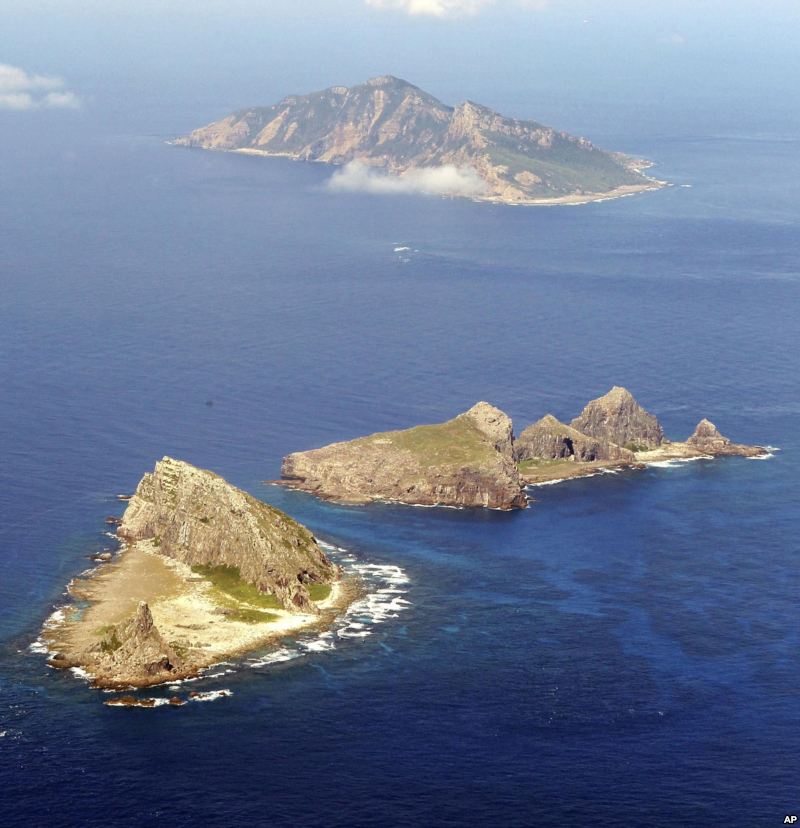
And why would they? Seriously, look at these things:

Hardly anything there to speak of — and these are the three of the four biggest islets in the Senkaku Islands. In all, the island chain is nothing more than a barren 1,700 acres of sand, scrub, and rock. A few endangered moles live there, along with some feral goats, but the Senkakus are not suitable for human habitation. It is debatable whether any fresh water sources even exist on the islands, and previous attempts at establishing industry on Uotsuri, the largest islet, have all ended in failure.

The above-water portions of the Senkaku Islands are of negligible value. But the islands’ worthlessness is irrelevant to the intensity of the dispute over their ownership. China and Japan do not seek possession of the Senkakus because they wish to possess the islands, but because possession of the Senkakus is a mechanism for obtaining possession over the surrounding sea. In other words: possession of the Senkakus is a means, not an end.

In previous eras, when competing claims of sovereignty over a territory could not be determined by reference to either treaties or to customary international law, there did remain one additional mechanism that states could resort to for conclusively resolving the question of ownership. That particular mechanism, however, has now been expressly prohibited by Article 2 of the UN charter. With sovereignty-by-conquest no longer a sanctioned means of dispute resolution, and when the states involved in the dispute have no interest in submitting the matter to an adjudicative body, the result is an effective stalemate. In a fruitless attempt to resolve the conflict by reference to international law, Japan and China have now been reduced to squabbling over ancient maps and conflicting historical accounts.

This is the current status of the Senkaku Islands, and of numerous other disputed island territories off the coast of China and Japan. Japan and China can each point to various 19th century maps or little-noticed governmental decrees to bolster their claims of sovereignty. But based on the existing historical record concerning the occupation and use of the Senkaku Islands, neither China nor Japan can convincingly demonstrate a superior claim.

Continue reading

Why Won’t Romney Explain His Tax Plan? Because the Romney Tax Plan is the Enactment of a VAT

The contents of Romney’s tax plan, like the contents of Romney’s personal tax returns, have been a continuing enigma throughout Romney’s election campaign. All the tax policy issue has taken a backseat to the tax returns issue, recently it has been the subject of renewed attention, from objections lodged by economists skeptical of the tax policy’s soundness, to Obama operatives who, sensing blood in the water, have taken to ridiculing Romney’s Lucy-with-the-football routine regarding the specifics of the tax plan.

These criticisms are fair. Although some economists do support Romney’s claims in theory — noting that there are “possible” explanations that could result in Romney’s tax plan actually working out — none have admitted to actually having had a chance to look at the details. But other economists have taken to pointing out that the emperor has no clothes. William Gale, the co-director of the Urban-Brookings Tax Policy Center, has gotten publicity from both sides of the aisle for his own derision of Romney’s tax plan, due to his attempt at debunking Romney’s claim that his plan is revenue neutral. In attempting to evaluate ‘the full Romney tax plan’ — a tax plan “which, by the way, does not exist,” Gale is quick to note — Gale and two other economists concluded that

a revenue-neutral plan that met five specific goals that Governor Romney had put forth (reducing income tax rates by 20 percent, repealing the estate tax, the alternative minimum tax, and capital income taxes for middle class households, and enhancing saving and investment) would cut taxes for households with income above $200,000, and—as a result of revenue-neutrality—would therefore necessarily have to raise taxes on taxpayers below $200,000.

Michael Graetz has also attacked Romney’s claims that broadening the tax base would be sufficient to pay for his tax cuts:

“You can’t get enough base-broadening to finance his rate reductions,” says Michael Graetz, a Columbia Law School professor who was a top tax official in President George H.W. Bush’s Treasury Department. “Romney says what he will do on tax cuts but he’s not prepared to say what he would do on the hard stuff.”

But Romney continues to be coy regarding any details of his tax plan, as he has been throughout the election. The only specific points that Romney has offered in defense of his plan’s claim to revenue neutrality are that “[the] tax cuts would be paid for through a combination of reduced tax breaks and the economic growth his plans would generate.” But these ‘specifics’ are really more like ‘vague generalities.’

In that vein, a recent Fortune article examined where these two items could actually result in a revenue neutral tax plan:

The debate over the Romney fiscal plan has gotten stuck on the revenue side of the equation, namely, how the tax cut would impact the amount of money coming into the Treasury. The Romney campaign insists that the tax cut is what they call “revenue neutral,” meaning that it would essentially pay for itself. There are only a few ways that this could be possible: 1) If taxes will ultimately be going up for certain tax payers through the elimination of deductions or 2) If the amount of economic growth generated by the tax cuts would increase revenue as more people start paying into the system or 3) A combination of both.

Fortune concluded that “[e]ven under the most generous economic assumptions, Mitt Romney’s tax plan simply doesn’t work.” Although, in theory, increased economic growth and elimination of income tax deductions could offset — at least to some degree — the effect of the Romney tax cuts, Romney won’t provide any of the supporting details that are necessary to bolster that conclusion. Namely, (1) Romney refuses to actually identify what deductions would actually be eliminated, and (2) Romney’s reliance on “economic growth” to explain how his tax plan could pay for itself is maddeningly circular — it is self-justifying and impossible to evaluate in the absence of specifics.

But the Fortune article overlooks the third possible mechanism by which the Romney Tax Plan could actually be revenue neutral; through the implementation of a new, non-income based form of taxation.

In other words, the missing piece of the Romney Tax Plan puzzle is the VAT.

If the VAT is the secret ingredient of the Romney Tax Plan, it would explain why Romney has continued to insist that his tax plan really can lower the income tax rate across the board while also remaining revenue neutral, and why Romney has refrained from actually identifying which deductions he is going to axe in order to pay for his tax cuts. Because Romney knows that his plan doesn’t actually need to get rid of deductions — the Romney tax cuts are not offset by increasing the proportion of household income that is subject to income tax, the Romney tax cuts are offset instead by another tax.

Romney has previously admitted, during the primary-era of the 2012 election cycle, that he was drawn to a VAT-style taxation system that, for reasons of political expediency, was layered onto the existing income tax system:

He notes that “my 59-point modest plan are immediate steps I’ll take on Day One and that the steps I will take Day Two include moving toward a Simpson-Bowles-style lower tax rate, a broader base tax system. . . . People say, ‘Well, let me see that plan.’ It’s like, ‘That’s going to take a lot more analysis and modeling than I have the capacity to do in the confines of a campaign.’ But I will campaign for lower tax rates and a broader base of taxation.”

What about his reform principles? Mr. Romney talks only in general terms. “Moving to a consumption-based system is something which is very attractive to me philosophically, but I’ve not been able to sufficiently model it out to jump on board a consumption-based tax. A flat tax, a true flat tax is also attractive to me. What I like—I mean, I like the simplification of a flat tax. I also like removing the distortion in our tax code for certain classes of investment. And the advantage of a flat tax is getting rid of some of those distortions.”

Since Mr. Romney mentioned a consumption tax, would he rule out a value-added tax?

He says he doesn’t “like the idea” of layering a VAT onto the current income tax system. But he adds that, philosophically speaking, a VAT might work as a replacement for some part of the tax code, “particularly at the corporate level,” as Paul Ryan proposed several years ago. What he doesn’t do is rule a VAT out.

There is ample evidence out there that that the apparent voodoo employed by the Romney tax plan, in reaching the conclusion that the plan is revenue neutral, can in fact be explained by the plan’s previously unmentioned inclusion of a VAT, or some other form of consumption tax. Romney’s own policy documents frequently reference studies based on consumption taxes. See, for instance, the Romney Program for Economic Recovery, Growth, and Jobs — a policy plan which the Economist described as “like ‘Fifty Shades of Grey’ without the sex.” Although the Romney Program for Economic Recovery does, indeed, splash out a lot of sensational language while remaining totally devoid of any substance, the documents isn’t notable for the specific policy proposals it contains (because, well, there aren’t any) but rather for the specific authority it relies upon in support of its disjointed claims of accelerated GDP growth and increased job creation.

True, the main text of the Program does not directly allude to a consumption tax, but it doesn’t provide for any other sort of concrete policy proposals either — the document reads like a horoscope, or an ad for a pay-per-call psychic, explaining how Romney will “unlock[] the potential for innovation, investment, and initiative in America’s dynamic economy” through the enactment of “four main economic pillars.” One of those pillars is Tax Reform:

Reform The Nation’s Tax Code To Increase Growth And Job Creation.
 

    Reduce individual marginal income tax rates across-the-board by 20 percent, while keeping current low tax rates on dividends and capital gains. Reduce the corporate income tax rate – the highest in the world – to 25 percent.
    Broaden the tax base to ensure that tax reform is revenue-neutral.

Romney then argues that enactment of this pillar will result in fantastic gains for the American economy, as “[a] significant body of economic research concludes that fundamental tax reform could increase real GDP growth over the next decade by 0.5 to 1 percentage point per year. Kevin Hassett and Alan Auerbach surveyed the literature and found that tax reform could increase output by between 5 and 10 percent.” The article referenced is Hassett and Auerbach’s survey, Toward Fundamental Tax Reform (2005), and the following excerpt from that article appears to be the source of the Program’s projected numbers:

Based on results from a fairly large number of different models, the literature suggests that a wholesale switch to an ideal system might eventually increase economic output by between 5 and 10 percent, or perhaps a slightly wider range.

There are two glaring points to be made here. First, the studies that Romney is relying on for his projected GDP growth are based upon an assumption of a “wholesale switch” from the current tax system to an “ideal system” — but these studies almost uniformly conclude that such a “wholesale switch” would be politically impossible. Not to mention the fact that these projections require Romney to address the trillion dollar question of what the “ideal system” is — a question for which most of the authors he cites to have contradicting answers.

But the research Romney’s Program uses to justify his projected numbers all have something in common. Although the survey explores a variety of differing and contradicting proposed tax reforms, almost all of the proposals include, to some degree, a consumption tax component — despite the fact Romney’s own platform has never alleged that he too is proposing a tax plan containing a consumption tax.

From what we know of Romney’s tax plan, however, there do appear to be a number of similarities with the VAT proposal set forth by Michael Graetz in chapter three of the Hassett and Auerbach survey, “A Fair and Balanced Tax System for the Twenty-first Century”:

The Corporate Income Tax. Lower the corporate rate to 25 percent, and more closely align book and tax accounting. …

Enact a Value-Added Tax. To replace the revenues just lost, enact a value added tax at a 10–14 percent rate. … In order to keep the tax rate as low as possible, the VAT tax base should be broad, covering nearly all goods and services. A broad VAT tax base with a single tax rate would minimize its economic distortions, and limiting exemptions would simplify compliance and administration

Hmm. Lower the corporate tax rate to 25%, and then use a broadened tax base to offset to ensure that the tax reform is revenue neutral? Now where could I have possibly seen that before…

One key point where Graetz’s plan and Romney’s proposal apparently differ is that, for personal income taxes, Romney has proposed that we “[r]epeal the Alternative Minimum Tax (AMT),” while Graetz, in apparent contrast, has proposed that we

“[l]ower the [Alternative Minimum Tax] rate to 25 percent and repeal the regular income tax. Everybody seems to want to repeal the AMT; let’s repeal the regular income tax instead. … Most of the special income-tax credits and allowances that now crowd the tax code and complicate tax forms would be repealed. But the deductions for charitable contributions, home-mortgage interest, and large medical expenses would be retained.”

But on a second look, Romney’s plan to repeal the AMT could in fact be equivalent to Graetz’s suggestion that we replace the current tax system with a modified AMT. We know that Romney has stated he would keep his tax plan revenue neutral by eliminating deductions — but we also know that Romney has a snowball’s chance in hell of touching the politically popular deductions for charitable giving, home-mortgage interest, and medical expenses. But if Romney’s plan to “eliminate the AMT” involves cutting marginal income taxes 20% “across the board” while “reduc[ing] tax breaks” — then, well, it would look a lot like Graetz’s plan.

Romney’s plan also bares some resemblances to William Gale’s discussion, at chapter two of the Hassett and Auerbach survey, of what a consumption tax ought to look like, even if Romney avoids specifically identifying the consumption tax component of his plan:

A well-designed consumption tax would (a) collect adequate revenues to cover expenditures over time and avoid reducing national saving through higher government deficits; (b) broaden the base to lessen interference in the economy; (c) tax already-existing capital—that is, concentrate any revenue relief on new saving or investment; and (d) treat interest income and expense in a consistent manner.

The irony is that Gale and Graetz have both gone on the record decrying Romney’s tax plan as a sham, noting that the disclosed details of Romney’s plan don’t add up. But what Gale and Graetz may have failed to consider — and what Romney’s justification for citing to Gale and Graetz’s work as support for his tax policy — is Romney’s plan only appears to be nonsensical because Romney is refusing to disclose the plan’s linchpin component: a consumption tax that offsets the income tax cuts.

Further support for a consumption tax component to the Romney tax plan is also found in the Program’s Appendix, where it references a study that

found that [tax] reform proposals would increase GDP by between 5 and 9 percent over the long run, using a dynamic economic simulation model. (Altig, David, Alan J. Auerbach, Laurence J. Kotlikoff, Kent A. Smetters, Jan Wallsier, “Simulating Fundamental Tax Reform in the U.S.,” University of California, Berkeley, September 29, 1999).

The source of the Appendix’s numbers seems to be from the following excerpt from that article:

We use our model to examine five fundamental tax reforms that span the major proposals currently under discussion. Each reform we consider replaces the federal personal and corporate income taxes in a revenue-neutral manner. The reforms are a proportional income tax, a proportional consumption tax, a flat tax, a flat tax with transition relief, and the X tax.

The proportional income tax applies a single tax rate to all labor and capital income, with no exemptions or deductions. The proportional consumption tax differs from the proportional income tax by permitting 100 percent expensing of new investment. One may think of it as being implemented via a wage tax at the household level plus a business cash-flow tax. The flat tax differs from the proportional consumption tax by including a standard deduction against wage income and by exempting implicit rental income accruing from the ownership of housing and consumer durables. The remaining two proposals modify the flat tax to address distributional concerns. The flat tax with transition relief aids existing asset holders by permitting continued depreciation of old capital (capital in existence at the commencement of the reform). The X tax aids lower-income taxpayers by substituting the flat tax’s single-rate wage tax with a progressive wage tax. To recoup the lost revenue, its sets the business cash-flow tax rate equal to the highest tax rate applied to wage income. Alternatively, one can think of the X tax as a high rate flat tax with a progressive subsidy to wages.

The proportional income tax raises the long-run level of output by almost 5 percent… [and] [t]he proportional consumption tax raises long-run output by over 9 percent.

So, to recap: Romney’s Program for Economic Recovery bases its exuberant claims regarding the effectiveness of Romney’s tax plan on an article which looked at possible GDP benefits of five “fundamental tax reform” proposals — four of which involved a consumption tax component.

If Romney is claiming that his “fundamental tax reform” will result in rampant GDP growth, and Romney uses these studies to prove the alleged economic advantages of the Romney Tax Plan, then, it may be presumed, that Romney’s tax plan is one of the proposed tax reforms that these studies examined. Because the tax plans considered by the studies were overwhelmingly based on the implementation of a consumption tax — and because Romney’s tax plan does not appear to have any overarching similarities to the proportional income tax reform plan — Romney’s tax plan contemplates the implementation of a consumption tax.

This conclusion is hard to avoid, at least without accusing Romney of being a liar. Either Romney’s tax plan contains a consumption tax component — or else Romney has been deliberately relying upon irrelevant and unrelated studies as support for his fantastic claims about the economic benefits of his tax proposal.

Take your pick.

-Susan

Susan’s Theory of the Secret Fifth Amendment in Kiobel, as explained via gchat

Michael:
I had a thought
The entire United States argument against extraterritorial application in this case is built around something like act-of-state doctrine.
Why don’t we just apply act-of-state doctrine?

Susan:
You could, and it should be part of it. But even Nigeria didn’t actually make a law saying human rights abuses is totes okay.
And also “but the country said it was okay” is not a get out of jail free card once you start with the genocide stuff.

Michael:
Well, wait.
Act of state is just the judgment of the legality of another nation’s conduct, right?

Susan:
Yes, but we’re not (necessarily) judging another nation’s conduct, for one — it’s a Kirkpatrick situation. And second, I don’t think the purposes of the act of state doctrine are supported if it’s interpreted to require a court to go “whelp, it’s not my place to say that another country shouldn’t commit genocide.”

Michael:
No

Susan:
Act of State = choice of law.

Michael:
Pause
I’m saying that the United States’ argument is built around an idea that seems roughly equivalent to act-of-state.

“HERE, ALTHOUGH PETITIONERS’
SUIT IS AGAINST PRIVATE CORPORATIONS ALLEGED TO
HAVE AIDED AND ABETTED HUMAN RIGHTS ABUSES BY THE GOVERNMENT
OF NIGERIA, ADJUDICATION OF THE SUIT WOULD NECESSARILY
ENTAIL A DETERMINATION ABOUT WHETHER THE NIGERIAN
GOVERNMENT OR ITS AGENTS HAVE TRANSGRESSED LIMITS IMPOSED
BY INTERNATIONAL LAW”

Susan:
Ohhh, no I’d disagree with you. I have a half-written post on it, but I’d argue the U.S.’s position incorporates the international component of the 5th amendment.

Susan:
Yeah, but that’s foreign affairs stuff. Act of State requires a court to select the foreign sovereign’s law for the court’s rules of decision.

Michael:
?!

Susan:
So it’s kinda where jus cogens comes into play. Nigeria can’t make a law saying “lol genocide is okay.”

Michael:
This is the definition I’m familiar with:
“This doctrine says that a nation is sovereign within its own borders, and its domestic actions may not be questioned in the courts of another nation.”
Wait
I understand now

Susan:
That’s the one sentence version, but it doesn’t mean that U.S. courts are categorically forbidden from questioning foreign countries’ acts.

Michael:
We’re talking about two conceptions of the act-of-state doctrine.
Mine was the broader one.
Yours is the more limited Supreme Court version.
Fair.

Susan:
“As we said in Ricaud, “the act within its own boundaries of one sovereign State …
becomes … a rule of decision for the courts of this country.” 246 U.S. at 310. Act of state
issues only arise when a court must decide–that is, when the outcome of the case turns upon–
the effect of official action by a foreign sovereign. When that question is not in the case,
neither is the act of state doctrine.”
I agree with you, I think, as far as aiding and abetting cases go.
Maybe for different reasons, though.

Michael:
I’m not saying that I think Kiobel actually implicates act of state.
I’m just saying that the U.S. position sounds much like act of state, such that there is no need to make new law if the U.S. is correct.

Susan:
Yeah, agreed.
I think the U.S. is 100% right.

Michael:
But…
Ugh
The U.S. thinks that there IS a need to make new law DESPITE the fact that we have act of state doctrine to solve the very problem that the U.S. uses to support the supposed need for new law.

Susan:
Okay wait I’m misunderstanding, then. What new law does the US think is needed?

Michael:
1) The U.S. believes that the Court should hold that the ATS does not apply extraterritorially in cases involving corporations.
2) It substantiates that position at least in part by invoking a notion that sounds just like act of state doctrine.

Michael:
See the United States’ distinction between “individual foreign perpetrators” and corporations

Susan:
When found residing in the United States.
An individual foreigner abroad (that somehow still had sufficient US contacts) would be in the same place.

Michael:
Maybe it would be more accurate to say that the U.S. is against ATS liability for the extraterritorial acts of corporations that do not have their principal place of business or headquarters here

Susan:
Yeah, part of the equation is subsidy-to-parent jurisdictional veil piercing.

Michael:
Maybe I was over-emphasizing the U.S.’s use of the word “individual.”

Susan:
This is why it’s all a 5th Amendment Due Process issue. The reasonableness of the US’s adjudicative jurisdiction here is both unconstitutional and in violation of international law.

My take was that individual humans can usually only really “be” in one spot at one time. Corporations are in many places at once. So a corporation’s existence in the US is not dispositive, like a human’s is.

Michael:
I see.
An interesting argument, but the U.S. is making that argument as a matter of international law and foreign policy, not from a Fifth Amendment perspective, no?

Susan:
Okay so maybe they don’t specifically say it, but it’s in there if you squint hard enough.

Michael:
Hahaha.
The “secret” Fifth Amendment argument?

Susan:
The Fifth Amendment in Exile.
Basically, the ATS is open ended, and hands out causes of action for int’l law violations like candy (pretend all of this is true)
But the court, before exercising jurisdiction, still has to consider: Personal jurisdiction, exhaustion of remedies, forum non conveniens,
Act of State, international comity, choice of law, political question doctrine, foreign affairs/case-specific judicial deference, and in corporate cases, corporate/subsidy-parent veil piercing issues.
All of these doctrines have some Due Process consideration behind them. (Separation of powers for a lot of them, too, but due process is a biggie.)
Even if the text of the ATS creates an opening for these suits, it’s just a grant of subject matter jurisdiction. All of the Due Process jurisdictional questions must be considered separately.
Like they would in any foreign-defendant case, but because of the subject matter, the judicial due process doctrines are firing on all cylinders.
So when you have a pirate residing in the U.S. being sued for torture and genocide he did abroad, and his home country says “fuck that bastard, you can sue him,” and the U.S. political branches are going, “fuck that bastard, you can sue him,” then the due process concerns evaporate.

Michael:
Interesting.
I still don’t think the United States is making that argument
But ok.

Susan:
I think in section C they are getting at it,
even if they don’t invoke the magic words of Due Process. But everything the US is counseling the court to consider is a doctrine that was invented either to serve due process, separation of powers, or both.

Michael:
You should write a post
A quick post.

Susan:
Maybe at lunch I’ll play around with getting my other post to work in WP.
Or maybe I’ll be uber-lazy and just copy and paste the chat.

Michael:
There you go.

The Trojan Horse in Kiobel: Royal Dutch Shell’s Conflation of Prescriptive and Adjudicative Jurisdiction

When the Supreme Court decided to rehear arguments in Kiobel, it instructed the parties to address the following question:

Whether and under what circumstances the Alien Tort Statute, 28 U.S.C. § 1350, allows courts to recognize a cause of action for violations of the law of nations occurring within the territory of a sovereign other than the United States.

In its Supplemental Brief addressing this question, Respondents came up with two arguments for why the answer to this question is “never.” First, Respondents argue, that the presumption against extraterritoriality prevents the ATS from applying in cases with an international component. And second, international law prohibits a state from using its prescriptive jurisdiction to recognize the claims presented by plaintiffs in Kiobel.

Both of these arguments are underwhelming. It is Respondents’ argument concerning an alleged lack of prescriptive jurisdiction, however, that is problematic. Respondents’ first argument is misguided, but primarily due to its overemphasis on the importance of the presumption against extraterritorial application, and a corresponding failure to address the broader context of the question posed by the Supreme Court in its order for rehearing. Respondents’ second argument, in contrast, is not an argument addressed at Kiobel’s merits; it is instead a Hail Mary pass, aimed at promoting certain policy objectives extending well beyond Respondents’ short-term interests in the Kiobel litigation. Respondents’ purpose in making this second argument was to attempt to influence the development of international law in a way that is favorable to Respondents’ corporate interests. It is Respondents’ hope that, through its deliberate conflation of prescriptive and adjudicative jurisdiction, Respondents will be able to bait the U.S. Supreme Court into enshrining, as precedent, a previously-unrecognized restriction in international law limiting states’ ability to regulate corporate behavior.

Extraterritoriality
Respondents’ primary argument for why Kiobel should be dismissed is that the Supreme Court must read into the Alien Tort Statute a prohibition on any cause of action arising from events that took place abroad. But Respondents have ignored the fact that this canon, known as the presumption against the extraterritorial application of U.S. law, is but a minor component of a comprehensive jurisdictional scheme regulating the jurisdictional reach of U.S. courts. The United States, in its Supplemental Amici Brief in Kiobel, thoroughly catalogued many of the other components of this jurisdictional infrastructure, and described the role they play in regulating the jurisdiction of U.S. courts in hearing cases under the Alien Tort Statute. These components include:

  • Exhaustion of remedies;
  • Forum non conviens;
  • Personal jurisdiction/due process;
  • Act of State;
  • International comity;
  • Political question; and
  • Case-specific judicial deference.

Although the presumption against extraterritoriality can be a factor in considering whether the exercise of jurisdiction over an ATS claim is appropriate, Respondents have elevated the importance of this single rule of statutory interpretation to an absurd degree. The question posed by the Supreme Court, in its request for reargument, is addressed at the limits imposed by the U.S.’s jurisdictional scheme as a whole — not the constraints imposed by any individual element of it.

Nevertheless, the majority of Respondents’ Supplemental Brief is spent addressing, in exhaustive detail, the limitations imposed by the presumption against extraterritoriality. Although there are lots of reasons to think that Respondents have turned a molehill into a mountain with their extraterritoriality argument, and I won’t get into all of them here (not in this post, anyway), here are, briefly, two points that suggest that presumption against extraterritoriality is insufficient, standing alone, to justify a dismissal of Kiobel:

1. As is repeated in many of the amici briefs, the first Congress would have been equally concerned about a U.S. citizen attacking a diplomat in Canada and avoiding liability by hiding in the U.S., as it would have been concerned about a U.S. resident attacking a diplomat in the United States. Ultimately, the purposes behind the ATS’s enactment are not compatible with a presumption that Congress intended to create a tort scheme that would allow the U.S. to serve as a safe haven to those who violate international law abroad, while only providing an enforcement mechanism against those who violate international law while easily reachable in the U.S.

2. Respondents ignore the fact that the Supreme Court has already, albeit implicitly, affirmed the reach of the ATS to acts occurring on foreign soil. In O’Reilly de Camara v. Brooke, 209 U.S. 45 (1908), Justice Holmes dismissed a suit brought under the ATS for acts that occurred in Cuba, on the grounds that the plaintiff’s claim for damages was based on property that she had no recognizable rights to. Before dismissing on those grounds, however, Holmes’ decision briefly “mention[ed] some technical difficulties that would have to be discussed before the plaintiff could succeed[,]” and noted that plaintiff’s claim had several other defects. Notably absent, however, is any hint or suggestion that plaintiff’s claims were invalid because they concerned events that occurred in Cuba, and not in the United States.

Prescriptive Jurisdiction

Respondents’ second — and more dangerous — argument is that permitting Kiobel to be heard in a U.S. court is a violation of international law, and therefore, pursuant to the Charming Betsy canon, the ATS should not be interpreted in a manner that would authorize a U.S. court to hear a case like Kiobel. In reaching this conclusion, however, Respondents deliberately mischaracterize the nature of their argument: while Respondents repeatedly claim that “a U.S. court’s exercise of prescriptive jurisdiction under the ATS” is prohibited by international law (Respondents’ Supplemental Brief, at 47) (emphasis added), Respondents’ actual arguments in support of this claim only address limitations on a U.S. court’s exercise of adjudicative jurisdiction.

This isn’t simply an error or misunderstanding on Respondents’ part; it is an intentional conflation of two distinct concepts. Respondents want the Supreme Court to find that the United States lacks prescriptive jurisdiction to regulate foreign corporate activities, not merely that U.S. courts lack adjudicative jurisdiction to hear claims about those activities.

This is because Royal Dutch Petroleum’s corporate interests would be best served by a norm of international law that minimizes a state’s authority to regulate the foreign activities of corporations, even for corporations that are incorporated or headquartered in that state’s territory. As far as Shell is concerned, having Kiobel dismissed on, say, forums non conveniens grounds, or for reasons of international comity, would only be a partial victory for Shell at best. Even if Kiobel is dismissed from New York federal courts, Shell hasn’t won all that much as long as the plaintiffs are still able to turn around and re-file their claims in London or the Hague.

And so Respondents insist throughout their brief that their argument is concerned with prescriptive jurisdiction. Respondents even going so far as to quote the entirety of the section on prescriptive jurisdiction from the Restatement (Third) of the Foreign Relations Law of the United States — perhaps hoping that the Supreme Court will focus on analyzing how the available bases of prescriptive jurisdiction apply to the situation in Kiobel, and fail to notice the fact that prescriptive jurisdiction is irrelevant here. Examples of these efforts at mischaracterization in Respondents’ brief include the following:

“Affording a federal-common-law claim under ATS jurisdiction … would violate international law because there is no accepted basis on which the United States may prescribe its law to govern such a case. ” (Id., at 38).

“the Charming Betsy presumption is not overcome by the text or historical context of the ATS, neither of which affirmatively indicates that federal courts should assert … any prescriptive jurisdiction with respect to conduct on foreign soil.” (Id., at 47).

“A U.S. court’s exercise of prescriptive jurisdiction under the ATS and federal common law as to conduct on foreign soil typically will violate international law[.]” (Id.)

But Respondents’ actual arguments, with the sole exception of its brief aside regarding sec. 402 of the Restatement (Third), are addressed exclusively at the question of why the Court’s exercise of adjudicatory jurisdiction under the ATS, at least in Kiobel, would be in violation of international law:

“That is because adjudication of such a case in a U.S. court clearly violates the international-law norm against universal civil jurisdiction.”

Respondents provide a long list of authorities that Respondents would have the Court believe support its claims that prescriptive jurisdiction is the actual issue in Kiobel. However, Respondents’ authorities consist solely of foreign court decisions concerned with the question of adjudicative jurisdiction. It is only Respondents’ use of delicate phrasing that creates a suggestion that these sources address the topics of the prescriptive power of legislative branches, when in fact that subject is never addressed. For instance, Respondents allege the following:

To the contrary, foreign governments and tribunals view the assertion of civil—as opposed to criminal—universal jurisdiction as a violation of international law. In Jones v. Ministry of Interior for the Kingdom of Saudi Arabia, [2006] UKHL 26, the United Kingdom’s House of Lords observed that “there is no suggestion that [universal civil jurisdiction] represents current international law.”

But Jones v. Saudi Arabia was not about “foreign governments” prescribing jurisdiction. Instead, the opinions begins with the following description: “[t]he issue at the heart of these conjoined appeals is whether the English court has jurisdiction to entertain proceedings.” (Also notable is the fact that Respondents’ quote from Jones — “there is no suggestion that [universal civil jurisdiction] represents current international law” — is actually an instance in which the UK court summarizes Breyer’s concurring opinion in Sosa. That hardly counts as foreign authority on whether or not the U.S. had the ‘prescriptive jurisdiction’ to enact the ATS!)

Every single foreign source that Respondents cite to is, once reviewed, clear a case concerned with adjudicative jurisdiction:

An Australian appellate court similarly explained, in rejecting a plaintiff’s contention “that international law confers universal jurisdiction on the Australian courts to hear and determine a civil claim of torture[,] … [t]here is a considerable body of authority denying the existence of such jurisdiction, despite the recognition of the prohibition of torture as jus cogens.”

An allegation of an abuse of a “jus cogens” norm committed anywhere in the world, cannot alone justify the civil jurisdiction of the U.S. courts. Such jurisdiction, without any underpinning of a clear connection with the forum (i.e. truly “universal” jurisdiction), is only well established in the criminal context.

Moreover, Respondents’ reliance on sec. 402 of the Restatement (Third) of Foreign Relations is particularly odd — not to mention inappropriate — given the explicit textual support for the ATS that the Restatement provides just a couple short sections later, at section 404. Respondents dismiss section 404’s explicit grant of prescriptive jurisdiction to “define and [] punish” violations of international law by stating:

“this principle refers to universal criminal jurisdiction and offers no support for the assertion of universal civil jurisdiction.”

But either Respondents are willing to knowingly distort the authorities they cite to, or else Respondents simply didn’t bother to read all of section 404, because this principle absolutely provides support for an assertion of universal civil jurisdiction. See sec. 404, at comment b:

Universal jurisdiction not limited to criminal law. In general, jurisdiction on the basis of universal interests has been exercised in the form of criminal law, but international law does not preclude the application of non-criminal law on this basis, for example, by providing a remedy in tort or restitution for victims of piracy.

Finally, in light of Respondents’ own exclusive reliance on case law dealing with adjudicative jurisdiction, not prescriptive jurisdiction, Respondents’ argument for why the Court should disregard the authorities cited to by Petitioner is particularly absurd:

[i]n fact, Petitioners’ authorities are inapposite … because they exercised adjudicative (rather than prescriptive) jurisdiction.

The legal strategy employed here by Respondents can best be described as the “these are not the droids you’re looking for” argument. It is an attempt to distract the Court from what Respondents are actually proposing: that the U.S. should recognize a new norm of international law which imposes expansive limitations on a sovereign’s power to regulate corporate coduct. Trussed up in language of “adjudicative jurisdiction,” this attempted intrusion on state sovereignty seems much more palatable — and, who knows, maybe some of the judicial minimalists on the bench will fall for it. But look at what Respondents are actually saying:

A U.S. court’s exercise of prescriptive jurisdiction under the ATS and federal common law as to conduct on foreign soil typically will violate international law even in cases where the defendant is a U.S. individual or corporation. … In the typical “foreign-squared” ATS case, the exercise of prescriptive jurisdiction will be unreasonable because, while the U.S. has a connection with the defendant, the activity being regulated neither takes place in the United States nor has direct effects here[.]

This is — technically speaking — insane. No one can seriously doubt that the U.S. has the power to regulate the foreign activities of its domestic corporations. And yet Respondents go one step father, and claim that doing so would actually be a violation of international law. Respondents are not arguing that it is only the United States that lacks the authority to prohibit Royal Dutch Petroleum from committing human rights abuses in Nigeria — Respondents are arguing that the United Kingdom and the Netherlands don’t have that authority either.

With that in mind, I would like to review how Royal Dutch Petroleum describes, in its Supplemental Brief, the international norm that it is proposing should be adopted by the Supreme Court in Kiobel:

In the typical “foreign-squared” ATS case, the exercise of prescriptive jurisdiction will be unreasonable because, while the U.S. has a connection with the defendant, the activity being regulated neither takes place in the United States nor has direct effects here; the plaintiffs have no connection with the United States; the foreign state has a strong interest in regulating the alleged conduct; and U.S. attempts to regulate may conflict with that foreign state’s law.

Keeping the factual situation alleged by the Kiobel plaintiffs in mind, here is an attempted translation of what Respondents actually mean to say in the above paragraph:

Even if Royal Dutch Shell was a U.S. company, it would be unreasonable, and therefore a violation of international law, for the U.S. to prescribe a domestic law prohibiting Royal Dutch Shell from committing human rights abuses in Nigeria. U.S. law regulating Royal Dutch Shell’s joint ventures with foreign sovereigns would be unreasonable because, although Royal Dutch Shell is incorporated in the U.S., all of the human rights abuses are being committed in Nigeria, and these human rights abuses don’t actually cause any harm on U.S. territory. The victims of these human rights abuses have no connection to the U.S. (aside from being subject to human rights abuses committed by a U.S. company). Nigeria has a strong sovereign interest in how foreign corporations conduct their business in Nigeria, and whether or not those corporations respect human rights. Attempts by the U.S. to prohibit Royal Dutch Shell from engaging in foreign human rights abuses would necessarily conflict with Nigerian law, which specifically permits and condones Royal Dutch Shell’s actions there.

This translation is slightly tongue in cheek, but the scheme proposed by Respondents is specifically advocating against the existence of prescriptive jurisdiction to regulate foreign human rights abuses. Respondents’ argument goes too far to be taken seriously.

In short, Respondents would have the Court believe that it would be a violation of international law for the United States to institute a civil cause of action against U.S. nationals who, acting under a grant of government authority, violate international law while abroad. In fact, under international law, the United States would itself be liable for breaching international law in those circumstances. See Draft Articles on State Responsibility, Art. 5 (“The conduct of … a person or entity empowered to exercise elements of the governmental authority shall be considered an act of the State under international law if the organ, person or entity acts in that capacity, even if it exceeds its authority or contravenes instructions.”). And yet, under Respondents’ bait-and-switch theory of ‘prescriptive jurisdiction,’ international law actually prohibits the U.S. from making civil reparations available in that situation.

The Charming Betsy argument contained in Respondents’ Supplemental Brief is nothing more than at attempt at judicial misdirection. Although Respondents do make the (valid) argument that the U.S. lacks of adjudicatory jurisdiction to hear ATS claims regarding purely foreign conduct — an argument they would be idiots to avoid making, since its the strongest argument in favor of Kiobel’s dismissal — Respondents attempt to sell this argument as a much broader limitation on state’s sovereignty.

Simply put, it is not sufficient for Royal Dutch Petroleum’s purposes to have Kiobel dismissed solely for a lack of adjudicatory jurisdiction. What Respondents wants — and Respondents are hoping the U.S. Supreme Court will provide a global precedent for — is a finding that states not only lack the jurisdiction to adjudicate claims regarding a corporation’s foreign human rights abuses, but that states lack the authority to prohibit such human rights abuses in the first place, even when those abuses are committed by a state’s own nationals.

-Susan

Fraud Charges (Finally!) Brought Against Gary Bolton, Jim McCormick, and Four Other UK Manufactures of Fake Bomb Detectors

Last week, the UK finally brought criminal charges against Jim McCormick, of ATSC, Ltd., for his role in the manufacturing and distribution of his worthless “bomb detectors.” These devices — the ADE-651, ADE-650, and ADE-101 are the three ‘products’ identified in the charges — are composed of nothing more than an empty plastic casing with an antenna glued into one end, but they are sold to governments worldwide under the absurd promise that the devices can detect drugs, bombs, guns, and diamonds at miraculous distances.

Although in 2010 the UK finally banned the sale of these devices to Iraq and Afghanistan — where they were endangering the lives of UK service members — in the two years since that ban went into effect, sales of fake bomb detectors have continued unabated to other countries around the world, including Mexico and Thailand.

Still, even if the criminal charges against McCormick are long overdue, it is a promising sign that the UK is finally taking some sort of tangible action against these charlatans:

Avon and Somerset Police have confirmed that a 55-year-old man, who lives in Somerset, will face six charges under the Fraud Act (2006).

The decision to charge James McCormick from Langport, follows consultation with the Crown Prosecution Service’s Central Fraud Division..

This charging decision follows a complex 30-month international investigation led by Avon and Somerset Police.

Mr McCormick will appear at the City of London Magistrates’ Court, Queen Victoria Street, London tomorrow Thursday July 12 2012

He will face six charges:

1 James William McCormick, between 15 January 2007 and 12 July 2012, had in his possession or under his control an article for use in the course of or in connection with a fraud, namely an ADE 101 device. Contrary to section 6 Fraud Act 2006

2.        James William McCormick, between 15 January 2007 and 12 July 2012, had in his possession or under his control an article for use in the course of or in connection with a fraud, namely an ADE 650 device. Contrary to section 6 Fraud Act 2006

3.        James William McCormick, between 15 January 2007 and 12 July 2012, had in his possession or under his control and article for use in the course of or in connection with a fraud, namely an ADE 651 device. Contrary to section 6 Fraud Act 2006.

4.        James William McCormick, between 15 January 2007 and 12 July 2012, made or adapted, supplied or offered to supply an article, namely an ADE 101 device, knowing that it was designed or adapted for use in the course of or in connection with, or intending it to be used to commit, or to assist in the commission of fraud. Contrary to section 7 Fraud Act 2006

5.        James William McCormick, between 15 January 2007 and 12 July 2012, made or adapted, supplied or offered to supply an article, namely an ADE 650 device, knowing that it was designed or adapted for use in the course of or in connection with, or intending it to be used to commit, or to assist in the commission of fraud. Contrary to section 7 Fraud Act 2006

6.        James William McCormick, between 15 January 2007 and 12 July 2012, made or adapted, supplied or offered to supply an article, namely an ADE 651 device, knowing that it was designed or adapted for use in the course of or in connection with, or intending it to be used to commit, or to assist in the commission of fraud. Contrary to section 7 Fraud Act 2006

The good news didn’t even stop there — the day after the charges were announced against McCormick, the City of London police’s Overseas Anti-Corruption Unit (OACU) followed suit, by finally bringing criminal charges against five other individuals who have long been active in the fake bomb detector trade:

Gary Bolton faces two counts contrary to sections 2 and 7 of the Fraud   Act 2006, relating to a device called ‘GT200’, which it is alleged was dishonestly represented as capable of detecting explosives.

Samuel Tree, Joan Tree, and Simon Sherrard have each been charged with one count contrary to Section 7 of the Fraud Act 2006, involving an ‘Alpha 6’ substance detection device.

Anthony Williamson faces the same charge in relation to an ‘XK9’ device.

Simon Sherrard faces an additional count contrary to Section 6 of the Fraud Act 2006 for possession of an Alpha 6 substance detection device for use in a fraud.

On July 11 Avon and Somerset Constabulary charged James McCormick with three counts contrary to section 6 and three counts contrary to section 7 of the Fraud Act 2006, relating to three devices, known as ‘ADE 101’, ‘ADE 650’ and ‘ADE 651’. He appears before City of London Magistrates on July 12.

Sadly, Carly Wickens, Bolton’s girlfriend and owner of the shipping company which was used to transport the fake bomb detectors is not among those charged. But at their appearances before the magistrate last week all of the accused plead not guilty, save for Gary Bolton, who deferred a plea awaiting sight of prosecution files. It appears that further activity in the case will not take place until September.

Most of the charges against the six individuals were brought under Section 7 of the UK’s Fraud Act (2006). That provision of the Act specifically  prohibits “making or supplying articles for use in frauds”:

(1)A person is guilty of an offence if he makes, adapts, supplies or offers to supply any article—

(a)knowing that it is designed or adapted for use in the course of or in connection with fraud, or

(b)intending it to be used to commit, or assist in the commission of, fraud.

James McCormick was also charged under Section 6 of the Act, for “possession … of articles for use in frauds”:

(1)A person is guilty of an offence if he has in his possession or under his control any article for use in the course of or in connection with any fraud.

Gary Bolton was the only defendant charges with actually committing fraud, pursuant to Section 2 of the Act, for fraud by false representation:

(1)A person is in breach of this section if he—

(a)dishonestly makes a false representation, and

(b)intends, by making the representation—

(i)to make a gain for himself or another, or

(ii)to cause loss to another or to expose another to a risk of loss.

I do wonder if the bulk of the charges were brought under Articles 6 and 7 of the Fraud Act due to the nature of the particular distribution scheme used by the defendants. For the most part, it appears that the GT-200, the ADE-651, the Alpha 6, and all of the other bogus devices, were sold not to unwitting customers who had been scammed into believing that these useless products actually worked. Instead, the fake bomb detectors were primarily sold to foreign governments through special arrangements made with corrupt foreign officials. In most cases, it is likely the officials were well aware that the devices did not perform as advertised, but rather arranged for their governments to purchase the devices in exchange for multi-million dollar kickbacks.

This means, for example, that the $10,000,000 USD spent by Thailand on the GT-200 did not entirely go into Gary Bolton’s pockets, although certainly many millions of it did. But the overhead for Bolton’s business consisted largely of bribes and kickbacks as opposed to parts and inventory. The devices themselves cost pennies to manufacture — instead, it was the bribes paid by ATSC, Ltd. and Global Technical, LTD. that likely made up a significant portion of the companies’ costs.

Which is likely why charges for fraudulent misrepresentation were not brought against most of the individuals involved in the fake bomb detector scams — because no fraud was committed, in most of their transactions. Both the sellers and the buyers of the ADE-651, the GT-200, and similar devices had full knowledge that what was being sold was a worthless piece of junk. Without the Fraud Act’s “articles for use in fraud” provisions, the actions of these companies might not have been chargeable at all.

It is notable that Bolton, unlike the other defendants, was in fact charged with one count of fraud through misrepresentation, which could imply that some of his customers were in fact duped by him. It would be curious to see what the basis for that charge was.

But I also wonder why the only claims brought by the UK were charges for fraud and fraud-related crimes — why on earth are these individuals not also being charged for bribery? After all, the Overseas Anti-Corruption Unit is the division of the London police that brought charges against five of the defendants, and that division’s primary responsibility is with regards to foreign bribery actions. So why is the OACU only bringing charges for fraud here? It certainly seems odd, but with the little amount of information released about the cases so far, it’s impossible to say what the significance of it may be.

And, although I’m certainly glad to see any kind of charge brought in relation to the fraudulent bomb detector scams, it is disappointing that it took the UK authorities so long to take action against what would appear to be a very simple problem. The articles for us in fraud charges are an open-and-shut matter — there does not exist an even remotely plausible argument that these ‘bomb detector’ devices are any more effective than a chunk of scrap metal would be when it comes to detecting any sort of substance. And yet, up until the day before charges were brought against Gary Bolton, et al., these devices continued to be sold to and used by foreign governments — and thereby endangering the  lives of both civilians and law enforcement officers.

It raises the inevitable question of whether the defendants still have some behind the scenes defenders within the UK government. Or, at the very least, whether the UK’s reluctance to bring bribery charges is a result of the UK government’s own culpability in assisting with the sale of the these devices.

This isn’t simply a matter of the UK not caring about foreign deaths. These devices have frequently endangered the lives of UK nationals, as well as the citizens of UK allies, in overseas military operations. In particular, the Government of Iraq has spent upwards of $100 mil. on the devices, with much of that coming from U.S. funded foreign aid, and has been using the devices to “detect bombs” for years. In February 2011, the Iraqi government arrested Major General Jihad al-Jabiri, the general responsible for many of Iraq’s purchases of fake bomb detectors (and who, not so coincidentally, received much of the bribe money that was kickbacked in return for said contracts), suggesting that perhaps Iraq would be moving away from use of the fake bomb detectors:

Investigation revealed that Jabiri recommended that Iraq sign five contracts to supply security forces with the detectors for between 23,548.37 pounds and 34,702.86 pounds each even though the real cost of the devices is no more than 61.97 pounds, the senior official said.

The first contract, valued at about 11 million pounds, was signed in January 2007 and will be the first case taken to court, the official said.

However, it does not appear that charges against al-Jabiri ever proceeded, while Iraq’s use of the fake bomb detectors has not been discontinued.

One would think that U.S. military to Department of State would take more interest in this issue, given the cost in lives of both Iraqi and joint forces, as well as the gross waste of funds that originated from U.S. foreign aid payments. Especially given that the devices originate not from some largely lawless state where enforcement against the devices would be difficult, but rather originate from a long-term friend and military ally, the United Kingdom.

Meanwhile, the arrest of Bolton, McCormick, and the rest of their ilk won’t be enough to end the harm they have caused worldwide. In Thailand, for instance, where the use of the GT-200 has been particularly prevalent, federal and state military and police forces remain unconcerned by the recent charges against the manufacturers, and continue to use the devices:

The army will not stop using the GT200 bomb detector despite doubts over the efficiency of a similar device, army chief Prayuth Chan-ocha says.

Gen Prayuth yesterday said the GT200 will continue to be used by the army in the far South.

He shrugged off the concerns raised in the report by the BBC’s Newsnight programme on Thursday. On the programme, Avon and Somerset Police in the UK said a British man, Jim McCormick, 55, would face six charges including producing and supplying ADE 651 devices knowing they were ineffectively designed or adapted to detect bombs.

The only positive news is that other divisions of the Thai government have expressed interest in pursuing charges over the GT-200 on their own, even if the agencies directly responsible for their use will not:

The Department of Special Investigation will take legal action against the manufacturers and distributors of allegedly defective bomb detectors if state agencies that bought them decline to do so.

DSI director-general Tarit Pengdith said yesterday he would wait to see whether the agencies take action first.

If they fail to do so, his department would step in, as his investigators had gathered enough evidence.

He said the DSI would take both criminal and civil action against the manufacturer and distributors.

Here’s to hoping that the prosecutions against the fake bomb detector squad are swift and successful.

-Susan

Zimmerman’s Police Statements Are Not Consistent With Established Facts

George Zimmerman’s written police statement, taken on the night that he shot Trayvon Martin, has now been released by his defense counsel, along with several audio recordings of oral statements he gave. I have not been able to listen to the recorded statements yet, but my transcript of the handwritten statement is as follows:

In August of 2011 my neighbors house was broken into while she was with her infant son. The intruders attempted to attack her and her child; however, SPD reported to the scene of the crime and the robbers fled, my wife saw the intruders running from the home and became scared of the rising crime within our neighborhood. I, an my neighbors formed a “Neighborhood Watch Program.” We were instructed by the SPD to call the non-emergency line if we saw anything suspicious & 911 if we saw a crime in progress. Tonight, I was on my way to the grocery store when I saw a male approximately 5’11” to 6’2″ casually walking in the rain, looking into homes. I pulled my vehicle over and called SPD non-emergency phone number. I told the dispatcher what I had witnesses, the dispatcher took note of my location & the suspect fled to a [darkened?] area of the sidewalk, as the dispatch was asking me for an exact location the suspect emerged from the darkness and circled my vehicle. I could not hear if he said anything. The suspect once again disappeared between the back of some houses. The dispatch once again asked for my exact location. I could not remember the name of the street so I got out of my car to look for a street sign. The dispatch asked me for a description and the direction the suspect went. I told the dispatch I did not know but I was out of my vehicle looking for a street sign & the direction the suspect went. The dispatch told me not to follow the suspect & that an officer was in route. As I headed back to my vehicle the suspect emerged from the darkness and said “you got a problem” I said “no” the suspect said “you do now”. And [illegible] and tried to find my phone to dial 911 the suspect punched me in the face. I fell backwards onto my back. The suspect got on top of me. I called “Help!” several times. The suspect told me “shut the fuck up” as I tried to sit up right. The suspect grabbed my head and slammed it into the concrete sidewalk several times. I continued to yell “Help!” each time I attempted to sit up, the suspect slammed my head into the side walk, my head felt like it was going to explode. I tried to slide out from under the suspect and continue to yell “Help”. As I slid the suspect covered my mouth and nose and stopped my breathing. At this point, I felt the suspect reach for my now exposed firearm and said “you gonna die tonight motha [fuckin’?].” I unholstered my firearm in fear for my life as he had assured he was going to kill me and fired one shot into his torso. The suspect got back allowing me to sit up and said “you got me.” At this point I slid out from underneath him and got on top of the suspect holding his hands away from his body. An onlooker appeared and asked me if I was ok, I said “no” he said “I am calling 911″ I said I don’t need you to call 911 I already called them I need you to help me restrain this guy.” At this point a SPD officer arrived and asked who shot him” & I said “I did” and I placed my hands ontop of my head and told the officer where my personal firearm was holstered. The officer handcuffed me and disarmed me. The officer then placed me into the back of his vehicle.

This statement is going to be a very big problem for Zimmerman’s defense team. It is more troubling than I expected — many of the more incongruous and bizarre claims that were in contained in the reports relayed by George Zimmerman’s brother and father are also present in Zimmerman’s own statement, and they are not adding up.

Even taking this statement in the most favorable light for the defense, it contains several factual inaccuracies and at least one gaping omission that Zimmerman’s counsel is going to have to explain. Some incorrect or distorted recollections are to be expected — witnesses are, in general, very bad at remembering a precise account of high stress events. That Zimmerman’s statement contains some odd inaccuracies is not notable in itself, or a sign that Zimmerman intentionally tried to misstate the truth. Zimmerman’s account, however, contains a number of troubling, self-serving statements that are inconsistent with the known facts of this case.

Here are excerpts of some of the more significant allegations in the statement, and a brief summary of the significance of those allegations.

 Tonight, I was on my way to the grocery store when I saw a male approximately 5’11” to 6’2″ casually walking in the rain, looking into homes.

Zimmerman lives in the far southwest corner of the neighborhood. Both entrances to the neighborhood complex are on the same road that Zimmerman lives on, and not on Twin Trees, where Zimmerman’s car was parked and where the first encounter between the two occurred. Why was Zimmerman on Twin Trees Ln., then? Zimmerman claims he just happened to notice Trayvon as he was driving to the grocery store, but it seems more likely Zimmerman pursued Trayvon in his car even before the call to police was made.

I have yet to see it confirmed precisely where Zimmerman’s truck was parked, or which way it was facing, but the consensus seems to be he was just east of the dog-leg of Twin Trees Ln., in the north side lane, facing towards the club house. In order to be in this location, Zimmerman would have had to have taken a very odd path out of the neighborhood complex.

[A]s the dispatch was asking me for an exact location the suspect emerged from the darkness and circled my vehicle. I could not hear if he said anything. The suspect once again disappeared between the back of some houses. The dispatch once again asked for my exact location.

Zimmerman’s call to the non-emergency line does not support this part of Zimmerman’s statement. In that call, Zimmerman does not narrate either (1) Trayvon “circling” his vehicle, or (2) Zimmerman losing sight of Trayvon on two separate occasions. In the phone call, we hear Zimmerman describing Trayvon “coming to check me out,” and then “running,” but Zimmerman never states that he lost sight of Trayvon before that. Nor does he mention any “circling” — only “approaching” and then passing by Zimmerman’s truck.

The suspect once again disappeared between the back of some houses. The dispatch once again asked for my exact location. I could not remember the name of the street so I got out of my car to look for a street sign.

First, there are exactly three streets in Zimmerman’s neighborhood. Three. It defies all reason that Zimmerman, the dedicated neighborhood watch leader, could not even name the three streets that make up his neighborhood. Additionally, the call logs from Zimmerman’s prior calls to the police seem to indicate that Zimmerman was repeatedly able to direct officers to precise crossroads in the neighborhood, reporting incidents at “nearest  Intersection:  TWIN TREES LN &  LONG OAK WAY”. A review of the transcripts of those calls would be necessary to be sure, but I suspect that will be easily confirmed.

And second, there are no street signs anywhere near where Zimmerman’s car was parked, where the shooting took place, or anywhere in between. If Zimmerman was going to look for a street sign, he was going the wrong way. In fact, in the call to police, Zimmerman freely admits his purpose in exiting the vehicle was to follow Trayvon:

Dispatcher: Are you following him?
Zimmerman: Yeah

So Zimmerman’s written statement does not provide his prior admitted reason for getting out of his vehicle, and substitutes it with a nonsensical alternative explanation. Why would Zimmerman lie about his reason for getting out of the car, when the truth was not even particularly detrimental to his claims? It does show that Zimmerman was aware of a need to rewrite the events, starting even with basic details.

The dispatch told me not to follow the suspect & that an officer was in route. As I headed back to my vehicle the suspect emerged from the darkness and said “you got a problem” I said “no” the suspect said “you do now”.

Dispatch instructed Zimmerman not to follow the suspect at approximately 7:11:55 – 7:12:05pm. My best estimate of when the encounter between Zimmerman and Trayvon occurred is between 7:15:30 – 7:15:45pm, and it seems unlikely based on available testimony that it occurred any sooner. So that is, conservatively, an entire three minute period of events, which Zimmerman’s statement utterly omits, and which his statement glosses over as if it were a period of only a few seconds.

In the minimum 200 second time period that elapsed between Zimmerman being instructed to return to his vehicle and the time of the fight, what did Zimmerman do? We do not know, and his statement to police never explains it. The physical altercation between Zimmerman and Trayvon occurred ~35 meters from the location of Zimmerman’s truck — he could have walked there and back to his truck again three times over, in the time that elapsed.

Zimmerman apparently believes that his actions during that time period are best left unstated. We can only speculate as to why.

[E]ach time I attempted to sit up, the suspect slammed my head into the side walk[.]

Trayvon’s body was found over a body length away from the sidewalk. The shell casing from Zimmerman’s gun was found ~4 ft from the sidewalk. Zimmerman’s back and the fronts of his boots and the front cuffs of his pants are damp, and either shown in photos or reported by witnesses to be covered in grass. Witnesses also reported the fight occuring in the grass between the houses.

It is definitely possible that the fight between the two occurred partially on the sidewalk, but this part of Zimmerman’s story has always felt wrong to me — it just does not add up. But, based on released evidence so far, it is impossible to get any better of a reconstruction of how the fight actually played out.

As I slid the suspect covered my mouth and nose and stopped my breathing. At this point, I felt the suspect reach for my now exposed firearm and said “you gonna die tonight motha [fuckin’?]”. I unholstered my firearm in fear for my life as he had assured he was going to kill me and fired on shot into his torso.

This statement reads like it was perfectly scripted to provide a self-defense claim. Zimmerman’s own stated reason for shooting Trayvon was not based on Trayvon’s unarmed physical assault, but rather on Trayvon’s “assur[ances]” that he would kill Zimmerman. If you’re going to claim self-defense, it can’t hurt to make the claim that your victim conveniently notified you of his murderous intent seconds before you shot him.

Apparently, Zimmerman did not consider using lethal force during the beating until Trayvon made a threat to take Zimmerman’s own gun away, and the “fear for [his] life” only came as a result of Zimmerman’s own firearm being introduced to the fight. But nothing about this description of the fight makes sense, no matter how I try to picture how it might have happened. (1) With a single hand, Trayvon was able to cover Zimmerman’s airway sufficiently to stop his breathing. (2) With his other hand, Trayvon was able to grab Zimmerman’s holstered weapon. (3) Despite not being able to breathe, Zimmerman does not use his (apparently unrestrained) hands to clear his airway. Instead while Trayvon was laying on top of him and while Trayvon was also grabbing at the gun, Zimmerman was able to unholster the gun at his side — presumably single-handedly, using only the hand on the same side as the gun, as Trayvon was on top of him — .raise the gun from his waist  to chest level, push Trayvon far enough off of him in order to place the gun between himself and Trayvon, and fire. (4) The first 911 call shows that the “help!” calls continue right up to, and are cut off by, the screams for help. Zimmerman was apparently still able to shout during this time period, despite having had his breathing “stopped” by Trayvon.

It doesn’t make sense. It is possible, however, that owing to the stress of the fight and the intensity of the moment, Zimmerman is remembering the details out of order, leading to the story’s incoherency.

An onlooker appeared and asked me if I was ok, I said “no” he said “I am calling 911”

I wonder if the “onlooker” referred to hear is witness “John,” who reported stating during the fight that he was calling 911? If so, then either Zimmerman is completely wrong about events, or John apparently only stated he was calling 911 after Trayvon was already dead.

At this point I slid out from underneath him and got on top of the suspect holding his hands away from his body.

This could explain why there is contradicting witness testimony regarding who was on top and who was on bottom of the fight. The witness who reported seeing someone in a “white shirt” on top may have seen Zimmerman pinning Trayvon after he was already dead.

-Susan

The Source of the ICC’s Privileges and Immunities in Libya: Experts on Missions Immunity, Customary Immunity, or Immunity by Security Council Resolution?

Saif Al-Islam Gadaffi, son of recently deposed Libyan dictator Muammar Gaddafi, was captured last year by local officials in Zintan, Libya, and has been held there ever since. Although the International Criminal Court has had an arrest warrant issued for Saif since June 2011, and since Saif’s capture been requesting that Libya transfer him into the ICC’s custody, Saif has remained in the control of the Zintani militia.

Last week, an ICC defense lawyer and her translator were arrested in Libya for “spying” and for providing illegal assistance to Saif. The Zintani militia that detained Melinda Taylor, the defense attorney appointed by the ICC to represent Saif Al-Islam, are now claiming that she had transmitting secret letters to her client. Two other ICC officials who were with Taylor were not arrested, but opted to remain with her and her Lebanese translator:

The four were in Zintan so that Taylor could meet with her client, Saif al-Islam Qaddafi, to discuss his defense in the ICC case against him. The court issued an arrest warrant last June for Saif, as well as his father Muammar and former Libyan intelligence chief Abdullah al-Senussi, for crimes against humanity committed during the regime’s brutal attacks on civilian demonstrators in early 2011. Now, the Libyan authorities claim that Taylor and Assaf exchanged documents with Saif, and had “recording equipment” with them during the interview. Neither activity would be unusual for an attorney-client meeting, but Taylor and her team are supposedly being investigated on charges of spying. Libyan authorities have said that they will be held for 45 days, and frequent references to “threats to national security” do not inspire confidence in their fate thereafter.

The reaction of the international community to the arrests has been oddly muted, perhaps in part due to uncertainty regarding the legal status of Libya’s actions under international law. Although Taylor was an ICC agent who was arrested for performing her official duties, it is not clear that international law actually prohibits Libya from arresting Taylor in this situations. To muddy the waters even further, the arrest of the ICC agents follows right on the heels of Libya’s challenge to the ICC’s jurisdiction to even hear the case against Saif — the first such jurisdictional challenge that the ICC has faced in it short history.

The odd and unfortunate situation has come about as a result of the nature of the ICC’s jurisdiction over Saif Al-Islam, which was not derived from any treaty obligation incurred by Libya but rather through a resolution of the U.N. Security Council Resolution. Resolution 1970 (2011), which authorized the initial multilateral intervention in Libya, also contained a provision referring the situation in Libya to the ICC:

ICC referral

4.  Decides to refer the situation in the Libyan Arab Jamahiriya since 15 February 2011 to the Prosecutor of the International Criminal Court;

5.  Decides that the Libyan authorities shall cooperate fully with and provide any necessary assistance to the Court and the Prosecutor pursuant to this resolution and, while recognizing that States not party to the Rome Statute have no obligation under the Statute, urges all States and concerned regional and other international organizations to cooperate fully with the Court and the Prosecutor;

6.  Decides that nationals, current or former officials or personnel from a State outside the Libyan Arab Jamahiriya which is not a party to the Rome Statute of the International Criminal Court shall be subject to the exclusive jurisdiction of that State for all alleged acts or omissions arising out of or related to operations in the Libyan Arab Jamahiriya established or authorized by the Council, unless such exclusive jurisdiction has been expressly waived by the State;

7.  Invites the Prosecutor to address the Security Council within two months of the adoption of this resolution and every six months thereafter on actions taken pursuant to this resolution;

8.  Recognizes that none of the expenses incurred in connection with the referral, including expenses related to investigations or prosecutions in connection with that referral, shall be borne by the United Nations and that such costs shall be borne by the parties to the Rome Statute and those States that wish to contribute voluntarily;

The ICC’s authorization to prosecute human rights violations in such situations is provided via Article 13(b) of the Rome Statute. Referral of a case by the Security Council is the only manner by which jurisdiction can be conveyed to the ICC for a crime committed in the territory of a state that is not a party to the Rome Statute.

But even with a Security Council referral, the ICC’s jurisdiction is not necessarily guaranteed — the other jurisdictional requirements contained in the Rome Statute must also be met. Although Libya did not voluntarily authorize ICC jurisdiction, it still has the right to challenge that jurisdiction under Article 19 of the Rome Statute. Libya is in fact currently pursuing a jurisdictional challenge in regards to the ICC’s jurisdiction to prosecute several of the would-be defendants, including Saif. Libya asserts that ICC jurisdiction would be improper under Article 17(1)(a) of the Rome Statute, as “[t]he case is being investigated or prosecuted by a State which has jurisdiction over it, unless the State is unwilling or unable genuinely to carry out the investigation or prosecution.” In Libya’s May 1, 2012 filing to the ICC, Libya moved to have the case deemed inadmissible before the ICC, claiming that the new Libyan transitional government was properly pursuing criminal charges against Saif and the other defendants through Libya’s domestic criminal justice system.

The ICC has indicated, however, that it is not going to concede jurisdiction without a fight. On June 5th, just two days before the kidnapping of Taylor’s party, the Office of the Prosecutor (OTP) filed its response to Libya’s challenge. Although it was conceded that Libya had in fact brought domestic charges against the defendants, which under principles of complementarity would prevent the ICC from trying the case, the OTP concluded that Libya has failed to demonstrate that it has the practical ability to actually carry out a prosecution of Saif Al-Islam Gadaffi itself:

The Applicant has demonstrated that it has taken concrete steps to investigate the same person for the same conduct at issue in the case before the ICC. Further, there is no evidence to suggest that the Applicant is not genuine in its investigation and prosecution of Saif Al-Islam. However, there remain questions about its ability to advance the investigation and prosecution of Saif Al-Islam. Therefore the Court should accept the Applicant’s offer to provide further information, including the testimony of the General Prosecutor, to provide clarity on its ability to advance its case.

The OTP was concerned in particular about Libya’s failure to afford Saif Al-Islam with defense counsel:

However, despite the Applicant’s predictions at the time it filed its challenge on 1 May 2012, it does not appear that Saif Al-Islam has received a defence lawyer  within Libya, a precondition to presenting to him the charges and completing the  investigation under Libyan law”. This lack of progress could be related to the restrictions established because the Zintan militia exercise custody over him. The Prosecution is mindful of the substantial challenges faced by the Applicant, but this apparent lack of progress raises questions about whether the Applicant is able to “otherwise carry out its proceedings” within the meaning of Article 17(3). Therefore, the Prosecution submits that the Court should require the Applicant to appear before the Court to provide additional information on its ability to advance the investigation and prosecution of Saif Al-Islam.

Given the timing of these events, it could seem at first glance that the arrest of Taylor on June 7th was in retaliation to, or at least related to, the OTP’s filing on June 5th indicating that it intended to proceed with criminal charges before the ICC. There is another wrinkle, however — the Libyan transitional government was not responsible for the arrest of the ICC officials. Rather, it was a local Zintani militia group — the same group holding Saif Al-Islam — that detained the ICC defense counsel, apparently at the militia’s own initiative. The Zintani militia group has been holding Saif as a way of gaining leverage over the federal Libyan government, and now they may have decided to double up on their claims by taking the ICC staff as prisoners too.

So the whole situation is a mess right now. The ICC is claiming that it maintains jurisdiction to prosecute Saif for war crimes due, in part, to Libya’s inability to provide Saif with access to counsel. Local government actors in Libya have now kidnapped the ICC defense counsel that was being provided to Saif, for their own motives, which tends to confirm the ICC’s assessment regarding Libya’s ability to try Saif and the other defendants in its own courts. And the Libyan transitional government is still trying to argue that the ICC shouldn’t have jurisdiction to bring charges, but lacks sufficient control over the Zintani militia to either try Saif for itself or to free the ICC staff.

But while the arrest of the ICC defense counsel is clearly a poor diplomatic move on Libya’s part, it is less certain whether it also constitutes a breach of international law. Some commentators have suggested that the ICC staff have immunity from domestic judicial processes, but the source of such immunity is debatable.

1. The ICC’s Agents Have No Immunity in Libya through the Rome Statute. States Parties to the Rome Statute are obligated by Article 48 to provide the ICC with “such privileges and immunities as are necessary for the fulfilment of its purposes.” But Libya is not a party to the Rome Statute, and is not bound by any international obligations through that instrument. (Nor is Libya a party to the Agreement on Privileges and Immunities of the International Criminal Court, which supplements and expands the immunity of Court officials, but likewise only applies to states that are signatories to the instrument.)

Even though the Security Council has referred the situation in Libya to the ICC, that does not have the effect of conferring the treaty obligations contained in the Rome Statute onto Libya.  Paragraph 4 of Resolution 1970 did not, in itself, curtail any of Libya’s jurisdiction as sovereign, but instead expanded the jurisdictional reach of the ICC to permit it to bring charges against violators of human rights in Libya — in effect, the Security Council has delegate a sliver of its own administrative jurisdiction to the ICC, to permit it to bring charges against a crime that was otherwise not within its jurisdictional ambit. But the ICC was not granted any rights to enter the territory of a sovereign entity which had not already ceded those rights to the ICC via treaty.

[Update: Over at EJIL Talk, Dapo Akande makes the argument that the treaty obligations contained in the Rome Statute can also be imposed on a state by Security Council resolution. Article 48 of the Rome Statute, he argues, now applies to Libya

because the UN Security Council, in referring the Libyan situation to the Court, has imposed the Statute on Libya. In SC Res 1970, the SC decided that Libya shall cooperate with the ICC. That resolution does not make it explicit that this is an obligation to cooperate in accordance with the Statute. However, … the obligation to cooperate under SC Res 1970 is an obligation to cooperate in accordance with the Statute. It is the Rome Statute that defines and sets out the boundaries of Libya’s obligation to cooperate. Art. 48 is part of that obligation of cooperation. Just as ICC  parties have an obligation to accord immunities to ICC personnel, so does Libya. Indeed, this provision is absolutely crucial to the cooperation obligation. Were Libya not obliged to provide immunity to ICC personnel working on the situation referred to by the Security Council, the obligation to cooperate would be rendered meaningless. Libya would be able to frustrate ICC investigation simply by using its national law and legal processes to harass ICC staff.

This explanation is not entirely satisfying to me. Akande’s argument is that, through a one line resolution ordering Libya to “cooperate” with the ICC, the Security Council has essentially forced Libya to become party to the Rome Statute and incur all the obligations of a party to that treaty. But which parts of the Rome Statute? All of them? Or just the ones that the Court finds convenient to invoke? Why is Article 48 automatically applied to Libya, but not Article 88 — which mandates that “States Parties shall ensure that there are procedures available under their national law for all of the forms of cooperation which are specified under this Part”? Or may Libya propose changes to the ICC’s Rules of Procedure and Evidence pursuant to Article 51? And what about financial contributions to the ICC — is Libya on the hooks for those too?

Secondly, the text of the Rome Statute does not necessarily support the claim that the entirety of the instrument applies to cases where jurisdiction is invoked through Article 13(b) — after all, the Rome Statute does clearly provide at different points provisions governing “States Parties” and other provisions that govern simply “a State.” This would imply “States Parties” refers only to parties, while “a State” includes both parties and states that have voluntarily accepting jurisdiction in a specific case or had jurisdiction forced upon them.

But, the Rome-Statute-Applies-Automatically argument certainly does make things more convenient. I’d just be more comfortable with it if the Security Council was required to be explicit before it could mandate a state’s accession to a treaty.]

2. The ICC officials have no immunity from domestic judicial process, but by arresting them, Libya is failing “to cooperate fully with the [ICC] and the Prosecutor”, as it is required to do by Security Council resolution. Over at Opinio Juris, Kevin Jon Heller has suggested that the immunity of the ICC officials derives solely from Security Council Resolution 1970. However, strictly speaking, this is not an argument that the ICC officials have “immunity.” That is, it is not that Taylor and her interpreter have a special immunity from judicial process under international law, but rather that Libya had a more general prohibition against failing to cooperate with the ICC. In the present situation, it so happens that  Libya’s failure “to cooperate fully with and provide any necessary assistance to” the ICC took the form of Libya’s decision to arrest the ICC’s officials. However, Libya would be equally in violation of international law had it, say, built a giant wall around Zintan that prevented Taylor and her interpreter from entering.

The claim that the ICC’s “immunity” is nothing more than a side effect of the Security Council’s mandate of cooperation is also supported by Article 87 of the Rome Statute, and Article 17 of the Negotiated Relationship Agreement between the International Criminal Court and the United Nations. Article 17 of the Negotiated Relationship, which is titled “Cooperation between the Security Council of the United Nations and the Court,” provides at Section 3 that:

Where a matter has been referred to the Court by the Security Council and the Court makes a finding, pursuant to article 87, paragraph 5 (b) or paragraph 7, of the Statute, of a failure by a State to cooperate with the Court, the Court shall inform the Security Council or refer the matter to it, as the case may be, and the Registrar shall convey to the Security Council through the Secretary-General the decision of the Court, together with relevant information in the case.  The Security Council, through the Secretary-General, shall inform the Court through the Registrar of action, if any, taken by it under the circumstances.

In other words, the Security Council is the ultimate arbiter of whether or not a state is failing to abide by its command that the state in question cooperate with the ICC, and is the entity that is responsible for taking action when its orders are not being followed. Although the ICC has the ability to notify the Security Council of any incidents that may arise, the state’s obligation is solely to the Security Council and not to the Court. So, at least pursuant to Article 87 of the Rome Statute or Article 17 of the Negotiated Relationship, the proper procedure for the ICC in this situation is to refer the issue to the Security Council and let them decide how to figure it out. So far, however, the only sort of decisive action that the Security Council has taken in response to the matter is to release a press statement:

The members of the Security Council express serious concern over the detention in Libya since 7 June 2012 of the International Criminal Court (ICC) staff members, and urge Libyan authorities at all levels and all concerned to work towards immediate release of all the ICC staff members.

The members of the Security Council emphasize that it is the legal obligation of Libya under the Council’s resolution 1970 (2011) to cooperate fully with and provide any necessary assistance to the ICC pursuant to that resolution.

This press statement indicates that the Security Council is of the position that Libya’s obligation to release the ICC staff members is derived from resolution 1970, and not from an alternative source under international law. However, although Libya is certainly obligated to cooperate with the ICC pursuant to the Security Council resolution, this may not be the sole source of the rights of the ICC’s agents in Libya. Taylor, as the ICC appointed defense counsel for Saif, may also have true immunity under international law through two other sources, discussed below.

3. The ICC’s Agents May Have Immunity as Agents on Missions Pursuant to the Convention on the Privileges and Immunities of the United Nations. Because Libya has not ceded any of its jurisdiction to the ICC, any immunity that the ICC officials have comes not through the Rome Statute, but through the U.N. conventions to which Libya is a party. Pursuant to the Convention on the Privileges and Immunities of the United Nations (CPIUN), the U.N.’s officials are “immune from legal process in respect of words spoken or written and all acts performed by them in their official capacity.” However, as the ICC is not itself a U.N. agency, the ICC’s personnel are not covered by the terms of that instrument, at least not directly. But it is possible that, at least in this particular case, and owing to the nature of the ICC’s involvement in Libya, ICC officials have agent on mission immunity pursuant to the CPIUN.

Section 22 of the Convention on the Privileges and Immunities of the U.N. provides for immunity not just for U.N. officials, but also for “Experts on Missions for the United Nations”:

Experts  (other  than officials coming within the scope of article V) performing missions for the United Nations shall be accorded such privileges and immunities as are necessary for the independent exercise of their functions during the period of their missions, including the time spent on journeys in connection with their missions. In particular they shall be accorded … immunity from personal arrest or detention and from seizure of their personal baggage[.]

Could the ICC defense counsel be Experts on Missions for the U.N., and therefore immune from criminal prosecution pursuant to the CPIUN? After all, the ICC’s jurisdiction to prosecute Saif was provided by the U.N.’s Security Councilm, and was supplemented by Paragraph 5 of Resolution 1970, which instructed that “Libyan authorities shall cooperate fully with and provide any necessary assistance to the Court and the Prosecutor pursuant to this resolution.” The ICC was only in Libya pursuant to the Security Council’s mandates, performing work that the Security Council had requested.

The question turns upon the meaning of “Experts on Missions” under the treaty. The ICJ’s Advisory Opinion

On the Applicability of Article VI, Section 22, of the Convention on the Privileges and Immunities of the United Nations would lend some support to the claim, anyway:

The Court will … consider first what is meant by “experts on missions” for the purposes of Section 22, and then  the meaning to be attached  to  the expression “period  of  [the] missions”[.] …

The  General Convention  gives  no definition  of  “experts  on missions”. Al1 it does is to clarify two points, one negative and the other positive. From Section 22 it is clear, first that the officials of the Organization, even if chosen in consideration of their technical expertise in a particular field, are not included in the category of experts within the meaning of that provision; and secondly that only experts performing missions for the United Nations are covered by Section 22. The Section does not, however, furnish any indication  of  the nature,  duration  or place  of these missions.

Nor is there really any guidance in this respect to be found in the travaux préparatoires of the General Convention. The Convention was initially drafted and submitted to the General Assembly by the Preparatory Commission set up at San Francisco in June 1945; that initial draft did not contain anything corresponding to the present Article VI. That article was added by the Sub-Commission on Privileges and Immunities established by the Sixth Committee to examine the draft, but the contemporary official records do not make it possible to ascertain the reasons for the addition

The purpose of Section 22 is nevertheless evident, namely, to enable the United Nations to entrust missions to persons who do not have the status of an officia1 of the Organization, and to guarantee them “such privileges and immunities as are necessary for the independent exercise of their functions”. The experts thus appointed or  elected may or may not be remunerated, may or may not have a contract, may be given a task requiring work over a lengthy period or a short time. The essence of the matter lies not in their administrative position but in the nature of their mission. …

To sum up, the [International Court of Justice] takes the view that Section 22 of the General Convention is applicable to persons (other than United Nations officials) to whom a mission has been entrusted by the Organization and who are therefore entitled to enjoy the privileges and immunities provided for in this Section with a view to the independent exercise of their functions; that during the whole period of such missions, experts enjoy these functional privileges and immunities whether or not they travel; and that those privileges and immunities may be invoked as against the State of nationality or of residence unless a reservation to Section 22 of the General Convention has been validly made by that State.

Although Taylor was clearly acting on behalf of the ICC at the time of her arrest, she was acting on a mission that had been delegated to the ICC by the Security Council. Possibly, then, that is sufficient to grant her immunity from prosecution under Article 22 of the CPIUN, as the ICJ’s Advisory Opinion is clear that it is not necessary for the expert to have a contract with the U.N. or to be paid by the U.N. to be entitled to immunity. “Experts on Missions” are determined not by their administrative title, but by the nature of their mission, and their immunity extends to the extent necessary to permit the expert to carry out her duties.

As Taylor was on a mission to serve as defense counsel for Saif Al-Islam, and that mission was performed at the (albeit indirect) behest of the Security Council, and as Libya’s arrest of Taylor interfered with the ICC’s ability to afford a criminal defendant with the right to counsel that is provided both by international law and by the Rome Statute, Taylor may have had immunity from prosecution pursuant to the CPIUN.

4. The ICC’s Agents May Have Functional Immunity by Operation of Customary International Law. It is also possible that the ICC officials’ immunity from criminal prosecution exists entirely apart from any treaty or convention. Although diplomatic immunity is often codified in treaties and other international instruments, it is also a part of customary international law, at least as it applies to the foreign officials of sovereigns. But do agents of international organizations, like the agents of foreign states, posses functional immunity under customary international law?

Functional immunity, as opposed to the more general immunity ratione personae granted to heads of states and other diplomatic bigwigs, is the immunity of foreign officials in relation to acts performed in their official capacity. If Taylor had been acting on behalf of a foreign state rather than an international organization, she would not be entitled to any general immunity under customary international law, but she would likely be entitled to functional immunity. As counsel for Saif, it was Taylor’s performance of her official duties that lead to her arrest — and thus functional immunity would presumably apply.

However, Taylor was not acting in Libya on behalf of a foreign state, but on behalf of an international organization. Whether or not the customary norm of diplomatic immunity extends to officials acting on behalf of international organizations in general, or to officials of the ICC in particular, remains an unsettled question. There is conflicting domestic case precedent cutting both ways, and although the state practice is largely there, measuring the opinion juris in this situation is made somewhat difficult by the lack of official pronouncements.

In any event, the question of the ICC official’s diplomatic immunity under customary international law is more convoluted than I care to get into in this blog post, but there is a decent argument to be made that such a norm  of immunity does in fact exist. Even if agents of international organizations are not granted a blanket immunity under CIL, for instance, they could have immunity in circumstances such as those surrounding Melinda Taylor’s presence in Libya. It could also be bolstered in this particular case by other tenants of international law, as a showing that the functions carried out by Taylor as an IO agent, and for which she is arrested, are the sort of functions for which IO agents are customarily immune from sovereign interference, even if there is no generally applicable immunity.  For instance, human rights law provides for a right to assistance of counsel in all criminal proceedings —  and a norm providing ICC defense counsel with immunity from criminal prosecution that is intended to interfere with that right would be consistent with both human rights norms and with the norms of diplomatic immunity as applied to states. Similarly, this customary norm of IO immunity could be held to apply automatically to IO agents that are in a state pursuant to a lawfully ordered intervention. That is, when the Security Council takes the step of interfering with a state’s sovereignty by ordering that the state accept certain IO officials and agents into its territory, there could be an implicit norm that the Security Council has also usurped the state’s sovereign right not merely to exclude that person, but also to pursue criminal charges against that person for engaging in the acts that they were sent to the state to perform.

-Susan

Alabama Passes Law Against U.N. Conspiracy to Destroy Freedom

In my previous post on the United State’s failure to ratify the U.N. Convention on the Law of Sea, I discussed how U.S. opposition to international organizations as a whole has manifested as symbolic opposition to that treaty in particular. Because of the relatively low stakes that have been at play when it comes to ratifying or not ratifying the Convention, political factions have largely ignored the merits of joining LOST, and instead have turned ratification of LOST into a more general referendum on whether or not international organizations are bad for America.

It turns out that there is currently an even better example of such symbolic anti-UN posturing. Conservative groups hostile to U.S. engagement with international organizations have a new cause célèbre to advocate against: Agenda 21.

Agenda 21 is a United Nations “action plan” designed to promote an international commitment to sustainable development. It was adopted by the UN in 1992 as a “a comprehensive plan of action to be taken globally, nationally and locally by organizations of the United Nations System, Governments, and Major Groups in every area in which human impacts on the environment.” But Agenda 21 is a squishy, aspirational document. It has zero teeth, and is more akin to an advertising campaign than to international law. It is not promoted by any specific bloc of states, and it is not designed to defuse any active political conflicts.

Which means Agenda 21 is the perfect anti-UN scapegoat. “Opposing” Agenda 21 is harmless and devoid of immediate practical consequences — there is no risk of offending any specific state by opposing it, nor any risk that opposition to Agenda 21 could have any serious consequences to our international relations.

And so Agenda 21 has been chosen as a pet cause to rally anti-UN sentiment behind. To many conservative organizations, Agenda 21 is a nefarious plot designed to destroy national sovereignty, eliminate private property rights, and establish a socialist world government. It is alleged that Agenda 21 seeks the following goals: [PDF]

  • The step by step abolition of private property, primarily through the implementation of the Wildlands Project and Smart Growth.
  • Education of youth to prepare them for global citizenship.
  • Control and ultimate reduction of human population

Moreover, they believe that Agenda 21 is a real and immediate threat to American freedoms, which will eliminate capitalism and property rights through the introduction of initiatives such as “Smart Growth development standards in every metropolitan area within the United States,” which would implement plans for “a concentration of high rise living, ‘mixed use buildings,’ ‘walkable communities’ with mass transit such as light rail, and bicycle trails.” God save us all.

In January of this year, the Republican National Committee decided to don the tinfoil cap as well, and adopted a “Resolution Exposing United Nations Agenda 21” into its national party platform:

WHEREAS, the United Nations Agenda 21 is a comprehensive plan of extreme environmentalism, social engineering, and global political control that was initiated at the United Nations Conference on Environment and Development (UNCED) held in Rio de Janeiro, Brazil, in 1992; and,

WHEREAS, the United Nations Agenda 21 is being covertly pushed into local communities throughout the United States of America through the International Council of Local Environmental Initiatives (ICLEI) through local “sustainable development” policies such as Smart Growth, Wildlands Project, Resilient Cities, Regional Visioning Projects, and other “Green” or “Alternative” projects; and,

WHEREAS, this United Nations Agenda 21 plan of radical so-called “sustainable development” views the American way of life of private property ownership, single family homes, private car ownership and individual travel choices, and privately owned farms; all as destructive to the environment; and,

WHEREAS, according to the United Nations Agenda 21 policy, social justice is described as the right and opportunity of all people to benefit equally from the resources afforded  us by society and the environment which would be accomplished by socialist/communist redistribution of wealth; and,

WHEREAS, according to the United Nations Agenda 21 policy National sovereignty is deemed a social injustice; now therefore be

RESOLVED, the Republican National Committee recognizes the destructive and insidious nature of United Nations Agenda 21 and hereby exposes to the public and public policy makers the dangerous intent of the plan; and therefore be it further

RESOLVED , that the U.S. government and no state or local government is legally bound by the United Nations Agenda 21 treaty in that it has never been endorsed by the (U.S.) Senate, and therefore be it further

RESOLVED, that the federal and state and local governments across the country be well informed of the underlying harmful implications of implementation of United Nations Agenda 21 destructive strategies for “sustainable development” and we hereby endorse rejection of its radical policies and rejection of any grant monies attached to it, and therefore be it further

RESOLVED, that upon the approval of this resolution the Republican National Committee shall deliver a copy of this resolution to each of the Republican members of Congress, all Republican candidates for Congress, all Republican candidates for President who qualify for RNC sanctioned debates, and to each Republican state and territorial party office and recommend for adoption into the Republican Party Platform at the 2012 Convention.

In response to the RNC’s Resolution, state legislatures all around the U.S. have been bravely combatting the threat of United Nations Agenda 21, by passing symbolic resolutions declaring Agenda 21 to be a threat to capitalism, the U.S., and single family homes.

It’s kind of poetic, in a way. Largely symbolic resolutions, being passed to combat largely symbolic declarations.

But it’s also completely insane. True, there is not much harm to be had from such antics, but to some degree it could undermine the Federal government’s ability to speak in a unified voice when it comes to international environmental law and policy. And also it makes America look like a bunch of complete idiots.

So far, three states  —  Kansas, Tennessee, and Alabama —  have passed resolutions or laws intended to protect America from Agenda 21.

Of the three, Alabama wins the award for nuttiest legislative initiative. Last week, Alabama’s governor signed into law an act prohibiting Alabaman state agencies from entering into any contractual relations with unspecified “non-governmental and inter-governmental organizations”:

Under existing law, the state, subject to certain federal laws or rules, has the right to develop its environmental and developmental policies. This bill would prohibit the State of Alabama and its political subdivisions from adopting and developing environmental and developmental policies that, without due process, would infringe or restrict the private property rights of the owner of the property.

BE IT ENACTED BY THE LEGISLATURE OF ALABAMA:

(b) The State of Alabama and all political subdivisions may not adopt or implement policy recommendations that deliberately or inadvertently infringe or restrict private property rights without due process, as may be required by policy recommendations originating in, or traceable to “Agenda 21,” adopted by the United Nations in 1992 at its Conference on Environment and Development or any other international law or ancillary plan of action that contravenes the Constitution of the United States or the Constitution of the State of Alabama.

(c) Since the United Nations has accredited and enlisted numerous non-governmental and inter-governmental organizations to assist in the implementation of its policies relative to Agenda 21 around the world, the State of Alabama and all political subdivisions may not enter into any agreement, expend any sum of money, or receive funds contracting services, or giving [sic] financial aid to or from those non-governmental and inter-governmental organizations as defined in Agenda 21.

According to the executive director of the Alabama Republican Party, the Alabama Act is intended to “shelter Alabamians” from “a precursor for the creation of a world government.”

Tennessee and Kansas both passed more symbolic anti-Agenda 21 resolutions. The one passed in Tennessee was almost identical to the Resolution as adopted by the Republican National Committee, but  Tennessee did at least take the step of correcting one of the resolution’s blatant inaccuracies. It replaced this resolving paragraph

BE IT FURTHER RESOLVED, that neither the U.S. government nor any state or local government is legally bound by the United Nations Agenda 21 treaty in that it has never been endorsed by the U.S. Senate

with:

BE IT FURTHER RESOLVED, that neither the U.S. government nor any state or  local government is legally bound by the United Nations Agenda 21 in that it is not treaty [sic] which has ever been endorsed by the U.S. Senate.

One would think that the qualifier “which has ever been endorsed by the U.S. Senate” would be rendered unnecessary by the fact that Agenda 21 is not, in fact, instrument that could be endorsed by the Senate in the first place. Apparently not.

In addition to the three states that passed bills, an Anti-Agenda 21 bill remains pending in Louisiana. Luckily, although Georgia, Arizona, and Minnesota also considered similar resolutions, those states ultimately decided against joining the conspiracy theorists. New Hampshire’s House of Representatives likewise had the good sense to kill a similar bill, which would have created a committee to “study procedures to prevent the implementation of United Nations Agenda 21 into the state, counties, regional commissions, towns, and cities; other implementation by nongovernmental organizations; the clarification of constitutional issues relevant to the study; and any related concerns with the implementation of United Nations Agenda 21.”

But Alabama and the Republican National Committee, at least, are not going to stand idly by while our freedoms and rights are trampled by the international community. Without laws symbolically denouncing this socialist conspiracy, our great Nation could be at risk from the horrors of mixed-use buildings and bicycle trails.

-Susan

Sovereignty, Soft Power, and the U.S.’s Refusal to Ratify the UN Convention on the Law of the Sea

The United Nations Convention on the Law of the Sea (“UNCLOS”) is up for debate before the U.S. Senate once again, which means the perennial debate over whether the U.S. should finally ratify the treaty is currently making its rounds through the media. Last week, five former Secretaries of State — Henry Kissinger, Condoleezza Rice, George Shultz, James Baker, and Colin Powell — joined in on the effort, publishing an OpEd in the Wall Street Journal on Time to Join The Law of the Sea Treaty: The U.S. has more to gain by participating in convention deliberations than by staying out. The former Secretaries of State lay out their case for why ratifying UNCLOS in our national security, economic, and sovereign interests.

Unfortunately, judging from the tenor of other recent articles and political statements regarding UNCLOS, this latest round of debate before the Senate will not be any more productive at achieving that end than prior rounds have been.

The political wrangling over whether or not to ratify the UNCLOS has long been stalled out in the U.S., having been transformed into an argument between competing ideals rather than a policy debate. Opposition to UNCLOS is often not really about UNCLOS; the question has instead become a symbolic fight between two opposed camps, the sovereignists and the internationalists, regarding the U.S.’s proper role in the international community. Are we going to protect the democratic interests of the American people from foreign interference with our national interests by non-democratic international organizations? Or are we going to be a good little team player, and join UNCLOS to demonstrate just how committed the U.S. is to cooperation and kumbaya?

As a result, the arguments against ratifying UNCLOS tend to mention “sovereignty” a lot, without ever going into too many specifics, or else recite a list of generic problems inherent in just about any international agreement, without ever specifying why UNCLOS is more objectionable than any other treaty. In recent months, however, the argument de jure of the sovereignists has been that the U.S. cannot join UNCLOS because of China.

Because of what about China, exactly? Well, that part is not entirely clear. Although the specifics of the China argument are often murky, its general formulation usually goes something like this:

Herein lies a major danger in U.S. ratification of UNCLOS. In adopting, promoting, and acting on new interpretations of international law, China is attempting to upset the status quo and establish new norms of maritime behavior. By signing up to UNCLOS, the United States might unintentionally signal approval of these errant interpretations.

What this argument lacks in logic, it makes up for with self-promoting claims of American virtue, and how the United States — unlike, say, China or Iran — has no need to enter foreign treaties, since we already abide by international law. The sub-argument for this claim against UNCLOS is the “but we’re already obeying UNCLOS so why should we sign it” argument:

Besides, we are adhering to UNCLOS. It’s the Chinese that are trying to redefine UNCLOS according to their own purposes, without re-negotiating the contract, and in so doing undermining customary law.

Of course, this claim is completely contradicted by the arguments of yet other UNCLOS detractors. John Bolton, the former U.S. ambassador to the UN, suggested in his own Wall Street Journal OpEd that the U.S. shouldn’t sign on to UNCLOS because it gives us the power to redefine the law of the sea for our own purposes. By not being part of UNCLOS, he argues, we can act at will, while China will be stuck trying to find loopholes in the treaty:

With China emerging as a major power, ratifying the treaty now would encourage Sino-American strife, constrain U.S. naval activities, and do nothing to resolve China’s expansive maritime territorial claims. … If the Senate ratifies the treaty, we would become subject to its dispute-resolution mechanisms and ambiguities. Right now, since we are the world’s major naval power, our conduct dominates state practice and hence customary international law—to our decided advantage.

So, to summarize these claims: (1) Joining UNCLOS would be bad because, through China joining UNCLOS, China has been able to redefine the law of the sea by arguing for new interpretations of it; and (2) Joining UNCLOS would be bad because, through the U.S. not joining UNCLOS, the U.S. has been able to redefine the law of the sea through its own practices.

On the other hand, the arguments in favor of UNCLOS are largely premised upon a laundry list of supposed soft power benefits that are to be gained through ratifying the treaty. The OpEd from the former Secretaries of State are a good example of how nebulous and unsatisfying these alleged benefits can sound, in contrast to the claims of the sovereignists:

As the world’s pre-eminent maritime power with one of the longest coastlines, the U.S. has more than any other country to gain—and to lose—based on how the convention’s terms are interpreted and applied. By becoming party to the treaty, we would strengthen our capacity to influence deliberations and negotiations involving other nations’ attempts to extend their continental boundaries.

Which is probably why the pro-UNCLOS factions have, for nearly two decades now, failed to get UNCLOS ratified. No matter how you try and spin it, “increasing our capacity to influence deliberations” sounds like a rather flimsy prize, especially when it comes at the cost of American sovereignty.

But this lack of substantive debate likely persists due to the fact that the practical effects for the United States for ratifying UNCLOS, whether negative or positive, have been relatively minor. To date, the U.S. has done a decent job of splitting the baby when it comes to UNCLOS, consistently abiding by most of UNCLOS’s provisions while simultaneously claiming to only be following customary law. As a result, the question of whether or not the U.S. should formally ratify the convention has been largely academic.

Because the U.S. has been a superpower throughout all relevant points of UNCLOS’ existence, whether the U.S. joins or doesn’t join UNCLOS has made so little difference that the U.S. could afford to ignore the debate altogether, or at least make it into a question of lofty principles rather than concrete policy. Which is why the U.S. has succeeded in being the only major power that has avoided ratifying UNCLOS — the stakes just haven’t been that high.

But UNCLOS has been in force for eighteen years now. U.S.’s strategy of refusing to commit one way or another will not come without a price for much longer. Starting with 60 member nations when it came into effect in 1994, UNCLOS now has 162 members, including every Western nation other than the United States. During that time period, UNCLOS has been steadily solidifying, from its initial existence as a recital of customary international law, into the widely-adopted international institution it is today.

With 80% of the world’s nations party to it, UNCLOS is now the framework by which States negotiate the division of sovereignty interests over the world’s oceans. The law of the sea is no longer made through pure customary law, as it was in the 18th and 19th centuries; the frame for the debate has changed, and as a result UNCLOS and law of the sea are now effectively synonymous.

This is not to say that the rules under the UNCLOS regime are vastly different from what the rules were under the old pure-CIL regime. The actual substance of the law of the sea has not changed all that much — in most situations, complying with customary international law of the sea means complying with UNCLOS, and vice versa.

But even if the rules themselves haven’t changed, the ways in which those rules could change has been altered. UNCLOS is now the mechanism to which the overwhelming majority of states turn when they feel a need to settle a question regarding the content of the law of the sea. True, the old law of the sea is not likely to experience much upheaval, and UNCLOS is less important there — those customary norms were developed over centuries of seafaring, as states scuffled and squabbled with one another until an adequate balance of their rights was finally struck, and as a result those rules now enjoy a sort of tenure under international law.

But UNCLOS also provides the framework under which new rules are crafted, tinkered with, implemented. When, due to political or environment change, novel situations arise — be it the development of new deep seabed mining techniques, the opening of the Northwest passage, commercial investments in Antarctica, rising international sea levels, or what have you — states will have to find new ways of drawing jurisdictional lines and of coordinating their activities. Right now, the primary institution for establishing those new ways is through UNCLOS. UNCLOS provides both the procedural mechanisms for how and when states actually talk to one another, and the substantive rules that they play by.

When new jurisdictional schemes need to be created, states anchor their claims with references to UNCLOS, and expect states advancing competing interests to do the same. States that try to advance their interests outside of — or worse yet, in contradiction with — this framework are punished for it, occasionally through hard procedural mechanisms, but more often through a softer loss of diplomatic power. True, using the social framework of UNCLOS will not be nearly as effective as using the world’s strongest navy, when it comes to advancing the national interest — but the UNCLOS framework is present in every debate and discussion among UNCLOS members regarding international law of the sea, setting the scene for international relations for years to follow. U.S. naval ships, in contrast, are only invoked on the occasions where the U.S. direct interests are on the line, and are rather imprecise tools when it comes to shaping the precise contours of international law.

John Bolton, in the OpEd quoted above, displayed a somewhat questionable understanding of the concept of “state practice” by making the dubious assertion that the U.S. can unilaterally establish state practice, simply by virtue of its status as a superpower. But even if this claim were true, it fails to recognize a corresponding fact — that the overwhelming majority of state practice and opinio juris both lies behind using UNCLOS’s mechanisms as a means of developing international ocean policy. Superpower or not, the U.S.’s “state practice” of refusing to operate through UNCLOS hardly outweighs the state practice of the 162 nations who do use the institution. The institutional weight of UNCLOS is becoming firmly entrenched, and the longer the U.S. refuses to play ball, the less opportunity the U.S. will have to shape that institution in ways favorable to U.S. interests.

When it comes to the generation and development of customary international law of the high seas, UNCLOS is currently the biggest game in town. In a decade or so, it will be the only one. China, it seems, has realized this already. Maybe the next time ratification of UNCLOS comes up for vote before the Senate, the U.S. will have finally realized it too.

-Susan