Can you reuse a stamp from a mailed letter that did not get postmarked?

Sadly, no.

I was guessing that would be the answer, but I figured it was worth checking. For some reason, the stamps on the DadMail I receive seem to go unmarked by the post office an unusually high percentage of the time. I received a letter from him today with four forever stamps on it, all unmarked, which seemed like a waste. So I wondered… I don’t suppose I could scrape those off and slap them on another letter?

According to 18 U.S.C. § 1720, paragraph 3,

Whoever knowingly uses in payment of postage, any postage stamp, postal card, or stamped envelope, issued in pursuance of law, which has already been used for a like purpose—
Shall be fined under this title or imprisoned not more than one year, or both[.]

So it looks like the Post Office is way ahead of me on that one.

But now here’s another question. I am reasonably certain the letter my dad sent me was not nearly heavy enough to warrant four stamps. I’m pretty sure it could have gotten by on two. If I were to go to the trouble of weighing it and checking the requirements, and found two of them were in fact not needed, would it be a violation to use just those two? Tragically, I think even the unnecessary stamps are now forfeit, as “which has already been used for a like purpose” suggests yes, their use for the purpose of mailing — even if the use was not required — now makes them tainted.

And anyone else remember hearing about that old trick where you write the receiver’s address in the sender space, and the sender’s address in the receiver space, so that when you don’t attach any postage it gets “returned” to the intended recipient? I wouldn’t exactly recommend trying it, but it looks like that’s only punishable by a fine under 18 U.S.C. § 1725. Although I am sure there is a fraud statute lurking out there you could tag that under as well.

-Susan

I see your dissent, and raise you a re-dissent.

I was trying in my last post to stick mostly to issues of remedy in the hypothetical world where a violation is assumed, because Establishment Clause jurisprudence ain’t my forte, but I’ll try and respond a little. (Except respond in that wishy-washy way where y’don’t actually cite many laws because y’don’t actually know that many…)

First off, hey, I am more than happy to abandon Lemon. To quote dear buddy Nino, “As to the Court’s invocation of the Lemon test: Like some ghoul in a late night horror movie that repeatedly sits up in its grave and shuffles abroad, after being repeatedly killed and buried, Lemon stalks our Establishment Clause jurisprudence once again, frightening the little children and [government] attorneys.” If the one thing to come out of Salazar is a final stake through the Lemon test’s heart, that wouldn’t be too shabby.

But Scalia lost me a bit during the oral arguments yesterday, with his apparent bafflement with the idea that a cross might somehow not represent everyone. If you want to test that theory, just imagine a national monument to veterans that was a Wiccan symbol — and watch the fur fly and howls of fury ring out.

A cross is Christian. I do feel there’s ample leeway for crosses under the First Amendment when, like Argonne, a cross is erected — specifically at the time it was created — as a deliberate memorial to war, but there is some serious retconning going on with Sunrise Rock. And this is where I really agree with Buono — it is not the cross per se that is so offensive, it is the strong arm tactics that prevent the display of any other religion. As for the MLK Jr.’s church example, that would not be at all problematic, because the history there makes it abundantly clear that the governmental intent would not be promotion of any particular religion. The same can just as adamantly not be said to be the case for Sunrise Rock, where legislative protection has never been prefaced as anything other than protection-of-a-cross-because-it’s-a-cross.

And I’m not really sure Kagan was right about that when she said during the oral arguments that the VFW was free to change the speech, but I can’t find the article I was reading yesterday that covered that in more detail, so maybe I’m the one mixed up. (And if she is right, the government made a serious error. What if the VFW turned it into “a monument for the dead killed by the traitorous U.S. government on 9/11”?)

What bothers me most about the whole deal is the blatant bad faith of the government in all of these instances. I don’t think it’s really arguable that:

1) The overwhelming majority of these cases involve the government defending Christian symbols and refusing to allow the display and placement of non-Christian symbols; and,

2) If the Sunrise Rock cross had not specifically been a “cross,” Congress would not have wasted so many man hours writing new laws to defend it.

The fact the government can do this over and over and over again and then still put on the innocent act and breathlessly proclaim, “Oh! But it’s not about Christianity! It’s just about the memorial and our heritage!” every time it gets litigated bothers the hell out of me. And the bad faith in Sunrise Rock is even more apparent — this whole issue started up because they wanted to avoid having to let other religions also be displayed in the park. “Bad faith” almost doesn’t go far enough in describing the government’s tactics — they aren’t being subtle about their promotion of Christianity and they don’t even care.

To summarize: The government cannot weasel its way into promoting a particular religion by abusing loopholes, engaging in legislative creativity, and bending over backwards to escape black letter restrictions that prohibit the substance of what they are doing.

(And to clarify that statement a bit — no, I do not believe there is any “conspiracy” or deliberate intent to do this. It’s just the result of a series of unconnected acts by a largely-Christian legislative branch which results in an emergent pattern of Christian favoritism. But that doesn’t make it okay.)

As for the standing, I’m completely with you, and I think I may have came across more strongly than I truly feel. (Although the “is standing really-truly jurisdictional-in-the-classical-sense, particularly when its prudential” line of thought is an awesome subargument all in its own I might address later…) Still, what would happen in a case where the government did blatantly establish a religion? But in such a way as to not directly infringe on anyone else’s rights to practice? The injury would resemble some version of “mental distress” or “offended sensibilities,” but I don’t think it should be dismissed solely on that ground. We proved from Roe v. Wade that we can invent new standing tests when faced with sui generis injuries that don’t quite pass the standard test, and there are already allowances on tax payer standing when it comes to religion. So I think a reasonable argument can be made to recognize a different set of injuries that can provide for standing in the Establishment Clause context. “I’m offended” is never sufficient, but something more along the lines of “I am severely offended, and the Constitution protects me from having my religious sensibilities trampled on by the government in narrow situations that involve the state promotion of religion.” Only written so it sounds prettier.

-Susan

Japanese Women May Gain The Right To Keep Their Names

I was reading about the recent electoral victory of the Democratic Party of Japan and the increase in the number of women in the Diet, when I came across this startling fact.

Japan’s government plans to submit legislation as early as next year to allow married women to keep their maiden names, the Yomiuri newspaper reported, citing unidentified government officials.

The bill will enable married couples to use separate surnames and children will be able to choose the surname of either parent, the Yomiuri said.

The change will make it easier for women in the workplace as more married females take up employment[.]

I wouldn’t have guessed there’s a first world country around today where women literally do not have the option to keep their real name and also get married. After poking around some more, it appears that the law doesn’t actually mandate women change their name to their husband’s, but that the couple must both choose the same last name. So, 97% of the time, it’s the man’s name.

This issue has apparently been kicked around before. Although in 2002, 65% voted in favor of abolishing the prohibition,

[T]raditionalists have roared back, arguing that allowing two-name families will promote excessive individuality, encourage the complete dissolution of the family and even create misunderstandings at mailboxes and gravestones.

“I understand it’s inconvenient for working women to change their surnames mid-career, but we should continue the existing system to avoid confusion and to give a good example to children,” said Sanae Takaichi, an LDP lawmaker. “Dual surnames are not part of Japanese culture.”

Of course, although maintaining the right to choose your own name despite being married would be a nice step, gender equality in Japan faces many other roadblocks:

Japan ranked 91st out of 128 countries in the World Economic Forum’s annual ranking of gender-equal countries presented on Thursday, the lowest ranking among all high income countries except for South Korea and five Middle Eastern countries.

-Susan

Standing, Remedies, and Establishment Clause Violation Through Disparate Impact

Out of guilt from shooting down my co-blogger’s noble campaign to get me to go to the Salazar v. Buono hearing this morning (I am sorry, but I do not get out of bed at 5:30am for the Establishment Clause), I figured I’d make up for it by at least writing a little about the case.

If you want to know more about Salazar, check out Scotuswiki’s write up, but, in brief: smallish cross on federal preserve, National Park Service decided to take it down, Congress forbid the use of any federal funds in taking it down, Buono sued under the Establishment Clause, court agreed with Buono, cross was put in a box, Congress sold the land the cross was on to a private group, government alleges that fixed any problem, Buono kept suing alleging that the transfer was invalid, district court ageed, Ninth Circuit agreed, now they argue about it before SCOTUS.

The mere selling off of the property doesn’t fix things by itself. The federal government maintains some control over the cross still as they designated the cross a national memorial. One of only 45 in the U.S. It’s pretty clear Congress took special measures to save the monument because it was a cross — no one could in good faith believe they’d take such attentive care of it has it been depiction of Ganesh. Moreover, government ownership or non-ownership of the monument is not itself dispositive — in last term’s Summum decision, Judge Alito noted that “persons who observe donated monuments routinely—and reasonably—interpret them as conveying some message on the property owner’s behalf . . . . This is true whether the monument is located on private property or on public property, such as national, state, or city park land.”

Besides, a general hallmark of private speech is the ability to change the content of your speech or to cease speaking all together. The owners of the Sunrise Rock Cross have no such ability. Under 18 U.S.C. §1369, they would apparently be committing a federal crime if they tried to change or destroy the monument. So it’s not really “private” speech if the government is requiring the speech, on penalty of imprisonment.

But ignoring the merits for now, I want to take a look at the procedural issues. On appeal, the government is raising two issues: first, that Buono lacks requisite standing as his harm is “ideological” rather than “religious,” and second, Congress’ transfer of the land the cross is on to a private party successfully remedied any constitutional problems that had existed.
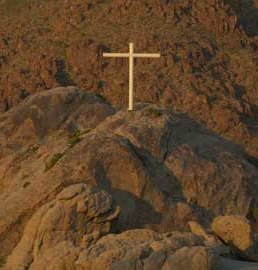
mojavecross1The standing issue is actually pretty interesting, especially Buono’s arguments that the court lacks jurisdiction to hear Salazar’s argument that Buono lacked jurisdiction. Buono alleges that (1) If the government wanted to appeal the standing issue, it had to do so within 90 days of Buono I (2004), which they did not, and (2) Anyway that claim is barred by res judicata. As for the merits as to standing, basically, in these lines of cases, plaintiffs’ allege injuries that boil down to some version of “but it hurts my feelings.” Offended sensibilities normally do not provide for standing, but in the context of the Establishment Clause, a lot of the time offended sensibilities truly are going to be the biggest injury suffered — so if “offense” isn’t particularized enough of an injury, a huge chunk of EC violations will be immune to review.

But let’s say we get through all the procedural arguments, hear it on the merits, and Buono wins. What is his remedy now?

One issue arises from what Buono himself alleges the harm to be. Buono, a Roman Catholic, has specifically stated he has no particular objection to the displaying of religious symbols on government property, he just thought that the preserve should be open to displays of all faiths. (A Buddhist group requested and was denied permission to put up their own monument in 1999). So the most straight forward remedy to Buono’s injury wouldn’t really be simply chucking out the old monument, when in itself its not causing the harm.

So conceivably it could be remedied by simply allowing any religious group that wanted to put up a monument to do so. Now, this is Not Going To Happen. Once people from kooky sects all over the place start showing up asking permission to put up their monument of their god, which just happens to resemble sexually explicit imagery/depictions of Jesus as a cyborg/Prince Philip, Duke of Edinburgh, they will quickly reach a decision to remove all religious imagery rather than allow any. (Mojave has 1.6 million acres — you can fit a lot of religious paraphernalia in there if you were going to allow that.)

And I don’t think the Court would find (assuming again the Court manages to wade through all the standing issues to get there, which is doubtful) that any Establishment Clause violation is fixed simply by removing all further government interest in the monument, such as its designation or the federal ability to continue to regulate it. The major issue is that the cross strongly appears to be government endorsed speech, removing a few additional government entanglements won’t solve that. So the remedy would be to remove the cross.

Now, although the land was sold off, the government still maintains a number of interests in the cross, including a property interest in the possibility of reverter, which was provided for under the bill that decreed the land transfer, § 8121. Ignoring how this concerns the merits of the case, how might this it affect any possible remedy assuming a violation is found?

In Salazar, that’s all pretty clear. The district court enjoined the actual land transfer, even though the “mechanics” of it were completed, so the Supreme Court could simply uphold the injunction. Even if the sale could not be enjoined, thanks to the cross’s status as a monument, there are a number of other ways the government could be ordered to take back control of the land and remedy the violation. From the Ninth Circuit’s opinion,

Even if the land were transferred under § 8121(a), it may revert to the government under § 8121(e), or as provided in other statutes. In particular, we noted that 16 U.S.C. § 431 authorizes relinquishment of lands containing “national monuments” to the federal government, and 16 U.S.C. § 410aaa-56 authorizes the Department of the Interior to “acquire all lands and interest in lands within the boundary of the [Mojave] preserve by donation, purchase, or exchange.”

But what about in a case where this isn’t clear cut? I don’t know enough about this area of law to predict what would happen, but it seems to me there are some seriously thorny issues that could arise here, in a similar case where the transfer is not enjoinable and there are no other statutes that can be used to get it back.

What’s to stop the government from building a couple dozen giant statutes on various federal lands that declare “Ahura Mazda is Our Lord”, and then selling off all the patches to private bidders? Assuming all the formalities of the sale are complied with, fair consideration is given by the private party, etc., what remedy would even be available? Would there now be a Takings Clause issue, if the government were ordered to take the land back and take down the Ahuras? What if the properties have changed hands a few times since the initial transfer? Or it had been twenty years? Or if the new owners “promised” to take down the monuments, but kept randomly putting them back up from time to time? I think this is my primary issue with the government’s case in Salazar: it proves too much. And trying to fix any mess created would not be a simple task.

Finally, for a brief note on the actual merits–

Cases like Salazar are fairly frequent, and the vast majority of them involve the government displaying Christian symbols and refusing to allow non-mainstream-Christian faiths to display their own. The pattern is unmistakable — the government will defend to its last legal breath its ability to display indicia of adherence to the Christian faith, but not any other symbol of religious worship. It’s the pervasive pattern, rather than any one odd cross up on a hill somewhere, that causes the Establishment Clause concerns. No, the Sunrise Rock Cross does not in itself a threat to religious liberties or the First Amendment, but the disparate impact of the government’s choice in which monuments to defend is itself a violation of the Establishment Clause.

-Susan

The King Is Still Alive, and I Want To Copyright It

From the Frequently Asked Questions page of the U.S. Copyright Office’s website:

How do I protect my sighting of Elvis?
Copyright law does not protect sightings. However, copyright law will protect your photo (or other depiction) of your sighting of Elvis. File your claim to copyright online by means of the electronic Copyright Office (eCO). Pay the fee online and attach a copy of your photo. Or, go to the Copyright Office website, fill in Form CO, print it, and mail it together with your photo and fee. For more information on registration a copyright, see SL-35. No one can lawfully use your photo of your sighting, although someone else may file his own photo of his sighting. Copyright law protects the original photograph, not the subject of the photograph.

How many times exactly has this question been asked for it to qualify as “frequent”?

-Susan

Global Trivia Question of the Day

Q: Under International Law 101, statehood is determined, in part, by the diplomatic recognition of other states. In most cases, there exists a well established global consensus on whether any particularly entity is or is not a state, but there are exceptions. What are the seven United Nations member states that are not recognized by at least one other U.N. member state?

Continue reading

Does Scalia believe the world would be better off if he were a mathematician instead?

I do love Scalia, but his thoughts on the wasted talents of brilliant legal minds strike me as uncharacteristically short sighted.

“I used to have just the opposite reaction,” Scalia said, according to the Law Blog account. “I used to be disappointed that so many of the best minds in the country were being devoted to this enterprise.

“I mean there’d be a … public defender from Podunk, you know, and this woman is really brilliant, you know. Why isn’t she out inventing the automobile or, you know, doing something productive for this society?

“I mean lawyers, after all, don’t produce anything. They enable other people to produce and to go on with their lives efficiently and in an atmosphere of freedom. That’s important, but it doesn’t put food on the table, and there have to be other people who are doing that. And I worry that we are devoting too many of our very best minds to this enterprise.”

The first objection is the obvious — I remain extremely skeptical that “so many of the best minds in the country” are truly inefficiently allocated to the study of law. People who are involved in the legal field will, unquestionably, encounter many brilliant people who are also in the legal field — because that’s mostly who they meet. This doesn’t mean there are somehow more of them there. And even though lawyers are the most likely profession to become prominent via politics and to achieve elected office, well, I’m pretty sure Scalia isn’t accusing our politicians of being the best minds in the country.

Second, even if it were true, it’s not clear to me that it would be a waste, per se, to have your best minds working as lawyers. Inasmuch as “law” can be said to have a purpose, its purpose is to reduce society’s transaction costs. That may not in itself be producing new goods or products, but it is increasing societal wealth.

Lawyers aren’t parasites, they’re route finders; the legal profession provides a highly specialized service that directs you in how to go from legal condition A to legal condition B. Sure, you’d probably be able to figure it out for yourself, eventually — but it would take you eons longer than someone who’s already spent a big chunk of their life learning that sort of thing. So having brilliant people focused on figuring out the best ways to bring down the inherent costs of human interactions doesn’t strike me as a bad thing.

Third and finally, even if our best and brightest were overrepresented in the legal field, that doesn’t mean society would necessarily be better off if they were directed to a different field instead. Although there are plenty of exceptions, I’d say that, for the most part, the good lawyers I’ve met are good because their talents and interests make them uniquely situated for legal work. They are good at rhetoric, good at logic and obfuscation, good at writing, good at wading through abstract chains of ideas. If they couldn’t be lawyers, they might make for great English professors or diplomats, but I don’t exactly see them going out and inventing the automobile.

-Susan

The infallible dog is a creature of legal fiction.

This article today at CNN reminded me of something I’ve been interested in for a while now — the reliability of sniffer dog use in criminal investigations and law enforcement.

There are two major uses of dogs in this context that are highly problematic: use of dogs for “scent lineups” to identify criminal suspects and use of narcotics detecting dogs. (In most other contexts, I’m a-okay pretty much across the board with dog tracking– I don’t have any problems with using dogs for detecting explosives or for border searches.) While drug scenting dogs are a much more complicated legal problem, relating to the constitutional requirement of probable cause for Fourth Amendment purposes, the use of dogs for scent lineups has a much greater empirical problem, and their use in the courtroom has not been methodologically sound [PDF].

The requirements for a sniffer dog to be certified are not particularly rigorous, and in Texas and Florida especially, it looks as if a lot of innocent people have been put behind bars as a result of unscrupulous practices by dog trainers. A major problem in the use of scent lineups is that, while dogs actually are pretty good at picking out the “correct” scent from a list of possibilities put before them, when provided with a scent line up with no correct matches, the dogs will all too often default to a “closest match” and produce a false positive.

For the use of narcotics dogs, the science isn’t much more comforting. Although you generally won’t get a false conviction because of the use of a drug sniffer dog (either the police find the drugs on you or they don’t), their use amounts to a real infringement on Fourth Amendment protections. Under United States v. Place, brief detention by law enforcement in a public area for the purpose of carrying out a “dog sniff” is not a search for Fourth Amendment purposes. In Illinois v. Caballes, Justice Souter dissented (from which the title of this post is also taken), noting that:

At the heart of both Place and the Court’s opinion today is the proposition that sniffs by a trained dog are sui generis because a reaction by the dog in going alert is a response to nothing but the presence of contraband. . . . Hence, the argument goes, because the sniff can only reveal the presence of items devoid of any legal use, the “sniff does not implicate legitimate privacy interests” and is not to be treated as a search. . . .

Pretty much every circuit — except possibly my home circuit, the 11th, which has not “squarely addressed” the question — treats it as probable cause to undergo a search when a sniffer dog gives a positive hit. The only evidentiary standards are that the handler must testify to the dog being “trained” and “reliable”. (The only exception to this rule that a not-particularly-thorough search turned up: United States v. Trayer, 898 F.2d 805, 808 (D.C. Cir. 1990)(dog giving positive hit alert at sleeper car on train is not in itself probable cause)).

And most worryingly, some circuits only look at the training of the dog, not the handler. This is pretty faulty reasoning, as the trainer is half the equation — they’re the ones who have to interpret what the dog is indicating. See United States v. Outlaw, 134 F.Supp.2d 701, 813 (5th Cir. 2003) (“an alert is simply an interpretation of a change in the dog’s behavior by a human handler”). In addition to bad trainers who aren’t used to the dogs and don’t know when they’re giving an alert, there’s also the possibility of very closely trained dog/handler combos being susceptible to the Clever Hans effect.

Dogs just aren’t perfect. For example, tired dogs do significantly worse than rested dogs — dogs can’t sweat so they have to pant to dissipate heat, and unfortunately you can’t exactly pant and sniff at the same time — so an overworked and overheated dog is going to produce less reliable results. However, even assuming all dogs are as infallible as Rin Tin Tin, a positive alert from a narcotics dog just doesn’t seem to meet the threshold for probable cause.

Using Bayes’ theorem, and granting dubiously high estimates of dog accuracy (98%) at detecting when drugs are present, and assuming .5% of the population possesses drugs on them at any given time, then then the odds of a dog alert correctly indicating the presence of drugs is only 1 in 5.

“If the dog sniffs 10,000 people, 50 (10,000 x .005) will possess drugs. Out of these, the dog will correctly alert to 49 (50 x .98). Of the remaining 9950 people that do not possess drugs, the dog will falsely alert to 2% of this group, resulting in 199 (9950 x .02) false detections.

Out of this population of 10,000, the dog has positively alerted to 248 people, 49 of which are correct detections and 199 are false alerts. Thus, the probability that an individual actually possesses cocaine based on this dog is 49 out of 248, a detection rate of less than 20%.” Robert Bird, An Examination of the Training and Reliability of the Narcotics Detection Dog, 85 Ky. L.J. 405 (1996).

That doesn’t sound like probable cause to me.

-Susan

“Readers who find Figure II puzzling should recall that a diagram of an imaginary axis must, of course, itself be imaginary.”

I spent a fair chunk of yesterday sitting out on the patio reading Elizabeth Moon’s Trading in Danger. It should surprise no one that I absolutely adored it. A scifi adventure novel premised upon the profit to be gained from interstellar trade, you say? Why yes that does in fact sound like something I’d quite enjoy reading. (And, like many of Moon’s books, it features a strong female protagonist in a universe where gender is irrelevant to your qualifications for any job. I think I’m in love!)

The bad news about the future is that there are still tariffs. Looks like we’re going to develop an FTL drive before we actually achieve free trade. (Sadly, I would consider this to be a rather realistic proposition.) But the book manages to create one of the few scifi universes I’ve encountered where the idea of backwater worlds still using horse-and-plows for agriculture actually made sense. In Serenity, I was never quite able to accept the whole Wild Wild West theme– it was based on planetary cultures deliberately choosing to embrace a cowboy lifestyle rather than the cowboy lifestyle making sense given the resources available. But Trading in Danger depicts an economic and political system for the galaxy where encountering a mix of archaic farming techniques and space-age technology makes perfect sense.

In addition to that, other notable features of the book include: 1) A galactic corporation with a monopoly on the instantaneous communication market — and its relentless rent-seeking behaviors in order to maintain that monopoly serve as the backdrop for the events of the series; 2) A constant evaluation of opportunity costs, struggles of where to allocate cash on hand and when to take on a loan given the prevailing interest rates, and arguments over how credit ratings apply to sub-entities of corporate structures. The characters are traders, after all, and thus their internal struggles over where the best trading opportunities are to be found are prominently featured; and, 3) Constant wrangling over contract law, such as how breach and damages are to be determined when a system civil war breaks, or what indemnity clauses are to be included in the final text of an agreement.

And last, but not least, there is ample quoting from the IUCC. That’s right — the Interstellar Uniform Commercial Code. It made me so nostalgic for Martha Ertman’s Contracts course; I can totally imagine Prof. Ertman chilling out on a starship somewhere waxing rhapsodic about the default contract terms provided for under IUCC Art. 347.2.

So of course the whole time I was reading the book I had Krugman’s essay “A Theory of Interstellar Trade” in mind. (It’s worth reading simply for its groan-inducing jokes and references to science fiction, physics, and academia. Such as setting up his graphs so that his line is named ET.)

“If trading space vessels move at high velocities, we can no longer have an unambiguous measure of the time taken in transit. The time taken by the spacecraft to make a round trip will appear less to an observer on the craft than to one remaining on Earth. Since an interstellar voyage is an investment project which must have a positive present value, there is obviously a problem in deciding which transit time to use in the present value calculation.”

The essay’s not directly applicable to Elizabeth Moon’s universe, as Krugman assumes (slightly more realistically) that FTL travel is not possible, and thus deals with the relativistic effects that approaching-light-speed travel causes. With time distortion + lack of instantaneous communication, can interstellar arbitrage result in equalized interplanetary interest rates? Yes, actually — well, assuming we can stay within the bounds of special relativity. Krugman makes no representations as to how his theory might apply to non-inertial reference frames.

Although Krugman rejects FTL and instantaneous communication, he does assume that even if our technology will not have discovered how to break the light speed barrier, our economic systems will have discovered the near-equivalent: perfect forecasts on the price of goods over indefinite periods of time. In Trading for Danger, nothing close to this exists — which is a good thing, as it’s that very uncertainty over prices that provides a fair share of the drama and obstacles faced by the characters. The traders must make months-long trips between star systems based upon speculation on where the most profitable transactions are to be had, and if you guess wrong, you’re down a whole lot of time and credits. (Yes, they do have FTL — but given acceleration and deceleration times, it’s no quick jaunt to go between stars.)

So I’m going to add a Third Fundamental Theorem of Interstellar Trade to Krugman’s article: for good science fiction, you need to screw around with the laws of physics as the plot demands, but hold your laws of economics constant. Imagining FTL is more fun than imagining perfect futures markets.

-Susan

CritCart: Maps For Liberals

I have a weird fascination with maps — I could probably list “staring at maps” as a hobby, but that’d make me sound like a freak, so I won’t. They’re just cool. I think it’s the combination of so many different fields that appeals to me; there’s so much going on. Pretty much any map is going to involve geography — why do the Rockies dwarf the Blue Ridge Mountains? Why are the Hawaiian islands in a chain like that?; history — take a look at these old maps of Georgia. Atlanta doesn’t even make an appearance until 1855, and Decatur is the regional hub!; art — how to make maps that are, in addition to being accurate, understandable and pretty; math — okay, admittedly, the math part is of less interest to me, but I’m sure if I actually understood the math behind cartography, I’d think it was awesome; anthropology — why are human settlements located where they are?; psychology — psychology and cartography have a lot more to do with each other than you might guess; and politics — especially politics. Plus there’s toponomy, which has got to be one of the coolest academic fields ever. If law doesn’t work out for me, I’m totally going to be a toponymist. And finally, historical mapmaking provides for awesome adventure stories.

Okay, I’ll stop rambling now, but the point of all that? Maps are really cool, and everyone else should recognize that too. And also, more importantly, I’ll probably use this blog to talk about maps at least on a semi-regular basis, so it’d be nice if I could maybe convince a couple people to actually be interested in what I’m writing about.

And as a basic-but-cool intro post on maps, I thought I’d write about critical cartography. Critical cartography is, like critical legal theory, a movement that disputes the idea that our cultural infrastructure is inherently neutral and value-free, and argues instead that our institutions are pervasively biased in a manner that entrenches existing social hierarchies and power structures.

Maps are not photographs; they’re very deliberate, precise, thought out human creations. Maps doesn’t show “how the world really is,” but rather the world as the cartographer wanted to show it. The best introduction to critical cartography is Brian Harley’s Deconstructing the Map [PDF].

The ‘rule of ethnocentricity’ — whereby most societies have maps that place their own homeland in the middle:

“[T]he scientific Renaissance in Europe gave modern cartography coordinate systems, Euclid, scale maps, and accurate measurement, but it also helped to confirm a new myth of Europe’s ideological centrality through projections such as those of Mercator. Or again, in our own century, a tradition of the exclusivity of America was enhanced before World War II by placing it in its own hemisphere (‘our hemisphere’) on the world map. Throughout the history of cartography ideological ‘Holy Lands’ are frequently centered on maps. Such centricity, a kind of ‘subliminal geometry,’ adds geopolitical force and meaning to representation. It is also arguable that such world maps have in turn helped to codify, to legitimate, and to promote the world views which are prevalent in different periods and places.”

And the ‘rule of the social order,’ which results in maps that record not just what the land looks like, but what the social structures between the people on the land look like:

“Pick a printed or manuscript map from the drawer almost at random and what stands out is the unfailing way its text is as much a commentary on the social structure of a particular nation or place as it is on it topography. The map-maker is often as busy recording the contours of feudalism, the shape of a religious hierarchy, or the steps in the tiers of social class, as the topography of the physical and human landscape… it is taken for granted in a society that the place of the king is more important than the place of a lesser baron, that a castle is more important than a peasant’s house, that the town of an archbishop is more important than that of a minor prelate, or that the estate of a landed gentleman is more worthy of emphasis than that of a plain farmer. Cartography deploys its vocabulary accordingly so that it embodies a systematic social inequality.”

And for a visual example, check out the two maps below — the Mercator Projection and the Gall-Peters Projection. The Gall-Peters map was introduced as a challenge to the more traditional Mercator map — which depicts Greenland the same size as Africa, even though it’s 14 times smaller in reality. Neither map is objectively “more correct” than the other, but it does suggest that the rules of social order and ethnocentricity are alive and well today.

Gall-Peters-Projection

Mercator-World-Map

-Susan